

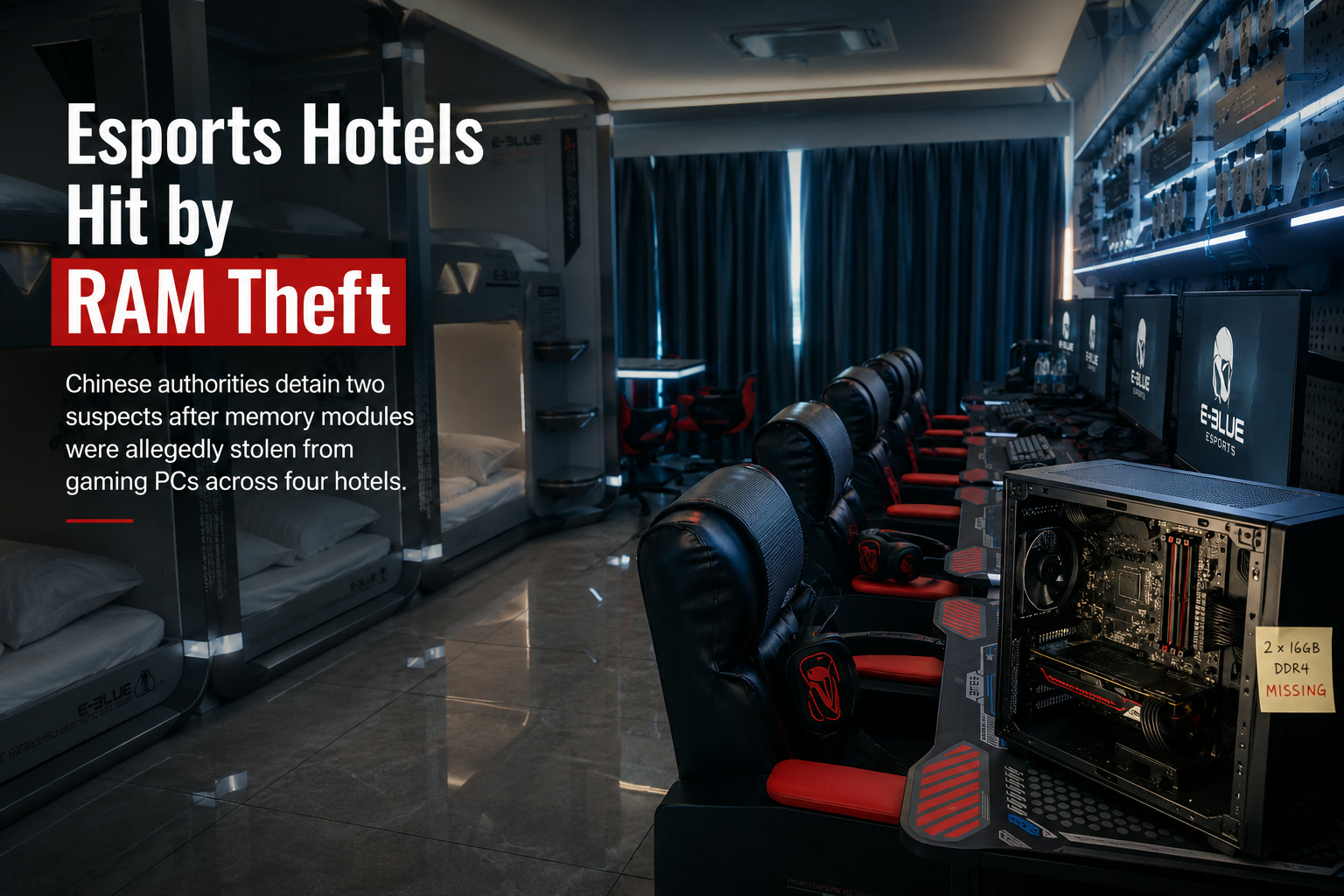
Esports hotels have become increasingly popular in China by combining hotel accommodation with access to powerful gaming computers. Guests can check into a private room, sit down at a high-end PC and begin gaming without bringing their own equipment.
That convenience, however, creates an unusual security problem.
Two individuals were recently detained in China after allegedly removing 16 RAM modules from gaming PCs across four esports hotels. The thefts reportedly took place over almost two weeks in Shihezi, a city in China's Xinjiang region.
Rather than stealing entire computers, monitors or other obvious equipment, the suspects appear to have targeted one of the easiest internal components to remove and resell.
The case demonstrates how rising component values are turning individual PC parts into attractive targets—and why hotels offering expensive gaming systems inside private rooms may need to rethink how those machines are secured.
Routine Maintenance Exposed the Missing Components
The theft was reportedly discovered after an esports hotel operator encountered problems with several computers during routine maintenance.
From the outside, the machines may have appeared completely normal. The cases were still present, the systems remained in the rooms and there was no immediately obvious sign that parts had been removed.
Only after staff opened the affected computers did they discover that RAM modules were missing.
A PC with only part of its installed memory removed might still power on and appear functional. However, users could experience significantly reduced performance, game instability, slower loading, application crashes or problems when running several tasks simultaneously.
This makes RAM theft less immediately visible than taking an entire graphics card or desktop computer.
Once the missing components were identified, the hotel reportedly reviewed the suspects' movements and contacted the authorities.
Four Hotels Were Allegedly Targeted
The incident was not limited to a single hotel room or one opportunistic theft.
The two suspects allegedly visited four esports hotels within the same region and removed a combined total of 16 RAM sticks over nearly a fortnight.
This pattern suggests that the alleged thieves understood the operating model of esports hotels and knew that private rooms would contain gaming systems with valuable internal components.
It also indicates that they may have expected the missing parts to go unnoticed until the computers were checked more closely.
Unlike an internet café, where gaming PCs are usually placed in an open area surrounded by employees and other customers, hotel-room computers are installed in private spaces.
That privacy is part of the service, but it also gives a dishonest guest more time to inspect or open the computer without being directly observed.
The RAM Was Quickly Resold
The stolen modules were reportedly sold through second-hand trading platforms and physical computer stores.
The suspects allegedly received a combined US$1,840, or approximately RM7,526, from the sales.
RAM is particularly attractive for resale because it is compact, easy to transport and compatible with many systems that support the same memory generation and specifications.
A person carrying several RAM sticks is also less conspicuous than someone attempting to leave a hotel with a large graphics card, monitor or desktop tower.
Once sold individually through different channels, the components can also become difficult to trace unless their serial numbers were documented in advance.
This creates a strong incentive for hotels and gaming businesses to maintain detailed records of the components installed in every system.
Why RAM Has Become an Attractive Target
Computer memory was once viewed as a relatively ordinary upgrade component. In powerful gaming PCs, however, high-capacity and high-speed RAM kits can represent a meaningful part of the system's value.
Gaming hotels may install premium memory to support modern games, streaming, multitasking and demanding applications.
A high-end system could contain 32GB, 64GB or even more memory, often divided across multiple modules.
Removing just one or two sticks from each computer can produce a substantial resale value while leaving the rest of the machine in place.
RAM is also easier to remove than many other internal components.
After opening the side panel, a person generally needs only to release the retaining clips around the memory slot. The module can then be lifted out without disconnecting power cables or removing large brackets.
That does not mean every guest could do it safely, but anyone familiar with building computers would likely recognise how quickly the component can be removed.
The Computers May Continue Working
One reason this form of theft can remain hidden is that a computer does not always stop working when some of its RAM is removed.
Consider a gaming PC equipped with four memory modules. If two are taken, the computer may still boot using the remaining pair.
Staff might not notice immediately unless they check the system specifications or a guest reports reduced performance.
Even when the machine fails to start, the symptoms may initially be mistaken for a software error, loose cable, motherboard issue or failed component.
A thief who understands PC hardware may deliberately leave enough memory installed to avoid creating an obvious failure.
This makes routine hardware inventory and automated monitoring important for businesses managing large fleets of gaming computers.
Esports Hotels Face a Unique Security Challenge
Traditional hotels are designed around privacy. Guests reasonably expect that cameras will not be installed inside bedrooms.
Esports hotels must respect the same expectation, even though each room may contain computer equipment worth thousands.
This creates a difficult balance.
Hotel operators cannot monitor guests continuously inside their rooms, but they still need to protect expensive systems that are easily accessible throughout the stay.
Standard CCTV coverage in corridors may show who entered and left a room, but it cannot reveal what happened to the computer while the guest was inside.
A guest may also have many legitimate reasons to sit near the system, move peripherals or inspect connections.
Hotels therefore need security measures that detect tampering without intruding on personal privacy.
This Is Not the First High-Value PC Theft From an Esports Hotel
The RAM incident follows earlier reports of thieves posing as hotel guests and removing considerably more expensive components.
In one previous case, an esports hotel reportedly lost several AMD Ryzen 7 9800X3D processors and NVIDIA GeForce RTX 5070 graphics cards.
Those components are much more valuable than individual RAM modules, but they are also more difficult to remove.
A graphics card usually requires the thief to disconnect power cables, release the motherboard slot, remove case screws and carefully extract a relatively large component.
A processor requires even greater technical confidence because the cooler must be removed before the CPU can be accessed.
The fact that thieves were reportedly willing to perform those procedures inside hotel rooms shows how attractive unsecured gaming computers can become.
It also suggests that some offenders are not acting randomly. They may understand PC hardware, know which components retain resale value and arrive with the tools required to remove them.
A Private Gaming Room Can Become a Hardware Workshop
An esports hotel room gives a dishonest guest several advantages.
The individual may have hours—or even an entire night—without staff entering the room. The sound of opening a case or removing screws may not attract attention. A small toolkit can be carried inside an ordinary bag.
The guest may also have access to online hardware guides while performing the removal.
After taking the components, the person can close the case, reconnect the system and leave the room looking largely unchanged.
Unless the hotel checks every machine immediately after checkout, the theft might not be detected until the next guest reports a problem.
By then, the components may already have been sold.
Gaming PCs Need Tamper-Evident Protection
Hotels do not necessarily need to make the computers impossible to open. They need to make unauthorised access difficult, visible and traceable.
Tamper-evident seals can help staff identify whether a side panel has been removed.
Special case screws or lockable enclosures can slow down someone attempting to access the internal components without permission.
The computers could also be secured inside purpose-built furniture that still provides sufficient ventilation but limits direct access to the case panels.
None of these measures will stop a determined attacker completely. Their purpose is to increase the effort required and make tampering easier to detect.
A thief may reconsider if opening the case will leave obvious evidence or require specialised tools.
Automated Hardware Monitoring Could Detect Changes
Software-based inventory tools can also play an important role.
A central management platform can record the expected hardware configuration of every computer, including:
When the system boots, the platform can compare the detected configuration with the approved baseline.
If a computer that previously had 64GB of RAM suddenly reports only 32GB, the hotel could receive an alert immediately.
This would not prevent the theft, but it could significantly reduce the time between removal and discovery.
Faster detection gives staff a better chance of preserving CCTV footage, reviewing access records and identifying the relevant guest before the components are resold.
Serial Numbers Should Be Recorded
Hotels and gaming centres should maintain a component-level asset inventory rather than recording only the desktop computer's external asset tag.
Where available, the serial numbers of RAM modules, processors, graphics cards and storage devices should be documented.
This can support police reports, insurance claims and communication with second-hand computer shops.
It may also help identify stolen parts if they later appear on resale platforms.
However, component tracing is not always straightforward.
Some RAM modules may have limited visible identifiers, and buyers may not check whether a part has been reported stolen. Serial numbers can also be removed or hidden.
Even so, accurate records are far better than discovering after an incident that the business cannot prove which specific parts were installed.
A Checkout Inspection May No Longer Be Optional
Esports hotels may need a faster inspection process between guests.
Staff do not necessarily need to open every computer after every checkout. A short automated diagnostic could confirm the installed hardware, test basic stability and compare specifications with the expected configuration.
Any mismatch would trigger a manual inspection.
The hotel could also run the check shortly before the guest completes checkout. That would allow staff to address a suspected issue while the individual is still on the premises.
Such a process must be designed carefully to avoid unnecessary delays for legitimate customers.
However, a one-minute automated hardware check may be easier to justify than repeatedly replacing stolen components.
Second-Hand Buyers Also Play a Role
The resale market provides an important exit route for stolen computer parts.
Physical PC shops and online buyers may unknowingly purchase components removed from gaming hotels, offices or private systems.
Businesses buying used hardware should be cautious when a seller offers multiple identical components without clear proof of ownership.
Warning signs may include unusually low pricing, repeated sales of high-value parts, removed labels or inconsistent explanations about where the components came from.
Stronger cooperation between hotel operators, police, marketplace platforms and second-hand retailers could make stolen parts harder to sell.
That is important because theft remains profitable only when the offender can convert the components into money.
A Similar RAM-Only Theft Was Reported in South Korea
The problem is not limited to China or esports hotels.
A separate incident in South Korea reportedly involved an intruder entering an office and removing valuable DDR5 memory from computers while leaving the other equipment untouched.
The selective nature of the theft suggested that the offender knew exactly what to target.
Stealing only RAM reduces the time spent inside the premises and makes the stolen goods easier to conceal.
It also shows that computer-component theft is becoming more specialised.
Instead of taking an entire device, some thieves may now evaluate which individual parts offer the best combination of resale value, portability and ease of removal.
Rising Component Values Change the Risk Calculation
When the market value of memory, storage or graphics hardware increases, businesses may continue treating the equipment as ordinary office or hotel assets even though thieves increasingly view the components as liquid goods.
The physical size of an item no longer reflects its value.
A handful of RAM sticks can be carried in a pocket yet represent thousands in losses. A compact processor may be worth more than a large monitor.
Asset-protection policies therefore need to consider internal components, not just visible equipment.
This is especially important for organisations operating shared-access PCs, including gaming hotels, esports centres, universities, training rooms and computer laboratories.
Hotels Must Preserve Privacy Without Ignoring Security
Installing surveillance cameras inside hotel rooms would be inappropriate and would create serious privacy concerns.
The better approach is to secure the equipment itself.
Tamper seals, locked cases, automated hardware checks, detailed inventories and stronger checkout procedures can protect the systems without monitoring the guest's private activities.
Hotels should also make their policies clear.
Guests can be informed that computer hardware is inventoried, tampering is prohibited and system configurations are automatically verified.
That transparency may discourage opportunistic theft while avoiding intrusive surveillance.
Insurance and Deposit Policies May Also Change
Some esports hotels may respond by increasing security deposits or requiring stronger guest verification.
Deposits can create a financial deterrent, but they are not a complete solution.
The value of stolen components may exceed the deposit, and an offender using false or compromised identification may still disappear before the theft is discovered.
Higher deposits can also make the service less accessible to legitimate customers.
A better strategy combines identity verification with rapid technical inspection and physical tamper controls.
Insurance policies should also be reviewed to confirm whether internal component theft is covered and what evidence is required to support a claim.
The Incident Is Also an Asset-Management Failure
It is easy to frame the case only as a story about unusually specific thieves.
However, it also highlights weaknesses in hardware asset management.
Any organisation providing unsupervised access to expensive computers should assume that someone may eventually attempt to remove or replace components.
A dishonest user could steal premium RAM and install cheaper modules in its place. The computer would continue working, and the substitution might remain unnoticed for months.
Without baseline records and automated checks, the organisation may have no way to determine when the change occurred.
Physical security and IT asset management must therefore work together.
Final Thoughts
The alleged theft of 16 RAM modules from four esports hotels may sound unusual, but the method is logical from a criminal perspective.
RAM is small, valuable, easy to remove and relatively simple to resell. A gaming computer can sometimes continue operating even after some of its memory is taken, delaying discovery.
Esports hotels are particularly exposed because they place powerful gaming systems inside private rooms where constant surveillance is neither practical nor acceptable.
The solution is not to compromise guest privacy. It is to make hardware tampering difficult, detectable and quickly attributable.
Tamper-evident cases, component-level inventories, automated configuration checks and stronger inspection procedures can significantly reduce the opportunity for theft.
As computer components become more valuable, businesses can no longer protect only the desktop case sitting on the table. They also need to account for what is installed inside it.











Comments 0