

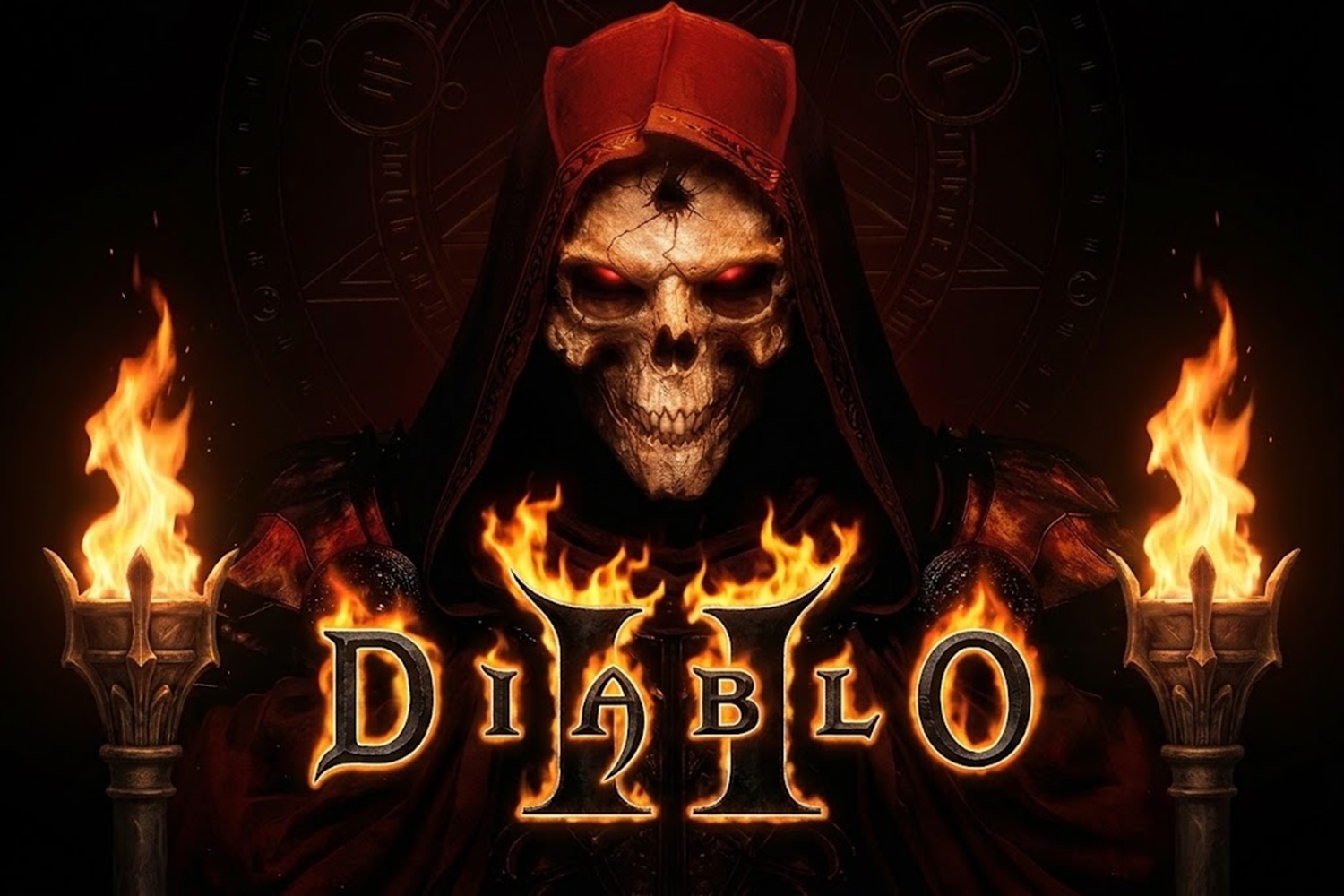
Diablo II is one of the defining action RPGs of the PC era, expanding the dark world of the original Diablo into a far larger journey across the corrupted lands of Sanctuary. Released by Blizzard Entertainment in 2000, the game follows a new hero pursuing the mysterious Dark Wanderer, whose journey spreads demonic corruption from the forests surrounding the Rogue Encampment to distant deserts, jungles, ancient temples, and eventually the depths of Hell itself. Players choose a character class, develop specialized skills, collect increasingly powerful equipment, and battle enormous numbers of demons while uncovering the growing influence of the Prime Evils. Its combination of fast combat, randomized loot, character building, atmospheric exploration, and endlessly repeatable progression became a blueprint for generations of action RPGs.
The original Diablo II includes five playable classes—the Amazon, Barbarian, Necromancer, Paladin, and Sorceress—each offering dramatically different ways to approach combat. One character may specialize in summoning an army of undead, another in devastating elemental magic, while others depend on melee strength, defensive auras, bows, javelins, or carefully constructed combinations of skills. Randomized equipment means that two journeys rarely develop exactly the same way, while Normal, Nightmare, and Hell difficulties encourage players to continue strengthening characters long after the first completion. The result is a game where finishing the story can feel less like an ending and more like the beginning of a much deeper character-building experience.
Now playable online through Lemon Web Games, Diablo II brings its dark fantasy campaign, five original character classes, randomized dungeons, real-time combat, skill trees, equipment hunting, boss battles, and four-act journey directly into the web browser. Players can begin in the Rogue Encampment, pursue the Dark Wanderer across Sanctuary, develop increasingly specialized character builds, and hunt for rare weapons and armour while confronting some of the most memorable demons in action RPG history. The simple act of defeating another monster always carries the possibility of discovering an upgrade, making exploration and combat difficult to put down. Whether starting a first character or returning to Sanctuary after many years, Diablo II remains remarkably effective at turning one more dungeon, one more boss, and one more piece of loot into hours of adventure.
The Dark Wanderer Connects Diablo II to the Original Game
Diablo II begins after the events beneath Tristram, where Diablo was defeated during the first game. That victory did not permanently end the threat. The warrior who attempted to contain Diablo's soul eventually became corrupted, transforming into the mysterious Dark Wanderer.
Players follow the destruction left behind as the Wanderer travels east. Villages fall, demons appear across previously peaceful regions, and familiar forces begin gathering around his path. The hero is always slightly behind, discovering the consequences of events that have already occurred.
This structure creates a strong sense of pursuit. Each act reveals more about what the Wanderer is attempting to accomplish and why the Prime Evils remain such an enormous threat to Sanctuary.
Five Classes Offer Completely Different Adventures
The Amazon specializes in ranged weapons, javelins, spears, and passive combat skills. She can remain at distance with bows or become surprisingly dangerous with specialized spear and javelin techniques.
The Barbarian is built around physical power, weapon mastery, combat techniques, and powerful war cries. He can become an aggressive melee fighter capable of surviving directly among large groups of enemies.
The Necromancer takes an entirely different approach by raising skeletons and golems, casting curses, and using poison or bone magic. A successful Necromancer can transform fallen enemies into the foundation of an increasingly large army.
The Paladin combines martial combat with magical auras that enhance himself and potentially nearby allies. The Sorceress completes the original roster with powerful fire, cold, and lightning spells capable of clearing entire groups when properly developed.
Skill Trees Make Character Development Meaningful
Every class has three skill trees containing abilities that gradually define the character's fighting style. Skill points earned through leveling can be invested into active attacks, spells, summons, passive bonuses, and supporting abilities.
Because points are limited, players need to think about which abilities deserve investment. Spreading points across too many unrelated skills can create a weak character, while focusing on complementary abilities can produce dramatically stronger builds.
This system gives replaying Diablo II enormous value. Two characters from the same class can operate very differently depending on their skill choices and equipment. Experimenting with builds becomes an important part of the experience.
Loot Is the Heart of Diablo II's Progression
Nearly every enemy can drop equipment, gold, potions, or other useful items. Most drops are ordinary, but occasionally something much more valuable appears.
Equipment is divided into different quality levels, including basic items, magical equipment, rare items, set pieces, and powerful unique gear. The moment a special item lands on the ground can be genuinely exciting because it may dramatically improve a character or inspire an entirely different build.
This constant possibility transforms routine combat into progression. Even a familiar group of monsters remains worth defeating because any one of them could produce the next important upgrade.
Randomized Statistics Keep Equipment Interesting
Many magical and rare items receive randomized properties, meaning equipment with similar names or appearances can provide very different bonuses. One weapon may increase damage while another improves attack speed or elemental effects.
This makes item comparison a regular part of the adventure. An apparently stronger weapon may actually perform worse for a particular build if its bonuses do not support the character's skills.
Players gradually learn which properties matter most for their chosen class. Equipment hunting becomes increasingly strategic rather than simply choosing the item with the largest number.
Socketed Equipment Adds Another Layer of Customization
Some weapons, armour, shields, and helmets contain sockets that can hold gems and other compatible enhancements. These allow players to modify equipment rather than relying entirely on its original statistics.
Different gems provide different effects depending on where they are inserted. A gem placed in a weapon may behave differently from the same gem placed in armour or a shield.
This creates another useful decision. A valuable socket does not need to be filled immediately if the player expects to find a better gem later. Equipment becomes something that can be developed rather than merely replaced.
The Horadric Cube Encourages Experimentation
During the second act, players obtain the Horadric Cube, one of Diablo II's most famous items. It functions as additional storage but also allows certain items to be combined through recipes.
Basic transmutation can convert groups of smaller gems into higher-quality versions, while other recipes provide different forms of equipment manipulation. Discovering what the Cube can do becomes another part of learning the game.
The system also foreshadowed the increasingly complex crafting mechanics that later action RPGs would adopt. Diablo II gives players reasons to value items that might otherwise appear ordinary.
Act I Begins at the Rogue Encampment
The adventure starts at the Rogue Encampment, surrounded by corrupted wilderness that once belonged to the Sisterhood of the Sightless Eye. Players gradually explore caves, forests, ruins, burial grounds, and monasteries while investigating the demonic forces spreading through the region.
This act introduces many systems gently. Characters begin with basic equipment and relatively simple skills, allowing players to learn movement, combat, inventory management, and character progression before facing larger threats.
The journey ultimately leads toward the Monastery and the powerful demon Andariel. Defeating her opens the path east and confirms that the corruption extends far beyond the surrounding countryside.
Andariel Provides the First Major Test
Andariel is the final boss of Act I and one of the Lesser Evils. Her poison attacks can overwhelm poorly prepared characters quickly.
The battle teaches an important Diablo II lesson: preparation matters. Carrying appropriate potions, improving resistances, and ensuring equipment is repaired can significantly change the difficulty of a boss fight.
Defeating Andariel feels like a major accomplishment for a new character. It also reveals that the pursuit of the Dark Wanderer is becoming much more dangerous.
Act II Travels to Lut Gholein
The second act shifts dramatically from gloomy forests to the desert city of Lut Gholein. Outside the city lie deserts, underground tombs, ruined temples, sewers, and ancient structures connected to the Horadrim.
The change in environment gives Diablo II a sense of scale that the original game never attempted. Players are no longer exploring beneath one town; they are travelling across an entire world.
Act II also introduces more complicated quests involving several artifacts and locations. The search eventually leads toward the tomb of Tal Rasha, where an ancient evil waits underground.
Duriel Is One of the Game's Most Infamous Bosses
Duriel confronts the player inside a confined chamber, leaving little space to escape. His speed and powerful melee attacks can make the first encounter extremely difficult.
Ranged characters may suddenly find themselves unable to maintain their preferred distance, while melee characters need enough durability to survive his attacks.
The fight is memorable precisely because it forces players outside their comfort zone. Defeating Duriel often requires preparation, stronger equipment, or a revised strategy.
Act III Enters the Jungles of Kurast
The third act moves into dense jungle surrounding Kurast, a region corrupted by the influence of Mephisto. Narrow pathways, swamps, temples, ruins, and aggressive enemies create a very different atmosphere from the open deserts of Lut Gholein.
Exploration becomes more dangerous because enemies can approach rapidly from surrounding vegetation. Large groups frequently appear together, rewarding characters with reliable crowd-control abilities.
The act gradually leads toward Travincal and the deeply corrupted heart of Kurast. By this stage, the player is confronting the Prime Evils much more directly.
Mephisto Guards the Gateway to Hell
Mephisto, Lord of Hatred, waits beneath the ruined city. His encounter represents a major escalation because players are now directly battling one of the three Prime Evils.
The fight rewards strong resistances and careful positioning. Characters that performed comfortably against ordinary enemies may suddenly discover weaknesses in their defensive setup.
Mephisto would also become one of Diablo II's most frequently hunted bosses because of the possibility of valuable item drops. Repeated boss runs became an important part of the game's long-term culture.
Act IV Takes the Battle Into Hell
The fourth act brings players to the Pandemonium Fortress and the burning landscape surrounding Hell itself. Compared with the earlier acts, the environment feels openly hostile and apocalyptic.
Enemy groups become stronger, resistances matter increasingly, and the player is clearly approaching the campaign's central confrontation. The smaller number of quests gives the act a focused, relentless pace.
Everything ultimately points toward the Chaos Sanctuary, where seals must be activated and powerful enemies defeated before Diablo himself can appear.
Diablo Remains an Iconic Final Boss
The confrontation with Diablo is the culmination of the original four-act campaign. His attacks include powerful fire, lightning, and close-range abilities capable of destroying poorly prepared characters quickly.
Players need to understand their character by this stage. Offensive strength alone is rarely enough if resistances, health, and mobility have been neglected.
Defeating Diablo completes the original campaign, but Diablo II is deliberately built to continue afterward. Higher difficulty levels provide stronger enemies, better potential loot, and new reasons to refine the character.
Nightmare and Hell Difficulties Transform the Campaign
After completing Normal difficulty, players can continue into Nightmare and eventually Hell. These modes do more than simply increase enemy health.
Resistances become increasingly important, monsters gain greater strength, and character weaknesses that were easy to ignore earlier can suddenly become serious problems. Builds need to become more focused and equipment choices more deliberate.
The reward is access to better potential loot and increasingly powerful character development. Completing all three difficulties became a major long-term objective for dedicated players.
Mercenaries Provide Useful Support
Players can hire companions who fight automatically alongside the main character. Different acts provide mercenaries with different combat styles, ranging from ranged Rogues to desert warriors and other specialists.
A mercenary can provide valuable damage or distract enemies that would otherwise focus entirely on the player. Keeping them alive and properly equipped becomes increasingly useful as difficulty rises.
The system adds another small layer of character development because the mercenary becomes part of the overall build rather than simply temporary assistance.
Town Portals Make Exploration More Manageable
The ability to create Town Portals allows players to return quickly to safety. In town, equipment can be repaired, potions purchased, items sold, and inventory reorganized.
This creates a comfortable rhythm between danger and preparation. Players venture into hostile areas, fill the inventory with loot, return to town, and then continue exploring.
Town Portal Scrolls also provide an emergency escape during difficult encounters. Keeping a few available is often one of the simplest ways to avoid losing unnecessary progress.
Waypoints Reduce Repeated Travel
Waypoints scattered throughout each act allow players to teleport between previously discovered locations. Activating them becomes extremely useful, especially during long quests or repeated boss runs.
The system encourages exploration because finding a waypoint permanently improves access to that part of the act.
Combined with Town Portals, waypoints keep Diablo II's large world manageable without eliminating the sense of travelling through dangerous territory.
Randomized Maps Make Repeated Play Feel Different
Many wilderness areas and dungeons are procedurally arranged, meaning layouts can differ between games. Entrances, exits, rooms, corridors, and monster groups are not always located in exactly the same positions.
This makes replaying characters more interesting because players cannot memorize every route perfectly. Familiar environments still require exploration.
Randomization also supports the loot-driven structure. Repeated runs remain slightly unpredictable even when the objective is already well known.
Shrines and Environmental Objects Reward Curiosity
Sanctuary is filled with shrines, chests, urns, corpses, racks, and other objects that can provide temporary bonuses or useful items.
Shrines may improve skills, experience gains, resistances, armour, or other statistics for a limited time. Finding the right shrine before a difficult encounter can provide a noticeable advantage.
These small discoveries make exploration rewarding even outside major quests. Clicking one more chest can occasionally produce something unexpectedly valuable.
Gold Matters, but Equipment Matters More
Gold is used for purchasing equipment, potions, repairs, gambling, and other services, but the strongest characters are usually defined by what they find rather than what shops sell.
This makes monster hunting the real economic engine of the game. Valuable drops can replace expensive store purchases entirely.
Gambling provides another way to spend excess gold by purchasing unidentified equipment with uncertain properties. Most results are ordinary, but occasionally something much better appears.
Set Items Encourage Collection
Set equipment belongs to themed groups that provide additional bonuses when multiple matching pieces are equipped. Finding one piece naturally encourages players to search for the rest.
Completing a set can dramatically change a character, although individual pieces may sometimes be replaced by stronger rare or unique equipment.
The collectible nature of these items adds another reason to continue playing after the story has been completed.
Unique Items Become Legendary Discoveries
Unique equipment contains fixed names and distinctive combinations of properties, making many pieces immediately recognizable among experienced players.
Finding a powerful unique can transform a character or inspire an entirely new build. The rarity of desirable items makes their appearance especially exciting.
This hunt became one of Diablo II's defining long-term activities. Players could spend countless hours repeatedly fighting bosses and elite enemies in search of one specific piece of equipment.
The Lord of Destruction Expansion Expanded Diablo II Further
Diablo II later received the Lord of Destruction expansion, which added a fifth act and two additional classes: the Assassin and Druid. It also expanded the item system substantially with runes, charms, jewels, additional equipment, and other improvements.
Act V takes players to Mount Arreat to confront Baal, the remaining Prime Evil. The new region adds snowy battlefields, fortified areas, caverns, and another major endgame journey.
The expansion became so closely associated with Diablo II that many longtime players consider the complete Diablo II experience to include Lord of Destruction. However, the original 2000 game already established the core mechanics and four-act campaign that made the series famous.
The Soundtrack Defines Sanctuary's Atmosphere
Matt Uelmen's music is one of Diablo II's most recognizable features. Acoustic instruments, unsettling ambient sounds, and dark melodic themes give each act a distinct atmosphere.
The Rogue Encampment feels lonely and dangerous, Lut Gholein feels exotic and mysterious, while Hell becomes increasingly oppressive.
Sound effects reinforce the experience through weapon impacts, monster cries, spells, footsteps, and the unmistakable sound of valuable items dropping onto the ground. Audio is central to Diablo II's identity.
The Dark Art Direction Has Aged Remarkably Well
Diablo II uses pre-rendered sprites and detailed backgrounds rather than fully polygonal environments. The result creates a grim, hand-crafted appearance that remains highly atmospheric.
Dungeons are filled with candles, bloodstained stone, abandoned equipment, demonic architecture, and environmental storytelling. Outdoor regions change dramatically between acts without losing the oppressive tone.
The visual style keeps Sanctuary grounded in dark fantasy rather than colourful heroic fantasy. Even safe towns feel surrounded by a world that is barely holding back corruption.
Playing Diablo II Online Today
Through Lemon Web Games, Diablo II can now be played directly in your web browser with no downloads or setup required. Features of the web-based version include:
New players should avoid spreading skill points across too many abilities simply because everything looks useful. Choosing a small group of complementary skills generally creates a much stronger character later. Equipment should support those strengths rather than simply providing the highest armour or damage number available.
It is also worth keeping resistances in mind early. Fire, cold, lightning, and poison become increasingly dangerous as the campaign progresses, especially during higher difficulties. A character with excellent damage but poor survivability can struggle badly against later bosses.
Who Should Play Diablo II
Diablo II is especially suitable for players who enjoy long-term character development. The first playthrough provides a complete adventure, but the game becomes much deeper when characters move into Nightmare and Hell and begin searching for increasingly specialized equipment.
It is equally rewarding for players who love experimentation. Starting another class or creating a completely different build can transform familiar areas into a new experience because the rhythm of combat changes so dramatically.
Play Diablo II Online Now
Diablo II begins with a campfire, a corrupted wanderer, and a trail of destruction leading east across Sanctuary. Choose a class, develop powerful skills, descend into randomized dungeons, hunt for increasingly rare equipment, and follow the Dark Wanderer from the Rogue Encampment through Lut Gholein, Kurast, and ultimately the burning gates of Hell.
Through Lemon Web Games, players can experience this legendary action RPG directly in a modern browser and rediscover the addictive combination of combat, exploration, character progression, and loot hunting that helped define the genre. Every defeated enemy brings experience, every dungeon may hide an upgrade, and every new character offers another way to confront the forces of Hell.
Final Thoughts
Diablo II remains extraordinary because nearly every part of the game supports the same irresistible progression loop. Fighting enemies earns experience and loot, stronger equipment allows harder enemies to be challenged, higher difficulties provide better rewards, and new equipment creates opportunities for increasingly specialized builds. The systems constantly feed into one another.
The five original classes also provide remarkable variety. An Amazon filling the screen with ranged attacks feels completely different from a Necromancer advancing behind summoned skeletons, a Sorceress destroying groups with elemental magic, a Paladin fighting beneath powerful auras, or a Barbarian charging directly into melee. Finishing the campaign with one class can immediately create curiosity about another.
Through Lemon Web Games, Diablo II can now be enjoyed directly in the browser as one of the most influential action RPGs ever created. Its atmosphere remains dark, its character progression remains addictive, and the possibility that the next monster might drop something extraordinary still makes one more battle difficult to resist. More than two decades after its original release, the pursuit of Diablo through Sanctuary remains as compelling as ever.











Comments 0