

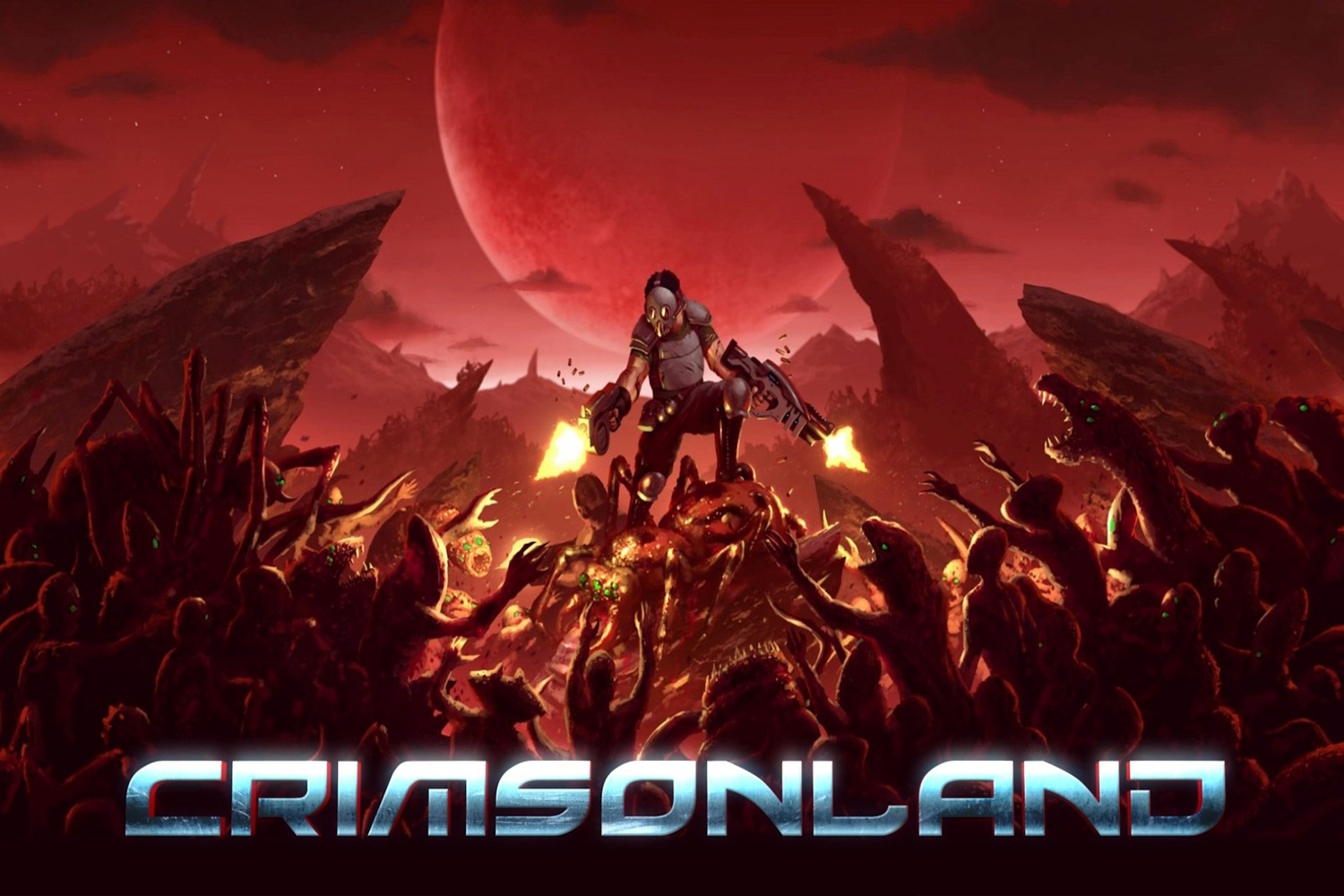
Crimsonland is built around one wonderfully direct idea: place the player in an open battlefield, surround them with enormous numbers of monsters, provide an increasingly destructive arsenal, and see how long they can survive. Aliens, zombies, giant spiders, mutant creatures, and other hostile enemies pour onto the screen from every direction, forcing players to move constantly while firing into the growing swarm. What begins as manageable crowd control can quickly become complete chaos as dozens of enemies close in simultaneously. The result is a fast, addictive top-down shooter where movement, target prioritization, weapon choice, and positioning matter every second.
Originally developed by 10tons, Crimsonland became a cult favorite because it combines straightforward arcade shooting with surprisingly deep progression. Weapons range from rapid-firing machine guns and shotguns to rockets, plasma weapons, flamethrowers, and other powerful tools capable of clearing large sections of the battlefield. Experience gained from defeated enemies eventually allows players to select perks that can alter movement, weapon handling, damage output, survivability, and numerous other aspects of the current run. This means two sessions can develop very differently depending on the weapons and perk combinations that appear.
Now playable online through Lemon Web Games, Crimsonland brings its relentless horde shooting, weapon collection, RPG-style perks, Quest missions, Survival challenges, and local cooperative action directly into the web browser. Players can work through structured missions to unlock additional content or jump into survival-oriented modes where the only real objective is staying alive while the battlefield becomes increasingly crowded. The controls are straightforward enough to understand immediately, yet surviving the largest enemy waves requires constant movement and increasingly smart decisions. For anyone who enjoys arcade shooters where the screen gradually transforms into complete controlled chaos, Crimsonland remains one of the genre's most entertaining classics.
A Top-Down Shooter Built Around Constant Movement
Crimsonland is viewed from above, giving players a clear look at the battlefield and the enemies approaching from every direction. Movement is independent from aiming, allowing the player to retreat in one direction while firing somewhere else. This simple control structure creates the foundation for nearly every advanced strategy in the game.
Standing still is rarely a good idea. Enemy groups constantly try to surround the player, and even relatively weak monsters become dangerous once they arrive in sufficient numbers. Surviving means identifying open space and moving toward it before escape routes disappear. The battlefield is effectively changing every second.
Experienced players eventually begin moving in large loops around enemy groups rather than simply retreating from whatever is closest. This gathers monsters together and makes powerful weapons much more effective. Good movement can turn an overwhelming swarm into a concentrated target.
Enemies Attack From Every Direction
Unlike shooters where enemies approach through predictable corridors, Crimsonland frequently allows threats to enter from almost anywhere. This prevents the player from focusing exclusively on one edge of the screen. A seemingly safe retreat can suddenly become dangerous when another group appears behind it.
Situational awareness therefore becomes extremely important. The player needs to monitor the immediate area around the character while also watching larger groups forming farther away. Focusing too much on one target can allow smaller enemies to close the distance unnoticed.
This creates constant pressure even when the player has a powerful weapon. Firepower helps, but awareness prevents the player from becoming trapped. The strongest runs combine both.
Quest Mode Provides Structured Progression
Quest mode gives Crimsonland a more organized campaign structure by dividing the game into a large collection of missions. Instead of surviving indefinitely, players enter individual stages with specific enemy waves that need to be cleared. Completing these challenges gradually unlocks additional weapons, perks, and other options. Progress therefore has a clear purpose.
The early missions provide an effective introduction to basic enemy types and weapon handling. Later quests become significantly more demanding by increasing enemy density and combining different creatures together. Players who learned to rely on one simple strategy are gradually forced to adapt.
This progression also makes Quest mode useful for learning the wider game. Weapons and perks encountered here provide knowledge that later becomes invaluable in Survival. Completing missions effectively teaches the player how Crimsonland's systems interact.
Survival Mode Removes the Safety Net
Survival mode represents Crimsonland in its purest form. There is no final group of enemies waiting to be defeated and no conventional level exit. Monsters simply keep appearing while the player tries to remain alive for as long as possible. The challenge ends only when the character finally becomes overwhelmed.
This creates a naturally escalating difficulty curve. Early enemies can be dispatched comfortably, allowing the player time to establish a weapon and collect initial perks. As the run continues, enemy numbers increase until the screen becomes crowded with movement. The challenge transforms from simple shooting into large-scale crowd management.
Scores provide the main measure of success. A player who survives only slightly longer than before may still establish a new personal record. That makes Survival extremely replayable.
The Battlefield Gradually Becomes Complete Chaos
One of Crimsonland's most satisfying qualities is watching a relatively empty battlefield slowly transform into something almost impossible to control. The opening moments may contain only a handful of enemies. Several minutes later, monsters can cover huge portions of the screen while explosions and projectiles appear everywhere.
This escalation creates a strong sense of momentum. Players can physically see how much more dangerous the situation has become. Every cleared swarm provides only temporary relief because another group is already approaching.
The visual chaos also makes powerful weapons especially satisfying. A rocket or energy blast cutting through a dense group can eliminate dozens of enemies in moments. Few things in the game feel better than temporarily reclaiming open space from a massive horde.
Weapon Variety Keeps Every Run Interesting
Crimsonland offers a broad selection of firearms and energy weapons, each encouraging a different approach to combat. Rapid-firing weapons are useful for sustained pressure, while shotguns provide tremendous close-range stopping power. Explosive weapons can destroy groups, and energy-based equipment introduces other forms of crowd control. No single weapon feels ideal for every situation.
This variety forces players to adapt according to what becomes available. A run built around a machine gun develops differently from one centered on rockets or plasma. Movement strategy may change as well because certain weapons perform best at particular distances.
Weapon familiarity therefore becomes an important part of long-term improvement. The more players understand each option, the easier it becomes to recognize when a pickup is worth changing to.
Machine Guns Provide Reliable Sustained Fire
Machine guns are among the easiest weapons to understand because they provide consistent rapid fire at useful range. They work well against continuous streams of smaller enemies and allow the player to maintain pressure while moving. This reliability makes them especially comfortable during early or mid-stage combat.
Their weakness appears when enemy density becomes extreme. Individual bullets may not clear large groups quickly enough once the battlefield becomes crowded. Players need to concentrate fire efficiently rather than spraying randomly.
Still, machine guns remain excellent all-purpose tools. They reward accurate tracking and provide steady damage without requiring complicated timing. For many players, they provide a dependable foundation.
Shotguns Reward Close-Range Courage
Shotguns behave very differently because their strength comes from spreading heavy damage across a relatively short area. A well-placed blast can eliminate several nearby enemies simultaneously. This makes them powerful when monsters have already closed the distance. The drawback is obvious: allowing enemies that close is dangerous.
Using a shotgun effectively therefore requires confidence. Players need to maintain just enough separation to attack without becoming surrounded. Retreating while firing can create a strong rhythm where approaching enemies repeatedly enter the weapon's ideal range.
Dense crowds make shotguns particularly satisfying because multiple pellets can strike several targets at once. The weapon feels extremely physical compared with more precise firearms. Every shot has immediate impact.
Rocket Launchers Turn Crowds Into Targets
Explosive weapons become increasingly valuable as enemy numbers grow. A rocket launcher may fire more slowly than a machine gun, but one successful impact can damage or eliminate an entire cluster of creatures. This makes grouping enemies together especially useful. Movement and weapon strategy begin supporting one another.
The risk comes from relying on slower shots when enemies approach from several directions. Missing an important rocket can leave the player without enough immediate damage to create space. Accurate placement is essential.
When used correctly, explosive weapons can completely change the battlefield. Large groups disappear in seconds, creating temporary breathing room. They are perfect examples of Crimsonland's love of overwhelming firepower.
Energy Weapons Add Another Style of Destruction
Plasma and other energy-based weapons provide alternatives to conventional bullets and explosives. Their projectiles often behave differently, creating opportunities for unique crowd-control strategies. Some become especially effective against dense groups where repeated hits can spread through multiple targets.
These weapons also contribute to the science-fiction side of Crimsonland's arsenal. The game may contain zombies and spiders, but it is equally comfortable introducing advanced futuristic technology. The result is a deliberately mixed monster-shooter setting.
Learning when energy weapons outperform conventional firearms is part of mastering the game. Their strengths are not always immediately obvious, but certain perk combinations can make them extremely effective.
Flamethrowers Create Continuous Area Pressure
Flamethrower-style weapons provide another approach by covering nearby space with sustained damage. Instead of focusing on one precise target, the player can sweep across groups and create a dangerous zone between themselves and approaching enemies. This can be extremely useful when surrounded.
The relatively close engagement range requires careful movement. Players cannot simply stand far away and eliminate threats safely. The weapon encourages aggressive crowd management. Maintaining an escape route remains essential.
Watching a large group disappear under continuous fire is extremely satisfying. Crimsonland understands that weapons should not only be useful but enjoyable to operate. Visual destruction is part of the reward.
Reloading Can Become a Dangerous Moment
Weapons need time to recover or reload, and those pauses can become extremely dangerous when enemies are already close. A player who empties the magazine without considering the surrounding swarm may suddenly discover that there is no safe space available during the reload. Ammo management therefore influences positioning.
Experienced players begin creating distance before reaching an empty magazine. This gives the weapon enough time to become ready again without allowing enemies to make contact. Reloading becomes part of movement strategy rather than something handled automatically.
Certain perks can improve this situation dramatically. Faster weapon handling can turn previously dangerous pauses into manageable ones. Character development therefore has an immediate effect on combat rhythm.
Experience Makes Every Kill More Valuable
Defeating enemies does more than simply clear space. Kills generate experience that gradually fills the player's progression meter. Once enough experience has been accumulated, the player gains a level and receives an opportunity to select a perk. This adds an RPG-style layer to the arcade shooting.
The system encourages players to keep engaging enemies rather than avoiding them indefinitely. Clearing a large group produces both immediate safety and long-term character improvement. The reward loop becomes extremely satisfying.
Leveling also provides hope during difficult runs. A new perk can dramatically improve the player's situation at exactly the moment things are becoming dangerous. Surviving long enough to earn another level can therefore become a short-term objective.
Perks Transform the Character During a Run
Perks are one of Crimsonland's most important systems because they allow the player to shape each run differently. Some improve raw damage, while others affect movement, weapon behaviour, health, experience gain, or survivability. The choice offered at each level can influence the direction of the entire session.
This means players are constantly making decisions rather than simply shooting. A perk that looks useful immediately may not fit the current weapon, while another could create a powerful combination later. Knowledge becomes increasingly valuable.
Strong perk combinations can make the character feel dramatically more capable than at the beginning. Movement becomes faster, weapons become deadlier, and survival options increase. The progression happens rapidly enough to remain exciting.
Movement Speed Can Be More Valuable Than Damage
Damage upgrades naturally look attractive because killing enemies faster seems like the obvious path to survival. However, movement speed can become equally important once enemy density increases. A faster character has more opportunities to escape closing groups and reposition before becoming trapped. Mobility effectively creates additional survivability.
This is especially useful against fast enemy types. A slow character may struggle even with powerful weapons if monsters continuously reach close range. Increased movement provides time to aim and fire. Distance becomes a resource.
The strongest builds often balance offense with mobility. Extreme damage means little if the player cannot escape. Crimsonland consistently rewards practical combinations.
Reload Improvements Increase Survivability
Anything that reduces downtime between attacks can have enormous value. Faster reloading allows the player to continue applying pressure before enemies close the distance. This is particularly important with weapons that normally contain lengthy pauses. A perk can transform how comfortable a weapon feels.
Reload improvements also make aggressive play more practical. The player can remain closer to a swarm knowing the weapon will become ready again sooner. This reduces the need to retreat as far between volleys.
Perks therefore do not simply increase numbers. They can change the rhythm of combat. A familiar weapon may suddenly feel completely different after the right upgrade.
Damage Perks Can Turn Good Weapons Into Monsters
Increasing damage becomes extremely powerful when combined with weapons already capable of hitting several enemies. A stronger explosive can clear wider groups before they close in, while rapid-fire weapons may eliminate individual enemies before they accumulate into a dangerous swarm. Offensive perks prevent the battlefield from becoming overcrowded.
The temptation is to select damage whenever possible, but doing so can create a fragile build. If movement, health, or other defensive options are ignored completely, one mistake can end the run. Crimsonland encourages specialization but still punishes imbalance.
Finding the correct mixture depends partly on the player's confidence. Someone with excellent movement may safely prioritize offense, while another player benefits from greater durability. There is no single perfect build for everyone.
Health and Survival Perks Forgive Mistakes
Defensive perks become increasingly useful once the screen fills with enemies. Even skilled players can make mistakes when several threats overlap. Additional health or other survival benefits can turn a potentially fatal collision into something recoverable. That extra margin can extend a run significantly.
Defensive upgrades are especially valuable for players still learning enemy movement. Surviving mistakes provides more time to practice later stages. A run does not need to end because of one imperfect dodge.
However, defense alone cannot keep the battlefield under control. Eventually enemies need to be eliminated quickly enough to preserve movement space. The best defensive strategy still includes strong offense.
Different Perk Combinations Encourage Experimentation
One run may become focused on speed and evasive movement, while another develops into a high-damage explosive build. A third may emphasize weapon handling or unusual perk interactions. The random selection prevents every game from following exactly the same path. Adaptation becomes part of the experience.
This unpredictability keeps Survival interesting even after players understand the core mechanics. The opening minutes may look familiar, but the available perks gradually push the run in a different direction. Players need to make the best use of whatever appears.
Experimenting with combinations also reveals strategies that may not seem obvious initially. A perk that looks modest alone can become excellent when paired with another effect. Discovery continues long after the controls are mastered.
Power-Ups Can Completely Reverse a Bad Situation
Power-ups appear during combat and can provide temporary advantages strong enough to rescue a run that appears almost finished. A player trapped by enemies may suddenly gain enough offensive power to clear the surrounding area. These moments provide dramatic reversals. The battlefield can change almost instantly.
The challenge is reaching the power-up safely. Moving toward it through a dense swarm may create more danger than the item is worth. Players need to judge whether the reward justifies the route.
Power-ups therefore become tactical objectives. They are not simply bonuses collected automatically. Their position can influence the player's movement for several seconds.
Enemy Variety Prevents One Strategy From Working Forever
Crimsonland throws several kinds of monsters at the player, each creating different movement problems. Slow zombies can become dangerous through sheer numbers, while faster creatures demand immediate attention. Large enemies may absorb more damage, and small aggressive monsters can slip through gaps in the player's defense. The mixture matters more than any individual creature.
Different combinations change which target should be prioritized. A huge slow enemy might look threatening, but a faster group approaching from behind can be far more dangerous. Players need to judge based on position rather than appearance.
This prevents combat from becoming simple target practice. The battlefield constantly demands decisions about what should die first. Target priority becomes another skill.
Zombies Create Dangerous Crowds
Zombies represent the classic horde threat. Individually they may not appear especially intimidating, but large groups can occupy enormous areas of the battlefield. Once enough accumulate, they begin limiting movement. Their real weapon is space.
This makes crowd-clearing weapons especially effective against them. Explosives, spread attacks, and other area damage can eliminate several at once. Players who allow zombies to build up for too long may eventually lose the ability to maneuver safely.
Zombies demonstrate one of Crimsonland's central lessons: weak enemies become powerful in sufficient numbers. The player needs to control population before it becomes unmanageable. Prevention is easier than recovery.
Giant Spiders Bring Faster Pressure
Spider-like enemies tend to create a different kind of threat because their movement can feel more aggressive. They close distance quickly and can force the player to change direction before a larger swarm is fully organized. Speed makes them particularly dangerous when mixed with slower creatures. They disrupt comfortable movement patterns.
Fast enemies often deserve priority because they can reach the player first. Ignoring them while firing into a larger distant group can create sudden danger. The player needs to switch targets quickly.
Their presence also makes movement-speed upgrades more valuable. Staying ahead of fast enemies creates additional shooting time. Defensive positioning and perks begin interacting directly with enemy design.
Alien Creatures Strengthen the Science-Fiction Atmosphere
Crimsonland is not limited to conventional undead enemies. Alien creatures and mutant threats help create a broader science-fiction apocalypse where almost anything can appear on the battlefield. This variety keeps the game visually interesting and supports its enormous weapon arsenal. There is no need for strict realism.
The mixed enemy roster also allows different movement patterns and durability levels. Some aliens may require more sustained damage than basic zombies, while others contribute additional speed or pressure. Players cannot judge everything by size alone.
The overall effect is deliberately excessive. Crimsonland wants to throw every kind of monster it can imagine at the player. The chaos is part of its charm.
Mutant Lizards Add Another Horde Type
Mutant lizard-like creatures provide yet another enemy shape and movement style. Their presence reinforces the feeling that the player is fighting through a world completely overrun by hostile life. No explanation is needed for why so many different monsters are present. Survival is the only concern.
Like other enemies, their danger increases dramatically when several types overlap. A player may be avoiding one large group only to discover another approaching from a different direction. The combination determines the difficulty.
This constant variety helps maintain visual readability as well. Different silhouettes make major threats easier to identify during chaos. Players learn to recognize danger at a glance.
Crowd Management Is More Important Than Individual Accuracy
Traditional shooters often reward precise shots against specific enemies. Crimsonland certainly benefits from accuracy, but controlling the shape of the entire swarm can be even more important. The player is not simply killing individual monsters. They are trying to preserve open space.
This means firing into the densest section can sometimes be better than targeting the closest enemy. Removing a large group creates a safe route for later movement. Combat becomes almost geographical.
Experienced players begin seeing the battlefield as moving territory. Enemies control parts of the screen until firepower clears them. Survival depends on continuously reclaiming enough space to maneuver.
Circling the Horde Is a Powerful Technique
One common survival strategy is to move around the outer edge of enemy groups rather than cutting directly through them. This causes many creatures to cluster together as they follow the player. Concentrated enemies become easier to damage with area weapons. Movement effectively organizes the battlefield.
The technique also reduces the chance of becoming surrounded from every direction. By continuously moving around a large loop, the player keeps most enemies on one side. This makes incoming threats easier to monitor.
However, the strategy can fail when new enemies appear directly along the intended route. Players need to remain flexible. No movement pattern is completely safe.
Open Space Is the Most Valuable Resource
Health and ammunition are obviously important, but open space may be even more valuable. Once enemies occupy every escape route, even the strongest weapon can struggle to save the player. Maintaining room to move should therefore influence every decision. Shooting is partly about creating space.
This changes how players evaluate kills. Eliminating an enemy directly ahead can be more valuable than destroying several somewhere else because it opens a route. Tactical positioning matters even inside enormous battles.
The concept becomes increasingly obvious during late Survival runs. The screen may be almost completely filled with enemies, leaving only narrow corridors of movement. Staying alive means continuously finding or creating another opening.
Quest Missions Teach Skills Needed for Survival
Quest mode is not only a campaign. It effectively functions as a long training environment where players encounter different enemy combinations, weapons, and situations. Completing the missions exposes the player to many systems before Survival becomes extremely demanding. Knowledge builds gradually.
Certain quests encourage aggressive shooting, while others reward movement or careful weapon use. This variety prevents the campaign from becoming repetitive. Each mission teaches something slightly different.
By the time many quests have been completed, players are far better prepared for unrestricted horde modes. The structured content and survival gameplay support one another. Progression feels cohesive.
Sixty Missions Provide Plenty of Structured Action
Quest mode contains 60 individual missions, giving players a substantial sequence of challenges before even considering endless score chasing. This provides clear short-term objectives for anyone who prefers defined levels over open-ended Survival. Every completed mission represents concrete progress.
The missions also create natural stopping points. Players can complete a few during a short session and return later without losing track of a long continuous run. This works particularly well for browser play.
Completing the full set becomes its own achievement. By the later quests, enemy density and difficulty provide serious tests of everything learned earlier. The campaign grows alongside the player.
Unlocked Weapons Expand Future Possibilities
Progressing through Quest mode gradually unlocks additional weapons, giving players more options in later modes. This creates a satisfying connection between structured progression and replayability. Completing another mission may add something that changes future Survival runs. Unlocks have practical value.
The growing arsenal also provides motivation to continue through difficult quests. Players know another weapon may be waiting ahead. Curiosity becomes part of progression.
Once unlocked, experimenting with new equipment can reveal completely different strategies. A weapon that initially seems awkward may become a favorite after enough practice. The game continually provides reasons to revisit earlier assumptions.
Local Co-Op Makes the Chaos Even Better
Crimsonland supports local cooperative play, allowing multiple players to fight the monster hordes together. Adding another person dramatically changes the battlefield because enemies can be attacked from several directions at once. Teamwork can make large swarms easier to control. It can also create additional chaos.
Players can naturally divide responsibilities. One may focus on a dangerous enemy group while another clears smaller creatures approaching from behind. Coordinating movement prevents both characters from becoming trapped in the same area. Cooperation creates strategies unavailable in solo play.
Co-op also amplifies the game's arcade personality. Explosions, projectiles, and enemies fill the screen even more dramatically when several players are firing simultaneously. The result can become wonderfully chaotic.
Co-Op Requires Better Awareness
More players do not automatically make everything easier. Everyone needs enough movement space, and several characters running in different directions can split enemy groups unpredictably. Poor coordination may create situations where one player accidentally pulls enemies toward another. Communication helps.
Weapon choices can also complement one another. A player carrying a strong crowd-clearing weapon may pair well with someone using rapid fire against individual threats. Different strengths can cover weaknesses.
This adds replay value because cooperative strategies develop naturally over repeated sessions. Crimsonland remains simple to understand, but teamwork creates another layer. Friends can become part of the build.
Score Chasing Gives Survival Long-Term Appeal
Once players understand the mechanics, Survival naturally turns into a competition against previous performance. The score represents how effectively the player survived the escalating swarm. A small improvement can feel meaningful because the later minutes of a run are increasingly difficult. Personal records become motivating.
Score chasing also encourages players to evaluate perk and weapon choices more critically. A combination that feels fun may not necessarily produce the longest survival time. Players begin comparing approaches.
This creates a natural reason to return even after all major systems are understood. There is always another score to beat. Crimsonland's simplicity makes improvement easy to measure.
Quick Restarts Keep Failure From Slowing the Action
A survival run can end abruptly after one positioning mistake, but Crimsonland does not force players through lengthy delays before trying again. Another attempt can begin quickly. This keeps the game focused on action rather than punishment.
Rapid restarts also encourage experimentation. Players can test unfamiliar weapons or unusual perk combinations without worrying that one bad decision will waste an enormous amount of preparation. Failure becomes part of learning.
This creates the familiar "one more run" effect. A player knows exactly what went wrong and immediately wants another attempt. The next session often begins before frustration has time to settle.
The Visual Style Keeps Large Battles Readable
Top-down shooters can become difficult to follow when hundreds of objects overlap, but Crimsonland uses clear silhouettes and straightforward terrain to keep the main threats understandable. Enemies remain distinguishable from the player, while weapon effects provide immediate feedback. Readability matters more than decorative complexity.
The open arenas also help. There are fewer complex environmental structures blocking the view. The primary question is where enemies are moving rather than how to navigate elaborate scenery.
This visual simplicity allows the horde itself to become the spectacle. Seeing massive numbers of creatures approaching is more impressive when nothing distracts from them. The battlefield tells its own story.
Blood and Destruction Reinforce the Arcade Impact
Crimsonland makes enemy elimination visually satisfying through exaggerated effects and persistent traces of combat. As a run continues, the battlefield becomes increasingly covered with evidence of previous encounters. The environment effectively records the violence of the session. Progress becomes visible.
This also contributes to the game's title and identity. The battlefield genuinely begins looking different after prolonged combat. A previously empty arena becomes marked by everything the player has survived.
The effect is deliberately arcade-like rather than realistic. Crimsonland is interested in feedback and spectacle. Every weapon should feel powerful.
The Soundtrack Supports Relentless Action
Fast shooting benefits enormously from energetic music and impactful sound effects. Weapons need to sound distinct, enemy destruction needs clear feedback, and the overall audio should reinforce the pace of the battle. Crimsonland's presentation understands this. Sound makes the combat feel heavier.
Audio can also help players recognize what is happening without looking directly at every object. Weapon cadence communicates when another reload may be approaching, while enemy sounds contribute to awareness. Listening becomes part of play.
During long survival sessions, the soundtrack helps maintain momentum. The game is built around staying engaged rather than relaxing. Audio supports that intensity.
Crimsonland Helped Define the Horde-Shooter Formula
Long before modern survivor-style games became enormously popular, Crimsonland was already exploring many of the ideas that make large-scale horde combat addictive. The player fights increasingly large enemy populations, gains experience, chooses perks, changes weapons, and develops an increasingly powerful build while surviving as long as possible. The structure feels remarkably familiar today.
The difference is that Crimsonland remains much more manually controlled than many later auto-attacking survivor games. Aiming and shooting remain the player's responsibility. Success therefore combines character progression with mechanical execution.
This gives the game historical importance within the broader evolution of horde shooters. Many modern players may recognize familiar systems even if they never encountered Crimsonland originally. The foundation has aged well.
Manual Aiming Keeps Skill Central
Because the player directly controls where weapons fire, strong perks cannot completely replace accurate shooting. Powerful equipment helps, but wasted shots reduce the ability to manage crowds efficiently. Targeting remains important throughout a run.
This also allows skilled players to extract more value from weaker weapons. Good aim can compensate for lower damage by eliminating the most dangerous enemies first. Mechanical skill remains visible.
The combination of RPG progression and direct shooting prevents the game from becoming passive. Even an extremely strong build still needs to be controlled properly. The player remains involved every second.
Different Modes Support Different Kinds of Players
Quest mode appeals to players who enjoy structured progression, while Survival offers endless score chasing. Additional challenge variants provide other ways to engage with the same combat system. This means Crimsonland does not rely on one single format. Players can choose what suits their mood.
A short session might involve completing a few Quest missions, while a longer one becomes a serious Survival attempt. Co-op can transform the same mechanics into a social experience. The core shooting remains familiar across all modes.
This versatility contributes heavily to replay value. Crimsonland is not finished simply because one campaign has been cleared. Its systems are designed for repeated use.
The Game Becomes More Strategic Than It First Appears
At first glance, Crimsonland can look like nothing more than holding the fire button while running away from monsters. That approach may work briefly, but higher difficulty quickly exposes its limitations. Weapon choice, perk selection, movement patterns, enemy priority, and power-up positioning all influence survival. Strategy emerges naturally from the chaos.
Good players are constantly making small decisions. Is that weapon pickup worth crossing the swarm? Should the next perk improve damage or movement? Which enemy group is currently controlling the most important escape route? These questions happen in real time.
The deeper strategy never overwhelms the arcade foundation. Players do not need complicated spreadsheets to improve. They simply learn from repeated runs.
A Strong Build Can Feel Almost Unstoppable
One of the greatest pleasures in Crimsonland is reaching the point where weapons and perks combine into something exceptionally powerful. Enemies that were dangerous earlier begin disappearing almost instantly. Large swarms can be cleared before they close the distance. The character begins feeling like a walking weapon platform.
This power fantasy is especially satisfying because it was earned during the run. The player remembers how vulnerable the character felt at the beginning. Every perk contributed toward the transformation.
The game eventually responds by sending even larger enemy numbers. No build remains comfortable forever. The escalating swarm keeps pressure on even the strongest characters.
Eventually Every Run Becomes a Fight for Seconds
The late stages of Survival can become so crowded that long-term planning gives way to immediate survival. The player is no longer thinking several minutes ahead. The objective becomes finding enough open space to remain alive for another few seconds. Every dodge matters.
These moments create enormous tension because the player knows the run is already valuable. A high score is within reach or has already been achieved, and one mistake will end everything. Concentration becomes intense.
When the run finally ends, there is often a strong sense of relief mixed with disappointment. The battlefield was inevitably going to win eventually. The only question was how long the player could delay it.
Why Crimsonland Remains So Addictive
The game provides extremely clear feedback between action and reward. Kill enemies, gain experience, choose perks, find stronger weapons, survive longer, and produce a larger score. Every system feeds directly into the next. There is almost no unnecessary delay.
Random weapon and perk combinations prevent complete predictability. Players know how the game works but not exactly how the next build will develop. This creates enough uncertainty to make repeated runs interesting.
Most importantly, Crimsonland makes improvement easy to feel. New players become overwhelmed quickly, while experienced players can control massive swarms for significantly longer. Progress happens in both the character and the person holding the controls.
Playing Crimsonland Online Today
Through Lemon Web Games, Crimsonland can now be played directly in your web browser with no downloads or setup required. Features of the web-based version include:
- Browser-based top-down horde shooting
- No installation required
- 60 Quest missions with progressively tougher enemy encounters
- Survival-focused gameplay against continuously growing monster swarms
- Machine guns, shotguns, rockets, plasma weapons, flamethrowers, and other firearms
- RPG-style experience and perk selection during combat
- Zombies, aliens, giant spiders, mutant creatures, and other enemy types
- Power-ups capable of changing difficult situations quickly
- Local cooperative gameplay
- Score chasing and replayable survival challenges
- Accessible play through Lemon Web Games
New players should focus first on maintaining movement space rather than chasing every enemy individually. Keep moving, avoid becoming trapped near the edge, and try to guide large groups into shapes that are easier to attack. Weapon power matters, but positioning determines whether that power can actually be used safely. Open space should always be treated as a resource.
Perk choices should also complement the current situation rather than following one fixed priority. Extra damage may be excellent when the player already has strong mobility, while movement or survivability can be more valuable during a difficult run. Experiment with combinations and learn how different weapons behave against large groups. Crimsonland rewards adaptability.
Who Should Play Crimsonland
- Players who enjoy fast top-down shooters
- Fans of enormous enemy hordes and survival challenges
- Players who like RPG-style perks inside arcade action games
- Fans of zombies, aliens, mutants, and monster shooters
- Players who enjoy experimenting with different weapon combinations
- Anyone who likes score-chasing survival modes
- Fans of local cooperative action
- Players interested in classic PC shooters
- Fans of modern survivor-style games who want to explore an earlier horde-shooter design
- Anyone looking for an action-heavy browser game with immediate replay value
Crimsonland is particularly suitable for players who enjoy games where the character becomes dramatically stronger during a single session. Weapons and perks can quickly transform the way a run feels, but mechanical skill remains important throughout. Players still need to aim, move, prioritize threats, and preserve escape routes. Progression supports skill rather than replacing it.
It is also an excellent choice for anyone who enjoys short action sessions that can easily become much longer. Quest missions provide compact objectives, while Survival can continue until the player is finally overwhelmed. Quick restarts make experimentation easy. There is always another weapon, perk combination, or score worth trying.
Play Crimsonland Online Now
Crimsonland throws players into open battlefields filled with increasingly enormous swarms of zombies, aliens, spiders, mutants, and other hostile creatures. Movement and aiming are controlled independently, allowing players to retreat while firing, circle large enemy groups, and create space before the horde becomes overwhelming. New weapons appear throughout combat, experience unlocks perk choices, and every successful level makes the character increasingly powerful. What begins as straightforward shooting gradually becomes a frantic battle for control of the entire screen.
Through Lemon Web Games, players can experience Crimsonland directly in a modern browser and discover why its horde-shooter formula remains so addictive. Work through 60 structured Quest missions, experiment with a broad arsenal, build powerful perk combinations, challenge Survival for increasingly higher scores, or bring another player into the chaos through local co-op. Few games make destroying hundreds of monsters feel this immediate.
Final Thoughts
Crimsonland remains compelling because it understands the satisfaction of escalating power. The player begins relatively vulnerable, carrying one weapon while a few enemies approach across an open battlefield. Before long, the screen can be filled with monsters while rockets, plasma, bullets, flames, and perk-enhanced attacks cut through enormous groups. The transformation happens quickly enough to feel exciting while still requiring skill.
Its RPG-style perk system adds just enough decision-making to keep every run interesting. Movement, damage, reload efficiency, health, weapon behaviour, and other bonuses can combine in dramatically different ways, while randomized weapon opportunities encourage adaptation. Quest mode provides structured progression, Survival offers endless score chasing, and local co-op turns the battlefield into even greater chaos.
Through Lemon Web Games, Crimsonland can be enjoyed directly in the browser as a classic example of how addictive top-down horde shooting can be. Its mechanics are straightforward, but controlling the battlefield against hundreds of enemies requires awareness, movement, weapon knowledge, and good perk decisions. For players who enjoy turning overwhelming monster swarms into explosions, experience points, and increasingly ridiculous firepower, Crimsonland remains an essential arcade shooter.











Comments 0