

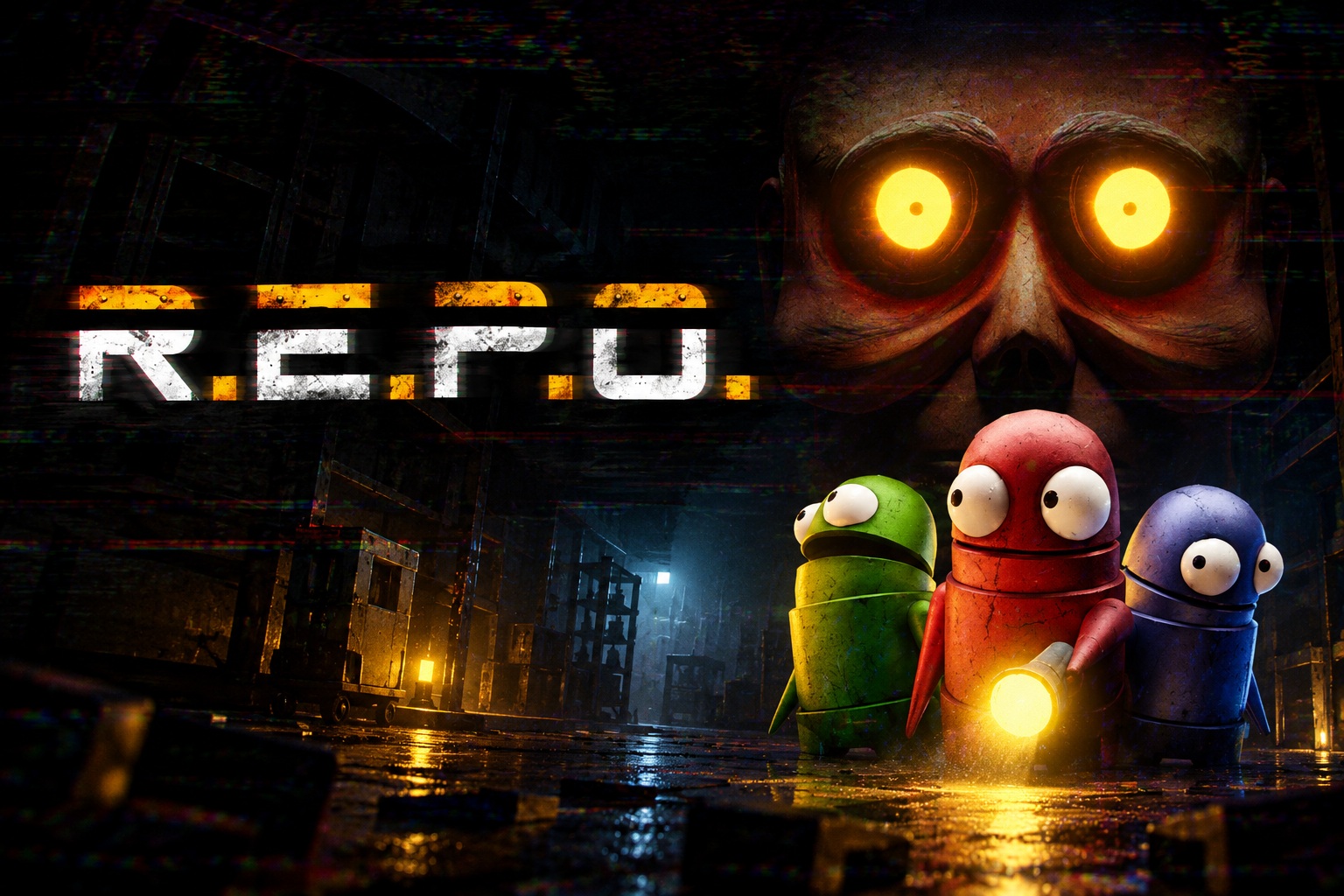
R.E.P.O. is a cooperative horror extraction game from semiwork that turns a seemingly simple salvage job into an unpredictable mixture of fear, teamwork, physics, and complete disaster. Players control small robotic workers employed by a mysterious computer intelligence and are sent into abandoned locations filled with valuable objects left behind by a vanished humanity. The objective sounds straightforward: find enough valuables, transport them safely to the extraction point, meet the required quota, and survive long enough to leave. The problem is that everything from the loot to the monsters obeys physics, meaning an expensive object can be destroyed just as easily by careless teammates as by whatever creature is lurking in the next room.
Up to six players can work together, using physics-based grabbing tools to carry everything from small fragile objects to enormous pieces of furniture that may require several robots to move safely. Proximity voice chat turns communication into part of the experience because teammates can only hear each other naturally when they remain close enough, creating genuinely tense moments when someone disappears down a corridor and suddenly stops responding. Successful runs generate SURPLUS that can be spent on upgrades, equipment, and weapons, gradually improving the team's chances during increasingly dangerous expeditions. The combination of extraction objectives, unpredictable monsters, physics-driven accidents, and hilarious multiplayer communication gives R.E.P.O. a personality that feels equally comfortable as a horror game and a comedy.
Now playable online through Lemon Web Games, R.E.P.O. brings its cooperative extraction missions, physics-based valuables, robotic characters, proximity communication, frightening monsters, equipment upgrades, and chaotic teamwork directly into the web browser. Players need to search dangerous locations, identify valuable objects, transport them without destroying them, reach the extraction point, and decide how much additional risk is worth taking once the required value begins to approach the objective. Every room can contain either the perfect item for completing the quota or a creature capable of turning an organized salvage mission into a frantic escape. Whether working carefully as a coordinated team or watching an expensive piano smash into a wall because three people tried to carry it at once, R.E.P.O. constantly creates memorable situations.
A Salvage Job Inside a Horror Game
The basic mission in R.E.P.O. is unusual because players are not primarily searching for weapons, ammunition, or keys. They are looking for valuable objects.
Furniture, decorative items, fragile objects, electronics, and other possessions scattered around abandoned environments can all contribute toward the required extraction value. The challenge is getting those items from wherever they were discovered to the extraction point without destroying them.
This turns exploration into a constant calculation. A large valuable object may be worth attempting to recover, but carrying it through several dangerous rooms could expose the entire team to unnecessary risk. Sometimes several smaller objects provide the safer route toward meeting the quota.
Physics Control Almost Everything
The physics system is at the centre of R.E.P.O. Objects have weight, size, momentum, and collision behaviour that directly affect how easily they can be transported.
Dragging a small object through a doorway is usually straightforward. Attempting the same thing with a long table, heavy cabinet, or awkward piece of furniture can become an engineering problem.
Objects can hit walls, doors, floors, staircases, other valuables, teammates, and monsters. Every collision introduces another opportunity for something expensive to lose value or break completely.
The Grabber Makes Every Robot a Moving Crane
Players interact with valuables using a physics-based grabbing tool rather than simply placing objects into an invisible inventory. Once grabbed, an item remains physically present in the world.
The robot effectively becomes a small mobile crane, carrying the object in front of itself while navigating the environment. Positioning matters because the object needs enough space to pass through doors and around corners.
This physical interaction gives even ordinary objects personality. A narrow lamp can be easy to transport, while a huge piece of furniture may require rotating, lifting, and repositioning several times before it fits through a doorway.
Heavy Loot Encourages Teamwork
Large valuables often become much easier to handle when several players cooperate. Multiple robots can grab different sections of the same object and distribute the workload.
The difficulty is that every player needs to move in roughly the same direction. One teammate moving too quickly while another turns sideways can cause the entire object to swing uncontrollably.
Successful teamwork makes heavy transportation feel surprisingly rewarding. Getting a massive object safely through several rooms can become an achievement in itself before the team even reaches extraction.
Fragile Objects Create a Different Challenge
Large furniture is difficult because of weight and size, but fragile valuables create the opposite problem. They may be easy to carry yet extremely vulnerable to impacts.
One careless turn can send an object into a doorframe, reducing its value or destroying it completely. Dropping something while running from a monster can be equally disastrous.
This creates some of the game's funniest choices. Players may need to decide whether saving a valuable object is worth slowing down while something dangerous approaches from behind.
The Extraction Point Turns Loot Into Progress
Finding valuables is only useful if they eventually reach extraction. Objects need to be transported into the designated area where their value can count toward the mission.
This creates natural staging areas during a run. Teams may gather several valuables near extraction before committing them together.
The extraction process also creates tension because valuable cargo often ends up concentrated in one place. A monster arriving at the wrong moment can threaten several minutes of careful work at once.
Every Run Revolves Around Meeting a Value Goal
R.E.P.O. gives the team a financial objective rather than asking them to eliminate every creature in the building. The mission succeeds by recovering enough valuable material.
This means players do not necessarily need to search every room. Once sufficient value has been found, continuing deeper becomes a voluntary risk.
Greed naturally becomes part of the game. An unexplored area may contain something extremely valuable, but it may also contain the encounter that ends the entire run.
Knowing When to Leave Is a Skill
Extraction games frequently create tension through the question of whether to continue searching, and R.E.P.O. uses that idea extremely well.
A team close to its target may decide that another room is worth exploring. If the gamble succeeds, extraction becomes easier. If something goes wrong, valuable progress can disappear.
Experienced teams gradually become better at recognizing when the objective has effectively been achieved. Sometimes the smartest strategy is simply leaving while everyone is still alive.
Monsters Turn Exploration Into Horror
The abandoned environments are inhabited by numerous hostile creatures, each introducing different dangers. Players rarely know exactly when an encounter will occur.
A quiet room can suddenly become extremely dangerous once a creature enters. The team may be forced to abandon the object being carried and concentrate entirely on survival.
This unpredictability keeps repeated missions tense. Knowing the general rules of the game does not mean knowing exactly what will happen during the next expedition.
Even the Monsters Are Affected by Physics
One of R.E.P.O.'s most entertaining ideas is that physics do not apply exclusively to the players and their valuables. Monsters also interact physically with the environment.
This creates opportunities for encounters that feel much less scripted than ordinary horror games. Objects can collide with creatures, monsters can become involved in environmental chaos, and physical forces can alter what happens during an attack.
The system produces surprising outcomes because everything shares the same unstable world. A carefully prepared plan can fail instantly—or an accidental physics interaction can unexpectedly save the team.
Stealth Can Be Better Than Fighting
R.E.P.O. gives players weapons and equipment, but combat is not always the best response. Staying quiet and avoiding a dangerous creature can preserve valuable resources.
Players often need to stop moving, reduce noise, and wait for danger to pass. Carrying something large makes this considerably harder because quickly finding a safe hiding position may not be possible.
The tension between valuable cargo and personal survival creates memorable decisions. Sometimes dropping everything and running is the only sensible option.
Sound Matters
Noise plays an important role because careless movement can attract unwanted attention. Objects crashing into the environment are not merely expensive mistakes; they can also make the surrounding area more dangerous.
This encourages teams to move valuable cargo carefully rather than dragging everything recklessly across the floor.
The effect becomes especially noticeable when transporting large objects. What should have been a quiet salvage operation can become extremely loud when several robots begin fighting with a piece of furniture.
Proximity Voice Chat Changes Communication
Communication in R.E.P.O. is more than a convenience. Proximity voice chat means teammates naturally hear one another according to distance.
When everyone remains together, coordination is simple. Once the team splits up, communication becomes less reliable and isolation begins increasing tension.
Hearing someone shouting from another corridor can be both useful and terrifying. Suddenly hearing nothing at all can be worse.
Voice Chat Also Creates the Comedy
The same system responsible for some of the horror also creates many of R.E.P.O.'s funniest moments. Players naturally react to unexpected monsters, broken valuables, failed transportation attempts, and teammates making terrible decisions.
Because voices come from the robots' positions, conversations feel physically connected to the world. Someone can become quieter while being dragged away or disappear completely behind a closing door.
The result produces comedy without needing scripted jokes. The players themselves create most of the humour.
The Small Robots Give the Game Immediate Personality
The playable robots are deliberately compact and expressive, creating a funny contrast with the threatening environments surrounding them.
Watching several tiny machines struggle to carry an enormous piece of furniture naturally looks ridiculous. Their appearance makes multiplayer accidents entertaining instead of simply frustrating.
The robots also help separate R.E.P.O. visually from more conventional cooperative horror games where everyone controls ordinary human characters.
SURPLUS Rewards Successful Extraction
Completing objectives provides SURPLUS that can be used to improve the team for future expeditions.
This creates a satisfying progression loop. Successful salvage generates money, money purchases improvements, and stronger robots become better prepared for more dangerous runs.
The system makes extraction feel meaningful beyond simply completing another level. Every successful mission contributes toward future survival.
Upgrades Improve the Robots
Robotic enhancements allow players to improve different aspects of their characters. Better capabilities can make moving valuables, surviving encounters, or navigating environments easier.
This gradually changes how the team approaches difficult situations. A task that initially required several players may become more manageable once useful enhancements have been purchased.
Progression therefore supports the physics mechanics rather than replacing them. Objects remain physical and dangerous, but improved robots become better equipped to deal with those problems.
Weapons Provide Another Way to Survive
Weapons can give players additional options when avoiding a creature is no longer possible.
They can provide valuable protection, particularly when the team becomes trapped or needs enough time to recover important cargo. However, relying entirely on weapons can create its own problems.
R.E.P.O. remains primarily an extraction game. Surviving a battle means little if every valuable object was destroyed during the fight.
Equipment Creates Interesting Purchasing Decisions
SURPLUS cannot necessarily buy everything immediately, so teams need to decide what will provide the greatest benefit.
One group may prioritize stronger transportation abilities, while another invests more heavily in defensive equipment or weapons. Different play styles naturally create different purchasing strategies.
These decisions add long-term planning between expeditions. The team is not merely preparing for one room but improving its chances across future missions.
Environments Reward Careful Searching
Valuables can appear throughout abandoned rooms, hallways, storage areas, and other sections of the environment. Thorough exploration usually produces better opportunities.
Searching carries obvious risks because every additional room increases the chance of encountering something dangerous.
Good teams gradually develop a rhythm where some players scout while others remain responsible for valuable cargo. Splitting responsibilities can improve efficiency, although separation also makes individual players more vulnerable.
Doors Become Unexpectedly Important
A simple doorway can become one of the greatest obstacles in R.E.P.O. when the team is carrying something large.
Players may need to rotate an object precisely before it fits. Someone holding the wrong side may accidentally wedge it against the frame.
When a monster is approaching, this normally mundane problem becomes genuinely stressful. Few games can make moving a table through a door feel like a survival challenge.
Stairs Can Become Physics Nightmares
Vertical movement creates additional problems because valuables behave according to gravity. Carrying something down stairs too quickly can cause it to bounce, rotate, or collide with the environment.
Multiple players need to coordinate carefully when transporting heavier objects across different elevations.
Again, the physics turn an ordinary action into gameplay. Moving from one floor to another can become an entire team operation when the cargo is valuable enough.
Dropping the Loot Can Sometimes Save Everyone
Players naturally become attached to valuable objects after spending several minutes transporting them. That attachment can become dangerous.
When a serious threat appears, continuing to hold the object may slow the player down or prevent quick movement. Dropping it can provide the mobility needed to escape.
The difficult part is accepting that survival occasionally matters more than protecting the cargo. The object can potentially be recovered later if everyone remains alive.
Failure Often Creates the Best Stories
A perfectly organized extraction can be satisfying, but many of R.E.P.O.'s most memorable moments come from plans collapsing completely.
A valuable object gets stuck. Someone accidentally damages it. A monster appears. Another teammate panics. Within seconds, the carefully controlled operation becomes chaos.
Because these disasters emerge naturally from physics and player behaviour, they rarely feel identical. Failure becomes entertaining enough that losing does not necessarily mean the session was wasted.
Cooperation Makes Difficult Jobs Manageable
A coordinated group can divide responsibilities effectively. Some players search for valuables, others transport cargo, and someone may keep watch for nearby threats.
Communication becomes particularly important when dealing with large objects. Calling out turns, doorways, stairs, and approaching enemies can prevent expensive accidents.
R.E.P.O. rewards teams that actually work together without requiring strict predefined classes. Roles develop naturally according to the immediate situation.
Playing Alone Changes the Experience
Although R.E.P.O. is designed strongly around cooperative play, the underlying systems become much more intimidating when fewer players are available.
Large objects become harder to transport and dangerous encounters cannot be divided between multiple teammates. The sense of isolation also becomes stronger.
This demonstrates how much of the game's personality comes from cooperation. More players bring additional capability, but they also introduce more opportunities for hilarious mistakes.
The Horror and Comedy Strengthen Each Other
R.E.P.O. works because it never needs to choose completely between being frightening and being funny. The two emotions frequently happen seconds apart.
A monster encounter may begin with genuine panic before someone becomes stuck behind furniture or accidentally throws an object across the room. The tension breaks naturally through player behaviour.
That contrast makes the scary moments more effective because the game is not relentlessly oppressive. Players relax, laugh, and become comfortable before something dangerous interrupts them again.
The Physics Make Every Run Unpredictable
Even when players revisit familiar environments, physical interactions ensure that events rarely unfold exactly the same way.
An object may fall differently, a teammate may approach from another angle, or a monster may collide with something unexpected. Small changes can alter the entire situation.
This unpredictability provides strong replay value. Players gradually become more skilled, but they can never completely eliminate chaos.
R.E.P.O. Works Especially Well With Friends
Cooperative horror becomes more memorable when every player contributes something unpredictable, and R.E.P.O. is built almost entirely around that idea.
The game provides the monsters, physics, valuables, and objectives, but the players create the stories. Someone becomes the careful planner, another becomes the reckless explorer, and somebody inevitably drops the expensive object.
Those personalities make each team feel different. The same mission can become an efficient professional operation or complete nonsense depending entirely on who joins.
Playing R.E.P.O. Online Today
Through Lemon Web Games, R.E.P.O. can now be played directly in your web browser with no downloads or setup required. Features of the web-based version include:
New players should resist the temptation to grab every object they see. Begin with manageable valuables and learn how the physics behave before attempting to transport something enormous through several narrow rooms. Carrying expensive objects slowly is usually better than reaching extraction quickly with half their value destroyed.
Teams should also establish basic communication early. Decide who is scouting, who is helping with heavy cargo, and when everyone should abandon an object because danger is approaching. The strongest teams are not necessarily those that fight every monster; they are the ones that consistently bring valuable items home.
Who Should Play R.E.P.O.
R.E.P.O. is particularly suited to groups who enjoy creating their own stories through gameplay rather than following a completely scripted campaign. The systems establish the problem, but player behaviour determines how the situation unfolds. Even simple tasks can become memorable when several people are involved.
It should also appeal to players who enjoy games where failure can still be entertaining. Losing valuable cargo or being forced to abandon an extraction may hurt progression, but the chain of ridiculous events leading to that failure can easily become the part everyone remembers.
Play R.E.P.O. Online Now
R.E.P.O. turns salvage work into one of the strangest jobs imaginable. Enter abandoned environments as a small robotic worker, search for valuable remnants of humanity, carefully transport them toward extraction, avoid the creatures roaming nearby, and earn enough SURPLUS to become better prepared for whatever the next mission contains. Every object obeys physics, which means even the simplest retrieval can become complicated once weight, doors, stairs, teammates, and monsters begin interacting.
Through Lemon Web Games, players can experience R.E.P.O. directly in a modern browser and discover why carrying valuable furniture with friends can somehow become both frightening and hilarious. Work together, protect the cargo, keep the noise down, and remember that sometimes dropping the expensive object and running away is the smartest investment possible.
Final Thoughts
R.E.P.O. succeeds because its strongest moments are not fully scripted. The game creates environments filled with valuable objects, dangerous monsters, physics, and extraction objectives, then allows players to produce the chaos themselves. Something as simple as carrying a piano can become an elaborate cooperative puzzle, and something as terrifying as encountering a monster can turn into comedy when everyone panics simultaneously.
The physics system is especially important because it connects almost every part of the experience. Valuables can break, heavy objects need cooperation, monsters interact with the environment, and careless movement can transform an organized operation into disaster. Progress through SURPLUS and robotic upgrades gives successful extractions meaningful rewards without removing the unpredictable nature that makes each run interesting.
Through Lemon Web Games, R.E.P.O. can now be enjoyed directly in the browser as a wonderfully unusual combination of horror, extraction gameplay, cooperative problem solving, and physics comedy. It can be genuinely frightening when the team becomes separated, deeply satisfying when a difficult object finally reaches extraction, and completely ridiculous when everything goes wrong at once. For players who enjoy multiplayer games where the best stories emerge naturally from teamwork and failure, R.E.P.O. provides exactly the right kind of chaos.











Comments 0