

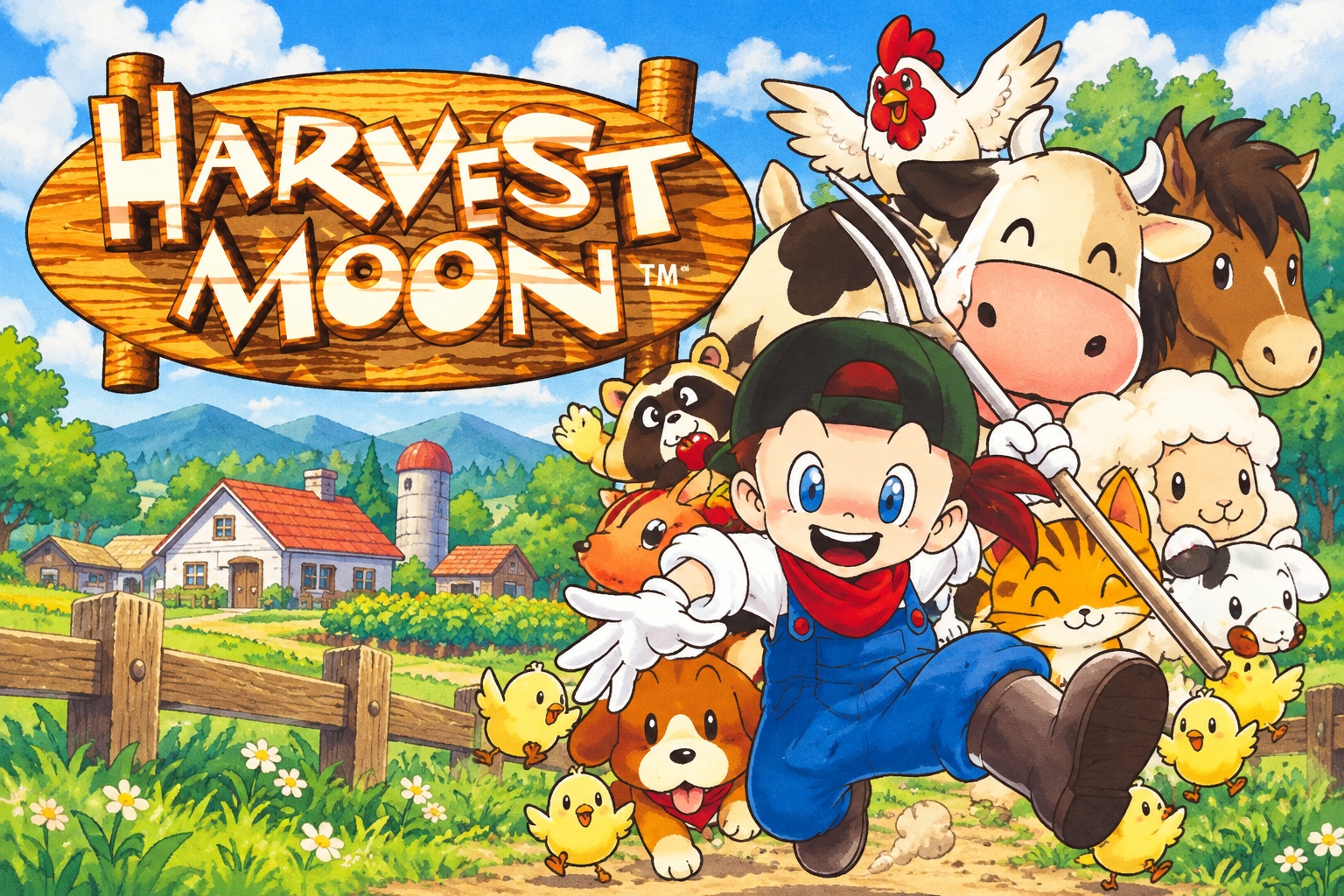
Harvest Moon is the original 16-bit farming simulation that introduced players to a completely different kind of progression from the action-heavy games that dominated the Super Nintendo era. Instead of defeating enemies or racing against a timer, players inherit a neglected farm from their grandfather and receive roughly two and a half years to transform it into a successful homestead. The land begins covered with weeds, rocks, tree stumps, and empty fields, leaving almost everything in need of attention. From this humble beginning, the player gradually builds a productive farm through planting crops, raising animals, expanding the farmhouse, improving tools, forming relationships, and learning how to use each day efficiently.
What makes Harvest Moon special is how naturally all of these systems connect. Crops provide money, money funds animals and upgrades, better tools allow more work to be completed before exhaustion, and a more successful farm creates enough stability to focus on relationships and village life. Seasons change which crops can be grown, weather influences daily plans, festivals interrupt the normal routine, and animals require consistent care regardless of what else needs to be accomplished. The game is peaceful in presentation, yet beneath that relaxed atmosphere is a surprisingly strategic time-management experience.
Now playable online through Lemon Web Games, Harvest Moon brings its farming, animal care, village relationships, seasonal festivals, marriage system, farmhouse upgrades, exploration, and classic 16-bit countryside atmosphere directly into the web browser. Players can clear their inherited land, plant and harvest crops, raise chickens and cows, visit the nearby village, improve their equipment, pursue one of five potential marriage partners, and gradually turn an abandoned property into a thriving farm. Every in-game day provides only a limited amount of time and stamina, so deciding what matters most becomes an important part of the experience. Whether the goal is building wealth, creating the perfect farm layout, starting a family, or simply enjoying the quiet routine of rural life, Harvest Moon provides an unusually personal form of progression.
The Farm Begins Almost Completely Overgrown
The inherited property is far from ready for planting when the game begins. Weeds cover much of the soil, rocks block useful spaces, and tree stumps occupy areas that could eventually become productive farmland. The first days are therefore devoted largely to clearing enough space to begin working properly.
This early labour establishes one of Harvest Moon's most satisfying ideas: visible improvement. Every weed removed and every field cleared permanently changes the appearance of the property. The player can look back after several seasons and immediately see how much progress has been made.
Clearing everything at once is rarely practical because stamina is limited. It is often wiser to prepare only the amount of land needed for immediate crops while gradually improving the rest of the farm over time.
Crops Provide the Foundation of Early Income
Farming begins with purchasing seeds and preparing plots of soil using the hoe. Once planted, crops need regular watering until they are ready to harvest. Selling the produce provides money that can then be reinvested into the farm.
Crop selection becomes increasingly important because the calendar continues moving whether or not a field is productive. Planting too late in a season can leave crops unfinished before the weather changes, wasting both money and labour.
Profitable farming therefore depends on planning. Players need to understand how long crops take to grow, how much time remains in the season, and whether they have enough stamina to maintain the fields every day.
Watering Creates the Daily Routine
Few activities define early Harvest Moon more clearly than watering crops. Every planted square needs attention, turning the watering can into one of the most frequently used tools on the farm.
At first, maintaining a large field can consume a significant portion of the day. Players need to balance the desire for greater income against the amount of work those additional crops will require.
Rain becomes extremely valuable because it can reduce the watering workload and free the day for other activities. A rainy morning may suddenly become an opportunity to visit town, clear more land, or explore the mountain.
Seasonal Changes Keep Farming From Becoming Repetitive
The year is divided into seasons, and those seasonal changes influence crops, weather, festivals, and the overall appearance of the countryside. A farm strategy that works during one period may need to be adjusted when the next season arrives.
Certain crops belong to particular seasons, making the calendar an important part of planning. Players who spend all their money immediately before a seasonal transition can find themselves poorly prepared for the next planting cycle.
The changing environment also gives the game a strong sense of time passing. The farm does not exist in a permanent summer. The world continually moves forward whether the player is ready or not.
Stamina Limits How Much Can Be Done Each Day
The farmer cannot work endlessly. Swinging tools, chopping stumps, breaking rocks, watering fields, and performing other physical tasks gradually consume stamina.
This creates a practical limit on productivity and prevents players from completing the entire farm in a single day. Learning when to stop working becomes just as important as deciding what to do next.
Overworking wastes time that could have been used more efficiently on another day. Harvest Moon rewards players who develop routines rather than attempting to accomplish everything immediately.
Tool Upgrades Make Farm Work More Efficient
As the farm develops, better tools become increasingly valuable. Improved equipment allows the player to perform tasks more effectively and reduces the amount of effort required for large jobs.
This progression is especially noticeable when expanding crop fields or removing tougher obstacles. Work that initially consumed most of the day gradually becomes much more manageable.
Tool improvements therefore represent genuine quality-of-life upgrades rather than simple numerical bonuses. They allow the player to operate a larger farm while still having enough time to participate in village life.
Chickens Provide a Reliable Source of Produce
Chickens introduce animal husbandry without requiring as much investment as larger livestock. Once properly cared for, they can provide eggs that contribute to daily income.
Animals need consistent attention, making them another responsibility added to the farm routine. Neglecting their needs undermines their productivity and reduces the benefit of owning them.
The gradual expansion from crops into livestock gives the farm a stronger sense of becoming a complete operation. Instead of relying entirely on seasonal fields, the player begins developing multiple sources of income.
Cows Become a Major Long-Term Investment
Cows require greater commitment but can become extremely valuable once they are healthy and properly cared for. Feeding them, keeping them safe, and maintaining their condition become regular parts of farm life.
Milk provides another reliable product to sell, making cows particularly useful once the player has enough resources to support them properly. Their value grows as the farm becomes more established.
Livestock also introduces a stronger emotional element. Animals remain on the property day after day, making them feel more permanent than crops that disappear after harvest.
Grass Supports the Livestock Economy
Growing grass is important because it provides feed for animals. Dedicating part of the farm to pasture therefore becomes an investment in long-term livestock management.
This creates another land-use decision. Space planted with grass cannot simultaneously be used for profitable crops, but animal care becomes much more sustainable when sufficient feed is available.
A successful farm therefore benefits from balance rather than maximizing one activity exclusively. Crops, grass, buildings, and animals all compete for limited space.
The Village Provides More Than Supplies
The nearby village serves as the social and commercial centre of the game. Players visit shops, speak with residents, purchase useful goods, and participate in events that break up the farming routine.
Regular visits also help establish relationships. Villagers react to the player over time, giving the world a stronger sense of community than a farm operating entirely in isolation.
This social layer makes Harvest Moon feel more like a life simulation than a pure agricultural management game. Success is measured partly through relationships, not only through money.
Five Women Can Become Marriage Partners
The original Harvest Moon offers five potential marriage candidates: Ann, Ellen, Eve, Maria, and Nina. Each has her own personality, routine, and preferences.
Building a relationship requires regular interaction rather than simply purchasing an upgrade from a menu. Players need to spend time in the village and pay attention to the person they hope to marry.
This makes romance another competing priority within the daily schedule. A player focused entirely on crops and livestock may become wealthy but miss opportunities to develop a personal life.
The Blue Feather Represents Commitment
Once a relationship has developed far enough, the Blue Feather becomes the traditional symbol used to propose marriage. This mechanic would later become one of the most recognizable traditions throughout the wider Harvest Moon series.
Marriage significantly changes the feeling of the farmhouse. What began as an isolated farming project becomes a shared home.
The system gives players a long-term objective unrelated to financial success. A prosperous farm is important, but building a family provides another way to define a successful life.
Family Life Extends Beyond the Wedding
Marriage is not simply an ending screen. The player continues working and developing the farm afterward, with family life becoming part of the remaining campaign.
This makes the relationship system feel integrated into the broader simulation. Farming does not stop because another objective has been completed.
The possibility of building a household also reinforces the game's central theme of creating a life rather than merely accumulating wealth. The farm gradually becomes both a workplace and a home.
Festivals Break Up the Normal Schedule
Seasonal festivals provide opportunities to leave the usual farming routine and participate in village events. These days make the calendar feel more meaningful and help the community feel alive.
Festivals also encourage players to maintain relationships because familiar villagers gather together rather than remaining in their ordinary locations. They become opportunities to experience the social side of the game.
The interruptions are valuable because normal farm life can become highly structured. A festival temporarily changes priorities and creates memorable milestones throughout the year.
Fishing Provides an Alternative Activity
Fishing allows players to spend time away from the fields while still potentially obtaining useful rewards. It is a quieter activity that fits naturally with the rural atmosphere.
The mechanic also provides variety during days when farming responsibilities are lighter. Once crops have been watered and animals cared for, remaining time can be used exploring other activities.
Fishing demonstrates one of Harvest Moon's greatest strengths: there is almost always something productive or relaxing to do, even when the main farm chores are finished.
The Mountain Encourages Exploration
The mountain area contains natural scenery, useful resources, and locations that offer a welcome contrast to the organized farmland. Visiting it can reveal items and opportunities unavailable elsewhere.
Because every journey consumes time, exploration needs to be planned around farm responsibilities. Spending an entire afternoon in the mountains may mean returning home late.
These excursions help prevent the game from becoming restricted to one small property. The farm is the centre of the experience, but the surrounding countryside remains important.
Power Berries Reward Curious Players
Hidden Power Berries provide permanent benefits and reward players who explore beyond the obvious farming routine. Finding them can improve the farmer's ability to work effectively.
These upgrades are especially valuable because stamina affects nearly every physical activity. Additional endurance means more fields can be maintained or more obstacles cleared before the farmer becomes exhausted.
Power Berries also give exploration a meaningful purpose. Secrets are not merely decorative; they can noticeably improve everyday life on the farm.
Weather Can Completely Change a Day
Daily weather influences what needs to be done and what may become dangerous. Rain can reduce crop maintenance, while severe storms can create additional problems.
Players therefore need to adapt rather than follow exactly the same routine every morning. A rainy day may free time for town, while a storm may encourage a more cautious approach.
Weather makes the farm feel connected to nature rather than operating like a predictable factory. The player controls many things, but not everything.
Storms Can Disrupt Carefully Made Plans
Bad weather can threaten crops, animals, and the smooth operation of the farm. A plan built around perfect conditions may suddenly need to change.
This uncertainty adds tension without turning Harvest Moon into a stressful game. The player learns to prepare for setbacks and maintain enough resources to recover.
The occasional disruption also makes successful seasons more satisfying. A productive farm feels earned because nature does not always cooperate.
Farmhouse Upgrades Show Growing Prosperity
As money accumulates, the farmhouse can be expanded. These improvements provide visible evidence that the player's work is transforming more than the fields.
A larger home also becomes important when pursuing marriage and family life. Economic progress and personal progress therefore become connected.
The contrast between the modest starting home and the improved property later in the game gives the campaign another satisfying visual progression.
Every Day Requires Priorities
Harvest Moon becomes most interesting when several responsibilities compete simultaneously. Crops need water, cows need care, chickens need attention, someone in town may need to be visited, and a festival may be approaching.
The player cannot always accomplish everything. Choosing which task matters most becomes a central part of the game.
This creates strategy without making the experience feel like a conventional strategy title. Decisions emerge naturally from daily life instead of appearing through menus filled with statistics.
Efficiency Gradually Becomes Second Nature
Early mornings can feel chaotic because even basic chores consume a large amount of time. As players become more familiar with the farm, movement and routines become far more efficient.
Tools are kept nearby, crop layouts become easier to water, animals are organized logically, and village visits can be combined with other errands.
This personal improvement is one of the most rewarding forms of progression. The player's knowledge develops alongside the farm itself.
The Limited Campaign Gives Every Season Meaning
Unlike later farming simulations that can continue almost indefinitely, the original Harvest Moon evaluates the player after roughly two and a half years of farm management.
This limited period gives every season greater importance. Wasting an entire year has consequences because there is only so much time available before the final evaluation.
The structure encourages replaying the game with better strategies. A second farmer may achieve far more simply because the player already understands the calendar and priorities.
Success Is Measured in Several Ways
Harvest Moon does not define success solely by how much money has been earned. The condition of the farm, livestock, upgrades, relationships, and family life all contribute to the sense of accomplishment.
This makes the experience surprisingly personal. One player may prioritize massive crop fields, while another focuses heavily on animals or marriage.
The evaluation at the end reflects the broader philosophy of the game. Building a good life involves more than maximizing one statistic.
The Pixel Art Creates a Warm Rural Atmosphere
Harvest Moon uses colourful 16-bit pixel art to make the countryside feel inviting. Crops visibly change as they grow, animals move around the farm, and seasonal colours transform familiar locations.
The artwork is simple enough to remain readable while still giving each location personality. The village, mountains, farmhouse, fields, and shops all feel distinct.
This visual warmth contributes significantly to the game's relaxing reputation. Even demanding farm work feels pleasant when surrounded by the cheerful countryside presentation.
The Music Makes Routine Feel Comforting
Music plays an important role in establishing the peaceful rhythm of farm life. Different themes accompany the farm, village, festivals, and changing seasons.
Because players repeatedly visit the same locations, memorable music helps those routines feel familiar rather than repetitive. Returning to the farm after a long trip can feel almost like returning home.
The soundtrack works especially well during quieter moments when the player is watering crops or walking through town. Harvest Moon demonstrates how repetition can become comforting when presentation and pacing support it properly.
Harvest Moon Helped Establish an Entire Genre
When Harvest Moon first appeared, farming was an unusual subject for a console game. The idea of spending hours planting vegetables, caring for cows, and building relationships was radically different from the action games surrounding it.
The formula proved powerful enough to inspire a long-running series and eventually an entire genre of farming and life simulations. Many later games would expand the concept with larger worlds, crafting, deeper relationships, and more complex customization.
The original remains important because the essential formula is already present. Farming, seasons, animals, villagers, romance, upgrades, and daily routines all work together remarkably well.
Playing Harvest Moon Online Today
Through Lemon Web Games, Harvest Moon can now be played directly in your web browser with no downloads or setup required. Features of the web-based version include:
New players should begin with manageable crop fields rather than planting every available square immediately. A smaller field that can be watered consistently is usually more profitable than an enormous one that consumes the entire day. Gradually expand as tools improve and daily routines become more efficient.
It is equally important to leave time for the village. Relationships, festivals, supplies, and marriage all require attention away from the farm. Harvest Moon becomes much more rewarding when agricultural success and social life develop together.
Who Should Play Harvest Moon
Harvest Moon is particularly suitable for players who enjoy watching small improvements accumulate over time. Clearing one patch of land or buying one chicken may seem minor, but after several seasons those individual decisions create a completely transformed farm.
It should also appeal to players who value freedom within a structured routine. The calendar keeps moving, yet the player decides which activities deserve attention and what kind of life the farmer will ultimately build.
Play Harvest Moon Online Now
Harvest Moon begins with an overgrown farm and a simple opportunity to build something better. Clear the land, plant seasonal crops, raise animals, upgrade tools, expand the farmhouse, explore the countryside, attend festivals, build relationships, and gradually create a life that looks completely different from the one that existed on the first morning.
Through Lemon Web Games, players can experience this landmark farming simulation directly in a modern browser and discover why its simple daily routines became the foundation for an entire genre. Every harvest, animal, friendship, and improvement adds another small piece to the story of the farm.
Final Thoughts
Harvest Moon remains remarkably enjoyable because progress is constantly visible. Empty land becomes fields, fields become profitable harvests, barns fill with animals, the farmhouse expands, and unfamiliar villagers gradually become friends or family. Few games make ordinary routines feel so meaningful.
Its limited time frame also gives the experience a sense of purpose that later endless farming games sometimes avoid. Every season matters, yet the game rarely forces players into one perfect strategy. Building a successful farm is important, but relationships, exploration, family, and personal routines can matter just as much.
Through Lemon Web Games, Harvest Moon can now be enjoyed directly in the browser as one of the foundational life simulations of the 16-bit era. Its mechanics may be simpler than those of modern farming games, but the core appeal remains completely intact: start with almost nothing, work carefully day by day, and watch a neglected piece of land gradually become a home.











Comments 0