

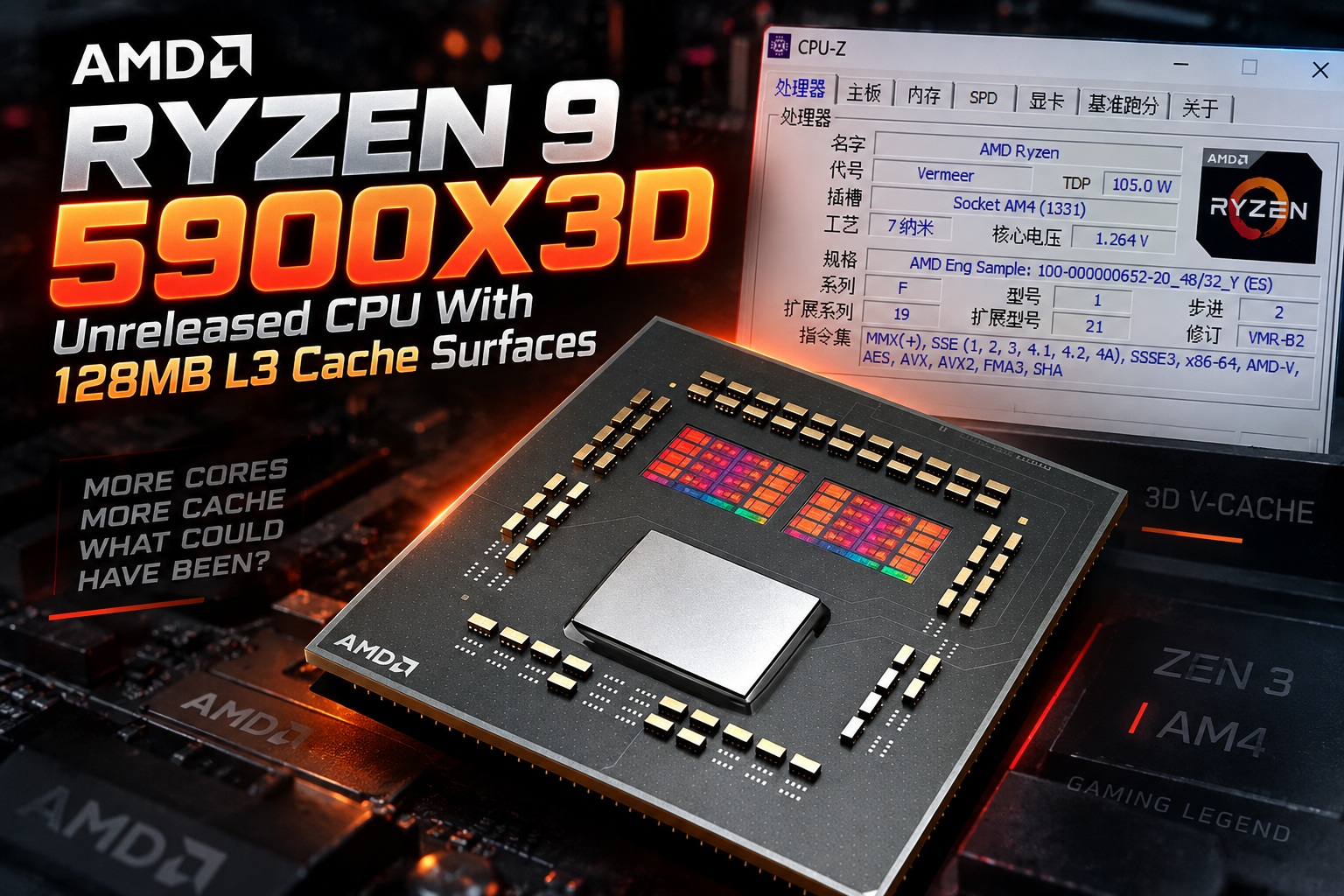
Details of an unreleased AMD Ryzen 9 5900X3D have surfaced online, suggesting that AMD may once have considered expanding its first-generation 3D V-Cache lineup beyond the Ryzen 7 5800X3D. The newly spotted processor appears to combine 12 Zen 3 cores with a much larger 128MB pool of L3 cache, potentially giving it a very different position within the AM4 family. Had it reached the market, the 5900X3D could have become an interesting alternative for users who wanted both strong gaming performance and additional multi-core capability.
A 12-Core X3D Chip That Never Reached Retail
Evidence of the Ryzen 9 5900X3D reportedly appeared on the Chinese Chiphell forums. Like the standard Ryzen 9 5900X, the unreleased X3D variant features 12 CPU cores, but the key difference is the addition of AMD's 3D V-Cache technology. The processor reportedly carries a total of 128MB of L3 cache, significantly more than the 96MB found on the Ryzen 7 5800X3D.
This suggests AMD may have been experimenting with multiple X3D configurations during the AM4 generation. The 5800X3D ultimately became the only widely released consumer X3D model for that platform, but the existence of a 5900X3D indicates the company may have evaluated a broader lineup before settling on the final retail strategy. The additional cores could have made the chip particularly attractive to users who wanted more than just gaming performance.
Two CCDs With 3D V-Cache On Only One
The Ryzen 9 5900X3D reportedly uses a dual-CCD design, although only one of those chiplets is equipped with 3D V-Cache. In practical terms, the processor appears to use a 96MB plus 32MB cache configuration, resulting in the total 128MB L3 cache figure. This approach is somewhat similar to later multi-CCD X3D processors, where only one chiplet carries the additional stacked cache.
There are no confirmed specifications for the processor's official base and boost frequencies. However, an HWiNFO screenshot reportedly shows the chip reaching close to 4.8GHz during operation. That would place its observed frequency in roughly the same performance territory as the Ryzen 7 5800X3D, at least based on the available engineering sample information.
The 5800X3D Remains One Of AM4's Most Popular Gaming CPUs
Despite being several years old, the Ryzen 7 5800X3D continues to hold a strong reputation among AM4 users. Its large 96MB L3 cache allows it to remain highly competitive in gaming workloads, particularly on systems where owners want to extend the life of an existing AM4 motherboard rather than move to a completely new platform. That longevity has made the processor one of AMD's most memorable gaming-focused CPUs.
AMD even revived the model as part of a 10th anniversary edition tied to the AM4 platform. The anniversary refers to the platform itself rather than the age of the 5800X3D, with AM4 having originally launched alongside the first Ryzen processors in 2017. The continued attention given to the 5800X3D shows just how successful AMD's first consumer 3D V-Cache implementation became.
AM5 Expanded The X3D Lineup
AMD took a much broader approach to 3D V-Cache when it moved to the AM5 platform and Ryzen 7000 Series processors. Instead of releasing a single gaming-focused model, the company introduced several X3D variants including the Ryzen 7 7800X3D, Ryzen 9 7900X3D and Ryzen 9 7950X3D. This gave users more choice across different core counts and price points.
The multi-model strategy also demonstrated that AMD had become increasingly confident in 3D V-Cache as a mainstream performance feature. However, those earlier X3D processors still came with restrictions around manual overclocking. Much like the 5800X3D, users had limited freedom to push traditional CPU frequencies beyond AMD's intended operating parameters.
Ryzen 9000 Changed The Overclocking Story
That limitation changed with the current Ryzen 9000 Series. AMD officially opened the newer 3D V-Cache lineup to manual overclocking, giving enthusiasts considerably more control over performance tuning. This represented a major shift from the earlier X3D generations, where AMD had taken a more conservative approach because of the thermal and voltage sensitivity of the stacked cache technology.
The change also shows how AMD's implementation of 3D V-Cache has matured over several generations. What began as a relatively specialised feature on the Ryzen 7 5800X3D has since evolved into a much broader product family with higher core counts, more flexible tuning and wider availability across AMD's desktop lineup.
What The 5900X3D Could Have Offered
If the Ryzen 9 5900X3D had launched commercially, it could have offered an appealing middle ground between the gaming-focused 5800X3D and the higher-core-count Ryzen 9 models. Its 12 cores and 128MB L3 cache would likely have made it more versatile for users balancing gaming with content creation, productivity and other multi-threaded workloads. The larger cache also would have given it a unique technical advantage within the AM4 lineup.
At the same time, AMD may have decided that the 5800X3D already provided the best balance of cost, gaming performance and platform compatibility for the market at the time. A more expensive 12-core X3D model could have overlapped with existing Ryzen 9 products or complicated the lineup. Whatever the reason, the newly surfaced sample offers an interesting glimpse at a product AMD apparently considered but never brought to mainstream retail.
Final Thoughts
The appearance of the unreleased Ryzen 9 5900X3D provides an interesting look at what AMD may have been exploring during the early days of its 3D V-Cache strategy. With 12 cores, two CCDs and a substantial 128MB of L3 cache, the processor could have become one of the most powerful and distinctive AM4 gaming CPUs of its generation. Its existence also suggests that AMD's first X3D plans may have been broader than the single-model lineup that eventually reached consumers.
In hindsight, the Ryzen 7 5800X3D proved more than capable of carrying the AM4 X3D name on its own, while later AM5 generations expanded the technology across several Ryzen 7 and Ryzen 9 models. The unreleased 5900X3D therefore remains an interesting piece of AMD history, showing how close the company may have come to launching a much more ambitious X3D lineup several years earlier.











Comments 0