

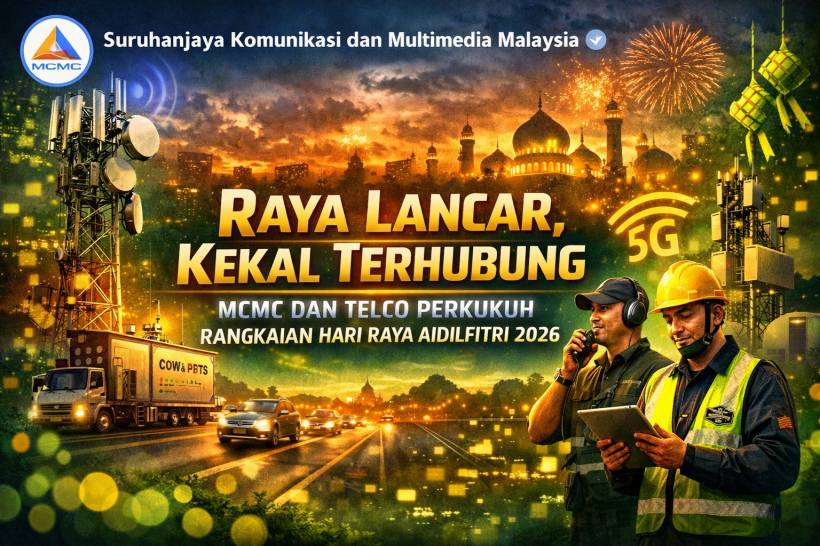
As Hari Raya Aidilfitri approaches, MCMC is pushing telecommunications providers to stay on high alert, with a clear message: keep networks stable, watch performance closely, and act fast if service quality drops. The concern is understandable. Every festive season brings a familiar surge in calls, messaging, mobile data use, video chats, and emergency communication as millions of Malaysians travel, balik kampung, and try to stay connected at the same time.
This is not just a routine reminder from the regulator either. MCMC says telcos have already rolled out 866 temporary network-strengthening measures across the country since early March 2026. That shows the industry is not waiting until the last minute. It is already preparing for the kind of traffic spike that typically hits highways, town centres, tourist areas, and family gathering spots during the festive break.
Why Festive Seasons Put Mobile Networks Under Pressure
Hari Raya is one of those periods when mobile networks get tested in very real ways. People are on the road for long hours, they are making more voice calls than usual, sharing location updates, sending festive greetings, uploading photos and videos, joining video calls, using navigation apps, and depending on mobile internet in places that may not normally see that level of demand. When all of that happens at once, even a decent network can start to feel the strain. This is why festive preparedness has become a serious operational issue, not just a customer service matter.
For many users, connectivity during Raya is not just about convenience anymore. It is tied to travel coordination, cashless payments, ride-hailing, family communication, and access to assistance if something goes wrong on the road. In that context, MCMC's move makes sense. A dropped call or slow internet connection may sound minor on paper, but during a nationwide holiday rush, those small failures can quickly become frustrating or even disruptive.
Hundreds of Upgrades Have Already Been Carried Out
According to MCMC, the 866 initiatives are spread across several categories. The largest portion, 774 measures, involves network optimisation work designed to improve coverage quality and boost capacity. Another 27 measures focus specifically on activating and modernising 5G infrastructure, helping networks cope with rising demand from users consuming more high-speed data.
On top of that, 21 temporary solutions have also been deployed. These include Portable Base Transceiver Stations, Cellular on Wheels, and Mobile Communications Vehicles. These are the kinds of mobile or flexible setups used when demand in a particular area temporarily exceeds what the existing infrastructure can comfortably handle. In simple terms, they are the telecom equivalent of bringing in extra lanes when traffic gets too heavy.
The Focus Is on Raya Congestion Hotspots
MCMC says the enhancements are being concentrated in high-traffic areas where network congestion is more likely. That includes major highways, rest and recreation stops, lay-bys, tourist destinations, and densely populated public areas. Anyone who has travelled during a festive season in Malaysia will know exactly why those locations matter. They are where thousands of people tend to gather, stop over, scroll endlessly on their phones, and put sudden pressure on nearby towers.
This targeted approach is probably the most practical one. Rather than trying to improve everything everywhere at once, the strategy is to reinforce the places most likely to buckle under temporary demand. MCMC also said it may carry out on-site monitoring at critical locations when necessary, which suggests the commission wants real-time visibility in case network conditions start to deteriorate.
A Reminder That Good Connectivity Needs Constant Maintenance
One thing this story quietly highlights is that strong mobile service during major holidays does not happen automatically. It takes planning, engineering work, temporary infrastructure, traffic forecasting, and close coordination between regulators and operators. People often only notice the network when it becomes slow or unreliable, but behind the scenes, there is a lot of preparation involved in keeping things smooth when usage suddenly spikes nationwide.
It also reflects how much modern celebrations now depend on digital connectivity. A festive season used to mainly mean physical travel and face-to-face visits. That is still true, of course, but now it also means livestreams, video calls, online maps, e-wallet transactions, social media sharing, and constant messaging. In other words, a stable mobile network has become part of the festive infrastructure itself.
What the Public Should Do If There Are Problems
MCMC is also asking users to report network-related issues directly to their service providers if they encounter them. Complaints can also be submitted through the commission's official online channels for further action. That matters because congestion issues are sometimes very location-specific, and timely reports can help operators identify where service degradation is happening faster.
For users, the takeaway is simple: do not just assume poor service during Raya is unavoidable. Telcos have been told to monitor performance continuously and respond immediately to disruptions or quality drops. So if coverage becomes unusually weak in a specific area, there is now a clearer expectation that providers should investigate and act.
Final Thoughts
MCMC's directive to telcos ahead of Hari Raya Aidilfitri shows just how important reliable connectivity has become during major festive periods in Malaysia. With 866 enhancement measures already carried out since early March, the industry is clearly treating the holiday travel surge as a serious network event rather than a routine seasonal bump.
The real test, of course, will come when millions of people hit the roads and start using their phones heavily at the same time. But at least on paper, the groundwork is already being laid through optimisation works, 5G upgrades, temporary mobile units, and targeted monitoring in congestion-prone areas. For Malaysians heading home this Raya, that is the kind of preparation they will be hoping they never have to notice.











Comments 0