

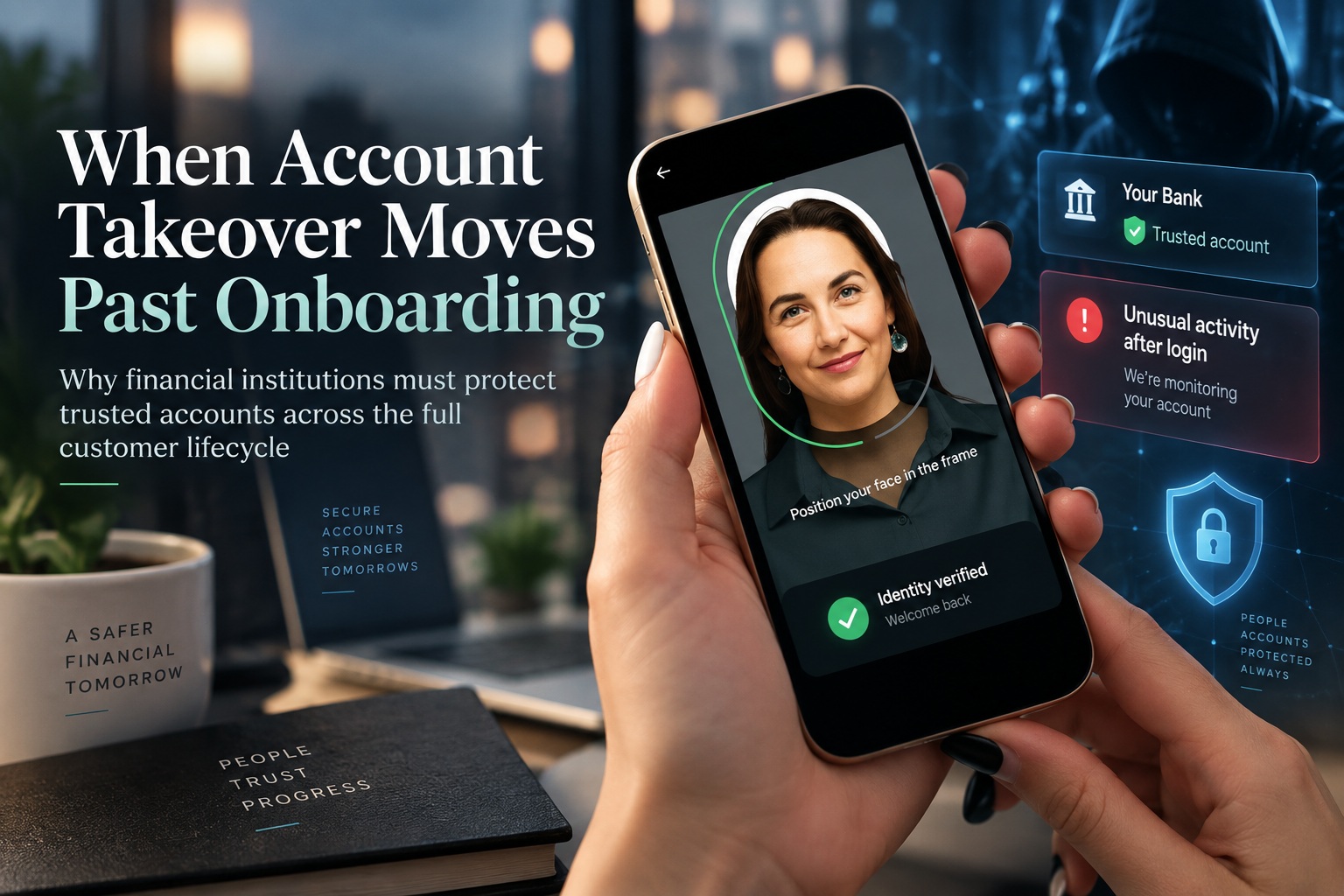
Banks, fintech companies, and digital financial platforms have spent years strengthening the way new customers are onboarded. Identity verification, document checks, biometric matching, fraud screening, and device analysis have all become standard parts of opening a digital account. Those controls have made it harder for fraudsters to create accounts using stolen or fabricated identities, but they have also pushed attackers toward another opportunity: taking over accounts that have already been verified and trusted.
That shift is creating a much harder problem for financial institutions. Once an account has passed onboarding and built a legitimate transaction history, many systems begin treating it as relatively trustworthy. Attackers increasingly understand that gaining control of an existing account can be more valuable than trying to create a fraudulent one from scratch, because the account may already have access to money, credit facilities, payment features, sensitive personal information, and established relationships with the institution. The challenge is therefore no longer limited to confirming who someone is at account opening, but continuously verifying that the person using the account today is still the legitimate customer.
Trusted Accounts Are Becoming More Attractive Targets
Modern account takeover attacks rarely depend on a single stolen password. Criminals are combining phishing, credential theft, social engineering, malware, SIM-related attacks, compromised email accounts, and increasingly sophisticated AI-assisted impersonation to gain access to legitimate customer identities. Once inside, they can begin making changes that strengthen their control while trying to blend in with normal activity.
A compromised account can be used to initiate unauthorised transfers, register a new device, change contact information, reset credentials, alter recovery options, or attempt higher-value financial transactions. In some cases, the attacker may avoid making an obvious fraudulent payment immediately and instead spend time modifying the account so that future activity appears more legitimate. This can make detection significantly harder because the account itself is genuine, the customer has already passed onboarding checks, and the attacker may be operating within systems that were designed to trust established users.
These attacks also tend to happen at moments that historically received less scrutiny than account creation. A bank may perform strong identity verification when a customer opens an account, but apply much lighter checks when that same customer adds a new device several months later or requests account recovery. Fraudsters are increasingly targeting those weaker points because they already sit inside the customer lifecycle rather than outside it.
Strong Onboarding Is No Longer Enough
The industry has rightly invested heavily in preventing fraudulent account creation, but onboarding should no longer be treated as the final moment when identity is strongly verified. A customer who was genuine at registration can still be compromised later, and an account that behaved normally for years can suddenly be controlled by someone else. Trust therefore needs to be treated as something that can change over time rather than something permanently established on day one.
This creates a difficult balance between security and usability. Customers expect digital banking to be quick and convenient, and they generally do not want to complete lengthy verification every time they sign in or transfer money. At the same time, fraud teams need enough assurance to detect when an apparently legitimate action is actually being performed by an attacker.
The answer is not necessarily adding more friction to every interaction. Instead, financial institutions are increasingly looking at ways to make verification adaptive, becoming stronger only when the situation justifies it. This makes it possible to preserve a smooth experience for normal low-risk activity while introducing additional checks when something unusual or high-impact happens.
Passwords and One-Time Codes Are Showing Their Limits
Traditional authentication methods remain useful, but they are increasingly vulnerable to modern social engineering. Passwords can be stolen through phishing, credential stuffing, malware, or data breaches, while one-time codes can be captured through fake login pages or manipulated out of customers by convincing callers pretending to be bank employees. Even when a customer technically completes the authentication process correctly, an attacker may have engineered the entire interaction.
This is why fraud prevention is gradually moving away from the idea that possession of the right password or device automatically proves identity. A successful login simply demonstrates that someone had the necessary credentials or access at that moment. It does not always prove that the person behind the transaction is the legitimate account holder.
Financial institutions therefore need stronger ways to evaluate who is actually performing the action, especially when the request could materially change the account. That could involve a combination of behavioural signals, device intelligence, transaction context, biometric checks, phishing-resistant authentication, and renewed identity verification depending on the level of risk.
Critical Moments Need Stronger Identity Assurance
An identity-centric approach does not apply the same level of verification everywhere. Instead, it identifies the points in the customer journey where an attacker could gain significantly more control and applies stronger assurance at those moments. This allows institutions to concentrate security where it matters most without forcing customers through unnecessary checks during routine activity.
Account recovery is one obvious example. If someone claims they have lost access to their normal authentication method, the institution is being asked to transfer trust to a different channel or device. That deserves more scrutiny than an ordinary login from a familiar phone. The same is true when a customer enrols a new device, replaces a phone number, modifies recovery information, changes an email address, or attempts an unusually large transaction.
Behavioural context can also help determine when additional verification is appropriate. A transaction from an unfamiliar device, a sudden change in location, unusual navigation through the banking application, repeated failed recovery attempts, or rapid changes to account settings may individually appear harmless. Viewed together, however, they could indicate that someone is trying to take control of the account.
The objective is to introduce step-up verification only when the risk increases. Customers completing familiar low-risk actions can continue with minimal friction, while higher-risk behaviour triggers stronger identity checks.
Phishing-Resistant Authentication Is Becoming More Important
As phishing grows more sophisticated, financial institutions are paying greater attention to authentication methods that are harder to steal or relay. Passkeys, hardware-backed credentials, device-bound authentication, and other phishing-resistant mechanisms can reduce dependence on passwords and one-time codes that users can be tricked into handing over.
These technologies are not a complete solution by themselves. Attackers may still attempt to manipulate account recovery, convince support staff to reset access, compromise a trusted device, or persuade customers to approve actions they do not fully understand. Strong authentication therefore needs to be combined with robust recovery controls and ongoing fraud monitoring.
The broader goal should be to create multiple layers of assurance. A bank should not have to rely entirely on a single password, device, biometric check, or risk score. Instead, different signals can reinforce one another, giving the institution greater confidence that the person performing a sensitive action is genuinely the customer.
Account Recovery Is Becoming a Major Battleground
Recovery processes deserve particular attention because they often exist specifically to bypass normal authentication when a customer loses access. That makes them incredibly useful for legitimate users and equally attractive to attackers. If a criminal cannot defeat the primary authentication method, convincing the institution to reset it may be the next best option.
Social engineering attacks against customer-service teams can be particularly effective when fraudsters possess detailed personal information obtained from previous breaches. Names, addresses, identification numbers, phone details, transaction history, and even security-question answers can sometimes be collected before the attacker ever contacts the bank. AI-generated voice or conversational tools may further improve the attacker's ability to impersonate customers convincingly.
Recovery therefore needs to be treated as a high-risk identity event rather than a customer-service shortcut. Institutions may need additional identity verification, stronger approval controls, waiting periods for particularly sensitive changes, or restrictions on what newly recovered accounts can immediately do.
Device Enrolment Can Quietly Turn a Compromise Into Persistence
Another critical moment occurs when a new device is added to an existing account. An attacker who initially gains temporary access may try to register their own smartphone, browser, authenticator, or security method before the victim notices. Once that happens, the criminal may no longer need the original phishing session because they have effectively created their own trusted route back into the account.
This is similar to what security teams increasingly observe in corporate identity attacks, where criminals immediately register new MFA methods after stealing access. In financial services, the same principle applies: device enrolment and authentication changes should be treated as high-value security events.
Customers should ideally receive clear notifications when new devices or authentication methods are registered, and institutions should consider additional verification when those changes occur under unusual circumstances. A familiar customer adding a replacement phone from their usual location may pose little risk, while an account suddenly registering multiple new devices from unfamiliar networks deserves much closer examination.
The Customer Experience Still Matters
Increasing security is relatively easy if every interaction is made difficult, but that approach quickly creates unhappy customers. Digital banking has succeeded partly because it removed much of the friction associated with traditional financial services, allowing people to transfer money, pay bills, manage cards, and update details almost instantly.
The real challenge is protecting customers without making legitimate users repeatedly prove themselves. This is where risk-based identity assurance becomes valuable. Instead of treating every login or transaction as equally suspicious, institutions can use context to determine when stronger checks are genuinely justified.
Done well, the customer may barely notice most of the security system. Verification becomes more visible only when the requested action carries higher risk or the surrounding behaviour looks abnormal. This allows banks to improve protection while preserving the convenience customers now expect from digital services.
Fraud Detection Needs to Follow the Entire Customer Lifecycle
Account takeover demonstrates why fraud prevention cannot end after onboarding. The customer lifecycle may continue for years, during which devices change, addresses change, phone numbers change, transaction patterns evolve, and attackers continually develop new techniques. A security model that strongly verifies identity once and then assumes permanent trust will inevitably develop blind spots.
Institutions therefore need to think about identity as a continuously evaluated relationship. Historical behaviour, trusted devices, previous authentication patterns, transaction context, and account changes can all contribute to an evolving picture of risk. The goal is not constant surveillance of ordinary customers, but recognising when activity suddenly stops looking like the person who normally controls the account.
This also means fraud, identity, cybersecurity, and customer-service teams need to work more closely together. An unusual login detected by the security team may become far more meaningful when combined with a recent phone-number change recorded by customer service and an attempted high-value transfer flagged by the fraud system.
AI Is Raising the Stakes for Both Attackers and Defenders
Artificial intelligence is likely to make this problem more difficult. Criminals can already use AI to create more convincing phishing messages, automate reconnaissance, imitate conversational styles, translate scams into multiple languages, and potentially enhance voice impersonation. These capabilities can make social engineering more believable while allowing fraud campaigns to scale more quickly.
Financial institutions can also use AI defensively, particularly for detecting unusual behavioural patterns across enormous numbers of transactions and customer interactions. Models can help identify combinations of signals that would be difficult for a human analyst to notice individually, such as an unusual device, a slightly abnormal login pattern, a profile change, and a suspicious payment occurring within a short period.
The key difference is that AI should support decision-making rather than automatically treating every anomaly as fraud. Customers legitimately travel, change phones, switch networks, and alter their spending habits. Effective systems need enough context to distinguish genuine change from malicious takeover without overwhelming users with unnecessary challenges.
Rethinking What It Means to Trust an Account
The most important shift is conceptual. Financial institutions have traditionally asked whether the account itself is legitimate. Increasingly, the better question is whether the person controlling the account right now is legitimate.
A customer may have passed every identity check during onboarding, used the account responsibly for years, and still become the victim of phishing tomorrow. The original verification remains valid, but it no longer guarantees that the current session belongs to the same person. Security therefore needs to move from a one-time trust decision toward continuous assurance at moments where control of the account could change.
This does not mean customers should repeatedly undergo full identity verification. It means the institution should know when the level of assurance established earlier is no longer enough for the action being requested.
Final Thoughts
Account takeover is forcing banks, fintech companies, and digital financial providers to look beyond the onboarding process. Strong identity verification at account opening remains essential, but criminals increasingly understand that an established account can be much more valuable than a newly created fraudulent one. Once they gain access, they inherit much of the trust the institution has already built around the legitimate customer.
The response should not be endless authentication prompts or additional friction everywhere. A more effective strategy is to apply stronger identity assurance selectively, particularly around account recovery, new-device enrolment, profile changes, authentication updates, unusual behaviour, and high-value transactions. Combining those controls with phishing-resistant authentication and behavioural risk analysis can make account takeover significantly harder without undermining the convenience of digital banking.
Financial institutions also need to recognise that trust is not permanent. It must be continually reassessed as the account evolves and as new actions are taken. The fact that an identity was verified several years ago does not prove that today's login, device change, or payment instruction is being made by the same person.
For fraud teams and digital banking leaders, that may be the most important lesson. The question is no longer simply "Was this customer verified when the account was opened?" It is increasingly "Do we have enough confidence that the person using this account at this moment is still the legitimate customer?" Institutions that can answer that question intelligently, without turning every interaction into an obstacle, will be much better positioned to deal with the next generation of account takeover fraud.











Comments 0