

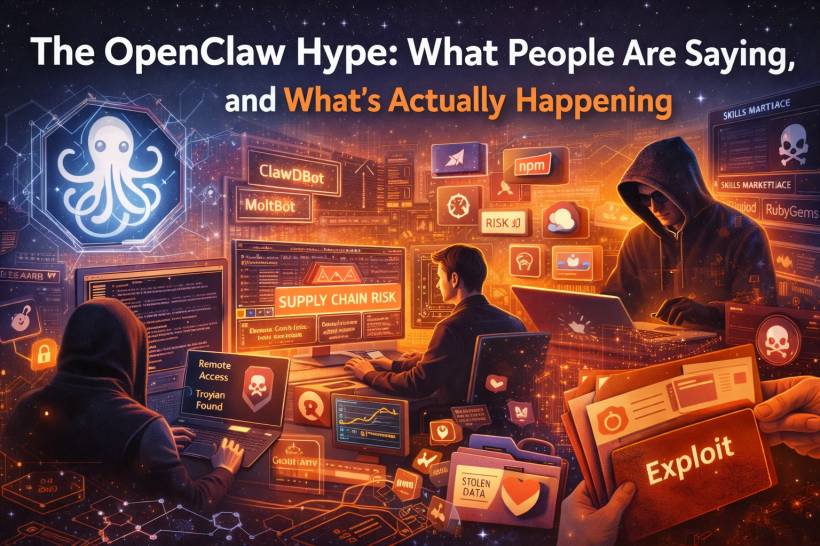
OpenClaw began the way a lot of open-source tools begin: a developer scratching a personal itch. The original idea was pretty relatable. Let an AI helper do the boring stuff like sorting email, managing schedules, and keeping notes organized, while you get on with your day.
But somewhere along the way, OpenClaw stopped being "a handy automation project" and turned into a loud conversation — not just in developer circles, but across security communities and the darker corners of the internet where people watch new tooling for abuse potential.
And that's where the hype split into two themes: excitement about AI automation, and worry about what happens when automation gets plug-in extensible and widely deployed.
From Side Project to "Security Keyword"
What's interesting isn't just that OpenClaw got popular. It's where it got popular.
It moved from niche developer chatter into security research feeds, Telegram channels, forums, and underground-adjacent discussions. Along the way, names like ClawDBot and MoltBot started appearing in the same conversations, sometimes described as "variants," sometimes as companion tools, and sometimes as something more botnet-like.
That sounds scary on the surface. But when the broader telemetry is looked at together, a more grounded picture shows up: yes, there's a genuine supply-chain risk here — but it doesn't yet look like a fully industrialized criminal ecosystem.
What OpenClaw Actually Is
At its core, OpenClaw is an AI automation framework that runs tasks through modular "skills" — installable plugins that can execute actions on your behalf.
A typical setup includes:
• A skills marketplace (often referred to as ClawHub) where plugins are shared
• Integrations to external services (productivity tools, cloud services, SSH, and so on)
• Gateway/orchestration components coordinating everything
The important part is that OpenClaw behaves less like a single app and more like a lightweight automation environment. And that's powerful — but it also expands the attack surface.
Why Plugin Marketplaces Make Security People Nervous
The moment you allow user-installable modules to execute logic, you inherit the same risks that have haunted other ecosystems for years:
• Package registries like npm and PyPI
• IDE plugin stores
• CI/CD automation marketplaces
That doesn't automatically mean "this will be abused," but it does mean the trust model becomes the whole game. The marketplace is no longer a nice-to-have feature. It becomes the front door attackers will try first.
The Big Red Flags Researchers Pointed Out
Security researchers flagged OpenClaw because multiple weakness patterns stack together in an ugly way:
• Malicious skills being uploaded and disguised as legitimate automation tools
• Lack of meaningful sandboxing, meaning skills can run with broad permissions
• Prompt-injection style attacks, where content manipulates the agent into doing attacker-chosen actions
• Token/OAuth abuse, where stolen tokens make malicious actions look "authorized"
On top of that, real-world deployments can make things worse:
• Public-facing instances with weak authentication
• Skills pulling remote code dynamically
• Shadow deployments that security teams don't even know exist
This is why the supply-chain angle dominates the discussion. If the skill is trusted, the attacker effectively borrows the automation environment's permissions.
The Weird Part: Lots of Talk, Not Much Confirmed "Business"
If this had already become a mature, criminalized ecosystem, you'd expect underground spaces to look a certain way:
• Monetization threads with pricing and support
• Panel screenshots, admin leaks, and operational chatter
• Services built around exploitation at scale
Instead, the conversation trends more toward:
• Speculation about what could happen
• Proof-of-concept experimentation
• Confusion and name-mixing (OpenClaw vs ClawDBot vs MoltBot)
So the vibe right now is less "this is running massive botnets already" and more "people are watching it closely because the ingredients for abuse are there."
The Risk That Looks Most Real Today
If you strip away the noise, the most credible danger pattern is straightforward:
• It runs inside a trusted automation agent
• It executes payloads that steal credentials, sessions, or data
• That data can be packaged and sold like typical stealer logs
This is dangerous even without botnet-scale operations, because automation tools reduce the distance between initial access and high-privilege execution.
Why The Hype Feels So Loud
Timing is doing a lot of work here. OpenClaw sits right at the intersection of three hot areas:
• Plugin marketplace trust models
• AI-assisted workflow execution
Security researchers tend to swarm early when a tool hits that overlap — usually before threat actors fully monetize it. That can create a perception gap where the discussion sounds like an outbreak, even when exploitation is still forming.
Final Thoughts
The best way to describe the OpenClaw situation is "high potential risk, early-stage exploitation."
The skills ecosystem is the real weak point, and it's exactly the kind of surface that historically gets weaponized after the hype settles. The fact that criminals aren't loudly commercializing it yet is not a comfort blanket — it's often just the phase before the market figures out how to turn it into money.
The broader lesson is bigger than OpenClaw: automation platforms with plugin ecosystems are becoming high-value targets earlier than most organizations realize, and long before they've put proper controls around them.











Comments 0