

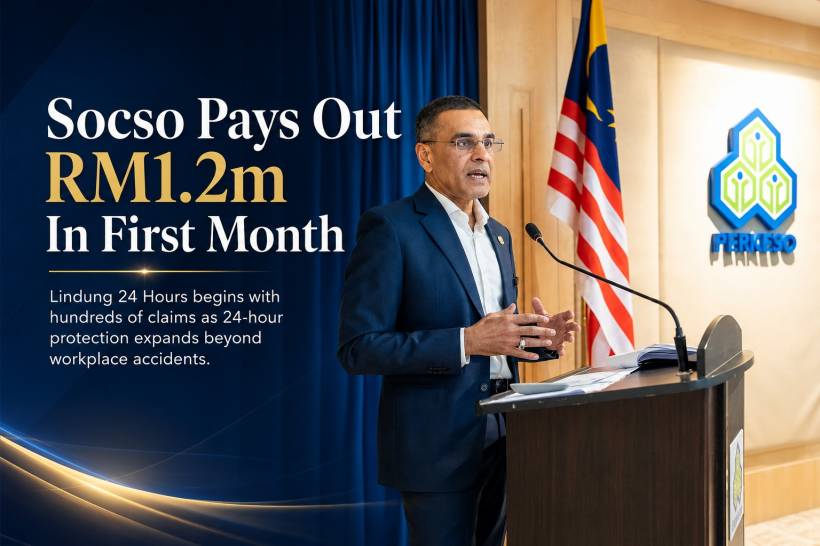
Malaysia's Social Security Organisation (Socso) says more than RM1.2 million in benefits was paid out under the newly introduced Lindung 24 Hours programme during its first month of implementation. The scheme, which began on 1 June, is designed to extend social protection beyond workplace and commuting accidents by covering eligible employees around the clock, including accidents that happen at home or during personal activities outside working hours.
For many workers, this marks a significant shift in the country's employment-related protection framework. Previously, coverage was largely tied to incidents connected directly to work, including accidents while travelling to and from the workplace. Lindung 24 Hours aims to close that gap by recognising that serious injuries and disability can occur regardless of where or when an accident happens.
592 Claims Recorded in June
Between 1 and 30 June, Socso received a total of 592 claims under the Non-Employment Injury Scheme, also known as Lindung 24 Hours.
That works out to almost 20 cases each day during its first month, showing that the new protection is already being used by contributors who may not previously have been eligible for assistance under existing workplace-related schemes.
According to Socso, the largest amount paid during the month was for implant-related costs, which totalled RM1.16 million. A further RM99,269 was paid out through the Temporary Disablement Benefit, known as FHUS.
The figures highlight how costly serious injuries can become, especially when treatment requires surgery, implants or extended recovery periods. Even a single accident can create financial pressure through hospital expenses, time away from work and the need for longer-term rehabilitation.
Support During Medical Leave and Recovery
One of the main benefits under Lindung 24 Hours is the Temporary Disablement Benefit. This provides income replacement for eligible contributors who are medically certified as unable to work while recovering from an injury.
This is particularly important for workers who may lose income during a period of hospitalisation or medical leave. Rather than receiving support only when an accident is linked to employment duties, eligible contributors can now receive assistance for qualifying accidents that happen outside normal working arrangements.
Beyond temporary income support, the scheme also includes a wider range of protections, including:
• Medical treatment and surgical expenses
• Implant-related costs
• Permanent Disablement Benefit, based on assessments by Socso's Medical Board
• Dependants' Benefit for eligible family members
• Constant Attendance Allowance for contributors who require ongoing personal care
• Rehabilitation services at Socso rehabilitation centres
Socso noted that the RM1.2 million figure does not include the value of rehabilitation services provided to contributors. These services can be especially important for people recovering from major injuries, as treatment may involve physical rehabilitation, occupational therapy or support to help them return to everyday life and work.
A Broader Approach to Social Protection
The main purpose of Lindung 24 Hours is to make social protection more comprehensive.
Accidents do not only happen at construction sites, offices, factories or during the daily commute. They can happen at home, while carrying out errands, during recreational activities or in other personal situations outside working hours.
By expanding coverage beyond employment-related incidents, Socso is positioning the scheme as a more modern form of worker protection. The focus is no longer only on whether an accident occurred during work duties, but on whether the contributor needs meaningful support after suffering an injury.
This could be especially valuable for employees who are their household's main income earner, where a sudden inability to work may affect not only the injured person but also their family.
Public Concerns Over Mandatory Contributions
Despite the early payout figures, Lindung 24 Hours has also attracted criticism from some Malaysians.
The scheme requires contributions that are fully borne by employees during Phase One, with a contribution rate of 0.75% for the first two years. Some members of the public have argued that participation should be optional, particularly for workers who feel they already have private insurance or do not expect to use the benefit.
There has also been public discussion around Socso's wider operating costs, including claims circulating online about expenditure on staff salaries and bonuses. Socso's latest statement appears intended, in part, to show that benefits under Lindung 24 Hours are already reaching contributors and supporting real medical needs.
The debate reflects a wider question around social insurance: whether mandatory contributions should be viewed mainly as an additional deduction from wages, or as a shared protection mechanism that becomes important when unexpected hardship occurs.
Final Thoughts
The first month of Lindung 24 Hours shows that there is already a real demand for broader accident protection outside the workplace.
With 592 claims submitted and more than RM1.2 million paid out in June, the scheme is beginning to demonstrate how accidents outside work can still create major financial and medical consequences for employees and their families.
Whether public concerns around contribution rates and compulsory participation continue will depend on how transparently Socso manages the programme, how easily contributors can access benefits, and whether Malaysians see clear value when support is needed most.











Comments 0