

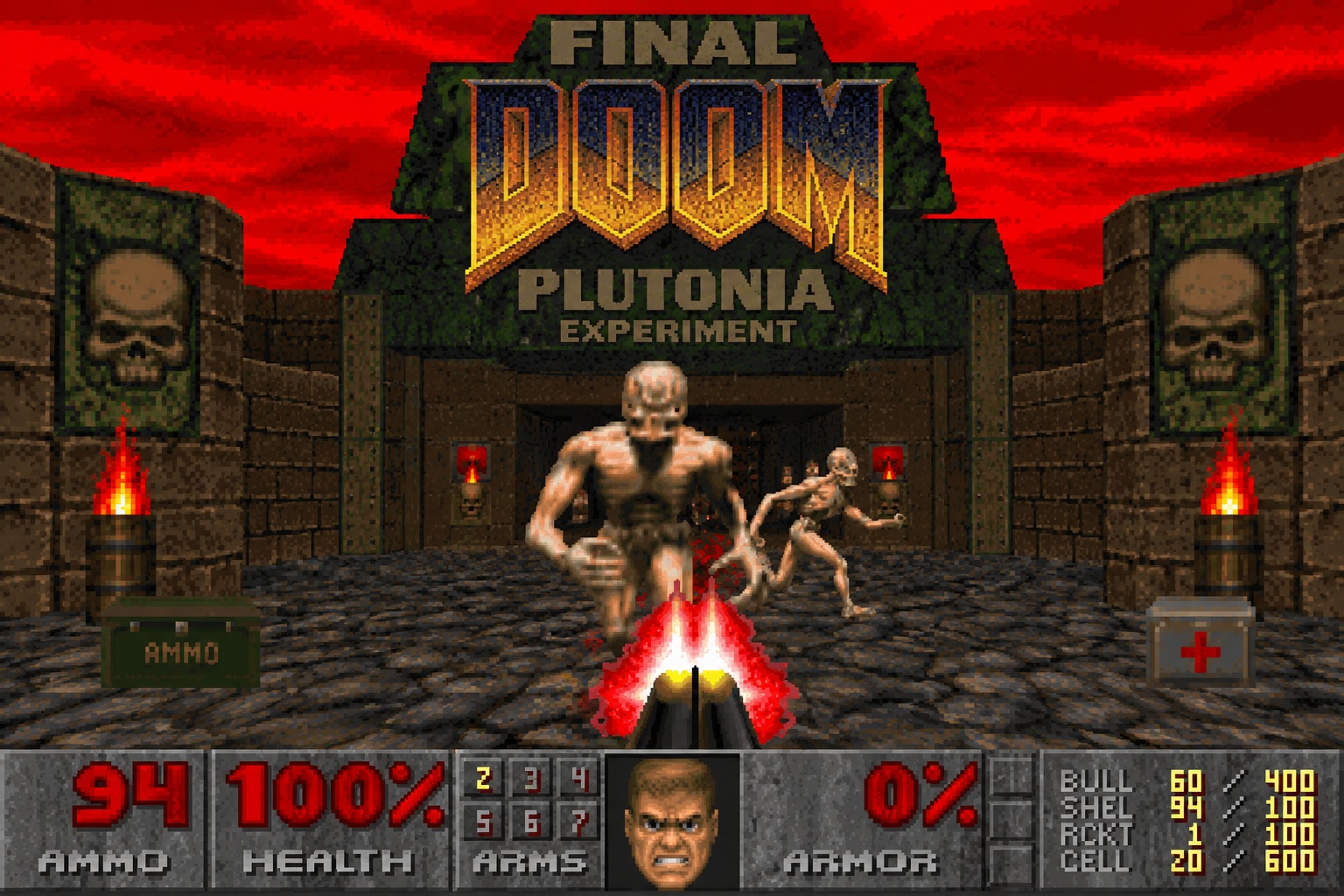
Final DOOM: The Plutonia Experiment is one of the most demanding official campaigns ever released for the classic DOOM engine, designed specifically for players who already understand the mechanics of DOOM II and want something far less forgiving. Released as one half of Final DOOM, the campaign delivers 32 maps filled with aggressive enemy placement, sudden ambushes, dangerous crossfires, compact battle arenas, hidden traps, and carefully controlled resources. Instead of introducing new weapons or monsters, Plutonia takes the familiar DOOM II arsenal and enemy roster and uses them in much more punishing combinations. The result is a campaign where knowledge, movement, positioning, and target priority matter from the very beginning.
The Plutonia Experiment was created by brothers Dario and Milo Casali, whose maps became famous for pushing classic DOOM combat far beyond the relatively forgiving structure of the original campaigns. Revenants, Arch-viles, Chaingunners, Mancubi, Arachnotrons, and other high-pressure enemies appear frequently and are often positioned where they can attack from multiple directions at once. The campaign expects players to understand how to use the Super Shotgun effectively, when to save rockets or plasma, how to trigger monster infighting, and when retreating is smarter than charging forward. Plutonia rarely allows careless play to go unpunished.
Now playable online through Lemon Web Games, Final DOOM: The Plutonia Experiment can be experienced directly in your web browser as part of a growing collection of classic, retro, action, horror, first-person shooter, and browser-playable games. Its web-based format makes it easy to jump straight into one of the toughest official DOOM campaigns without losing the fast movement, secret hunting, resource management, keycard exploration, monster infighting, and relentless combat that define the experience. For players who already know DOOM II and want a campaign that tests those skills much more aggressively, Plutonia remains one of the most memorable challenges in classic FPS history.
A Campaign Designed for Experienced DOOM Players
Plutonia does not spend much time easing players into the basics. From the opening maps onward, enemy placement is noticeably more aggressive, and dangerous monsters appear much earlier than many players would expect from the original DOOM II campaign. Revenants, Chaingunners, and Arch-viles are treated almost like normal combat tools rather than special late-game threats. This immediately tells the player that familiar strategies will need to be sharper and more efficient.
The difficulty comes from positioning as much as enemy strength. A single Arch-vile placed behind other monsters can completely change the priorities of an encounter, while a Chaingunner positioned across an open courtyard may force immediate movement. Plutonia frequently combines several threats at once, making target selection essential. The player must constantly decide what is most dangerous right now rather than simply shooting the closest enemy.
The Casali Brothers Built Around Pressure
Dario and Milo Casali became closely associated with a style of DOOM mapping that emphasizes compact arenas, traps, crossfires, and strong use of the existing monster roster. Plutonia reflects that philosophy throughout the campaign, often turning relatively small spaces into dangerous combat puzzles. A room does not need dozens of enemies to become difficult if those enemies are positioned intelligently. Two or three well-placed monsters can create enormous pressure.
This design makes Plutonia feel challenging without relying entirely on giant hordes. The campaign frequently asks the player to read the room, identify the most important threat, and move immediately. Understanding geometry becomes just as important as understanding weapons. Good positioning can make an encounter manageable, while poor positioning can turn the same fight into a disaster.
Revenants Become a Constant Threat
Revenants are one of the enemies most strongly associated with The Plutonia Experiment. Their homing projectiles force constant movement, while their powerful melee attacks make close-range encounters equally dangerous. Plutonia often places them on elevated ledges, narrow platforms, or behind other monsters where they can continue applying pressure from a distance. Their presence means the player rarely has the luxury of standing still.
The challenge becomes even greater when multiple Revenants are active at once. Several homing missiles can fill an area with moving threats, forcing players to use corners, walls, or sudden direction changes to break tracking. The Super Shotgun is highly effective against them at close range, but reaching that distance safely is not always easy. Learning how to control Revenants becomes an essential Plutonia skill.
Arch-viles Can Completely Reshape a Fight
Arch-viles are among the most dangerous monsters in classic DOOM, and Plutonia uses them extensively. Their ability to attack through line of sight and resurrect defeated monsters means they can turn a previously cleared area into a serious problem within seconds. When the distinctive Arch-vile sound is heard, experienced players immediately begin looking for cover and trying to identify its location. Leaving one alive for too long can dramatically increase the difficulty of the entire encounter.
The campaign frequently places Arch-viles where they are protected by other enemies or difficult to reach immediately. This forces the player to make uncomfortable decisions about whether to rush forward, spend valuable ammunition, or retreat and find a safer angle. Their resurrection ability is especially dangerous in areas filled with previously defeated Revenants or Chaingunners. Few enemies create more panic in Plutonia.
Chaingunners Punish Open Spaces
Chaingunners are another major part of Plutonia's identity because they deal rapid hitscan damage with very little warning. Unlike projectile enemies, their attacks cannot simply be dodged once fired, making line of sight extremely important. Plutonia often places them on distant ledges, behind windows, or across open courtyards where they can immediately punish players who step into the wrong position. This forces quick reactions and careful use of cover.
Because Chaingunners have relatively low health, they are easy to kill once targeted. The real problem is surviving long enough to eliminate them before their sustained fire removes a large amount of health. Players quickly learn to prioritize them even when stronger demons are nearby. In many Plutonia encounters, the most dangerous enemy is not the biggest one.
The Super Shotgun Remains Essential
The Super Shotgun is arguably the most important weapon in The Plutonia Experiment. Its enormous close-range damage makes it perfect for Revenants, Hell Knights, Chaingunners, and many other threats that appear constantly throughout the campaign. The slow reload creates a natural rhythm where the player fires, moves, waits, and then attacks again. Good movement during that reload is often what separates a successful fight from a failed one.
The regular shotgun still remains useful because it consumes less ammunition and fires more quickly. Efficient players switch between both depending on the situation rather than using the Super Shotgun for everything. Plutonia's resource placement encourages this kind of flexibility. Shell management becomes especially important during long maps with repeated close-range encounters.
Rockets Become a Key Crowd-Control Tool
The rocket launcher is extremely valuable in Plutonia because many encounters involve groups of medium and high-health enemies. Rockets can quickly reduce several targets at once, making them useful for Revenants, Mancubi, Arachnotrons, and other clustered threats. However, the campaign frequently places fights inside tight areas where splash damage can become dangerous. This means the player needs enough distance before committing to explosive attacks.
Rockets are also useful for triggering monster infighting. A well-placed explosion can cause multiple enemies to damage one another, allowing the player to preserve ammunition and reduce pressure. In Plutonia, this can be more than a clever trick; it can be an essential survival strategy. The campaign rewards players who understand how enemies interact.
The Plasma Gun Is Perfect for Emergency Pressure
The plasma gun becomes especially valuable when an encounter needs to be solved quickly. Its rapid stream of energy can stun and damage dangerous enemies before they have time to establish control of the room. Arch-viles, Revenants, and groups of medium-strength monsters can all be overwhelmed with sustained plasma fire. The problem is that energy cells are too valuable to waste casually.
Plutonia frequently creates situations where the player has to decide whether an immediate plasma solution is worth the ammunition cost. Spending too much early in the level can make a later encounter much harder. Saving everything, however, can be equally dangerous if the player loses health unnecessarily. Efficient resource use becomes part of the campaign's strategic depth.
The BFG 9000 Is More Than a Luxury
The BFG 9000 remains the ultimate solution when Plutonia throws several powerful enemies into the same area. Used correctly, it can eliminate multiple threats in seconds and completely change the balance of an encounter. The weapon is particularly effective in compact arenas where enemies are concentrated together. Proper positioning allows its damage to reach far beyond the initial projectile.
Because BFG ammunition is limited, every shot matters. Experienced players learn where the most dangerous fights occur and save cells accordingly. A perfectly timed BFG attack can make an overwhelming room manageable, while a wasted shot may leave the player struggling later. Plutonia rewards players who treat the weapon strategically rather than simply using it whenever it becomes available.
Monster Infighting Is a Major Survival Tool
Monster infighting becomes extremely useful because Plutonia frequently places different enemy types close together. A Mancubus projectile can strike a Revenant, a Revenant missile can hit another demon, and large groups can quickly begin fighting among themselves. The player can deliberately encourage this by moving between enemies and allowing their attacks to cross. This can save huge amounts of ammunition.
Infighting also reduces pressure because distracted monsters temporarily stop focusing on the player. During difficult encounters, that breathing room can be just as valuable as the damage itself. Skilled players learn to recognize when starting an enemy conflict is safer than attacking directly. The campaign often rewards patience and manipulation.
Compact Maps Create Intense Combat
Many Plutonia maps are relatively compact compared with enormous community megawads, but they use space very efficiently. Rooms connect back into earlier areas, windows reveal future locations, and switches can dramatically change the battlefield. A small map can still contain several distinct combat situations because different parts of the environment become active at different times. This creates strong pacing without unnecessary travel.
Compact design also makes traps more effective. When enemies suddenly appear, there may be limited space to escape, forcing the player to react intelligently rather than simply running away. Familiar areas can become dangerous again after a switch is pressed or a key is collected. The environment constantly participates in the combat.
Ambushes Define the Plutonia Experience
Plutonia is famous for making players suspicious of almost everything. Picking up a key, entering a new room, pressing a switch, or collecting a valuable weapon can trigger hidden doors and reveal enemies from multiple directions. These traps are rarely random; they are designed to exploit the player's likely position at that moment. Learning to anticipate them becomes part of mastering the campaign.
Experienced players often look around before collecting an important item. They identify potential escape routes, nearby cover, and suspicious walls before triggering the event. This changes the way levels are approached because exploration becomes more cautious without becoming slow. Every significant pickup can feel like a warning.
Keycards and Skull Keys Structure Progress
Colored keys remain central to navigation, opening areas that may have been visible much earlier in the level. Plutonia uses them to guide players through interconnected layouts while still encouraging exploration. A locked door often becomes a landmark that players remember until the matching key is found. This keeps the campaign readable even when maps become complicated.
Collecting a key is rarely the end of the problem. The pickup itself may trigger an ambush, and returning to the locked door can reveal a completely different combat situation. The game continually connects progression with danger. Even something as simple as collecting a blue key can become a major encounter.
Secrets Can Dramatically Improve Survival
Secrets are especially valuable in a difficult campaign like Plutonia because they often contain resources that make later fights more manageable. Hidden ammunition, armor, health, weapons, or power-ups can provide a major advantage. Some secrets are revealed through suspicious textures or unusual geometry, while others require more careful experimentation. Searching thoroughly can be the difference between entering a difficult room prepared and entering it nearly empty.
This encourages repeated play because players rarely discover everything during the first attempt. Returning to a familiar map with knowledge of important secrets can make the entire level feel different. What once seemed almost impossible may become much easier when the player knows where additional resources are hidden. Map knowledge is one of Plutonia's greatest rewards.
The Campaign Demands Better Resource Management
Plutonia is generous enough to remain fair, but it rarely encourages careless waste. Shells, rockets, plasma cells, health, and armor all need to be used intelligently. Spending powerful ammunition on weak monsters may leave the player struggling against an Arch-vile or group of Revenants later. Every pickup becomes part of a broader strategy.
Health management is equally important. Taking avoidable hits from Chaingunners or projectiles can slowly weaken the player before a major encounter begins. Experienced players therefore become more disciplined about movement and positioning. Surviving Plutonia is often about preventing small mistakes from accumulating.
Mancubi Control Space With Heavy Fire
Mancubi are dangerous because their projectile patterns can cover large sections of an arena. Plutonia frequently positions them where they can pressure the player while other enemies attack from different angles. Their high health also means they cannot always be removed immediately. Players need to understand the firing pattern and move through the gaps.
At the same time, Mancubi are excellent infighting tools because their wide attacks often strike nearby monsters. A well-positioned player can encourage one Mancubus to damage several other enemies before finishing it off. This turns a dangerous monster into a temporary ally. Plutonia regularly rewards that kind of tactical improvisation.
Arachnotrons Keep the Pressure Constant
Arachnotrons use sustained plasma fire to punish players who remain exposed. Their attacks are easier to predict than hitscan weapons, but the continuous stream can dominate open spaces and make movement difficult. Plutonia often places them on elevated platforms or across wide rooms where they can maintain pressure for long periods. Eliminating them quickly can open the battlefield dramatically.
Their combination with other enemies creates especially dangerous situations. A Revenant missile may force the player in one direction while Arachnotron plasma blocks another. These overlapping threats are what make Plutonia's combat feel so carefully constructed. The challenge comes from interactions between monsters rather than isolated enemies.
Pain Elementals Create Problems That Grow Over Time
Pain Elementals become increasingly dangerous the longer they remain alive because they continuously create Lost Souls. Plutonia sometimes places them in areas where reaching them is difficult, allowing the battlefield to fill with additional threats. This makes them another high-priority target. Ignoring one can transform a manageable room into a crowded mess.
Lost Souls can also block movement at exactly the wrong moment. A player trying to dodge a Revenant missile or escape an Arch-vile attack may suddenly collide with one and become trapped. This makes Pain Elementals much more dangerous than their direct damage suggests. Their real threat is how they change the battlefield over time.
Cyberdemons Become Tactical Obstacles
Cyberdemons are not always used simply as traditional bosses. In difficult DOOM mapping, they can function as environmental hazards, area-control enemies, or powerful tools for monster infighting. Their rockets are devastating, but those same rockets can also destroy other demons if the player positions carefully. Fighting one directly is not always the smartest solution.
Plutonia uses high-tier enemies to encourage this kind of tactical thinking. Sometimes the correct approach is to avoid a Cyberdemon temporarily and allow it to weaken everything around it. Other times the environment provides enough space for a direct fight. Understanding when to engage and when to manipulate becomes part of advanced play.
The Campaign Uses Verticality Effectively
Enemies frequently attack from ledges, windows, raised platforms, and distant structures, forcing the player to watch more than ground level. This creates layered combat where threats can exist above, below, and across the room simultaneously. Chaingunners and Revenants become particularly dangerous when positioned somewhere difficult to reach. The environment itself amplifies their effectiveness.
Vertical design also gives maps a stronger sense of place. Players may see an area early and only discover how to reach it much later. Elevators, stairs, lifts, and lowering platforms gradually connect these spaces. The layouts feel interconnected rather than simply linear.
Navigation Can Be Challenging but Rewarding
Plutonia maps often contain looping routes, hidden passages, and sections that reopen after switches are activated. The automap therefore becomes extremely useful for understanding how everything connects. Players who ignore it may find themselves wandering through previously cleared areas without realizing a new route has appeared. Checking the map periodically can save significant time.
At the same time, the campaign rarely depends entirely on the automap. Visual landmarks, texture changes, architecture, and enemy placement often help indicate where progress should continue. Learning a map gradually turns confusion into familiarity. Replaying a level with full knowledge of its layout can feel dramatically smoother.
The Automap Helps With Secret Hunting
The automap is also useful for identifying suspicious unexplored spaces. A gap behind a wall or an unusual shape in the level structure may suggest that a hidden room exists nearby. Players who enjoy searching for secrets can use this information to investigate more carefully. Plutonia rewards curiosity with valuable resources and alternate paths.
This creates another layer of mastery beyond simply surviving combat. Completing the level is one achievement, but understanding its entire structure is another. Players who return repeatedly often discover new details. That long-term learning helps explain why the campaign remains popular.
Difficulty Settings Transform the Experience
On moderate difficulty, Plutonia is already significantly more demanding than many classic DOOM campaigns. Increasing the difficulty adds even more pressure through stronger enemy placement and reduced margin for error. Familiar rooms can become completely different when additional Revenants, Chaingunners, or Arch-viles appear. The campaign therefore offers substantial replay value across multiple skill levels.
Higher difficulty also increases the importance of secrets, infighting, and efficient ammunition use. Strategies that work casually may become unreliable when every mistake costs more health. Players need to understand not only what enemies are present, but why they were placed there. Mastery becomes a combination of mechanical skill and map knowledge.
Plutonia Influenced Decades of DOOM Mapping
The Plutonia Experiment became extremely influential within the DOOM mapping community. Its combination of compact layouts, aggressive monster placement, difficult traps, and carefully designed combat encounters inspired countless community-created maps and megawads. Even decades later, creators continue building campaigns that deliberately evoke the Plutonia style. The name itself has almost become shorthand for a particular kind of challenging DOOM design.
That influence extends beyond visual homage. Many modern maps borrow the idea that difficulty should come from enemy placement and environmental pressure rather than simply enormous monster counts. A few monsters used intelligently can be more dangerous than a large unstructured horde. Plutonia demonstrated that principle extremely well.
Its Visual Identity Is Immediately Recognizable
Plutonia also developed a distinctive visual character through its use of familiar DOOM textures arranged in recognizable combinations. Stone, brick, metal, greenery, water, and hellish architecture often appear together, creating environments that feel more ancient and hostile than the industrial spaces of much of DOOM II. The maps remain unmistakably classic DOOM while still having their own personality. This helps the campaign feel cohesive even across many different locations.
The visual style also supports gameplay by making important spaces memorable. A distinctive courtyard or temple-like area becomes easier to recognize when returning later with a key. Strong landmarks reduce confusion in complex layouts. Atmosphere and navigation therefore work together.
Fast Movement Is Still Your Best Defense
Despite all the difficulty, the fundamental lesson remains the same as classic DOOM: keep moving. Projectiles can be dodged, enemies can be repositioned, and crowded fights become much easier when the player maintains control of the available space. Plutonia punishes players who remain stationary because several threats can quickly converge on one position. Speed is not merely convenient; it is a survival tool.
Good movement also makes weapon reload rhythms easier to manage. The player can fire the Super Shotgun, move during the reload, avoid incoming attacks, and then return fire from another angle. This constant movement creates the fast, aggressive rhythm that defines classic DOOM combat. Plutonia simply demands that players perform it more consistently.
The Campaign Rewards Knowledge More Than Grinding
There are no character levels, skill trees, equipment upgrades, or statistics to improve. The player becomes stronger entirely through understanding. Learning enemy behavior, remembering secrets, recognizing traps, and choosing better routes all produce noticeable improvement. A map that feels impossible initially can become manageable after several attempts.
This is one of the reasons Plutonia remains satisfying. Progress belongs to the player rather than the character. When a difficult encounter becomes easy, it is because the player learned how to handle it. That kind of mastery gives the campaign lasting replay value.
Why The Plutonia Experiment Still Feels Fun
The Plutonia Experiment remains enjoyable because it takes the elegant simplicity of DOOM II and pushes it toward a much higher skill ceiling. The same movement, weapons, enemies, and key systems remain intact, but stronger encounter design forces players to use them more intelligently. Every weapon matters, every enemy role becomes clearer, and map knowledge becomes increasingly valuable. The campaign never needs complicated new mechanics because the original systems already provide enormous depth.
It is also remarkably replayable because familiarity changes the experience so dramatically. Players who initially move cautiously through every room eventually learn where traps occur, how to manipulate monsters, which secrets matter, and where aggressive play is safe. A map that once took a long time can eventually be completed quickly and confidently. That transformation is one of the strongest rewards in classic FPS gaming.
Playing Final DOOM: The Plutonia Experiment Online Today
Through Lemon Web Games, Final DOOM: The Plutonia Experiment can now be played directly in your web browser with no downloads or setup required. Features of the web-based version include:
• Browser-based play for quick access
• No installation required
• 32 challenging maps built around classic DOOM II gameplay
• Aggressive use of Revenants, Arch-viles, Chaingunners, Mancubi, Arachnotrons, Pain Elementals, and other familiar demons
• The complete classic arsenal including the Super Shotgun, rocket launcher, plasma gun, chainsaw, and BFG 9000
• Traps, ambushes, secrets, monster infighting, key hunting, and tightly designed combat encounters
• Accessible play through Lemon Web Games
Playing The Plutonia Experiment online today offers an easy way to experience one of the toughest official classic DOOM campaigns directly in the browser. The web-based format keeps the focus exactly where it belongs: fast movement, intelligent weapon use, aggressive enemy placement, careful resource management, and constant exploration. It works equally well for players attempting the campaign for the first time and veterans returning to improve their routes or tackle a harder difficulty.
Who Should Play Final DOOM: The Plutonia Experiment
• Experienced players who enjoy classic DOOM and DOOM II
• Fans of difficult first-person shooters built around skill and map knowledge
• Players who enjoy Arch-viles, Revenants, Chaingunners, and aggressive monster combinations
• Fans of secret hunting, monster infighting, traps, keycards, and compact level design
• Players who enjoy mastering the Super Shotgun, rocket launcher, plasma gun, and BFG 9000
• Anyone looking for a browser-playable classic FPS campaign with a much higher challenge level
The Plutonia Experiment is especially suitable for players who already understand the fundamental mechanics of DOOM II and want a campaign that expects them to use those mechanics more effectively. Newcomers can still play it, but the difficulty is intentionally much less forgiving than the original campaigns. For players who enjoy learning through repeated attempts and eventually mastering difficult encounters, Plutonia offers some of the strongest official DOOM content available.
Play Final DOOM: The Plutonia Experiment Online Now
Final DOOM: The Plutonia Experiment is now available to play online through Lemon Web Games, giving players an easy way to experience this legendary high-difficulty campaign directly in the browser. Its web-based format makes it possible to jump straight into the action while preserving the tight level design, brutal ambushes, dangerous enemy combinations, limited resources, and relentless pace that made Plutonia famous. Every map presents another opportunity to prove how well you understand classic DOOM.
For players exploring the Lemon Web Games library, The Plutonia Experiment represents a much more demanding side of classic FPS design. It takes familiar tools and enemies and rearranges them into encounters where positioning and knowledge matter constantly. Whether you are dodging Revenant missiles, racing to eliminate an Arch-vile, escaping Chaingunner crossfire, or manipulating a Cyberdemon into fighting everything around it, the campaign continually rewards smart and confident play.
Final Thoughts
Final DOOM: The Plutonia Experiment remains legendary because it demonstrates how much difficulty and variety can be created using systems that players already understand. It does not need new monsters or weapons to feel different from DOOM II because its map design completely changes how those familiar elements are used. Revenants become constant pressure, Arch-viles become tactical emergencies, Chaingunners punish open movement, and high-tier enemies are often positioned to control entire sections of the battlefield. The campaign transforms familiarity into challenge.
Its greatest strength is the precision of that challenge. Plutonia rarely feels difficult simply because enemies have more health or because the screen is filled randomly with monsters. The real danger comes from placement, timing, crossfires, traps, and environmental control. When players fail, they can usually learn something useful about the encounter and return with a better strategy.
Through Lemon Web Games, Final DOOM: The Plutonia Experiment can be experienced directly in the browser as one of the defining challenge campaigns of classic DOOM. It remains essential for players who enjoy retro FPS games, difficult map design, fast movement, brutal ambushes, monster infighting, and the satisfaction of mastering encounters that initially seem overwhelming. If DOOM II taught you how to survive Hell, The Plutonia Experiment is where those skills are truly put to the test.











Comments 0