

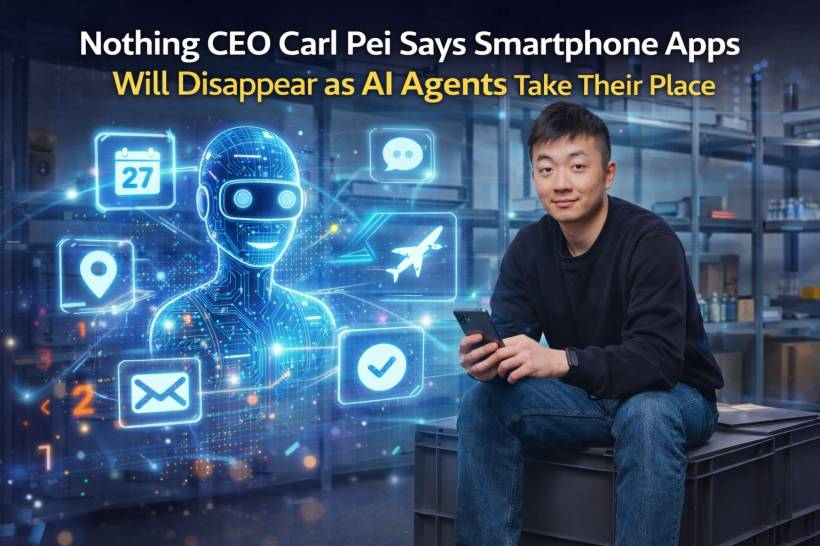
Carl Pei is once again pushing a big idea about where smartphones are headed, and this time it is a direct challenge to the app-based model people have used for years. Speaking at SXSW in Austin, the Nothing CEO said he believes apps will eventually fade away, replaced by AI agents that understand what users want and handle tasks for them in a much more direct way. In his view, the current smartphone experience still looks too much like the old PDA era: lock screen, home screen, app icons, app store, and a long chain of taps just to get simple things done.
That is the core of his argument. Phones have become dramatically more powerful, but the way people interact with them has not changed nearly as much. Pei argues that even basic real-world intentions, like meeting someone for coffee, still require users to jump between multiple apps for messaging, maps, transport, and scheduling. His idea is that future devices should skip that fragmented process entirely. Instead of forcing users to manually open tools one by one, the operating system itself should understand the intention and carry out the task through AI.
Why Pei Thinks Apps Are on Borrowed Time
Pei's comments were not framed as a minor software tweak. He was talking about a much larger shift in how digital products are built and used. He said founders and startups whose main value is tied closely to a single app should pay attention, because AI-native systems could disrupt that model whether they like it or not. In other words, if the operating system becomes smart enough to act on behalf of the user, the traditional app could start to feel less important as the main destination.
This does not mean apps are disappearing tomorrow, and Pei was careful not to present it as an overnight change. Even Nothing's own software still supports app-based behavior today. But his broader point is that the long-term direction of computing may shift away from humans navigating app interfaces manually and toward AI systems handling those steps in the background.
The First Step Is Useful, But Not Very Exciting
Pei described the current wave of AI assistants as only an early stage. Many companies are already working on features that can complete commands such as booking flights or hotels, but he reportedly dismissed that phase as "super boring." The reason is simple: those tools still wait for explicit instructions. They may automate a task, but they are not yet acting like systems that deeply understand the user over time.
What interests him more is the next stage, where the device starts learning long-term intentions. For example, if someone wants to live more healthily, the system could proactively surface useful suggestions, reminders, or actions without waiting for the user to manually think of every next step. Pei compared this kind of behavior to the growing idea of memory-driven AI, where the system builds context about the person and becomes more helpful over time.
A Phone That Acts More Like an Intelligent System
The more radical part of Pei's vision is not just that AI helps inside apps, but that the phone itself becomes the main intelligent layer. He has been talking about an AI-first device for a while, and that direction also played into Nothing's $200 million Series C funding round last year, where the company pitched a future built around AI and personalization that users could trust without constantly second-guessing the output.
In that model, the smartphone stops behaving like a collection of separate destinations and starts behaving more like a personal operating system that knows the user well enough to take action. Pei's argument is that the future should not be an AI agent awkwardly pretending to be a human by tapping through app menus. Instead, the system should expose an interface designed specifically for the agent, so the AI can operate in a more seamless and future-proof way.
Why This Idea Feels Plausible, Even If It Is Not Close Yet
There is a reason this argument resonates, even if it still sounds a bit futuristic. A lot of today's AI momentum is already moving in this direction. The industry is increasingly focused on agents that can schedule, search, summarize, buy, recommend, and coordinate tasks on behalf of users. TechCrunch recently described AI agents as tools expected to start making more autonomous purchasing and scheduling decisions for humans, which fits neatly with the sort of future Pei is describing.
At the same time, the jump from today's assistants to a truly agent-first smartphone is enormous. For Pei's vision to work, users would need to trust the system deeply, platforms would need cleaner ways for AI to interact with services, and software ecosystems would likely need to evolve beyond the current app-store model. So while the concept is compelling, it still depends on technical maturity, trust, and a much more interoperable software layer than what most phones have right now. This last point is an inference based on Pei's described model and the current app-based structure of smartphones.
The Real Message Behind the Prediction
What Carl Pei is really saying is not just that app icons may one day disappear. He is arguing that the smartphone itself is overdue for a more fundamental redesign. In his eyes, the hardware has improved, AI is advancing quickly, but the core user experience still feels stuck in an older era. His proposed answer is a phone that understands intent, remembers context, and acts with less friction than the app-heavy model people are used to.
Final Thoughts
Pei's prediction that apps will eventually give way to AI agents is bold, but it is not coming out of nowhere. It reflects a broader shift across the tech industry toward software that is more proactive, personalized, and agent-driven. Whether that future arrives in a few years or takes much longer, the bigger idea is already clear: the next smartphone battle may not be about who has the best camera bump or the fastest chip, but about who builds the most useful intelligent operating system.











Comments 0