


Smart glasses are moving quickly from niche gadget territory into something much more mainstream. Recent models from companies such as Meta have made the technology lighter, less obvious and more practical, while smaller manufacturers are entering the market with their own versions. Apple is also widely rumoured to be exploring the category, suggesting that camera-equipped glasses could soon become as common as wireless earbuds or smartwatches.
There are plenty of legitimate reasons someone might want them. Smart glasses can play music and podcasts, provide AI-powered assistance, answer questions about the surrounding environment and capture photos or video without requiring the wearer to pull out a phone. The privacy concern, however, is equally obvious: a camera positioned directly on someone's face can record the people around them far more discreetly than a smartphone.
Why Smart Glasses Are Becoming So Appealing
One of the biggest advantages of smart glasses is that they allow users to interact with technology while keeping their hands free. Someone riding a bicycle, cooking, travelling or spending time with family can capture a moment without stopping what they are doing and reaching for a phone.
Audio can also be delivered through speakers built into the frame, while microphones allow the wearer to talk to an AI assistant naturally. Newer models can potentially recognise objects, describe surroundings or provide information about whatever the wearer is looking at.
From the wearer's perspective, this can feel significantly more natural than constantly staring at a smartphone screen. That same convenience, though, creates a very different experience for everyone standing nearby.
The Camera Is The Main Privacy Concern
Smart glasses equipped with cameras make recording extremely easy. A person no longer needs to hold a phone at chest or eye level, making it less obvious that a photograph or video is being captured.
Most mainstream manufacturers include a small indicator light intended to show when recording is active. In theory, this gives people nearby some warning that the camera is being used.
In practice, those lights can be difficult to notice depending on distance, lighting conditions and the design of the glasses. There have also been concerns that indicators could potentially be obscured or modified, meaning they should not be treated as a perfect privacy safeguard.
Public Concern Is Growing
As these products become more common, concerns around recording without consent are growing as well. Someone wearing normal glasses rarely attracts attention, so people may not immediately realise that a camera is pointed towards them.
That uncertainty has already prompted restrictions in some environments. Smart glasses, for example, have reportedly been prohibited in New York courtrooms. Locations dealing with confidential information, legal proceedings or sensitive personal discussions are likely to pay particularly close attention to the technology.
The broader challenge is that smart glasses do not always look dramatically different from ordinary spectacles. Some models deliberately resemble conventional fashion frames, making visual identification increasingly difficult.
Look For Physical Clues First
Before using any detection software, there are a few physical characteristics that can sometimes reveal whether a pair of glasses contains electronics.
Smart glasses may have:
None of these clues is definitive. Modern designs are increasingly good at hiding electronic components, and some ordinary glasses can have thick frames for purely stylistic reasons.
That is where smartphone-based detection tools can become useful.
Bluetooth Can Reveal Nearby Smart Glasses
Many smart glasses depend on Bluetooth to communicate with a smartphone. Like other wireless accessories, they periodically broadcast identifying information that nearby Bluetooth-capable devices can detect.
Some applications use these broadcasts to look for known identifiers associated with smart glasses. If the identifier matches one in the app's database, the software can warn the user that a pair of supported smart glasses may be nearby.
This approach does not actually detect the camera itself. Instead, it detects the wireless device associated with the glasses.
That distinction is important because Bluetooth detection has limitations.
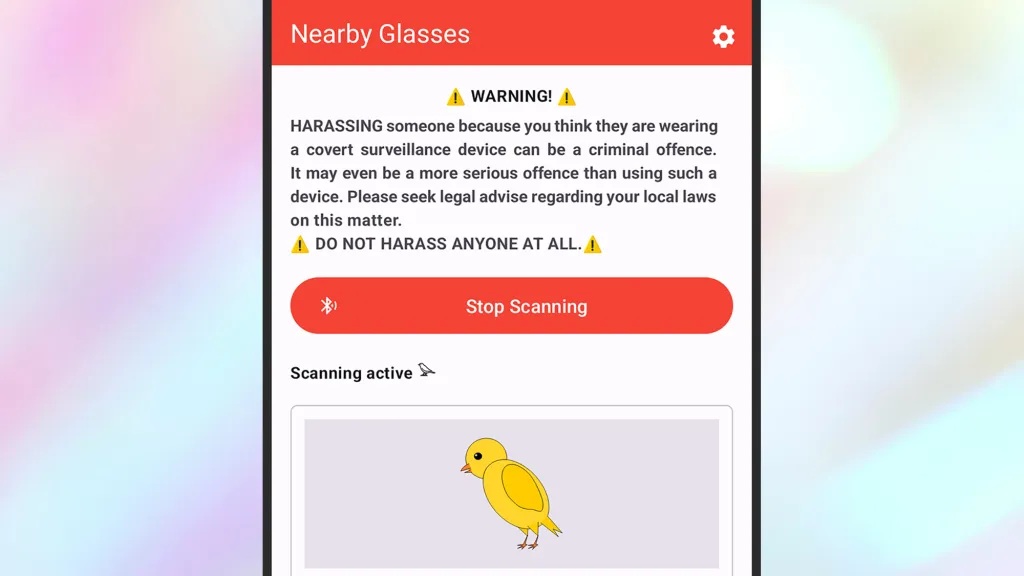
Nearby Glasses Offers Free Smart-Glasses Detection
One option is Nearby Glasses, which is available for both Android and iOS. The application is free and open source, allowing technically inclined users to inspect or modify the underlying code themselves.
Its main function is straightforward. Nearby Glasses scans Bluetooth devices in the surrounding area and compares their broadcast identifiers against known codenames associated with smart glasses.
When a recognised device is detected, the application can alert the user.
The app has also been available for some time and continues to receive updates, making it one of the more established options for this particular purpose.
You Can Adjust Detection Sensitivity
Nearby Glasses lets users adjust the sensitivity of its Bluetooth scanning through the settings menu. This is based on RSSI, or Received Signal Strength Indicator, which provides a rough indication of how strong a Bluetooth signal is.
Generally, a stronger signal suggests the device is closer to your phone. Users can therefore configure the app so that it only warns them when recognised glasses are relatively nearby rather than alerting them to devices further away.
This can help reduce unnecessary notifications in crowded places where many Bluetooth devices may be present.
Android users can also receive alerts while the application runs in the background, allowing detection to continue without keeping the app open continuously.
RSSI Is Not A Precise Distance Measurement
It is important not to treat RSSI readings as an exact measurement of physical distance. Bluetooth signal strength can be affected by walls, people, furniture, device orientation and other wireless interference.
Two devices sitting at the same physical distance can produce very different signal-strength readings depending on the environment.
These apps can therefore tell you that recognised smart glasses may be nearby, but they generally cannot point directly towards the wearer or tell you exactly how many metres away they are.
Think of the result as an indication rather than a radar system.
Nearby Glasses Cannot Guarantee Detection
There is another major limitation: the glasses need to be broadcasting detectable Bluetooth information.
If Bluetooth has been disabled, the device is operating in a mode that does not advertise its identity, or the model is not included in the app's database, Nearby Glasses may not detect it.
The application also cannot tell you precisely which person in a crowded room is wearing the identified device.
If you receive an alert in a café containing 30 people, for example, you may only know that compatible smart glasses are somewhere in the surrounding area.
ZuckOff Provides Another Detection Option
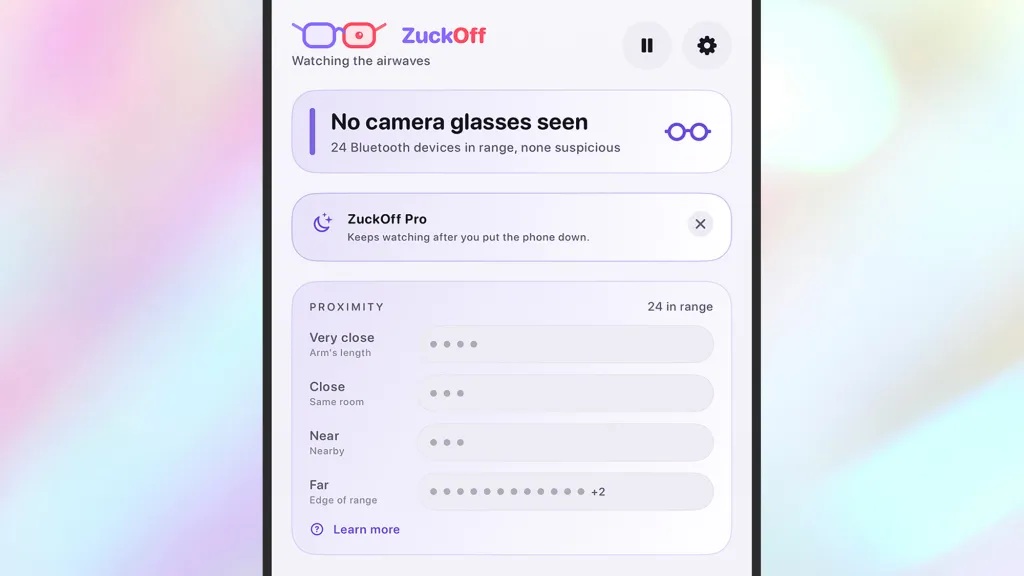
Another app available on Android and iOS is ZuckOff. As its name suggests, the application is particularly associated with detecting Meta-style smart glasses, although its underlying approach is similar to Nearby Glasses.
ZuckOff scans Bluetooth signals around the phone and examines the identifying information transmitted by nearby devices. When it recognises signals associated with supported smart glasses, it displays information about the detection.
The basic scanning functionality is free, but some additional capabilities require payment.
Paid Features Include Background Alerts And History
ZuckOff offers a subscription priced at US$14.99 per year or a US$29.99 lifetime purchase to unlock its full feature set.
Paid functionality includes features such as background scanning and a more complete detection history. Background notifications can alert users when recognised smart glasses enter the configured range without requiring constant manual scanning.
ZuckOff can also provide an estimate of whether the detected glasses appear relatively near or far based on signal strength.
Again, this should not be interpreted as precise location tracking.
You Can Whitelist Your Own Wearables
One particularly useful ZuckOff feature is the ability to register personal devices so they are not repeatedly identified as unwanted detections.
This can be useful for someone who owns several Bluetooth wearables or works around known devices regularly. Adding recognised equipment to the allowlist can reduce unnecessary alerts and make unusual detections easier to notice.
Ironically, someone who owns smart glasses themselves could also register their own pair so the application does not continuously warn about them.
Neither App Is A Perfect Smart-Glasses Detector
Both Nearby Glasses and ZuckOff should be treated as privacy tools rather than guaranteed surveillance detectors.
They depend primarily on Bluetooth information. If the glasses are not broadcasting a recognised signal, the applications may simply have nothing to detect.
They also cannot determine whether the camera is currently recording. Discovering that smart glasses are nearby does not automatically mean the wearer is filming.
Likewise, failing to detect anything does not prove that no smart glasses are present.
Recording Lights Still Matter
If you suspect someone is wearing camera-equipped glasses, one of the easiest things to check remains the recording indicator built into the frame.
Different models position these lights differently, but they are typically near the camera lens. When recording begins, the light is supposed to illuminate so that people facing the wearer can see that the camera is active.
In bright outdoor conditions or at a distance, however, the indicator may be difficult to spot. Users should therefore combine visual awareness with other methods rather than relying entirely on the light.
Context Is Often The Best Clue
Sometimes the surrounding situation tells you more than an app.
If someone repeatedly looks directly towards people or objects while touching the side of their glasses, issuing voice commands or interacting with the frame, they may be using smart features.
That still does not prove they are recording. Smart glasses can perform many functions that have nothing to do with photography, including music playback, navigation or AI assistance.
The goal should therefore be awareness rather than automatically assuming malicious intent whenever someone wears electronic eyewear.
Smart Glasses Create A New Social Challenge
Smartphones established a relatively obvious social signal for recording. When someone raises a phone and points its camera towards you, it is generally easy to understand what might be happening.
Smart glasses remove much of that signal.
The wearer can look directly at someone while recording in essentially the same posture they would use during normal conversation. That creates a new social problem even if manufacturers technically provide indicators.
People may start wondering whether normal eye contact also means a camera is running.
Businesses May Need Their Own Policies
Companies, healthcare facilities, schools and other organisations may increasingly need clear policies governing smart glasses.
A workplace handling confidential documents may decide camera-equipped glasses cannot be worn in certain areas. Hospitals could restrict their use around patients, while organisations discussing commercially sensitive information may ask attendees to remove them during meetings.
These policies are not necessarily anti-technology. They simply recognise that always-available cameras create different privacy risks from ordinary spectacles.
Clear rules can also prevent uncomfortable situations where employees or customers are unsure whether recording is permitted.
Do Not Rely Entirely On Technology
Detection applications are helpful, but common sense remains equally important.
If you are somewhere where privacy matters and you notice glasses that appear to contain a camera, it is reasonable to ask whether they are smart glasses and whether recording is taking place.
In a private venue, you may also be able to ask staff about their recording policy.
Technology can help identify potential devices, but social boundaries and clear expectations remain an important part of protecting privacy.
Smart Glasses Are Probably Here To Stay
Despite the concerns, smart glasses are unlikely to disappear. The technology continues improving rapidly, with lighter hardware, better cameras, longer battery life and increasingly capable AI assistants.
For many users, they could eventually become genuinely useful everyday devices. Navigation, accessibility, translation and hands-free assistance all have strong practical benefits.
The question is how society balances those advantages against the reasonable expectation that people should know when they are being recorded.
Manufacturers will likely face growing pressure to make recording indicators more obvious and tamper-resistant as adoption increases.
Final Thoughts
Smart glasses create a unique privacy challenge because they can look almost identical to ordinary spectacles while carrying cameras, microphones and wireless technology. Visual clues such as camera lenses, recording indicators and unusually thick frames can help, but they are becoming harder to spot as designs improve.
Apps such as Nearby Glasses and ZuckOff provide another useful layer by scanning surrounding Bluetooth broadcasts for identifiers associated with supported smart glasses. They can warn that a compatible device may be nearby, but neither application can guarantee detection, identify the exact wearer or confirm whether recording is taking place.
For now, the best approach is a combination of awareness, Bluetooth detection and common sense. As smart glasses become more common, understanding how to recognise them may become an increasingly useful part of protecting personal privacy in public and private spaces.











Comments 0