

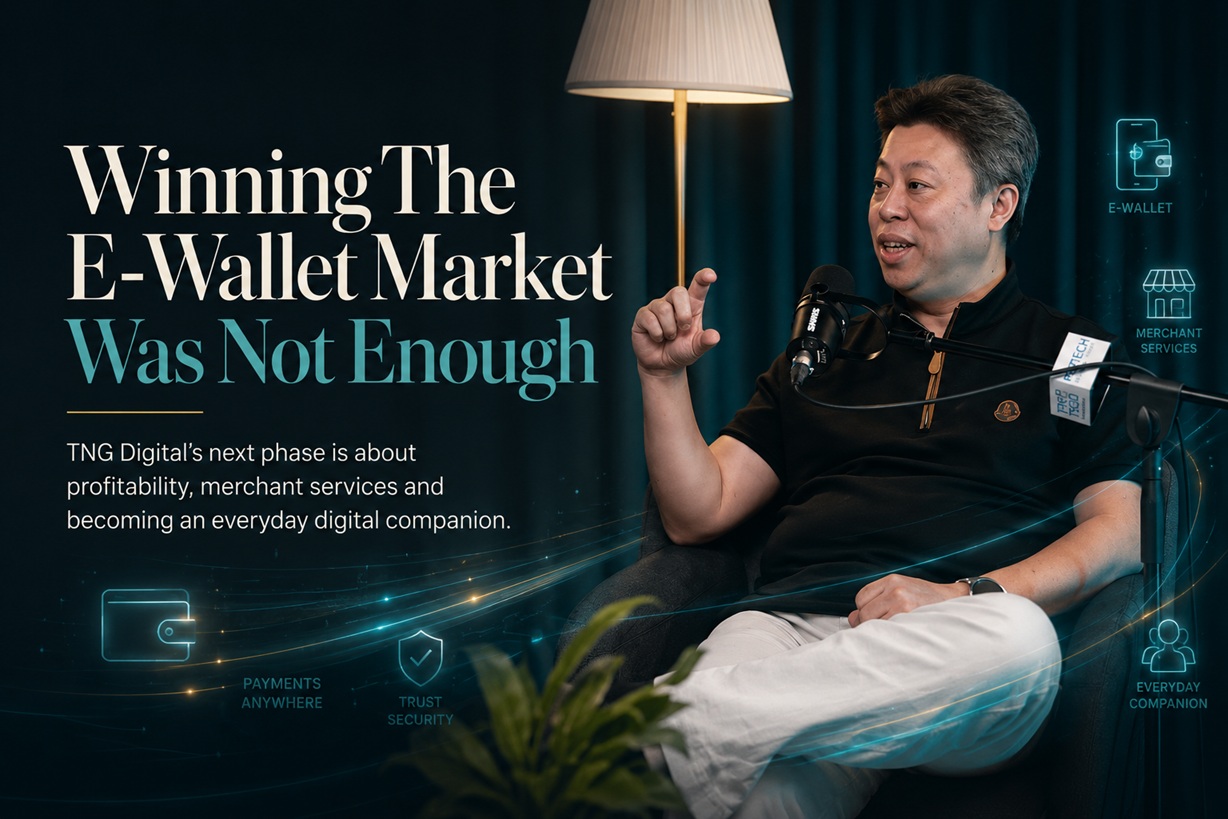
TNG Digital has already achieved something most fintech companies would love to have: enormous scale. TNG eWallet now has around 27 million verified users, including the vast majority of Malaysia's adult population, and roughly 13.5 million people actively transact on the platform each month. Yet having the biggest e-wallet audience in the country did not automatically translate into a profitable business.
That was the uncomfortable reality CEO Alan Ni had to confront several years ago. When shareholders asked how much additional market share TNG Digital needed before becoming profitable, his answer was surprisingly straightforward: more market share could actually mean more losses if the company remained dependent on payments alone.
The Problem With Winning On Payments
Payments remain the foundation of TNG eWallet, but the economics are not always particularly attractive. Certain transactions, especially low-value QR payments, can generate very little revenue once processing and operational costs are taken into account. Scaling those transactions therefore does not necessarily improve profitability at the same rate.
Alan's conclusion was that TNG Digital needed to monetise the relationship it had already built with millions of Malaysians rather than simply chasing even more payment volume. Three years ago, payments accounted for around 75% of the company's income. By 2026, that contribution had fallen to roughly 47%, not because payments disappeared, but because other businesses had grown around them.
Cross-border payments, which contributed almost nothing in 2023, now account for about 11% of income. B2B technology and merchant services have similarly grown from virtually zero to around 15%. That diversification helped TNG Digital reach break-even in September 2024, with the company remaining profitable every month afterwards and 2025 becoming its first full profitable year.
TNG eWallet Is Becoming Much More Than An E-Wallet
Payments may still represent somewhere between 60% and 70% of transactions on the platform, but opening TNG eWallet today reveals how far the app has moved beyond simply scanning QR codes.
There are financial services, travel products, investments, insurance, merchant offerings and even unexpected retail services. One example that came up during the discussion was the ability to buy Continental tyres directly through TNG eWallet, something that even people familiar with the app may not realise exists.
That creates a slightly unusual problem for TNG Digital: it has built so many services that users may struggle to find them.
Alan does not particularly like describing TNG eWallet as a "super app". Instead, he prefers the idea of an "everyday digital companion"—something customers use because it makes ordinary tasks easier rather than because it happens to contain the largest number of features.
From The Yahoo Approach To The Google Approach
The challenge with stuffing more services into a mobile application is that the interface can quickly become overwhelming. Alan compared the situation with early Yahoo homepages, where almost everything was visible through categories, icons and links, but actually finding what you needed could become tedious.
TNG Digital now wants to move closer to the Google model. Instead of expecting users to remember where dozens of icons are located, the company is placing greater emphasis on search.
Looking for tyres? Search for tyres. Planning a holiday? Search for travel. Interested in investments? Search instead of navigating through several screens.
That transition has not been completely painless. Moving familiar icons inevitably confused some existing users, particularly for frequently accessed services such as parking. TNG Digital acknowledges that the redesign could have been communicated better, but the broader direction is clear: the company believes search will become more practical than endlessly expanding the home screen.
After Search, TNG Digital Sees AI
Search itself may only be an intermediate step.
Alan believes the next evolution will involve voice interfaces and artificial intelligence, allowing users to simply tell the app what they want instead of navigating menus or even typing search terms.
This could be particularly useful for older users. Instead of family members teaching parents where several different buttons are located, they could eventually just say what they need and allow the app to guide them through the process.
Where Alan becomes much more cautious is when AI begins handling money autonomously.
TNG Digital's GoTravel features can already help users organise aspects of a trip, but the customer still controls the final payment. Having AI recommend hotels and build an itinerary is one thing; allowing an autonomous agent to move RM10,000 without explicit confirmation is another.
Agentic payments may eventually become technically possible, but consumer trust will determine how quickly they become acceptable.
Alan Ni Isn't Interested In 996 Culture
The conversation also offered some insight into how Alan runs the company.
Asked about the infamous 996 work culture—9am to 9pm, six days a week—he rejected the idea outright. According to Alan, walking through TNG Digital's office at around 7pm on a normal evening would usually reveal that roughly 90% of employees had already left.
His objection is not to working late when something genuinely important needs to be completed. It is to employees remaining in the office simply because they believe leaving before the boss will make them look less committed.
Urgent problems sometimes require long hours, and when that happens, he expects the team to deliver. But turning late nights into a daily performance is different. The preferred culture is essentially productive hustle rather than performative hustle.
The TNG Digital Story Actually Started Much Earlier For Alan
One of the more interesting parts of Alan's story goes back to 2013, long before he became CEO of TNG Digital.
While attending an executive programme at INSEAD through CIMB, Alan prepared a graduation presentation focused on Touch 'n Go. His argument at the time was simple: Touch 'n Go was sitting on a gold mine but was not extracting enough value from it.
He believed the business needed a technology partner and even suggested WeChat or Alipay as possibilities. Years later, the joint venture that eventually became TNG Digital emerged with Ant Group, and Alan found himself helping lead a company surprisingly similar to the concept he had pitched years earlier.
The only thing he badly underestimated was how long the transformation would take.
Merchant Services Could Be The Next Big Opportunity
Looking ahead, Alan appears particularly interested in what TNG Digital can do for merchants.
The company already works with around two million merchants, with approximately 80% described as small and medium-sized businesses. Many of those merchants can accept digital payments, but payments alone do not necessarily help them attract repeat customers or operate their businesses more efficiently.
Large retailers can afford custom mobile apps, loyalty programmes and sophisticated customer-management systems. A neighbourhood café or independent shop usually cannot.
TNG Digital believes it could provide some of that infrastructure through a platform millions of Malaysians already use. Instead of consumers installing separate loyalty apps for every café, restaurant and retailer they visit, TNG eWallet could potentially become the common platform connecting them.
Alan believes digitising merchant operations could eventually become another major growth engine, and he considers the company to still be near the beginning of that opportunity.
Final Thoughts
TNG Digital's story is a useful reminder that winning the user-acquisition race does not automatically mean winning the business.
With 27 million verified users, TNG eWallet already has extraordinary reach in Malaysia. The harder challenge has been figuring out how to turn that reach into a sustainable ecosystem without depending entirely on payment fees.
The company's shift into cross-border services, B2B technology, merchant tools, travel and other financial products appears to be working, with profitability finally arriving after years of growth. Now the strategy is moving toward something bigger: turning TNG eWallet from a payment utility into a platform people use throughout their everyday digital lives.
And if Alan Ni's prediction is right, the next stage may be less about adding another icon to the home screen and more about simply asking the app what you want—and letting it figure out the rest.











Comments 0