

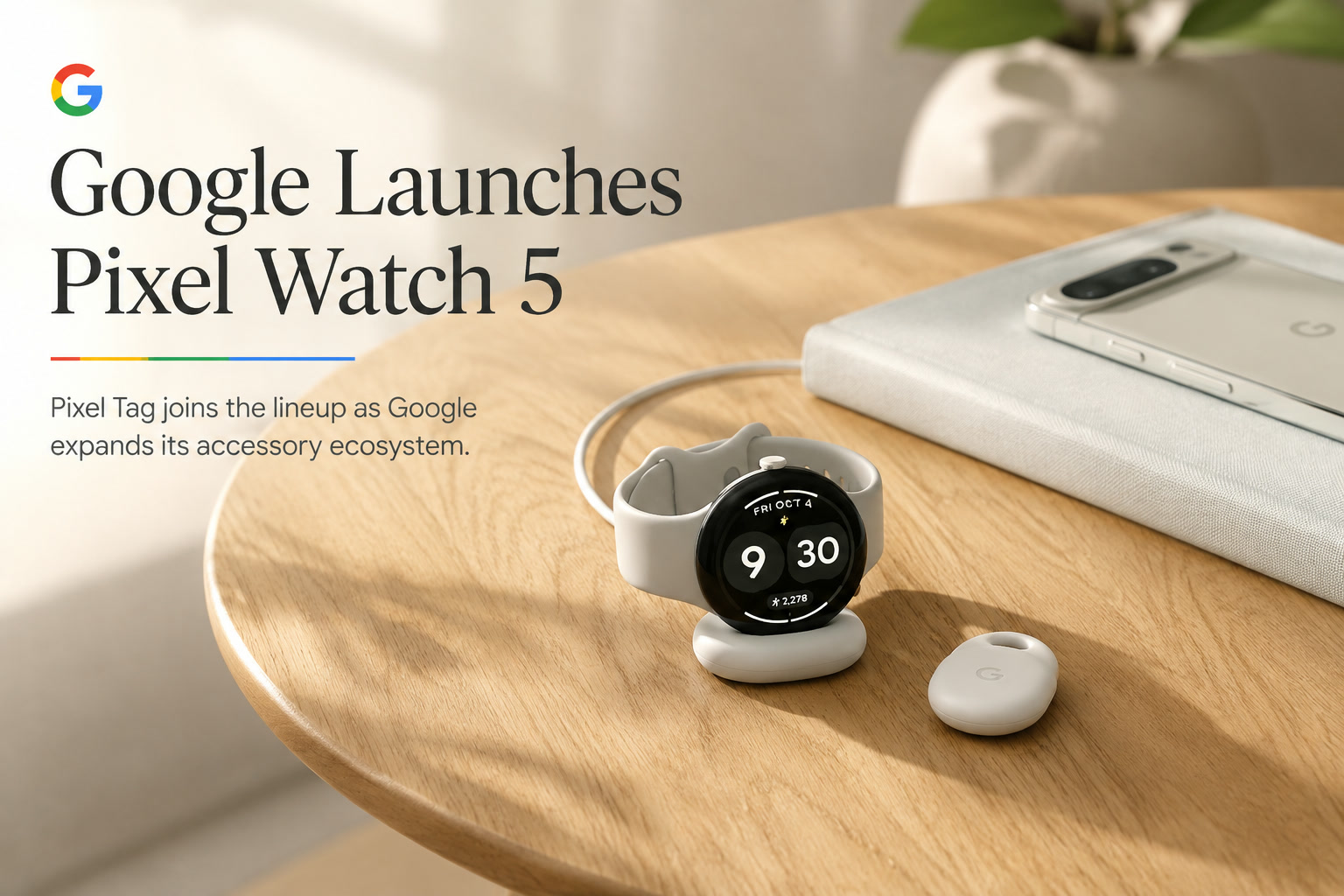
Google's latest Made by Google event may have put the spotlight on its newest Pixel smartphones, but the company also introduced a pair of accessories that could be just as interesting for people already invested in the Pixel ecosystem.
The two biggest additions are the Pixel Watch 5, Google's latest Wear OS smartwatch, and the Pixel Tag, the company's first dedicated item tracker. Google also briefly refreshed the Pixel Buds Pro 2 with a new olive colour option, but the bigger changes clearly revolve around the watch and the new tracker.
Together, these devices show Google continuing to build out the Pixel ecosystem beyond smartphones, with a stronger focus on health, AI, connectivity and device tracking.
Pixel Watch 5 Comes in Two Sizes
Google is once again offering its smartwatch in two different case sizes.
The Pixel Watch 5 comes in 41mm and 45mm variants, giving users a choice between a more compact watch and a larger model with additional battery capacity.
Both versions use a domed Actua 360 AMOLED display with a pixel density of 320 ppi, peak brightness reaching up to 3,000 nits and a refresh rate of up to 60Hz.
That brightness increase should make the display easier to read outdoors, particularly under strong sunlight.
Google has also protected the watch with custom 3D Corning Gorilla Glass 5, while the body carries 5 ATM water resistance and an IP68 rating against dust and water.
In practical terms, it is designed to comfortably handle everyday exposure to rain, workouts and water-related activities without users constantly worrying about damaging it.
Battery Life Depends on Which Size You Choose
One of the biggest differences between the two models is battery capacity.
The smaller 41mm Pixel Watch 5 is equipped with a 332mAh battery, while the larger 45mm version gets a significantly larger 465mAh battery.
Google claims the 41mm model can reach up to 48 hours of usage, while the 45mm version can stretch to around 72 hours when Battery Saver is enabled.
That could make the larger model particularly attractive for users who rely heavily on sleep tracking, GPS workouts and health monitoring and would rather not charge their watch every night.
Charging speeds remain broadly similar to the previous generation.
Using Google's Quick Charge Dock, the Pixel Watch 5 can reportedly go from empty to around 50% in approximately 15 minutes.
For a smartwatch, that kind of quick top-up can be useful. A short charging session while getting ready in the morning may be enough to keep the watch running for the rest of the day.
The Hardware Is the Same Across Both Models
Apart from size and battery capacity, Google has kept the internal hardware largely identical between the two versions.
Both Pixel Watch 5 models are powered by the Snapdragon W5 Gen 2 Accelerated platform, paired with a Cortex-M55 co-processor.
Storage has also been increased to 64GB of eMMC flash, providing more space for applications, downloaded media and offline content.
The use of a dedicated co-processor is particularly important for wearable devices because certain background tasks can be handled without constantly waking the main processor.
That can potentially improve efficiency for things such as health tracking, sensor monitoring and other always-on functions.
Wear OS 7 Powers the Experience
Software-wise, the Pixel Watch 5 runs Wear OS 7.0.
Google has continued expanding its integration between Wear OS, Fitbit health services and Gemini-based AI features, turning the Pixel Watch into much more than a basic notification companion.
Connectivity is extensive.
Depending on the version, the watch supports 4G LTE and UMTS, along with Bluetooth 6.0, dual-band Wi-Fi, NFC and Ultra-Wideband.
One particularly interesting addition is support for Satellite SOS communication.
Satellite connectivity could become increasingly valuable for users travelling or exercising in areas without conventional cellular coverage, especially when emergency assistance is needed.
Google Is Pushing Health Monitoring Further
Health tracking remains one of the most important areas for modern smartwatches, and Google appears to be expanding the Pixel Watch 5 considerably in this department.
Among the more notable additions are Insulin Resistance Trend and Blood Pressure Trend features.
Rather than simply displaying individual measurements, the emphasis appears to be shifting toward helping users understand longer-term patterns in their health data.
The Pixel Watch 5 also includes Google's Health Guardian system for passive monitoring.
Other features mentioned include breathing emergency detection, irregular rhythm notifications, AFib monitoring and loss-of-pulse alerts.
The overall direction is clear: Google wants the watch to continuously observe health signals in the background and surface potentially useful information before users necessarily realise something has changed.
As always, smartwatch health features should be treated as wellness and monitoring tools rather than replacements for professional medical diagnosis.
Fitness Tracking Gets a Broader Upgrade
The Pixel Watch 5 isn't only focused on health conditions.
Google has also upgraded the fitness side of the platform, with support for more than 50 exercise types.
Users can access tailored workouts and improved performance insights covering areas such as exercise, sleep and recovery.
That increasingly puts the Pixel Watch into competition with dedicated fitness watches rather than simply conventional smartwatches.
Instead of only recording how long someone exercised, modern wearables are becoming more interested in answering questions such as whether the user has recovered properly, whether they should train harder and how sleep quality may be influencing overall performance.
For users already invested in Fitbit services, that deeper integration could be one of the strongest reasons to choose a Pixel Watch.
Gemini Is Becoming Part of the Watch Experience
Unsurprisingly, Google is also bringing more AI into the Pixel Watch 5.
The watch includes new Gemini Intelligence features designed to proactively surface useful information.
That could include things such as flight updates, estimated arrival times and other contextual information that Google believes may be relevant at a particular moment.
Users can also raise their wrist and speak directly to Gemini.
The idea is to make the watch feel less like a small smartphone screen and more like an always-available assistant.
Instead of navigating through multiple applications, users could simply ask for information naturally.
Whether that becomes genuinely useful will depend heavily on how accurate and context-aware Gemini proves to be in everyday use.
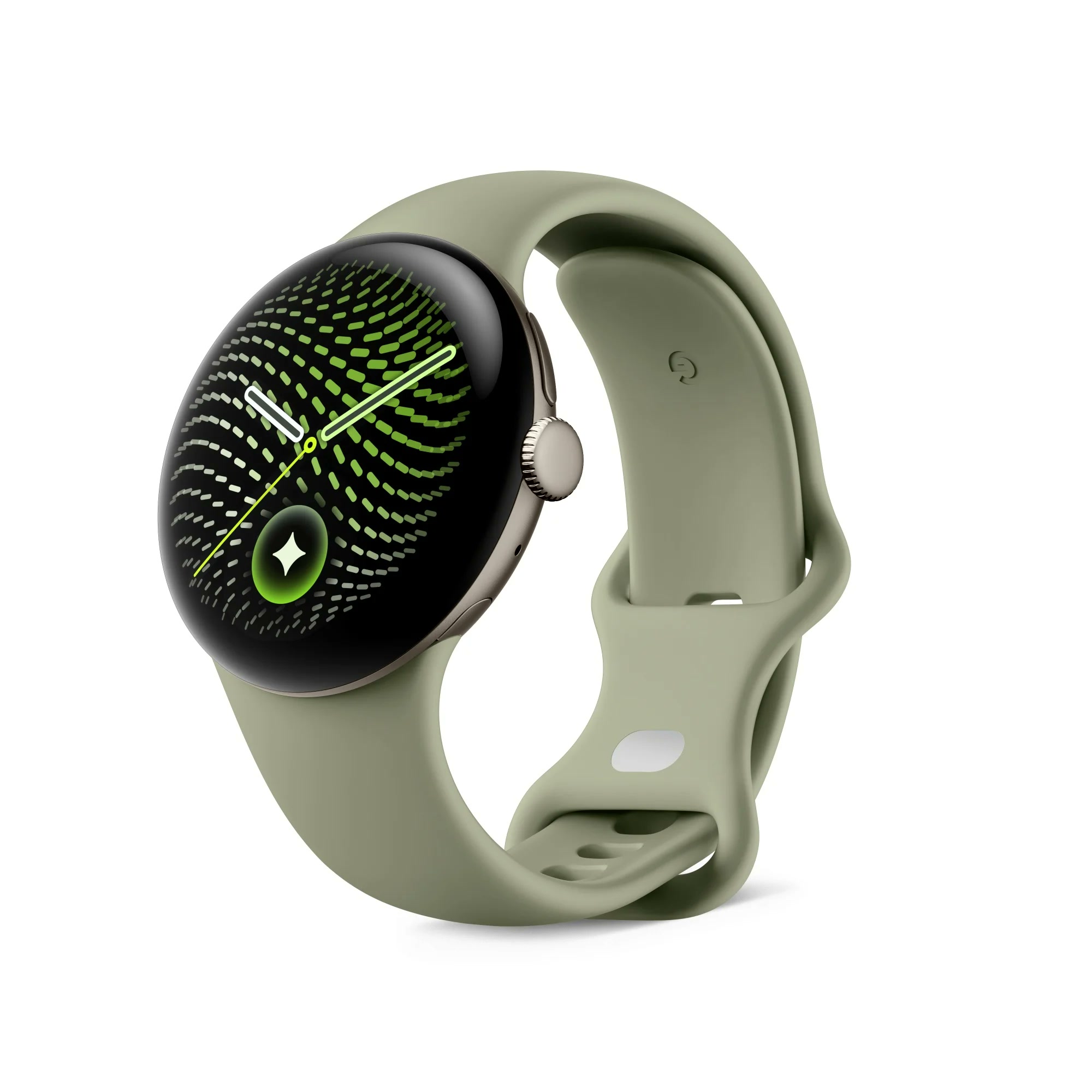
Pixel Watch 5 Comes in Several Colour Combinations
Google is offering different finishes depending on the watch size.
The 45mm model is available with:
The smaller 41mm version receives those same options along with an additional Champagne Gold aluminium case paired with a Canyon Active Band.
That gives the smaller model slightly more visual variety.
Pixel Tag Finally Brings Google Into the Finder Tag Market
The other major announcement is arguably more interesting simply because it represents something entirely new for Google.
The Pixel Tag is Google's first dedicated finder tag, giving Android and Pixel users a first-party alternative to trackers designed for locating bags, keys, luggage and other personal items.
The tracker has a compact oblong design constructed largely from metal and plastic.
It currently comes in a single Fog colour, essentially a clean white finish.
The design is intentionally simple, which makes sense for something that may spend most of its life attached to a keyring or hidden inside luggage.
Ultra-Wideband Should Make Finding Items More Precise
Pixel Tag uses an accelerometer as one of its primary sensors and includes a built-in speaker, with speaker openings positioned beneath the Google branding.
The important technology, however, is its wireless tracking capability.
Google has included Ultra-Wideband technology, which can provide much more precise location information when searching for a nearby tracker.
The device also supports Bluetooth Channel Sounding, adding another method for improving proximity and ranging information.
Instead of simply telling users that a missing item is somewhere nearby, technologies such as UWB can potentially provide directional guidance and much more accurate distance estimates.
That can be particularly useful when trying to locate something underneath furniture, inside a bag or somewhere within a crowded room.
The Pixel Tag Uses a Replaceable Battery
Google has gone with a familiar and practical battery solution.
Pixel Tag uses a standard CR2032 coin-cell battery, which can be replaced by the owner.
Google claims battery life of approximately one year.
Using a replaceable battery is arguably preferable for this type of accessory because users don't have to throw away the entire tracker once the internal battery deteriorates.
CR2032 batteries are also inexpensive and widely available.
It Should Handle Everyday Exposure to Water
The Pixel Tag carries an IP67 rating for dust and water resistance.
Google says it can survive immersion in approximately one metre of water for up to 30 minutes.
That should be sufficient for accidental exposure to rain, spills or briefly dropping a tracked item into water.
It isn't something users should deliberately take swimming, but it should be rugged enough for typical everyday use.
Pixel Watch 5 Pricing in Malaysia
For Malaysian buyers, the Pixel Watch 5 starts at RM1,799 for the 41mm version.
The larger 45mm model is priced at RM1,999.
Both versions are available for pre-order, with general availability scheduled to begin on 20 August.
Google says Malaysian customers will be able to purchase the watch through retailers and telecommunications partners including CelcomDigi, Maxis, Urban Republic, Senheng, Shopee, U Mobile and Thundermatch.
The difference of RM200 between the two sizes could make the 45mm version particularly attractive for anyone who prefers a larger display and values the additional battery capacity.
Pixel Tag Pricing Is Still Unclear for Malaysia
Google has yet to confirm official Malaysian pricing for the Pixel Tag.
International pricing reportedly places a single tracker at around US$29, which works out to roughly RM118 before local pricing, taxes or retail adjustments.
The Pixel Tag is expected to become available later, with Google indicating a November release timeframe.
It will be interesting to see whether Google sells the tracker individually only or introduces discounted multipacks, which have become common among competing finder tags.

Google Is Building a More Complete Pixel Ecosystem
The Pixel Watch 5 and Pixel Tag may not attract the same attention as a new flagship smartphone, but they arguably tell us more about Google's long-term hardware strategy.
Google increasingly wants Pixel users to remain inside a connected ecosystem.
The smartphone becomes the centre, while the watch handles health, fitness, notifications and AI assistance. The Pixel Tag extends that ecosystem into physical object tracking, while Pixel Buds cover audio.
That strategy is familiar because Apple and Samsung have already demonstrated how powerful a tightly connected device ecosystem can become.
The difference is that Google now appears increasingly willing to produce the first-party hardware needed to compete across all of those categories.
Final Thoughts
The Pixel Watch 5 looks like a meaningful refinement rather than a complete reinvention.
Its brighter display, improved battery options, expanded health monitoring, broader fitness support and deeper Gemini integration all reinforce Google's ambition to make the Pixel Watch a serious competitor in the premium smartwatch market.
The Pixel Tag, meanwhile, could prove to be the more strategically important product.
Google finally having its own first-party item tracker gives Pixel users another reason to remain within the company's hardware ecosystem, particularly when combined with UWB and Google's broader device-finding network.
Neither product is likely to overshadow the latest Pixel smartphones, but together they make Google's ecosystem feel increasingly complete.
And for users who already carry a Pixel phone, that interconnected experience may ultimately matter more than any single specification.











Comments 0