

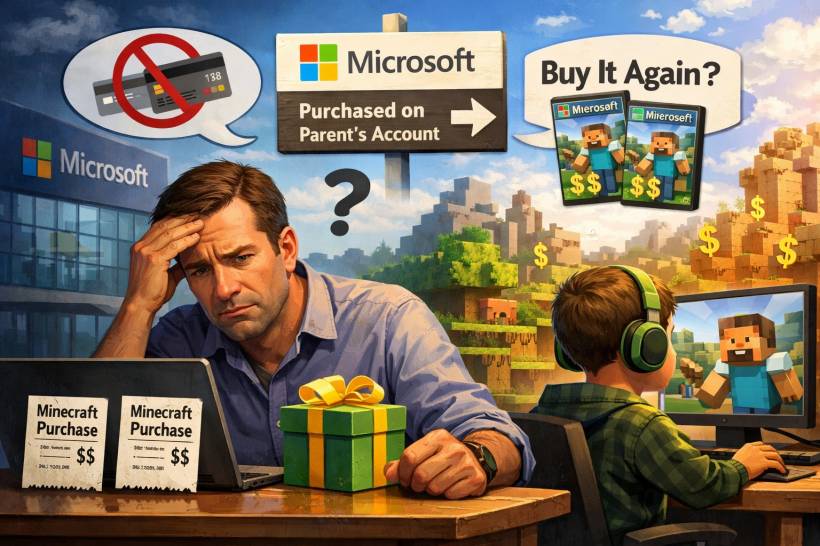
A Parent's Experience With Age Limits, Non-Transferable Purchases, and a System That Just Doesn't Make Sense. There are moments where technology is supposed to simplify parenting. We have parental controls, purchase approvals, family accounts, and digital safety features that exist to protect our children online. In theory, it sounds amazing.
Step One: Trying to Buy the Game the Right Way
The most logical way to buy a game for a child is directly under their account. That way, the game belongs to them, not anyone else.
So that's what I tried to do first. My child's account is correctly configured as a child profile under Microsoft Family. That's good — it means age protections, safer browsing, purchase controls, and content limits are enforced. This is exactly how Microsoft recommends families operate.
But here's the problem
Because the account is recognized as a child account, it simply isn't allowed to purchase Minecraft. Not even with parental approval. Not even as a supervised transaction. It's simply blocked due to age. From a safety standpoint, you can understand the intention. Kids shouldn't be able to buy random things. But what about when a parent is standing there wanting to purchase something responsibly?
The system doesn't care about intent. A child cannot purchase the game. Fair enough… so I did what any normal parent would do next.
Step Two: Buying Minecraft as a Parent – Surely That Solves It, Right?
If the child can't buy it, the logical fallback is:
And like most parents, I assumed Microsoft Family meant family sharing. I assumed the entire point of having a family ecosystem is so that a parent can buy something and assign or allow it to the child. After the purchase went through, I expected to simply let my child log in and play happily. Instead, I learned a painful reality. Minecraft purchased under a parent account belongs to the parent, not the child. It does not automatically transfer. It does not "share." It does not attach to the family group. It remains bound permanently to the adult account that paid for it. Meaning my child… still didn't own Minecraft.
Let that sink in. I had now:
✔ Followed parental safety best practices
✔ Tried to purchase responsibly
✔ Paid real money
And yet, my child — the only person the game was ever intended for — still had no legitimate ownership of it.
Step Three: Realizing the Only "Proper" Solution Is to Buy Minecraft Again
Eventually, after digging through explanations and support threads, the truth becomes obvious. If you want your child to truly own Minecraft under their account, there is only one official path:
You have to buy it again. Either as a gift purchase or redeemable license specifically tied to your child's account. It sounds absurd, but that is literally the reality. I initially tried to purchase under my child's account, couldn't because of age restrictions, then purchased under mine… only to discover that doing exactly that means the child still doesn't get the game. And now the platform suggests purchasing another copy. From a parent perspective, that feels incredibly unfair. From a consumer perspective, it feels almost deceptive.
Why This Feels So Wrong
Parents aren't trying to cheat Microsoft. This isn't a piracy conversation. Nobody is asking to share one copy with the entire neighborhood. Parents simply want the digital item they intended and paid for to belong to the child it was meant for.
And there is emotional frustration tied to this.
We respected child protection policies.
We complied with age restrictions.
We paid full price.
Yet the system still tells us we "did it wrong" and the only fix is spending more money. That kind of user experience breaks trust.
Workarounds: What Can Be Done (Even If It Shouldn't Be Necessary)
There are ways to at least allow a child to play without paying twice — but they come with conditions.
If the Child Uses the Same PC
The parent account can remain signed in to the Microsoft Store on that device. Minecraft becomes licensed to the device rather than strictly the user. The child can then sign into their own Windows or Xbox profile to play. It works — but only on that one machine.
If the Child Has Their Own PC
This workaround collapses. The license does not follow them. And again, Microsoft's "clean" answer is simply to buy another copy. These aren't elegant solutions. These aren't friendly design decisions. These are technical loopholes parents end up learning out of desperation. And that's the bigger issue — parents shouldn't have to work around a system that was supposedly built "for families".
Some Context: Why Does Microsoft Do This?
To be fair, there is a licensing and legal logic behind Microsoft's approach. Digital rights management traditionally ties ownership to accounts, not households. Microsoft's platform historically wasn't built around true shared licensing outside carefully controlled console models.
But here's the problem: real families don't think in terms of licensing architectures. They think in terms of basic fairness and common sense. If I buy a kid's game for a kid, the kid should own the game. Other ecosystems have figured this out. Google has Family Sharing. Apple has Family Purchases. Steam has Family Library Sharing. Xbox itself has "Home Console Sharing." So clearly, shared digital ownership within a family is not an impossible concept.
Which leads to the real question:
Suggestions Microsoft Should Seriously Consider
This situation is completely fixable. Microsoft could dramatically improve the family experience by:
• Enabling real Family Library sharing for key titles like Minecraft
• Providing clear warnings at checkout: "Purchases under this account cannot be transferred to children"
• Automatically prompting "Is this purchase intended for a child?"
• Offering a one-time transfer option for accidental parent purchases
None of these suggestions are radical. They are basic, family-friendly design principles.
Final Thoughts: Parents Aren't Wrong. The System Is.
This entire experience highlighted a frustrating truth: even when parents do everything right, Microsoft's ecosystem doesn't always support that effort.
I tried to buy Minecraft directly under my child's account and couldn't because of age restrictions. I then responsibly purchased it under my account, assuming a family system would behave logically. Instead, I learned that buying the game for my child didn't actually give it to my child — and the only true fix was spending more money. That's not good user experience. That's not family friendly. And it certainly doesn't feel fair. Until Microsoft modernizes how Minecraft licensing works for families, many more parents will walk the same road, feel the same frustration, and ask the same question:
And honestly — their frustration is absolutely justified.











Comments 0