

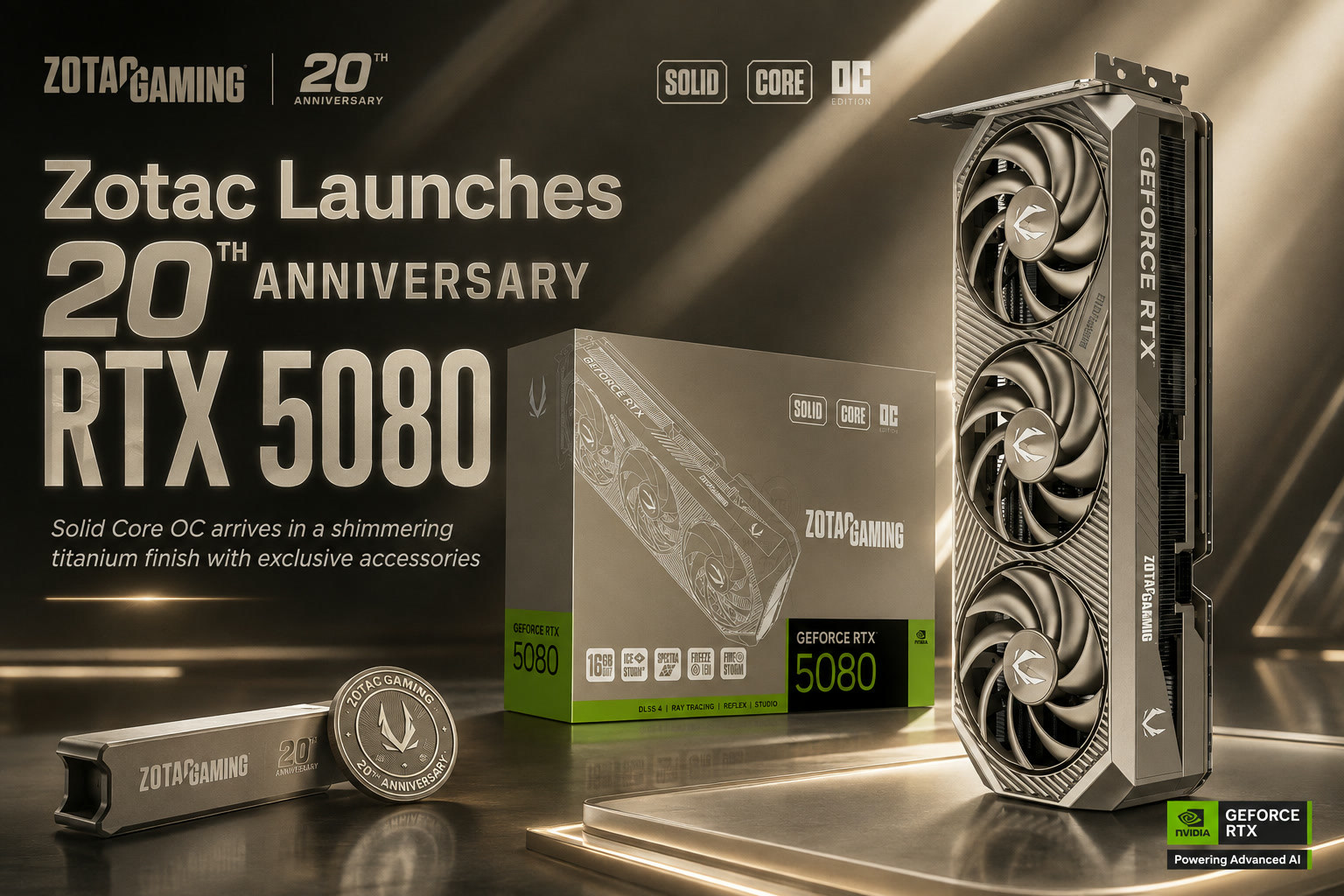
Zotac is celebrating a major milestone in its history, and naturally, the company has decided to mark the occasion with something aimed squarely at PC enthusiasts. For its 20th anniversary, Zotac has introduced a special-edition version of the GeForce RTX 5080 Solid Core OC, giving the existing high-end graphics card a completely different visual treatment along with a couple of exclusive accessories.
This isn't a faster RTX 5080 or a newly redesigned model underneath. The anniversary edition keeps essentially the same hardware, cooling system and performance specifications as the regular Solid Core OC. What buyers are really getting is a more distinctive collector-oriented version built around a new titanium-inspired finish, a mirrored backplate and an included ARGB support stand.
And considering how large modern flagship graphics cards have become, that last accessory is probably more practical than it initially sounds.
A New Titanium Finish Takes Centre Stage
The most obvious difference is the colour.
Instead of Zotac's standard finish, the 20th Anniversary RTX 5080 Solid Core OC receives a titanium-coloured exterior designed to shimmer as light moves across the surface.
That gives the card a more premium metallic appearance without completely changing the industrial styling of the existing Solid Core lineup.
For PC builders who carefully coordinate the appearance of their systems, this could make the anniversary edition particularly appealing.
Most graphics cards still tend to fall into one of three categories: predominantly black, white, or a mixture of dark metallic colours. A titanium finish sits somewhere between those traditional options and could work particularly well inside silver, aluminium or more minimalist builds.
It also makes sense for an anniversary product.
Rather than simply printing a "20th Anniversary" badge onto a standard card, Zotac has given the GPU enough visual differentiation that it should be immediately recognisable as something outside the normal lineup.
The Mirrored Backplate Is Exclusive to the Anniversary Edition
The card also comes with an additional special-edition mirrored backplate.
Rather than permanently replacing the existing backplate, the decorative panel reportedly attaches magnetically to the rear of the graphics card.
That's an interesting approach because it allows the anniversary styling to remain optional.
Users who want the more dramatic reflective appearance can install it, while those who prefer the cleaner titanium finish can simply leave it off.
A mirrored backplate could also interact particularly well with RGB lighting inside a case.
Reflections from memory modules, fans, light strips and other illuminated components could give the GPU a much more dynamic appearance depending on how the system is configured.
Obviously, none of this makes the graphics card faster.
But special editions aren't always about performance.
For many enthusiasts, the visual presentation of a high-end PC has become almost as important as the hardware itself.
Zotac Also Includes an ARGB GPU Support Stand
The second exclusive accessory is considerably more functional.
Zotac bundles its Duo ARGB GPU support stand with the anniversary model.
Modern high-end graphics cards are enormous.
Between large heatsinks, multiple fans, thick PCBs and increasingly substantial cooling assemblies, cards such as the RTX 5080 can place considerable weight on the motherboard's PCIe slot.
Over time, that can result in visible GPU sag, where the unsupported end of the graphics card begins to droop.
A support bracket or stand helps distribute some of that weight.
Zotac's inclusion of an ARGB-equipped stand means owners can stabilise the card while also adding another lighting element to the build.
For something positioned as a premium anniversary product, including the stand rather than selling it separately is a nice touch.
Underneath the Anniversary Styling, It Is Still the Same RTX 5080 Solid Core OC
Anyone hoping Zotac secretly increased clock speeds or unlocked additional performance may be disappointed.
The anniversary edition retains the same fundamental hardware specifications as the existing RTX 5080 Solid Core OC.
That means this is primarily a cosmetic and collector-focused release.
The cooling solution is also unchanged.
Zotac continues to use its IceStorm 3.0 triple-fan cooling system, including the same vapour chamber arrangement and BladeLink fan design used on the standard model.
That isn't necessarily a bad thing.
If the existing cooling architecture already handles the RTX 5080 effectively, there is little reason to redesign the entire card simply for an anniversary release.
Instead, Zotac can concentrate on changing the appearance while retaining a known thermal design.
The RTX 5080 Hardware Remains Familiar
At the heart of the card is NVIDIA's GeForce RTX 5080 GPU based on the company's Blackwell architecture.
The Anniversary Edition carries the same core specifications as its regular Solid Core OC sibling, including 10,752 CUDA cores.
It is paired with 16GB of GDDR7 memory connected through a 256-bit memory interface.
Memory operates at 30Gbps, while total graphics power remains rated at 360W.
Those specifications place the RTX 5080 firmly within NVIDIA's high-end gaming segment.
The card is intended for demanding workloads including high-resolution gaming, ray tracing and GPU-accelerated creative applications rather than mainstream gaming systems.
And because nothing has changed internally, buyers shouldn't expect the anniversary version to benchmark differently from the standard Solid Core OC under equivalent conditions.
GDDR7 Remains One of the Important Blackwell Upgrades
One of the major generational changes introduced with NVIDIA's RTX 50 Series was the transition to GDDR7 memory.
The RTX 5080's 16GB capacity might not look dramatically different from some previous-generation cards, but memory speed has increased substantially.
Running at 30Gbps across a 256-bit interface provides considerably more bandwidth than older GDDR6 or GDDR6X configurations.
That additional bandwidth becomes increasingly valuable as games push higher-resolution textures, heavier ray-tracing workloads and more complex rendering pipelines.
It can also benefit certain professional and creator workloads that regularly move large amounts of data between memory and the GPU.
So while the anniversary edition doesn't improve any of those specifications, it retains the full capabilities of the RTX 5080 platform underneath its new exterior.
Cooling a 360W GPU Is No Small Task
A 360W TGP also explains why Zotac continues using such a substantial cooler.
Moving that amount of heat away from the GPU requires considerably more than a basic heatsink and a pair of small fans.
The IceStorm 3.0 cooling system uses three fans together with a vapour chamber to spread heat efficiently across the cooling assembly.
Vapour chambers work on a similar principle to heat pipes but distribute thermal energy across a larger surface area.
That heat can then be transferred through the heatsink fins before being exhausted by the fans.
The result is inevitably a physically large graphics card, but that has become increasingly normal within the enthusiast GPU segment.
Performance, acoustics and temperature control are all competing against each other, and manufacturers have generally responded by simply giving their premium GPUs more cooling hardware.
This Anniversary Card Is More About Collectability Than Extra FPS
It is important to understand what Zotac is actually offering here.
This is not something like an RTX 5080 Ti hiding behind an anniversary badge.
It isn't equipped with additional CUDA cores.
It doesn't receive more VRAM.
Its memory isn't faster.
And Zotac isn't advertising significantly higher power limits or a radically different factory overclock.
The appeal lies in exclusivity and presentation.
For someone already considering an RTX 5080 Solid Core OC, the anniversary model offers a visually distinctive alternative.
For collectors or long-time Zotac customers, the 20th anniversary connection could make it even more appealing.
For someone who only cares about frames per second, however, the regular version should provide essentially the same underlying performance.
Twenty Years Is a Significant Milestone for Zotac
The special edition also serves as a reminder of how long Zotac has been operating within the PC hardware industry.
Twenty years is considerable time in a market where technology changes extremely quickly.
Over that period, GPU architectures have progressed through numerous generations, memory technologies have changed dramatically and graphics cards themselves have evolved from relatively compact expansion cards into enormous multi-slot components capable of consuming hundreds of watts.
Zotac has also expanded beyond graphics cards into areas such as compact PCs and other computing hardware.
An anniversary graphics card therefore makes sense as a celebration product, particularly since GPUs remain one of the products most closely associated with the Zotac brand.
Pricing Remains the Biggest Unknown
What Zotac hasn't revealed yet is how much the anniversary edition will actually cost.
That could ultimately determine whether this is an attractive alternative or primarily a collector's item.
For comparison, the standard RTX 5080 Solid Core OC carries a suggested retail price of RM6,029 in Malaysia.
The White edition sits slightly higher at RM6,259.
Considering the anniversary version introduces a special titanium finish, an exclusive mirrored backplate and the Duo ARGB GPU support stand, it would be surprising if Zotac priced it below either of those models.
A modest premium would be understandable.
The question is how large that premium becomes.
If the difference is relatively small, buyers already shopping for an RTX 5080 may find the anniversary edition easy to justify.
If the price climbs substantially, however, buyers may begin comparing it against higher-tier versions from competing manufacturers instead.
Special Editions Have to Balance Style and Value
That's always the challenge with anniversary hardware.
Manufacturers need to make the product visually distinctive enough to feel special without pushing the price so high that customers would rather spend the difference on additional performance.
Zotac's approach seems relatively sensible.
Instead of modifying the GPU or introducing a complicated new cooling design, it has taken an established product and added:
a removable mirrored backplate, and
a matching ARGB support accessory.
The underlying RTX 5080 remains untouched.
That keeps the anniversary model familiar while still giving collectors something visibly different.
It Could Look Particularly Good in Showcase Builds
The titanium finish could also find an audience among PC builders who spend almost as much time designing the appearance of their computers as selecting the components.
Modern cases increasingly feature panoramic glass panels, vertically mounted GPUs and elaborate lighting arrangements.
In those systems, the graphics card effectively becomes part of the visual centrepiece.
A reflective backplate combined with titanium bodywork and ARGB lighting could make the Zotac anniversary model particularly well suited to showcase PCs.
The magnetic design of the backplate also gives builders more flexibility depending on how the card is mounted.
A conventional horizontal installation exposes the backplate prominently through the side window, whereas a vertical mounting configuration places more emphasis on the cooler itself.
Either way, the anniversary styling should be much more visible than a simple commemorative logo hidden somewhere on the PCB.
Final Thoughts
Zotac's 20th Anniversary GeForce RTX 5080 Solid Core OC isn't trying to reinvent the RTX 5080.
Instead, it takes an already existing high-end graphics card and gives it a much more distinctive appearance to commemorate two decades of Zotac hardware.
The titanium finish is the obvious attraction, while the magnetic mirrored backplate and Duo ARGB GPU support stand give buyers a couple of genuinely exclusive extras.
Underneath all of that, however, this remains the same RTX 5080 Solid Core OC, complete with 16GB of GDDR7, 10,752 CUDA cores, a 256-bit memory interface, 30Gbps memory and a 360W TGP.
That means performance shouldn't be the reason to choose the anniversary edition over the regular card.
Style is.
And for enthusiasts who were already considering spending more than RM6,000 on an RTX 5080, a limited-looking titanium finish and commemorative accessories may be enough to make this version considerably more tempting — assuming Zotac doesn't attach too large an anniversary premium to the final price.











Comments 0