

For many healthcare organisations today, the real issue is no longer a lack of data. In fact, most hospitals and health systems already have more data than they know what to do with. The bigger challenge is something far more practical: how do you turn all of that information into something useful for the people actually delivering care on the ground?
That question has been central to the transformation at East London NHS Foundation Trust in the United Kingdom. Over the past several years, the organisation has been working to move beyond scattered reporting systems and disconnected data sources, with a stronger focus on making analytics genuinely helpful for frontline teams rather than just leadership dashboards.
At the centre of that effort was Dr Amar Shah, now national clinical director for improvement at NHS England, whose work helped shape a model where data was not treated as an abstract management tool, but as something that could actively support better decisions and better patient care.
Moving Beyond Fragmented Systems
One of the biggest barriers the organisation faced was something many healthcare providers will immediately recognise: too many systems that did not speak to one another.
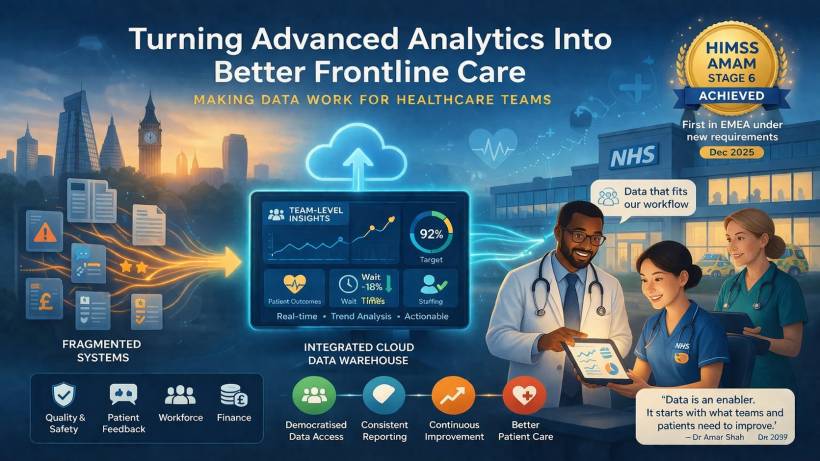
There were multiple platforms handling different parts of the organisation's operations, from quality and safety monitoring to patient feedback, workforce information, and finance. Each system held valuable data, but because they operated separately, getting a complete and useful picture was difficult. Even when data was available, it was not always presented in a way that fit naturally into clinical workflows.
That created a familiar problem. Staff wanted data, but the systems behind it were too fragmented and too slow to support what they actually needed in daily practice.
The answer was not just to collect more information. It was to rebuild the way data was organised and delivered.
Building a More Usable Data Foundation
To address this, East London NHS Foundation Trust shifted from a collection of fragmented on-premises systems to a fully integrated, cloud-based data warehouse.
That may sound like a technical infrastructure upgrade, and in one sense it was. But the real significance of the move was not simply where the data lived. It was how that change made the data more accessible, more connected, and more relevant to individual services and teams.
Instead of relying mainly on organisation-wide reporting, teams could access insights closer to real time and more directly tied to the services they were responsible for. That meant data became something people could actually use in context, rather than something handed down in broad summaries from above.
This is an important distinction, because in healthcare, timing and relevance matter just as much as accuracy. Data that arrives too late, or in a form that feels disconnected from day-to-day care, often ends up being ignored.
Why Team Feedback Matters So Much
What stands out in this transformation is that it was not driven by technology alone.
According to Shah, a major part of the journey involved understanding what individual teams actually needed and then designing around those needs. That required two things in particular: developing stronger technical capability internally and setting clear principles for how data should be delivered.
Over time, the organisation invested in building the technical skills needed to do more of the work itself. That reduced dependency on outside support and helped create a more sustainable model for continuous improvement.
Just as importantly, the design philosophy was deliberately built from the ground up. Rather than starting with what senior leadership or board members wanted to see, the organisation focused first on what frontline and corporate teams needed in order to improve care and performance in their own environments.
That is a subtle but powerful shift. In many places, dashboards are built primarily for executive reporting, and everyone else has to work around that. Here, the thinking went in the opposite direction.
Looking at Improvement Over Time, Not Just a Snapshot
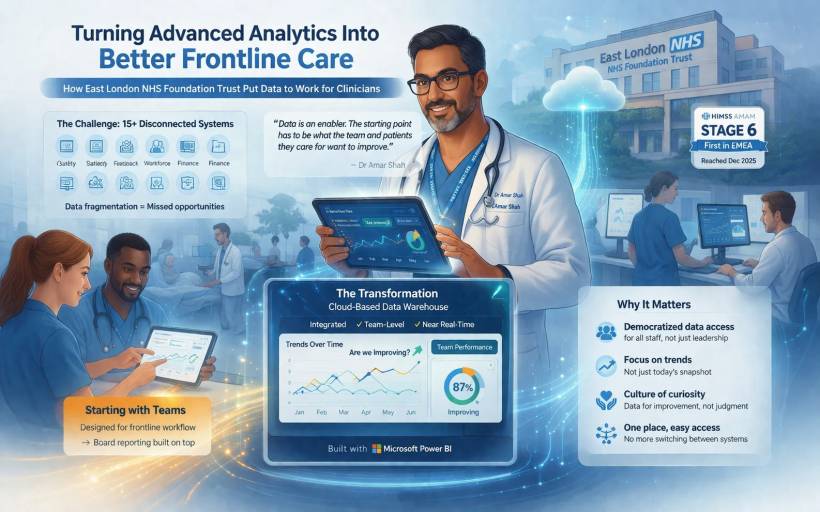
Using Microsoft Power BI, the organisation also moved away from the idea that dashboards should simply show current status.
That is often how analytics tools are used in healthcare and other sectors. A dashboard tells you how things look today, perhaps with a few colour-coded indicators, and that becomes the basis for discussion. But while that kind of reporting has value, it does not always tell you whether meaningful improvement is actually happening.
The approach here was more focused on trends over time. The key questions were not just whether performance was good or bad on a given day, but whether services were improving, where progress was stalling, and what needed attention next.
That makes analytics much more useful as a tool for improvement rather than just oversight. It changes the conversation from judgment to learning.
Data Should Support Curiosity, Not Fear
One of the most important ideas behind this work is that data should not be something staff associate only with scrutiny or criticism.
In many organisations, people's experience of data is often tied to performance management. They see numbers when they are being assessed, compared, or questioned. That can make data feel threatening rather than helpful.
Shah's view challenges that mindset. The starting point, he argued, should be improvement: what teams want to make better for the patients they care for, and how data can help them ask better questions.
That is a very different culture from one where dashboards are mostly used to check compliance or measure whether people are meeting targets. When teams feel they can explore data with curiosity rather than defensiveness, analytics becomes much more powerful.
In practical terms, that meant giving wider access to data across the organisation rather than keeping it concentrated among leadership. It also meant standardising how information was presented so that staff across different services were working with consistent views and shared understanding.
Why Democratizing Data Matters
Making data available to all staff was a deliberate part of the trust's strategy.
This idea of democratising data is increasingly important in healthcare. If only a small group of leaders or analysts can access meaningful insights, then the people closest to patient care are forced to rely on second-hand interpretations. That slows learning down and makes improvement less responsive.
But when teams can access relevant information themselves, and when that information is easy to understand and consistent across services, the relationship with data starts to change. It becomes a practical tool rather than a distant reporting mechanism.
This does not mean every clinician needs to become a data analyst. It means the information should be usable enough that teams can engage with it confidently, identify patterns, and ask better questions about the care they provide.
A Major Milestone With More Still Ahead
In December 2025, East London NHS Foundation Trust reached HIMSS Analytics Maturity Assessment Model Stage 6, becoming the first organisation in Europe, the Middle East and Africa to do so under the updated requirements.
That achievement carries several layers of meaning.
On one level, it serves as external recognition that the organisation is moving in the right direction. On another, it reflects the work and commitment of the teams who helped build and sustain the transformation. But it is also not being treated as an end point.
Stage 6 is significant, but it is not the final destination. There is still a higher stage to reach, and that reinforces the idea that digital maturity is an ongoing journey rather than a one-off achievement.
What Other Healthcare Organisations Can Learn
Perhaps the most useful takeaway from this story is that advanced analytics should never be pursued just for the sake of saying an organisation is data-driven.
The real value comes when analytics is tied directly to improving care. That means keeping clinicians at the centre of the process, making systems easy to access, and avoiding environments where staff have to jump between multiple disconnected platforms just to find the information they need.
If data lives in too many places, people will not use it. If it is difficult to access, it will be ignored. And if it feels like a tool for judgment rather than improvement, it will never become part of the culture in the right way.
Final Thoughts
The experience at East London NHS Foundation Trust shows that better analytics is not really about building flashy dashboards or collecting ever more data. It is about making information practical, accessible, and genuinely useful for the teams delivering care every day.
That is what turns analytics from a back-office function into something that can shape frontline care in a meaningful way.
For healthcare organisations trying to strengthen digital transformation, that may be the most important lesson of all: the technology matters, but the real impact comes from how well it fits into the daily reality of patient care.











Comments 0