

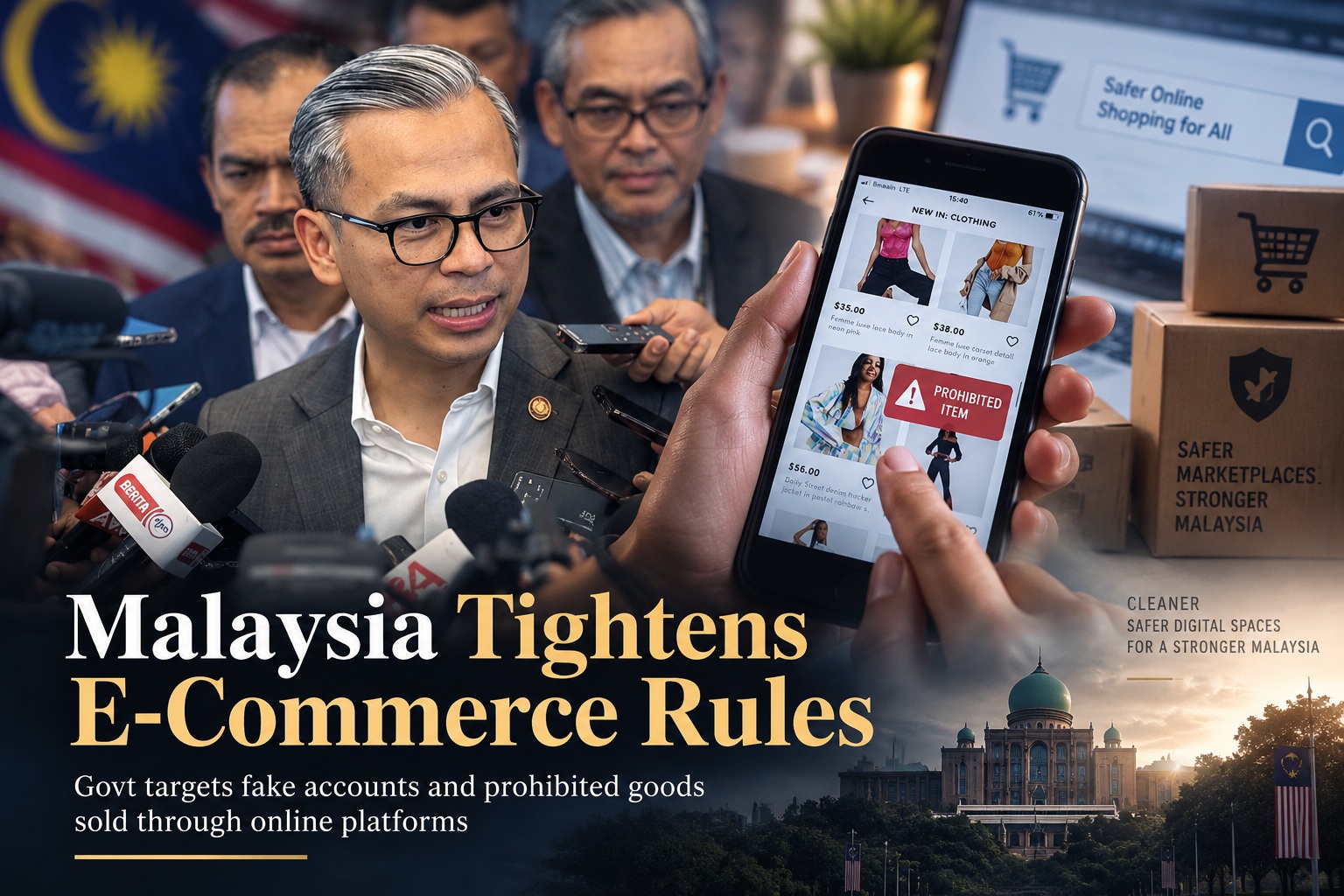
Malaysia is preparing to strengthen oversight of its e-commerce sector as authorities become increasingly concerned about prohibited goods being sold through online marketplaces, including illegal drugs. Communications Minister Datuk Seri Fahmi Fadzil said the government is ready to work across several ministries and enforcement agencies to close gaps in the current system and place greater responsibility on digital platforms.
The issue has become more pressing as online marketplaces grow into an important part of everyday commerce. While most major platforms already prohibit illegal products under their own policies, the government believes enforcement is still inconsistent and that Malaysia's existing legal framework may no longer be sufficient for the size and complexity of today's e-commerce industry.
Malaysia's E-Commerce Platforms Are Currently Not Licensed
One of the biggest gaps highlighted by Fahmi is that e-commerce platforms in Malaysia are currently not subject to a specific licensing framework.
Speaking during the Huawei WAIC Connect Malaysia 2026 Symposium, he said the government needs to examine whether stronger regulatory controls are necessary. The concern is that platforms can host millions of listings and sellers while enforcement responsibility remains spread across different agencies and existing laws.
That does not necessarily mean every marketplace will suddenly require a licence in the same way as a telecommunications operator, but the government is clearly questioning whether the existing model provides enough accountability when prohibited goods repeatedly appear online.
Several Agencies Will Need to Work Together
The Communications Ministry does not intend to address the problem alone. Fahmi said cooperation would involve the Home Ministry, Ministry of Domestic Trade and Cost of Living, police and other relevant agencies.
That cross-agency approach makes sense because online illegal trade crosses several regulatory areas at once. A prohibited product may involve criminal law, consumer protection, digital-platform governance, communications regulation and financial transactions.
The Malaysian Communications and Multimedia Commission has already been instructed to engage with e-commerce platforms over the issue, particularly following concerns about drugs being marketed online.
Prime Minister Datuk Seri Anwar Ibrahim has also reportedly raised the matter, reflecting growing concern within the government over how easily some prohibited goods can still reach consumers through digital marketplaces.
Drug Sales Have Become a Particular Concern
Recent discussions have focused heavily on the online sale of controlled substances, including fentanyl and another substance referred to as "piu-piu."
Even when marketplace terms explicitly ban these products, sellers can attempt to evade moderation by changing product descriptions, using coded language or continuously opening new accounts.
This creates a difficult challenge for platforms because removing one listing does not necessarily remove the person or network behind it. If the same seller can immediately return under another identity, enforcement becomes an endless cycle of deleting individual products without disrupting the underlying operation.
That is why Fahmi believes platforms need to look beyond simple keyword filtering.
Blocking Keywords Does Not Solve the Real Problem
One obvious response to illegal product listings is to remove suspicious search terms. If users cannot search for a particular drug name, it becomes harder for sellers and buyers to find one another.
But keyword blocking has clear limitations. Sellers can misspell words, substitute symbols, use coded terminology or advertise through images rather than text. As soon as one keyword is blocked, another variation can appear.
Fahmi argues that platforms therefore need to address the accounts behind the listings, not just the words those accounts use.
The concern is that some sellers may be operating through fake or disposable accounts created specifically for prohibited transactions. Removing individual listings while allowing those accounts to continue operating does little to stop the problem.
Fake Accounts Are Becoming a Bigger Regulatory Focus
The ability to create fraudulent seller identities appears to be one of the areas the government wants platforms to improve.
If a marketplace knows that certain categories of goods are prohibited, it also needs mechanisms capable of identifying suspicious sellers before those sellers repeatedly upload illegal products.
That could involve stronger identity verification, behavioural monitoring and more aggressive enforcement against accounts linked to previous violations. The government has not yet announced specific requirements, so it remains unclear exactly what measures platforms will eventually be expected to introduce.
The broader principle, however, is becoming clearer: marketplaces may be expected to take greater responsibility for who is selling through their systems, not merely what is visible in each listing.
One Platform Was Described as Being Too Lax
Fahmi said that while most e-commerce companies already prohibit illegal goods, at least one platform appeared to be too relaxed in allowing such products to surface.
He did not frame the issue simply as a failure to delete banned listings quickly enough. His comments focused on whether platforms are doing enough to prevent fake seller accounts from being created and reused.
That distinction matters because it moves responsibility further upstream. Rather than waiting until an illegal listing appears and then removing it, regulators increasingly want platforms to prevent obvious abuse before it reaches consumers.
This is similar to the broader direction seen in social media and online advertising regulation, where platforms are gradually being pushed away from purely reactive moderation toward stronger preventive controls.
A New E-Commerce Law Is Already Being Developed
The debate comes as Malaysia is already preparing legislation intended to replace the Electronic Commerce Act 2006.
The existing law was created at a very different stage of internet development. Its main purpose was to give legal recognition to electronic messages, contracts and commercial transactions at a time when online commerce was still relatively new.
Today's e-commerce environment is significantly more complicated. Marketplaces now connect millions of buyers and sellers, handle payments, manage advertising, recommend products algorithmically and operate sophisticated logistics ecosystems.
The government therefore believes a more comprehensive legal framework is needed.
The New Law Could Expand Platform Accountability
The proposed legislation is expected to strengthen responsibilities across the wider e-commerce ecosystem, including platforms, sellers and potentially other participants involved in online transactions.
Exactly what those responsibilities will look like has not yet been disclosed. Issues such as seller verification, prohibited product monitoring, consumer complaints and platform liability could potentially become part of the discussion, but the government has not confirmed the final provisions.
What is clear is that the new law is intended to go beyond simply recognising online transactions as legally valid.
The emphasis is shifting toward who is accountable when commerce conducted through a digital platform causes harm or violates the law.
Several Government Bodies Are Involved in Drafting the Bill
The Ministry of Domestic Trade and Cost of Living has previously said that development of the new law involves input from several agencies.
These include the Attorney-General's Chambers, Communications Ministry, MCMC and Digital Ministry, reflecting the fact that modern online marketplaces sit across multiple regulatory areas.
The involvement of several agencies may help Malaysia develop a more coordinated framework, but it also highlights how difficult online commerce has become to regulate.
A marketplace is simultaneously a technology platform, advertising network, commercial intermediary and sometimes a payment or logistics ecosystem. No single traditional regulator naturally covers every part of that model.
The Proposed E-Commerce Bill Could Reach Parliament Soon
The government expects the proposed e-Commerce Bill to be tabled during an upcoming parliamentary session.
However, many of the most important details remain unknown. The government has not yet disclosed the specific obligations platforms will face, how enforcement powers will work or what penalties may apply when companies fail to comply.
Those details will determine whether the legislation becomes a major restructuring of Malaysian e-commerce governance or a more incremental update of existing rules.
For platforms, the key question will be how much responsibility they are expected to assume for third-party sellers operating on their systems.
Stronger Regulation Could Change Seller Onboarding
If fake seller accounts become a central regulatory concern, one area likely to attract attention is the registration process.
Marketplaces have traditionally tried to make seller onboarding as easy as possible because lowering barriers encourages more merchants to join. Stronger verification introduces friction, but it can also make anonymous abuse more difficult.
There is always a balance to strike. Legitimate small businesses should not face unnecessary bureaucracy simply to open an online store, but platforms also need confidence that the identity behind a seller account is genuine.
The government now appears increasingly concerned that the current balance may make it too easy for bad actors to create disposable accounts.
Technology Alone Will Not Eliminate Prohibited Listings
Even sophisticated automated detection will struggle to remove illegal commerce entirely. Sellers continuously adapt to moderation systems by changing keywords, images and product descriptions.
This means effective enforcement will likely require a combination of automated monitoring, human review, identity verification and cooperation with law-enforcement agencies.
Platforms also hold information that investigators may need to identify sellers, trace transactions or connect multiple accounts to the same operator.
The stronger regulatory framework being discussed could therefore involve not only content moderation but better cooperation between marketplaces and authorities.
Consumer Protection Is Also Part of the Bigger Picture
Although illegal drugs are driving much of the immediate concern, stronger e-commerce regulation could have implications far beyond prohibited substances.
Online marketplaces can also be abused for counterfeit products, unsafe goods, misleading advertisements and fraudulent sellers. Greater accountability could therefore strengthen consumer protection more broadly.
As Malaysians increasingly rely on digital marketplaces for everyday purchases, trust becomes critical. Consumers need confidence that platforms are not simply providing space for sellers but are actively working to keep obviously illegal or dangerous activity out of the ecosystem.
That is particularly important when marketplace algorithms themselves may help users discover or recommend products.
Platforms May Need to Become More Proactive
The larger direction of policy appears to be moving away from the idea that an e-commerce platform is merely a passive intermediary.
When platforms control seller registration, product visibility, search results and recommendation systems, governments increasingly expect them to take a more active role in preventing abuse.
For Malaysian marketplaces, that could eventually mean stronger account verification, faster removal processes and closer cooperation with regulators.
The final rules have not yet been revealed, so it would be premature to assume exactly what the government will mandate. But Fahmi's comments suggest the conversation is shifting from "How quickly did you remove the listing?" toward "Why was this seller able to operate in the first place?"
Final Thoughts
Malaysia's push for tighter e-commerce oversight reflects how much online commerce has changed since the Electronic Commerce Act was introduced in 2006. Digital marketplaces have become enormous commercial ecosystems, but the regulatory framework surrounding them has not necessarily evolved at the same speed.
The immediate concern is the sale of prohibited goods such as fentanyl through online platforms, but the government's focus on fake seller accounts suggests that authorities want to address the structure enabling those transactions rather than simply block suspicious keywords.
With a new e-commerce law already being prepared, Malaysia could soon introduce clearer responsibilities for platforms and sellers while strengthening cooperation between the Communications Ministry, KPDN, MCMC, police and other agencies.
The challenge will be finding the right balance. Regulation needs to make it harder for criminals to exploit online marketplaces without making legitimate digital commerce unnecessarily difficult for businesses and consumers.











Comments 0