

Intel may already be looking to expand its Arc G3 handheld processor lineup, with a new rumour suggesting that a lower-tier Panther Lake-based APU is currently in development.
The leak comes from well-known hardware tipster Jaykihn, who posted a short message referencing a "Panther Lake 4+0+4+4 handheld" configuration. While the post did not include a product name, launch window or performance target, the unusual core layout strongly suggests Intel could be preparing a more affordable Arc G3 option for portable gaming systems.
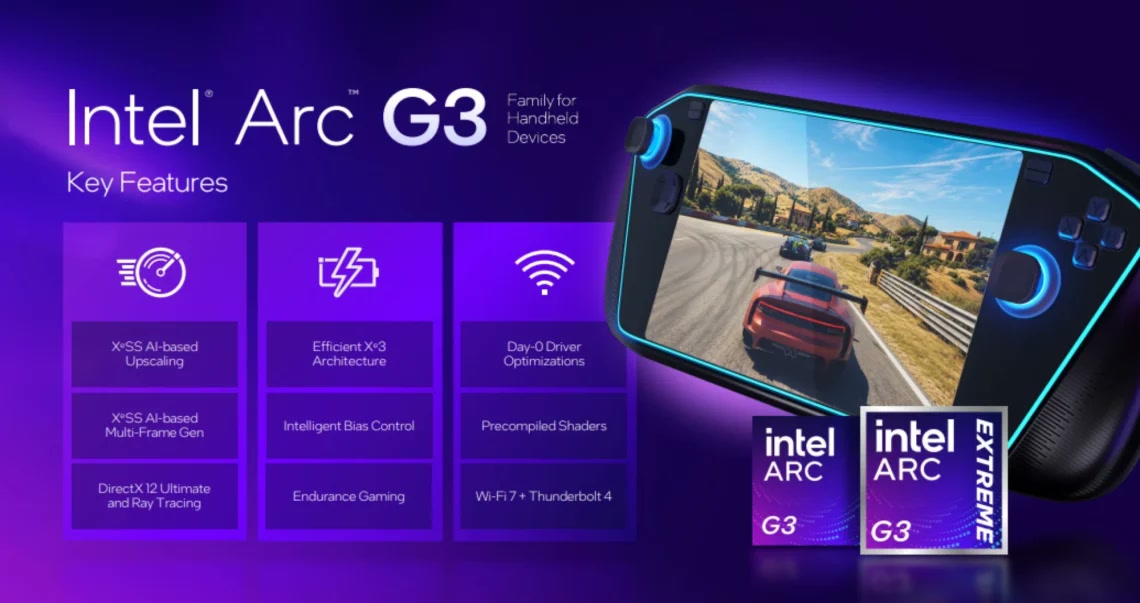
If the rumour proves accurate, the new chip would sit below the existing Arc G3 and G3 Extreme designs, potentially giving handheld manufacturers a way to build cheaper devices without abandoning Intel's newer Xe3 graphics architecture.
What Does the 4+0+4+4 Configuration Mean?
The leaked configuration appears to describe four different parts of the APU.
It could consist of:
That would make it significantly smaller than the higher-end Arc G3 processors currently associated with Panther Lake handhelds.
The decision to remove the conventional E-Cores entirely would also suggest Intel is focusing heavily on power efficiency and cost rather than maximum multicore CPU performance.
For a gaming handheld, that could make sense.
Portable gaming systems rarely need the same CPU resources as high-end laptops, especially when most performance limitations come from the integrated GPU and the device's overall power envelope.
How It Compares With Arc G3 Extreme
The current Arc G3 Extreme configuration is considerably larger.
Both the Extreme and standard G3 variants are described as using a 2+8+4 CPU arrangement, giving them a total of 14 CPU cores.
The difference between those two chips is primarily on the graphics side.
The higher-end G3 Extreme reportedly comes with 12 Xe3 GPU cores and uses Intel's more powerful Arc B390 integrated graphics, while the standard G3 uses 10 Xe3 cores paired with Arc B370 graphics.
Clock speeds are also relatively close, with the Extreme model reaching up to 4.7GHz on its Performance cores and the standard model reportedly topping out around 4.6GHz.
By comparison, a 4+0+4+4 design would represent a substantial reduction in both CPU and GPU resources.
A Smaller Chip Could Still Make Sense for Handheld Gaming
Fewer cores do not automatically mean the processor would be unsuitable for gaming.
Handheld PCs operate under strict thermal and power limits, which means manufacturers cannot simply run every CPU and GPU core at maximum performance all the time.
A smaller APU could actually be easier to optimise for lower-power systems.
If Intel can maintain strong single-core performance while keeping enough Xe3 graphics resources for mainstream handheld gaming, the chip could still deliver a very usable experience at 720p or 1080p.
The biggest difference would likely appear in demanding AAA titles, heavily multithreaded games and productivity workloads where the higher-end G3 models have more resources available.
For indie games, emulation and less demanding PC titles, however, a lower-tier Arc G3 could still be more than capable.
Intel's Xe3 Graphics Are the Bigger Story
One of the reasons the rumour is interesting is the progress Intel has made with its integrated graphics.
The G3 Extreme has reportedly delivered surprisingly strong gaming performance, showing that Intel's Xe3 architecture can compete much more seriously in the handheld space than earlier integrated graphics generations.
That makes even a cut-down four-core GPU configuration worth watching.
Intel does not necessarily need the lower-tier model to match the G3 Extreme.
It only needs to deliver enough performance to make handhelds cheaper while remaining competitive with other processors targeting the same price range.
That could help Intel broaden the appeal of its handheld platform considerably.
Price Is Currently the Bigger Problem
Performance is not necessarily the biggest obstacle facing Arc G3 handheld systems.
Price is.
Current handhelds using the higher-end G3 Extreme platform are positioned well into the premium segment, with some models selling for more than RM7,000.
That puts them far beyond what many casual handheld gamers are willing to spend.
At that price, consumers begin comparing the device not only with competing handhelds but also with full gaming laptops and desktop PCs.
A smaller and cheaper Arc G3 APU could therefore be strategically important.
Instead of competing exclusively at the high end, Intel could give manufacturers another option for devices targeting a much broader audience.
A More Affordable Intel Handheld Could Be the Real Goal
A cut-down processor could reduce several costs at once.
A smaller APU may be cheaper to manufacture, require less elaborate cooling and potentially allow manufacturers to use smaller batteries or simpler motherboard designs.
Lower power consumption could also improve battery life, which remains one of the biggest weaknesses of many Windows gaming handhelds.
If those savings eventually translate into lower retail pricing, an entry-level Arc G3 device could be significantly more appealing than another RM7,000-plus flagship.
That would also give Intel a better opportunity to compete directly with AMD-powered handhelds across multiple price segments rather than relying only on premium designs.
Memory Pricing Could Still Complicate Things
Even if Intel produces a cheaper APU, the final price of the handheld will depend on much more than the processor itself.
Memory prices remain an important factor.
Gaming handhelds typically require relatively fast memory because the integrated GPU shares system RAM rather than having its own dedicated VRAM.
Reducing memory capacity or bandwidth too aggressively could hurt graphics performance, while using larger amounts of expensive high-speed memory increases the cost of the device.
That means manufacturers will have to find the right balance.
A lower-cost processor only helps if the rest of the system can also be built at a reasonable price.
Intel Appears Serious About the Handheld Market
If the leak is accurate, the existence of another Arc G3 configuration suggests Intel is not treating handheld gaming as a one-off experiment.
A proper product family makes much more sense strategically.
The G3 Extreme can serve premium devices where manufacturers want maximum integrated performance.
The standard G3 could occupy the middle of the range.
A smaller 4+0+4+4 configuration could then target more affordable handhelds.
That kind of segmentation would look much more like a mature platform strategy rather than Intel simply placing one high-end processor into a handful of expensive devices.
Competition Could Be Good for Handheld Buyers
The handheld gaming PC market has become increasingly competitive.
AMD has already established itself strongly through Ryzen Z-series processors and custom chips used across several portable gaming systems.
Intel entering the segment more aggressively could put pressure on both pricing and performance.
More competition gives manufacturers additional processor options and makes it harder for any one platform supplier to dominate the category.
For consumers, that could eventually mean better battery life, stronger graphics performance and more affordable hardware.
The biggest question is whether Intel can translate its improved architecture into devices that are competitively priced.
This Is Still Only a Rumour
For now, the reported 4+0+4+4 Panther Lake configuration should be treated cautiously.
Intel has not officially announced a lower-tier Arc G3 handheld processor, and there are currently no confirmed specifications, product names or launch dates.
The final configuration could change before release, assuming the chip reaches the market at all.
Early leaks often reflect engineering samples or internal product planning rather than guaranteed retail products.
Still, the configuration makes enough sense that it would not be surprising to see Intel expand the Arc G3 family in this direction.
Final Thoughts
A lower-tier Arc G3 APU could be exactly what Intel needs to make its handheld strategy more accessible.
The G3 Extreme has demonstrated that Intel can deliver impressive integrated graphics performance, but premium handheld pricing limits how many people can actually experience it.
A smaller 4 Performance core + 4 Low-Power E-Core + 4 Xe3 GPU core design would obviously sacrifice some performance, but that may be an acceptable trade-off if it leads to substantially cheaper devices with better efficiency.
For many handheld gamers, maximum performance is not the only priority.
Price, battery life, thermals and portability matter just as much.
If Intel can use this smaller Arc G3 configuration to bring capable handheld PCs below today's premium price range, the lower-end model may ultimately be more important to the market than the flagship.











Comments 0