

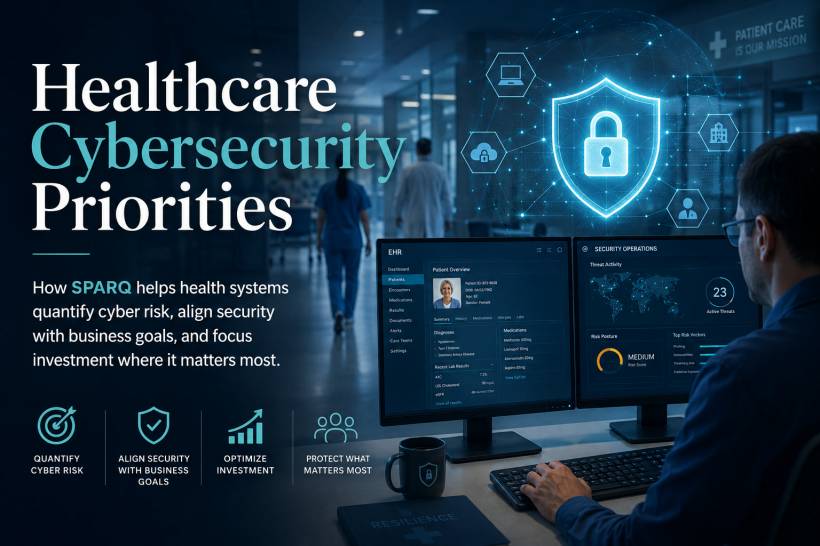
Cybersecurity incidents in healthcare are no longer rare events. Data breaches, ransomware attacks, system outages, and third-party disruptions have become part of the risk landscape for hospitals, clinics, insurers, and healthcare networks. The concern is no longer just whether an organisation has firewalls, backups, endpoint protection, or identity controls. The bigger question is whether leaders truly understand how each cybersecurity weakness can affect patient care, operations, finance, compliance, and reputation.
That is where many healthcare security conversations still get stuck. IT and security teams often explain risk using technical language, such as missing identity and access management controls, weak backup maturity, unpatched systems, or gaps in privileged access. These issues are serious, but they do not always translate clearly to senior executives or board members who are trying to decide where limited funding should go.
For cybersecurity to receive the right attention, the discussion has to move from "we need another tool" to "this is the business risk, this is the financial exposure, and this is how much risk we can reduce by investing in the right control."
Why Technical Risk Alone Is Not Enough
In healthcare, cybersecurity is directly tied to operational continuity. A ransomware incident can delay appointments, interrupt access to medical records, affect diagnostic systems, disrupt billing, and create pressure on clinical teams. When systems are unavailable, the impact is not limited to IT; it can affect the entire care delivery chain.
The challenge is that many cybersecurity reports still focus on vulnerability scores, audit findings, patch counts, or compliance gaps. These are useful for technical teams, but they may not be enough for executives who need to compare cybersecurity investment against other business priorities.
For example, saying that an organisation lacks immutable backups may sound technical. But saying that this gap could increase recovery cost, extend downtime, delay clinical operations, and expose the organisation to millions in avoidable risk makes the issue much easier to understand.
This is why cyber risk quantification is becoming more important. It helps security leaders explain cybersecurity in financial and operational terms.
How SPARQ Helps Turn Cyber Risk Into Business Language
CDW's Security Program Assessment and Risk Quantification, or SPARQ, is designed to help organisations assess cybersecurity risk in a more business-focused way. Instead of treating cyber risk assessment as a one-time compliance exercise, SPARQ uses a platform-based approach with artificial intelligence and ongoing updates to help organisations maintain a clearer view of their risk position over time.
The key difference is that the assessment does not simply produce a long list of weaknesses. It helps place a financial value on the risks identified, making it easier for leaders to compare priorities.
That changes the conversation. Instead of telling executives that there are dozens of security gaps to fix, a CISO can explain that a specific project may cost a certain amount but could reduce a much larger amount of annualised risk. For example, a security improvement that costs RM900,000 may be easier to justify if it reduces several million ringgit worth of potential exposure over time.
This kind of framing helps security teams communicate with CEOs, CFOs, boards, and audit committees in a way that aligns with business decision-making.
From Security Findings to Investment Priorities
One of the common problems in cybersecurity assessments is that organisations may receive too many findings at once. If a report lists 20 or 30 issues, leaders may struggle to decide what should be fixed first.
Risk quantification helps solve that problem by showing which issues carry the highest financial and operational impact. It allows organisations to ask more practical questions:
• Which projects should be funded first?
• Which risks can be accepted temporarily?
• Which risks should be transferred through cyber insurance?
• Which investments support compliance, resilience, and business continuity at the same time?
For healthcare organisations, this is especially useful because budgets are often tight, funding streams can change, and every investment must compete with clinical, operational, infrastructure, and staffing needs.
What Happens After Risk Is Quantified?
Once an organisation understands its cyber risk in financial terms, the next step is deciding how to manage it. Broadly, there are four ways to respond to risk.
An organisation can avoid the risk by stopping or changing the activity that creates it. It can accept the risk if it falls within the organisation's tolerance. It can transfer part of the risk through cyber insurance or contractual arrangements. Or it can mitigate the risk by investing in stronger controls, better processes, and improved resilience.
The value of a framework like SPARQ is that it helps organisations decide the right mix. Not every risk can be eliminated, and not every risk should be handled the same way. Some risks may be better reduced through technical controls, while others may be transferred through insurance or managed through operational changes.
This makes cybersecurity spending more targeted. Instead of funding projects based only on urgency or fear, leaders can make decisions based on measurable risk reduction.
Why This Matters for Zero Trust and Identity Security
Healthcare organisations are increasingly moving toward zero trust security models, where users, devices, applications, and access requests are continuously verified instead of automatically trusted.
However, zero trust is not achieved by buying one product. It requires maturity in identity and access management, endpoint protection, network segmentation, privileged access control, monitoring, and response capability.
Risk quantification can help organisations decide where to begin. If identity weakness represents one of the biggest exposures, then funding can be directed toward stronger authentication, access reviews, privileged account controls, and identity governance. If backup and recovery represent the highest risk, then investment may need to shift toward immutable backups, recovery testing, and downtime planning.
The point is not to fill every technical gap at once. The point is to focus on the gaps that matter most to patient care, business continuity, and financial resilience.
AI Adds Another Layer of Risk
As healthcare organisations adopt more AI tools, cyber risk becomes even more complex. AI may help improve workflows, support clinical documentation, analyse data, and assist with operational decision-making. But it can also introduce risks around data privacy, model governance, access control, third-party platforms, and inappropriate use of sensitive information.
The same risk quantification approach can be applied to AI. Organisations can evaluate where AI creates exposure, what the possible impact could be, and which controls are needed before expanding adoption.
This is important because AI is not only being used by defenders. Attackers are also using automation and AI-assisted techniques to improve phishing, social engineering, malware development, and reconnaissance. Healthcare organisations therefore need to think about AI risk as part of their wider cybersecurity strategy, not as a separate technology discussion.
Continuous Risk Management Is Becoming Essential
Traditional cybersecurity assessments often provide only a snapshot. They show what the environment looked like at one point in time. But healthcare environments change constantly. New systems are added, vendors are onboarded, users change roles, vulnerabilities emerge, and attackers evolve their methods.
That is why Continuous Threat and Exposure Management, or CTEM, is becoming more important. CTEM focuses on continuously identifying exposures, prioritising them, validating their impact, and addressing the most critical issues first.
Risk quantification supports this by connecting technical exposures to business impact. It helps answer questions such as which vulnerabilities should be patched first, which systems carry the highest operational risk, and which weaknesses could create the greatest financial exposure if exploited.
For healthcare, this is especially important because not all systems carry the same level of risk. A vulnerability on a non-critical test system is not the same as a vulnerability affecting clinical applications, patient records, diagnostic systems, or infrastructure supporting 24/7 operations.
Final Thoughts
Healthcare cybersecurity cannot be managed effectively through technical checklists alone. Security teams need to understand their vulnerabilities, but they also need to explain those risks in a way that business leaders can act on.
SPARQ reflects a growing shift toward financial risk quantification, where cybersecurity decisions are connected to operational impact, patient care continuity, insurance strategy, and investment planning. This allows security leaders to move beyond vague warnings and present clearer trade-offs: what the risk is, what it may cost, and how much can be reduced through the right action.
For healthcare organisations, the goal should not be to fix every cybersecurity gap at once. The real goal is to understand which risks matter most, prioritise them properly, and build a security programme that protects both clinical operations and long-term organisational resilience.











Comments 0