

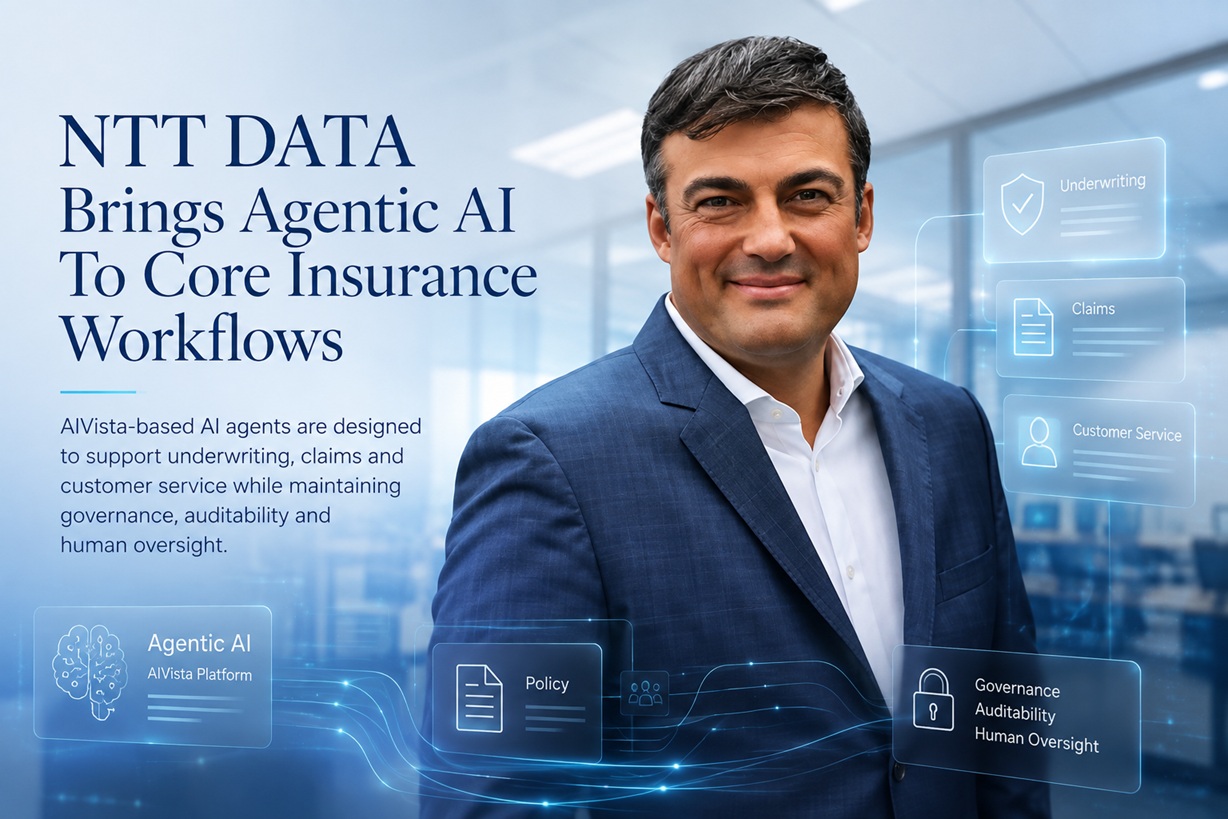
NTT DATA is pushing agentic AI deeper into the insurance sector with a new solution designed to support some of the industry's most important day-to-day workflows, including underwriting, claims processing and customer service.
Built on the company's AIVista platform, the solution combines configurable AI agents with insurance-specific data models, allowing insurers to automate and coordinate more complex tasks without completely overhauling the systems they already use.
AI Agents Designed Around Insurance Workflows
Instead of treating AI as a standalone chatbot or productivity tool, NTT DATA is positioning its new platform as something that can operate directly inside insurance processes. The system can be configured around an insurer's own products, internal procedures and regulatory requirements, making it more relevant to the way insurance companies actually work.
That means an AI agent could potentially assist with reviewing underwriting information, gathering claims documentation, routing cases to the appropriate team or handling routine customer enquiries, while more sensitive decisions remain subject to human review.
This is especially important in insurance, where automation cannot simply come at the expense of accountability.
Governance And Human Oversight Are Built In
Because insurers operate in heavily regulated environments, NTT DATA has placed governance at the centre of the solution. The platform includes controls intended to maintain auditability, traceability and human oversight, helping organisations understand what an AI agent has done and where human intervention may still be required.
That becomes increasingly important as AI agents move from answering questions to actually performing tasks across business systems.
An insurer needs to know not only that a process was completed, but also which data was used, which steps were taken and whether the decision complied with internal and regulatory policies.
It Does Not Require A Complete Core-System Replacement
One of the more practical aspects of NTT DATA's approach is that insurers do not need to replace their existing core platforms just to deploy the technology.
The agentic AI solution is designed to integrate with existing insurance systems, reducing the risk of locking a carrier into one particular technology stack.
That could make adoption considerably easier for established insurers, many of which still depend on large legacy platforms that are difficult and expensive to replace.
Rather than rebuilding everything around AI, companies can potentially introduce AI agents gradually into selected workflows and expand their use over time.
The Platform Can Work Across Multiple AI Models
NTT DATA is also trying to avoid another common problem in enterprise AI: becoming dependent on a single foundation model.
The platform can route different tasks across multiple models depending on the type of work being performed. This gives insurers more flexibility when balancing accuracy, cost, performance and regulatory requirements.
For example, one model may be better suited to document analysis while another performs better at customer-facing conversations or structured reasoning.
A multi-model approach also gives organisations more room to change providers later without redesigning the entire workflow.
Insurers Want AI, But Most Are Still Early In The Journey
NTT DATA's 2026 Global AI Report suggests that interest in AI across insurance is already extremely high.
Around two-thirds of insurers want to use AI in front-office interactions, including customer-facing services. Adoption interest is even stronger behind the scenes, with 86% supporting AI use across mid-office and back-office operations.
Those areas include functions such as claims administration, policy processing, underwriting support, compliance and internal operations.
The challenge is that interest has moved faster than implementation.
Many insurers are experimenting with generative AI and automation, but relatively few have successfully deployed agentic AI at scale across core business operations.
Moving from a proof-of-concept chatbot to autonomous systems capable of coordinating real insurance workflows is a considerably larger step.
Why Insurance Is A Natural Fit For Agentic AI
Insurance contains many processes that involve repetitive but information-heavy work. Employees often need to review documents, verify data, compare policies, check rules and pass cases between multiple departments.
That makes the industry well suited to AI agents capable of handling multi-step workflows.
Instead of an employee manually moving between several systems, an agent could potentially gather the required information, perform initial checks and prepare the case for final human review.
Done properly, this could reduce processing time without removing human responsibility from important decisions.
Final Thoughts
NTT DATA's new agentic AI offering reflects a broader shift in enterprise AI. Businesses are moving beyond assistants that simply generate text and toward systems capable of actually participating in operational workflows.
For insurance companies, the opportunity is significant. Underwriting, claims and customer service all contain areas where AI could reduce repetitive work and improve turnaround times.
The real challenge will be deploying that automation without sacrificing governance, transparency and human accountability.
That is likely why NTT DATA is putting so much emphasis on integration, auditability and multi-model flexibility. In a regulated industry such as insurance, the most useful AI agent will not simply be the one that can do the most work. It will be the one insurers can actually trust inside their core operations.











Comments 0