

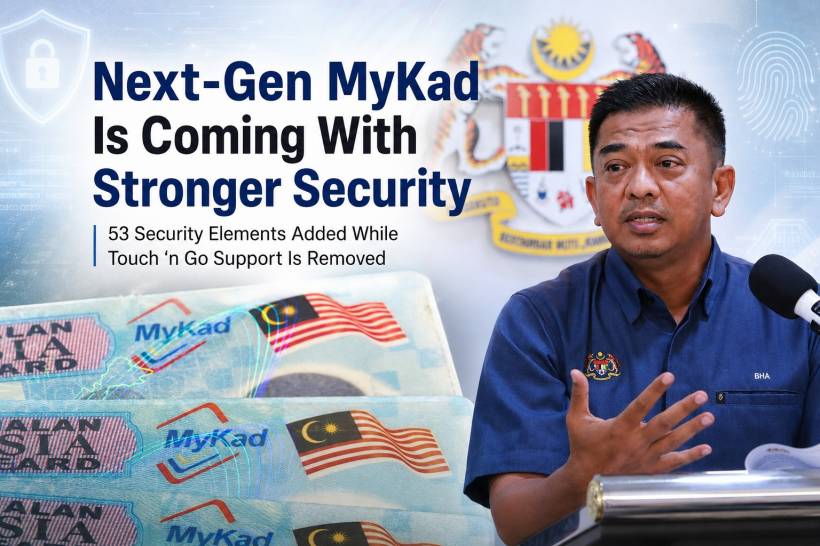
Malaysia's MyKad is getting ready for another major update, and this time the focus appears to be very clear: stronger identity protection. The next-generation national identity card is expected to be introduced sometime next month, although an exact launch date has not been confirmed yet. Ahead of the official rollout, National Registration Director-General Datuk Badrul Hisham Alias has shared several early details about what Malaysians can expect from the updated MyKad.
The biggest highlight is the security upgrade. The new MyKad will reportedly come with 53 security elements, which is a significant jump from the 23 found on the current version. That alone shows how much emphasis is being placed on making the identity card harder to forge, tamper with, or misuse.
However, there is also one noticeable trade-off. The upcoming MyKad will no longer include Touch 'n Go functionality.
A Bigger Focus On Identity Security
The MyKad is more than just a plastic identity card. For Malaysians, it is one of the most important personal documents we carry. It is used for official identification, government services, financial verification, healthcare registration, law enforcement checks, and many other daily administrative matters.
Because of that, security matters a lot.
As technology improves, the risks also evolve. Fake documents, identity fraud, data misuse, and more advanced forgery techniques are not problems that can be ignored. A modern identity card must be able to keep up with those threats.
That is likely why the new MyKad is being designed with a much broader set of security features. Moving from 23 to 53 security elements is not just a small refresh. It suggests a more serious redesign aimed at making the card more resilient against modern fraud attempts.
What Security Features Are Being Added?
According to the details shared so far, the upgraded MyKad will include several physical and digital security improvements.
Among the features mentioned are laser engraving, ultraviolet elements, holograms, guilloche patterns, microtext, enforcement-use QR codes, and a chip with enhanced encryption technology.
Some of these features are designed to help officers and authorised parties verify the card more easily. Others are meant to make duplication much harder.
Laser engraving can help create markings that are difficult to alter. UV elements are usually only visible under specific lighting, making them useful for verification. Holograms and guilloche patterns are commonly used in secure documents because they are hard to reproduce accurately. Microtext can add another layer of protection because it is difficult to copy clearly using normal printing methods.
The upgraded chip is also important. As more verification processes become digital, the chip inside the MyKad needs to remain secure against more advanced threats. Enhanced encryption should help protect the data stored inside and reduce the risk of unauthorised access or tampering.
Touch 'n Go Functionality Will Be Removed
While the security upgrades are welcome, many Malaysians will probably notice another change more immediately: the new MyKad will not support Touch 'n Go.
This may disappoint users who still keep their IC as a backup TNG card. Some Malaysians use it occasionally for parking, tolls, or emergency situations when their main Touch 'n Go card is not available. Even if it is not everyone's primary payment method, the feature has been around long enough that many people are familiar with it.
At the moment, no specific reason has been given for removing TNG functionality from the new MyKad.
Still, the decision is not entirely surprising when viewed from a security and modernisation perspective. Identity documents and payment functions serve very different purposes. As Malaysia moves toward more secure identity systems, separating payment convenience from official identification may make the new card simpler to manage and protect.
That said, for ordinary users, the practical takeaway is simple: once the new MyKad is introduced, do not assume your IC can still be used as a Touch 'n Go backup.
No Exact Launch Date Yet
Although the new MyKad is expected to arrive sometime next month, the exact launch date has not been announced.
Datuk Badrul Hisham said the official launch will be announced by the Home Ministry when the time comes. From the National Registration Department's side, he indicated that preparations are already in place.
This suggests that the rollout is close, but Malaysians will still need to wait for the formal announcement before knowing when applications, replacements, or upgrades will begin.
Malaysians Should Not Rush To Replace Their IC
One important point to remember is that the transition will happen in phases.
Previously, Home Minister Datuk Seri Saifuddin Nasution Ismail had already advised Malaysians not to rush to replace their ICs once the new documents are introduced. This is sensible because a sudden rush could create long queues, unnecessary congestion, and pressure on NRD counters.
For most citizens, the existing MyKad should remain valid until there is a proper reason or instruction to replace it. Unless your card is damaged, lost, outdated, or you are specifically required to upgrade, it may be better to wait for official guidance.
A phased rollout also gives the authorities time to manage production, distribution, verification systems, and public communication properly.
MyPoCA, MyTentera And Passport Updates Are Also Coming
The MyKad is not the only identification document getting an upgrade.
Updated versions of MyPoCA and MyTentera are also expected to be introduced in June. On top of that, Malaysia's passport is also expected to receive new security features.
This shows that the government is looking at identity security more broadly, not just the civilian MyKad. Different official documents serve different groups and purposes, but all of them need to remain trustworthy in an environment where document fraud and digital identity risks are becoming more sophisticated.
For travellers, military personnel, enforcement agencies, and ordinary citizens, stronger security documents can help reduce risks and improve confidence in verification processes.
Why This Upgrade Matters
Identity documents are often taken for granted because they are part of everyday life. Most people only think about their MyKad when they need to renew something, register for a service, open an account, or deal with official matters.
But behind the scenes, the security of an identity card is extremely important.
A weak identity document can create opportunities for fraud. It can affect financial systems, government services, border control, law enforcement, and personal privacy. As more systems rely on identity verification, the document itself must be more difficult to fake and easier to authenticate.
The new MyKad appears to be part of that wider effort.
Of course, the real test will come after launch. The card must not only be secure on paper. It must also work smoothly in real-world usage, across government agencies, enforcement checks, service counters, and digital verification systems.
Final Thoughts
The upcoming next-generation MyKad looks set to bring a major security upgrade, with 53 security elements compared to 23 on the current version. Features such as laser engraving, UV elements, holograms, microtext, QR codes, and enhanced chip encryption suggest a stronger focus on preventing forgery and protecting identity integrity.
At the same time, the removal of Touch 'n Go functionality will be a noticeable change for Malaysians who still use their IC as a backup payment card. It may not affect everyone, but it is something users should be aware of.
For now, the best approach is to wait for the official launch announcement from the Home Ministry and follow the National Registration Department's guidance. The transition will happen in phases, so there is no need to rush unless there is a clear requirement to do so.











Comments 0