

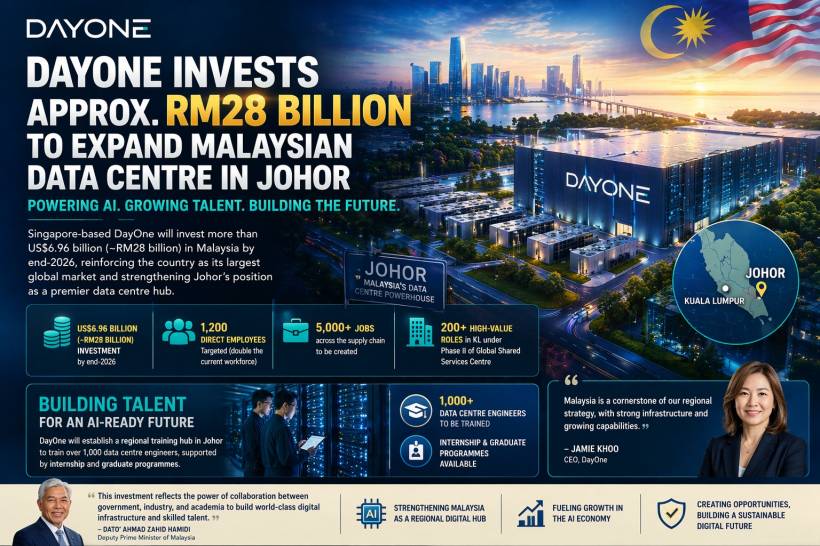
Malaysia's data centre momentum is showing no signs of slowing down, and Johor is increasingly becoming the centre of that story. The latest sign of that growth comes from Singapore-based DayOne, which is planning a massive expansion in Malaysia with an investment of more than US$6.96 billion, or roughly RM28 billion, by the end of 2026.
It is a major commitment, and one that says a lot about how international technology players now view Malaysia's role in the regional digital economy. Johor, in particular, is no longer just being talked about as an emerging location for digital infrastructure. It is now firmly establishing itself as one of the country's most important data centre hubs, drawing in both local giants and foreign investors looking to support cloud services, enterprise workloads, and increasingly, AI-driven demand.
Johor's Rise as Malaysia's Digital Infrastructure Hub
Over the past few years, Johor has steadily gained attention as a strategic destination for data centre development. Its proximity to Singapore, improving infrastructure, and growing ecosystem of technology and utility support have made it especially attractive for operators looking to expand in Southeast Asia.
That has already led to a growing list of major names entering the space, including both Malaysian and international firms. With DayOne now preparing to scale up its footprint, the message is becoming even clearer. Johor is not just participating in the regional data centre boom. It is helping define it.
This matters because data centres are no longer just back-end facilities sitting quietly behind the scenes. They are now essential infrastructure for a digital economy shaped by cloud platforms, enterprise software, streaming, e-commerce, fintech, and artificial intelligence. As demand for computing power rises, locations that can support that demand efficiently are becoming increasingly valuable.
A Bigger Bet on Malaysia
According to the company, the planned investment will deepen DayOne's presence in Malaysia and could eventually make the country its largest global market. That is a significant statement, especially when coming from a company with regional ambitions and cross-border operations.
It also suggests that Malaysia is moving beyond being seen as a secondary expansion option. Instead, it is now being viewed as a core market in its own right, capable of supporting large-scale digital infrastructure deployment and long-term operational growth.
DayOne has also indicated that Malaysia is expected to account for more than half of its global headcount growth in 2026. That is not a small number, and it shows that this expansion is not only about buildings, systems, and hardware. It is also about people, workforce development, and the creation of a deeper local presence.
More Jobs and a Larger Local Workforce
One of the more important aspects of the announcement is the employment impact. DayOne plans to double its local workforce to around 1,200 direct employees, which points to a strong operational commitment rather than a limited or short-term presence.
Beyond that, the company's broader expansion is expected to create more than 5,000 jobs across the supply chain. That is where the economic impact becomes even more meaningful. Large data centre investments tend to create opportunities not just within the company itself, but also across supporting industries such as engineering, maintenance, logistics, construction, procurement, energy services, cooling systems, security, and professional services.
There is also an additional layer to this through Phase II of DayOne's Global Shared Services Centre in Kuala Lumpur. More than 200 high-value roles are expected to be introduced there, covering areas such as finance, investment, procurement, and other corporate functions. That is worth noting because it shows the expansion is not limited to technical site operations alone. It also includes business and strategic functions that often bring more specialised roles into the local market.
Talent Development Is Becoming Just as Important as Infrastructure
One of the more interesting parts of DayOne's plan is its intention to establish a regional training hub in Johor. The goal is to train more than 1,000 data centre engineers to support AI-ready infrastructure.
That is a very important move, because one of the biggest challenges in any fast-growing digital infrastructure market is not just building capacity, but building talent. Data centres require specialised technical knowledge, and AI-oriented infrastructure raises the bar even further. These environments need people who understand systems reliability, networking, power management, cooling efficiency, hardware operations, security, and increasingly, the needs of high-performance computing environments.
By investing in training rather than simply hiring where possible, DayOne appears to be taking a more long-term view. It is recognising that Malaysia's digital ambitions will need a skilled pipeline of engineers and technical professionals, not just capital expenditure.
The company is also planning internship and graduate programmes, which could help create more direct pathways for young Malaysians entering the industry. That is especially meaningful in a sector where hands-on experience and specialised operational knowledge can make a real difference in employability.
Why AI Is Driving This Conversation
It is difficult to separate major data centre investments today from the wider AI boom. Across the world, demand for infrastructure is increasingly tied to artificial intelligence workloads, which require greater compute density, faster interconnects, more advanced cooling, and more resilient facility design.
That is why DayOne's emphasis on AI-ready infrastructure stands out. This is not just about building for current demand. It is about preparing for the next wave of digital services and enterprise needs, many of which will be tied to AI adoption across industries.
For Malaysia, this creates both an opportunity and a challenge. The opportunity is obvious: attract investment, create jobs, strengthen the country's digital position, and become more deeply integrated into the regional technology supply chain. The challenge is making sure that infrastructure growth is matched by talent readiness, power planning, policy support, and long-term sustainability.
Government Support and the Bigger National Picture
The announcement has also received a positive response from the Malaysian government. Deputy Prime Minister Ahmad Zahid Hamidi reportedly welcomed the initiative and highlighted the importance of collaboration between government, industry, and academia.
That is a key point, because digital infrastructure development cannot succeed in isolation. Data centres may be built by private companies, but the ecosystem around them depends heavily on public policy, education systems, utility planning, investment frameworks, and workforce development.
If Malaysia wants to remain competitive as more regional players expand their footprint, it will need to keep strengthening that broader support structure. Training hubs, graduate pipelines, university collaboration, and industry-aligned technical programmes will become increasingly important as competition for digital talent grows.
Malaysia's Window of Opportunity
DayOne's investment is another strong sign that Malaysia is currently in a favourable position within the regional technology landscape. Johor's growth as a data centre destination has been one of the clearest examples of that shift, but the larger story is about how the country is becoming more relevant in conversations around digital infrastructure, cloud expansion, and AI enablement.
The scale of the planned investment also sends a message to the rest of the market. Malaysia is no longer just attracting interest because of cost advantages or geographic convenience. It is increasingly being viewed as a serious platform for long-term digital growth.
That does not mean success is guaranteed. Rapid expansion always brings questions around sustainability, energy demand, land use, infrastructure readiness, and talent availability. But it does mean Malaysia has a real opportunity to build a stronger position if these growth areas are managed well.
Final Thoughts
DayOne's planned RM28 billion expansion in Malaysia is more than just another investment headline. It reflects the growing importance of Johor in Southeast Asia's data centre map and highlights how central Malaysia is becoming to the region's digital future.
The commitment to create jobs, expand its workforce, and train over 1,000 data centre engineers also gives the announcement more substance than a simple capital figure. It shows that this is not only about physical infrastructure, but also about building the human capacity needed to support the next stage of digital and AI growth.
For Malaysia, that makes this a promising development. The bigger question now is how effectively the country can turn this momentum into long-term advantage.











Comments 0