

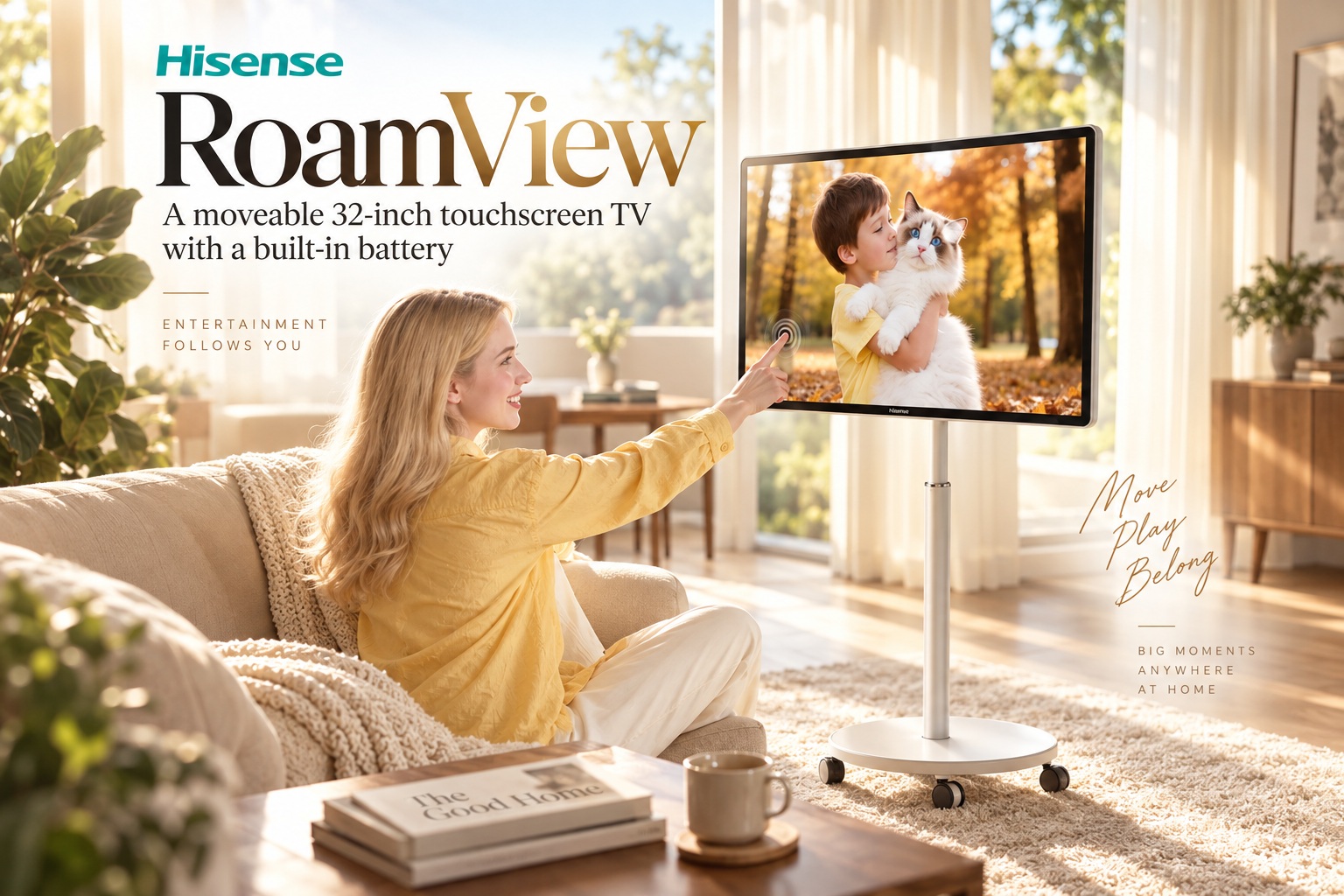
Most televisions are designed around one assumption: once you decide where they belong, they more or less stay there. Hisense is challenging that idea with the RoamView, a 32-inch touchscreen display mounted on an adjustable wheeled stand that can be moved between rooms whenever needed. More importantly, it carries its own rechargeable battery, meaning users do not necessarily have to park it beside a wall socket every time they want to watch something.
The RoamView joins Hisense's Lifestyle Series and sits somewhere between a television, oversized tablet, smart display, and portable entertainment centre. It can follow users from the bedroom to the kitchen, move into a home office for video calls, or even be taken outside for temporary viewing when conditions allow. At RM5,699 in Malaysia, however, Hisense is clearly positioning this as a premium lifestyle product rather than a conventional television with wheels attached.
A Television That Is Not Tied to One Room
The central idea behind RoamView is mobility. Instead of deciding whether the television belongs in the living room or bedroom, users can simply roll the display wherever it is needed. That could make it particularly useful for smaller homes, apartments, multipurpose rooms, or households where buying a separate screen for every space would be unnecessary.
This is not the first movable smart display we have seen, but Hisense's implementation goes further by integrating a 15,000mAh rechargeable battery into the stand. The company claims this can provide up to 10 hours of operation, potentially allowing the screen to remain unplugged for most of a day depending on usage. When the battery eventually runs low, Hisense says a full recharge takes approximately three hours.
The built-in battery is what makes the concept genuinely portable rather than simply movable. A wheeled television still feels tied to the room if an extension cable needs to follow it everywhere, whereas RoamView can be repositioned without immediately worrying about power. That opens up far more practical possibilities around the house.
The Stand Is More Flexible Than a Conventional TV Mount
Hisense has built quite a bit of adjustment into the supplied stand. The display height can be changed by as much as 30cm, while the screen itself can rotate through 180 degrees and tilt between -20 and +40 degrees. That should make it much easier to position the screen whether somebody is sitting at a desk, exercising on the floor, following a recipe in the kitchen, or watching from bed.
Being able to rotate and tilt the panel also matters because a movable display will rarely be viewed from the same position twice. Traditional televisions can be carefully aligned with a sofa and then forgotten, but RoamView needs to adapt every time it enters another room. The flexible mounting system therefore feels less like an optional convenience and more like an essential part of the design.
The screen can also be removed entirely from the stand if users need to transport it more easily. There is one important compromise, though: the battery is housed inside the stand, so a detached RoamView needs to be connected directly to a power source. The display itself is therefore portable, but truly cordless operation depends on keeping it attached to its mobile base.
A 32-Inch 4K Touchscreen Sits at the Centre
The RoamView uses a 32-inch 4K Edge LED display with touchscreen functionality, which immediately separates it from most ordinary TVs of the same size. Touch support allows the screen to operate more like a giant tablet when users are standing close enough to interact directly with it, rather than forcing every task through a remote control.
That makes sense given the device's intended mobility. A screen sitting beside a kitchen counter, desk, or exercise area may be close enough for direct interaction, and tapping the display can be more convenient than searching for a remote that was left in another room. Touch input also makes Android applications feel considerably more natural.
The 32-inch size is an interesting compromise. It is large enough to function as a genuine television from a modest viewing distance but still small enough to move around the home without becoming unwieldy. A 55-inch version might provide a more cinematic experience, but rolling it through doorways would quickly undermine the whole portability concept.
MediaTek Genio 1200 Provides the Processing Power
Inside, Hisense has equipped the RoamView with a MediaTek Genio 1200 SoC, paired with 8GB of RAM and 128GB of storage. Those specifications are much closer to what we would expect from a high-end smart display or Android tablet than a basic television, reflecting how much more the product is intended to do beyond streaming video.
The additional storage gives users room for applications and local content, while 8GB of memory should provide reasonable headroom for multitasking. Hisense has not specified the exact Android version on its regional product listing, but Android serves as the software foundation for apps, streaming services, wireless casting, and other smart features.
Using Android also makes the touchscreen considerably more useful. Instead of simply navigating television menus, users can interact with compatible applications directly, making RoamView potentially useful for entertainment, productivity, video calling, exercise content, or casual web-based activities depending on the software available.
Built-In Speakers Aim to Avoid External Audio Gear
For audio, Hisense says RoamView uses two 400cc stereo speakers designed to create a wider, room-filling soundstage. That is important for a product built around portability because requiring a separate soundbar would defeat much of the convenience.
Nobody should expect a 32-inch mobile screen to replace a serious home-theatre system, but integrated speakers make the device self-contained. Roll it into another room, start something to watch, and there should be no need to reconnect additional audio hardware.
Bluetooth 5.3 support also provides another option for users who want headphones or external wireless speakers. This could be particularly useful when the RoamView is being used in a bedroom or shared living environment where its built-in speakers may not always be appropriate.
The WideView Camera Turns It Into a Communication Screen
A built-in WideView camera expands the RoamView beyond entertainment. The camera can support video calls, making the screen useful for family conversations, remote meetings, or other communication scenarios where a laptop display feels unnecessarily small.
Mobility becomes genuinely useful here. Instead of arranging an entire room around a fixed webcam and television, RoamView can be rolled into a suitable position and adjusted to the correct height. It effectively becomes a large movable video-conferencing terminal whenever needed.
Privacy is addressed through a physical camera shutter, which is a welcome inclusion. Software privacy controls are useful, but physically covering the lens provides immediate visual confirmation that the camera cannot see anything when it is not being used.
Connectivity Covers Both Wired and Wireless Use
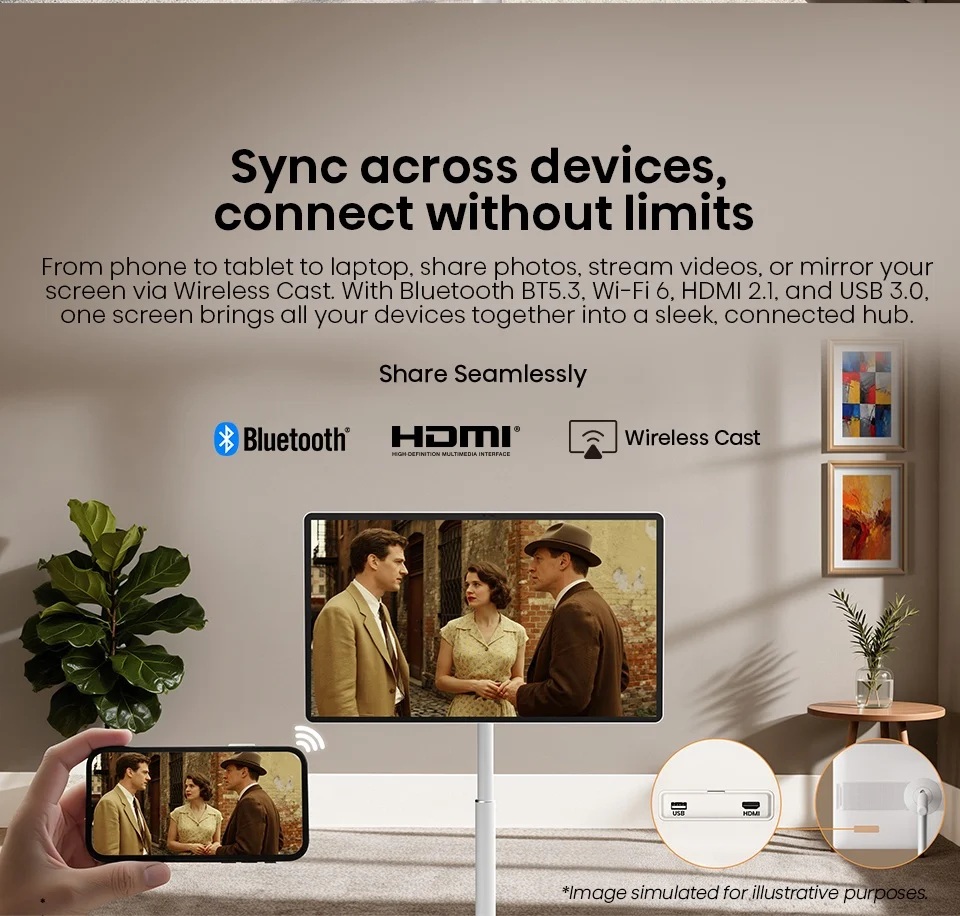
Hisense has included a reasonably modern selection of connectivity options. RoamView supports Wi-Fi 6, Bluetooth 5.3, HDMI 2.1, and USB 3.0, giving users several ways to connect additional devices or access content.
HDMI 2.1 means the display does not need to operate entirely as a self-contained Android device. A game console, computer, streaming device, or another HDMI source can still be connected when required. USB support similarly makes local media and compatible peripherals possible.
Wireless Cast allows content from phones, tablets, and laptops to be mirrored onto the larger screen. This is arguably one of the most natural uses for a device like RoamView: start something on a smaller personal device and quickly move it to the 32-inch screen without rearranging the room.
AI Features Handle Voice Control and Screen Brightness
Like almost every new connected device appearing in 2026, RoamView also arrives with several AI-labelled features. Hisense says its built-in intelligence enables voice commands for searching content, launching applications, controlling playback, and performing other common tasks.
Voice control makes particularly good sense on a movable screen because users may interact with it from different distances and positions. If the RoamView is across a bedroom or being used while cooking, touching the screen or finding a remote may be less convenient than simply asking it to perform an action.
An AI Light Sensor can also automatically adjust screen brightness based on ambient conditions. Since the display is expected to move between different environments throughout the day, automatic brightness adjustment is more relevant here than it might be on a conventional television permanently installed in the same location.

The Battery Opens Up Some Interesting Use Cases
Hisense advertises up to 10 hours of operation from the 15,000mAh battery, which could make RoamView useful in situations where a television would normally be impractical. It could be moved onto a covered balcony for an evening, rolled beside exercise equipment, positioned temporarily in a guest room, or used as a large recipe and entertainment screen in the kitchen.
Outdoor use is also mentioned, although users should still treat the product as an electronic display rather than rugged outdoor equipment. The presence of a battery does not automatically mean resistance to rain, extreme temperatures, or harsh environmental conditions.
Still, simply removing the need for constant mains power changes how people can think about a television. Instead of the screen defining the viewing location, the viewing location can define where the screen goes.
It Could Be Useful Beyond Watching Television
Calling RoamView a television does not completely describe what it is trying to be. The touchscreen, camera, Android operating system, wheels, battery, and adjustable positioning make it closer to a shared household smart display that happens to be large enough for television viewing.
A family could use it for entertainment in the evening, video calls during the day, exercise videos in another room, and then move it beside a desk as an additional screen. Businesses might also find uses for something similar in presentations, temporary collaboration spaces, showrooms, or mobile reception environments.
That flexibility is probably what Hisense is really selling. Someone simply wanting a 32-inch television can buy one for dramatically less money. The premium comes from having a screen that is expected to adapt to the user rather than requiring the user to adapt a room around it.
RM5,699 Makes It a Premium Lifestyle Purchase
Hisense has confirmed that the RoamView is now available in Malaysia for RM5,699. At the time of the announcement, the product did not appear to be available for direct purchase through Hisense's Malaysian website, although customers can use the company's store locator to find nearby physical retailers and confirm availability.
That price places the RoamView far above conventional 32-inch televisions, so buyers will need to value its mobility and smart-display capabilities to justify the premium. Viewed purely as a television, the economics are difficult. Viewed as a battery-powered 4K touchscreen, video-call station, Android device, casting display, and movable household screen combined into one product, the proposition becomes more understandable.
It is ultimately a niche device, but that does not necessarily make it a bad idea. Lifestyle technology increasingly succeeds by solving unusual problems that mainstream devices were never designed around.
Final Thoughts
The Hisense RoamView takes something as established as the television and asks a surprisingly simple question: why does the screen always have to stay in one place? Its 32-inch 4K touchscreen, adjustable rolling stand, 15,000mAh battery, Android software, built-in camera, speakers, and wireless connectivity create a device that can move through the home rather than permanently define one corner of it.
The 10-hour claimed battery life is arguably its most important feature because it turns mobility into something practical rather than decorative. Height adjustment, rotation, and tilt further reinforce that flexibility, while the MediaTek Genio 1200, 8GB of RAM, and 128GB of storage give the RoamView enough hardware to behave like considerably more than a television.
RM5,699 is undeniably expensive for a 32-inch screen, and anyone who simply wants Netflix in the living room can find much cheaper options. RoamView is aimed at people who see value in bringing the screen to wherever they happen to be rather than installing additional displays throughout the house.
It is an unusual product, but perhaps that is exactly the point. TVs have spent decades getting larger, thinner, and smarter. Hisense is now trying something different: making one that follows you around.











Comments 0