

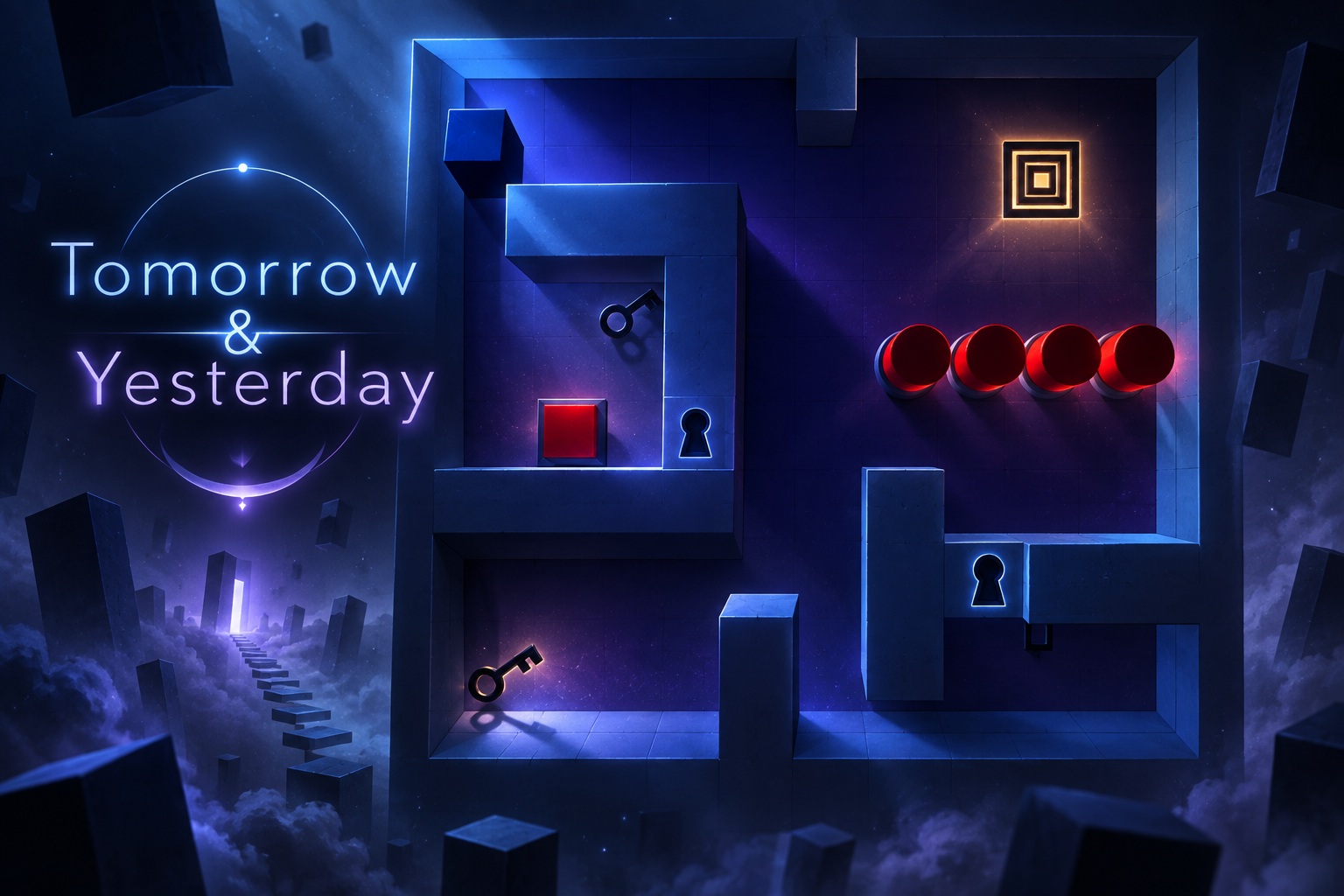
Tomorrow & Yesterday is a clever puzzle game built around time travel, maze-like levels, switches, locked doors, keys, and the unusual ability to cooperate with earlier versions of yourself. The game gives players a thoughtful browser experience where planning, sequencing, observation, and understanding cause and effect all matter. Instead of controlling several characters independently, players create those additional helpers by travelling backward in time and allowing their previous actions to repeat.
The appeal of Tomorrow & Yesterday comes from the way it transforms ordinary puzzle mechanics into something far more interesting. Standing on a switch or carrying a key would be simple in a traditional puzzle game, but here the player must often perform an action, travel back in time, and then work alongside the earlier version of themselves that repeats those movements. As levels become more complicated, multiple timelines begin interacting, turning every solution into a carefully arranged sequence of past, present, and future actions.
Now playable online through Lemon Web Games, Tomorrow & Yesterday can be experienced directly in your web browser as part of a growing collection of puzzle, logic, time-travel, maze, strategy, and browser-playable games. Its web-based availability makes it easy to jump into this unusual temporal challenge, where time machines, repeating past selves, switches, doors, keys, and multi-timeline problem solving come together in one memorable browser experience.
A Puzzle Game Built Around Time Travel
Tomorrow & Yesterday stands out because time travel is not simply part of the story. It is the central gameplay mechanic.
Players navigate small puzzle environments containing doors, switches, keys, and other obstacles. Some objectives cannot be completed by one character acting only in the present.
The solution is to use a time machine and return to an earlier point. The player's previous actions then become part of the puzzle, effectively creating another character who performs the same sequence again.
This turns time itself into a tool.
Working Together With Your Past Self
The most distinctive feature of Tomorrow & Yesterday is the ability to cooperate with earlier versions of your character.
Imagine that a door only remains open while someone stands on a switch. Normally, leaving the switch would immediately close the door and make progress impossible.
In Tomorrow & Yesterday, the player can stand on the switch first, travel backward, and then watch that earlier version repeat the action. The present version can now walk through the open doorway while the past self keeps the switch activated.
It is a simple idea, but it creates countless possibilities.
Your Previous Actions Become Part of the Puzzle
Every time the player travels backward, earlier actions become fixed parts of the timeline.
That means movement needs to be planned carefully. A poorly executed sequence can leave a past version standing in the wrong place or repeating an action that blocks progress.
The player is therefore solving two problems at once: what needs to happen now, and what needs to have happened earlier.
This is where Tomorrow & Yesterday becomes especially satisfying. A solution often begins with the realization that the action you need in the future must first be prepared in the past.
Switches Become Much More Interesting
Switches are common puzzle-game objects, but time travel changes how they work completely.
A switch might need to remain activated while another character moves elsewhere. Because only one player character exists initially, that seems impossible.
Creating a past version solves the problem.
Later puzzles can require several switches or carefully timed interactions, making players think about exactly when each version of the character should arrive at a particular location.
Keys and Locked Doors
Keys introduce another layer of logic.
Players may need to collect a key before accessing a certain area, but the order in which that happens can affect future timelines.
Sometimes a key must be obtained by an earlier version of the character. In other cases, one timeline may need to open a route that allows another version to reach the key.
This makes ordinary lock-and-key puzzles much more strategic.
Maze-Like Level Design
The stages in Tomorrow & Yesterday are compact but carefully structured.
Walls, corridors, switches, doors, keys, and time machines are arranged so that the solution depends on understanding the relationship between different areas.
The maze-like design encourages players to inspect the whole level before moving.
A pathway that appears useless at first may become essential once another version of the character exists in the timeline.
Planning Before Acting
Tomorrow & Yesterday rewards players who stop and think.
Moving immediately without understanding the level can create unnecessary complications, especially when past actions become permanent parts of later attempts.
It is often better to identify the switches, doors, keys, and time machines first, then imagine the sequence required to connect them.
This gives the game a calm but mentally demanding rhythm.
Cause and Effect Across Time
Every action has consequences.
Standing on a switch changes a door. Moving through a corridor changes where the character will appear later. Using the time machine creates another layer of cause and effect.
The puzzles therefore become exercises in temporal reasoning.
Players are constantly asking questions such as: What must happen first? Which version of the character should perform this action? When should the time machine be used?
That mental process is what gives the game its unique identity.
Time Loops Without Traditional Clones
Many puzzle games use clones or multiple controllable characters.
Tomorrow & Yesterday reaches a similar result through time travel.
The copies are not independent characters created from nowhere. They are recordings of what the player actually did earlier.
This makes the mechanic feel more logical and more personal. The player is literally cooperating with their own previous decisions.
Mistakes Can Teach the Solution
Failure is useful in Tomorrow & Yesterday.
A timeline that does not work often reveals exactly what needs to change. Perhaps a switch was activated too late, a character entered the wrong corridor, or the time machine was used before another task was completed.
Because the puzzles are compact, restarting and experimenting is easy.
Each failed attempt becomes part of the learning process.
Multiple Time Machines Increase the Complexity
Later levels introduce multiple time machines capable of returning the player to different points.
This dramatically expands the puzzle possibilities.
Instead of simply creating one past version, players may need to work across several temporal layers. One character can perform an action, another can travel to an earlier moment, and yet another can complete the final objective.
At this point, the game begins to feel like programming a sequence of events rather than controlling a single character.
Different Moments Create Different Versions of You
The interesting part of multiple time machines is that each version of the player represents a different point in the timeline.
These versions are connected because each one follows actions that were previously performed.
The player therefore needs to understand not only where each character is located, but also when that version exists.
This combination of spatial and temporal reasoning makes the later puzzles especially clever.
Simple Presentation Keeps the Logic Clear
Tomorrow & Yesterday benefits from a clean and straightforward presentation.
Because the central mechanic can become complicated, the levels themselves need to remain readable. Players should be able to identify paths, switches, doors, keys, and time machines without unnecessary visual distractions.
This simplicity helps the puzzle logic remain the main focus.
The game does not need elaborate graphics because the interesting part happens inside the player's head.
A Game About Sequencing
Many of the puzzles can be understood as sequences.
Action A must happen before Action B. Action B creates the conditions required for Action C. Then the player travels backward so the previous sequence can happen again while the current character performs Action D.
Thinking this way helps make difficult puzzles easier to understand.
Instead of asking, "How do I reach the exit?" players begin asking, "What sequence of events needs to exist before the exit becomes reachable?"
Temporal Cooperation
Cooperation is normally associated with multiplayer games, but Tomorrow & Yesterday creates a single-player version of the same concept.
The player cooperates with themselves.
One timeline handles a switch. Another collects a key. A later version moves through the route those earlier actions created.
It feels like coordinating a team, except every team member is the same character at a different moment in time.
Timing Without Fast Reflexes
Despite being built around time, Tomorrow & Yesterday is not primarily a fast-reaction game.
The difficulty comes from logical timing rather than physical reflexes.
Players need to understand when an action should happen in relation to other events, but they generally have time to think through the solution.
This makes the game suitable for players who prefer brain-teasing puzzles over action-heavy challenges.
The Satisfaction of Watching a Plan Work
One of the best moments in Tomorrow & Yesterday comes when a complicated timeline finally works.
A past self walks toward the switch exactly as planned. A door opens. Another version moves through. A key becomes accessible. The final route suddenly makes sense.
Watching all the pieces happen in the correct order creates a strong feeling of accomplishment.
The player has not simply discovered the solution—they have constructed it across time.
A Puzzle That Makes You Think Differently
Traditional puzzle games usually ask players to think about space: where can I move, and what can I reach?
Tomorrow & Yesterday adds another dimension.
Players must think about when actions happen.
That small change completely alters the problem-solving process and makes even simple level elements feel fresh.
Why Tomorrow & Yesterday Still Feels Fun
Tomorrow & Yesterday still feels fun because its central time-travel mechanic is easy to understand but capable of creating surprisingly deep puzzles.
The game begins with familiar concepts such as switches, doors, keys, and mazes, then gradually changes how players think about them.
Its enjoyment comes from discovery. Players slowly learn how past actions interact with present movement, then use that understanding to solve increasingly complicated timelines.
For modern players, Tomorrow & Yesterday offers a browser-playable logic game with a distinctive identity. It is a strong choice for anyone who enjoys time-travel puzzles, maze games, sequencing challenges, experimentation, and games where clever ideas matter more than fast reflexes.
Playing Tomorrow & Yesterday Online Today
Through Lemon Web Games, Tomorrow & Yesterday can now be played directly in your web browser with no downloads or setup required. Features of the web-based version include:
• Browser-based play for quick access
• No installation required
• Time-travel puzzle gameplay built around cooperating with previous versions of yourself
• Maze-like levels featuring switches, keys, locked doors, and time machines
• Increasingly complex temporal challenges involving multiple timelines and carefully planned sequences
• Accessible play through Lemon Web Games
Playing Tomorrow & Yesterday online today makes it easy to experience its unusual time-loop concept without additional installation. The browser format lets players jump directly into the puzzles and begin experimenting with past and present actions.
The game is best enjoyed patiently. Before moving, examine the level, identify which objects interact, and think about which actions may need to be performed by a previous version of the character.
Who Should Play Tomorrow & Yesterday
• Players who enjoy logic puzzle games
• Fans of time travel and time-loop mechanics
• Players who like switches, keys, doors, mazes, and sequencing challenges
• Fans of games where previous actions become part of future solutions
• Players looking for browser-playable puzzles that reward planning rather than reflexes
• Anyone interested in a clever game built around cooperating with their own past selves
Tomorrow & Yesterday is especially suitable for players who enjoy puzzles that create a genuine "aha!" moment.
It is also a strong choice for players browsing the Lemon Web Games library in search of something more thoughtful than a typical action game. The challenge comes from understanding the timeline rather than defeating enemies or chasing scores.
Play Tomorrow & Yesterday Online Now
Tomorrow & Yesterday is now available to play online through Lemon Web Games, giving players a simple way to experience this clever time-travel puzzle game directly in the browser. Its web-based format makes it easy to start playing without downloads or setup, while preserving the switches, keys, doors, time machines, maze layouts, and repeating past selves that define the experience.
For players exploring the Lemon Web Games library, Tomorrow & Yesterday offers a distinctive puzzle challenge built around one powerful idea: sometimes the person you need to help solve the puzzle is yourself from a few moments ago.
Playing Tomorrow & Yesterday today is a chance to enjoy a browser-playable logic game built around cause, effect, and carefully constructed timelines. Whether approached as a maze puzzle, a time-travel experiment, a sequencing challenge, or a thoughtful browser game, it delivers satisfying gameplay where every movement, switch, key, time machine, and past action matters.
Final Thoughts
Tomorrow & Yesterday remains memorable because it transforms a familiar puzzle structure through one clever mechanic. Doors, keys, switches, and mazes are ordinary puzzle elements, but allowing players to travel backward and cooperate with previous versions of themselves completely changes how those elements are solved.
Its greatest strength lies in the moment when a complicated timeline finally fits together. An action performed earlier suddenly becomes the key to progress later, and several versions of the same character effectively cooperate across time to complete the level.
Through Lemon Web Games, Tomorrow & Yesterday becomes easy to access and enjoy directly in the browser. It remains a worthwhile game for players who enjoy logic puzzles, time-travel mechanics, and creative problem solving. For anyone looking for a browser-playable game built around past selves, multiple timelines, switches, keys, and carefully sequenced actions, Tomorrow & Yesterday delivers a clever and rewarding puzzle experience.











Comments 0