

An early benchmark listing suggests that AMD's next-generation mobile processor could deliver a noticeable improvement in single-core performance, although efficiency and real-world results remain the bigger questions. AMD may still be some distance away from officially introducing its Zen 6 processor architecture, but an early benchmark entry has already offered a possible glimpse of what the company is preparing for its next generation of laptops.
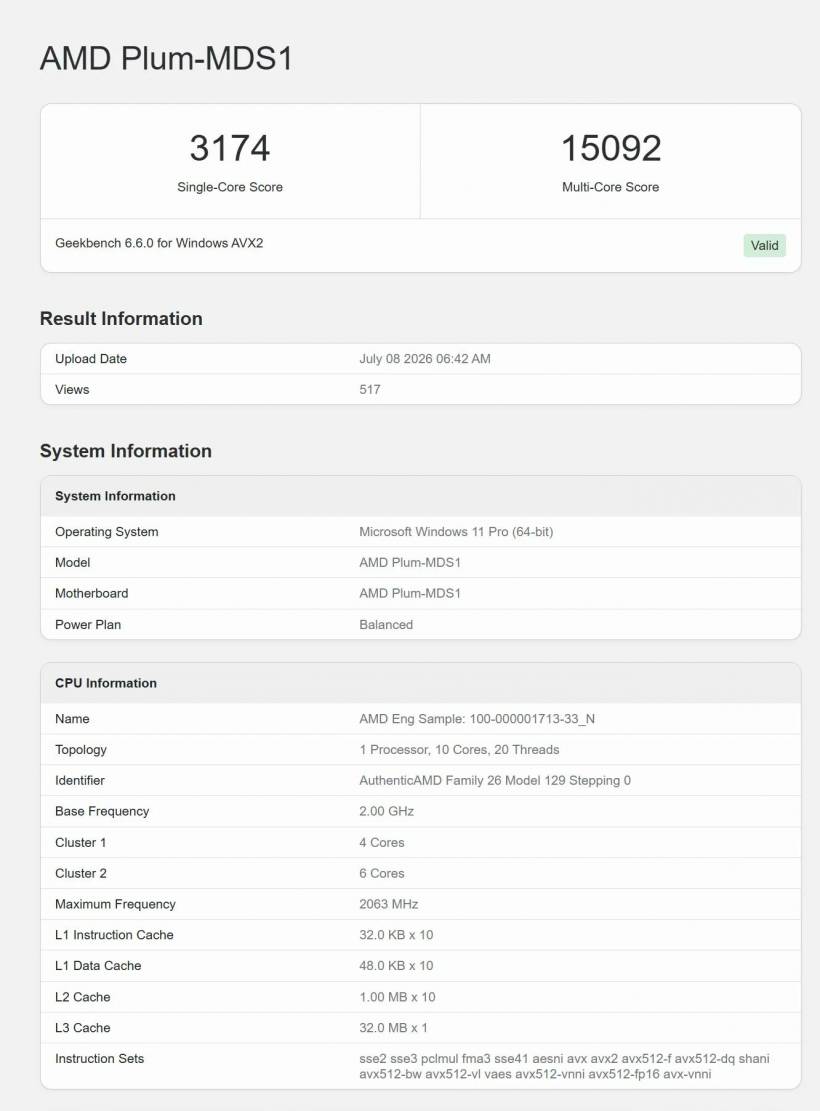
A 10-core engineering sample believed to be part of AMD's upcoming Medusa Point family has appeared on Geekbench under the name AMD Plum-MDS1. The processor recorded a single-core score of 3,174 and a multi-core score of 15,092.
Those figures immediately make the chip interesting, especially when compared with AMD's current high-end mobile processors. However, early benchmark results should always be approached carefully, as engineering samples often run with unfinished firmware, preliminary drivers and power settings that may not reflect the final retail product.
A New Hybrid 10-Core Design
The Medusa Point sample reportedly uses a 10-core configuration split across two CPU clusters. One cluster contains four cores, while the other contains six.
A likely explanation is that the processor combines full-performance Zen 6 cores with smaller Zen 6c cores designed to operate more efficiently. AMD has increasingly used mixed-core layouts in its mobile processors, allowing demanding workloads to run on the faster cores while background and lighter tasks are handled by more compact, power-conscious cores.
This approach is particularly important in thin-and-light laptops, where manufacturers must balance performance, heat output, battery life and physical cooling limitations.
If the reported configuration is accurate, Medusa Point could represent a further refinement of AMD's hybrid mobile strategy rather than simply increasing the total number of cores.
Strong Single-Core Gains
The most impressive part of the Geekbench listing is the single-core result.
Compared with the Ryzen AI 9 HX 370, the Medusa Point sample appears to be around 22% faster in single-core performance. Its multi-core score is also reportedly about 13% higher on average.
Single-core performance remains important because many everyday applications, games and operating-system tasks do not scale perfectly across a large number of CPU cores. Improvements in this area can make a laptop feel faster during common activities such as web browsing, office work, software launching and lightly threaded creative workloads.
The early result also places the Zen 6 sample more than 400 points ahead of the Ryzen AI Max+ 395 in single-core performance.
That said, the Ryzen AI Max+ 395 still holds an advantage in multi-core workloads, which is not surprising given its larger core configuration and positioning as a much more powerful processor for high-end systems.
Why the Multi-Core Result Needs Context
The Medusa Point chip's multi-core score may look less dramatic when compared with AMD's most powerful mobile processors, but direct comparisons can be misleading.
A 10-core APU designed for mainstream premium laptops may prioritise efficiency and sustained performance rather than trying to outperform a larger chip intended for workstations or desktop-replacement systems.
Clock speeds, thermal limits, memory configuration and laptop cooling can all have a major influence on benchmark results. An engineering sample tested in an unknown system may also be operating below its final boost frequency or with early power-management settings.
For this reason, the benchmark is better viewed as an early indication of Zen 6's potential rather than a final measure of how Medusa Point will perform in commercial laptops.
Battery Life Could Be the Bigger Challenge
Raw processing power may not be the only area AMD needs to improve.
Battery efficiency has become one of the most competitive areas in the laptop market. Intel's Lunar Lake platform raised expectations for all-day battery life, while newer Panther Lake systems are continuing to place greater emphasis on performance per watt.
AMD's current Ryzen AI processors remain competitive in performance, but some laptop models have struggled to match Intel-powered alternatives in sustained battery endurance.
This means Medusa Point will need to deliver more than higher Geekbench scores. It must also show that Zen 6 can provide stronger performance without significantly increasing power consumption.
For mobile users, a modestly slower processor with several extra hours of battery life can often be more useful than a faster chip that requires frequent charging.
More Than Just a CPU Upgrade
Medusa Point is expected to be an accelerated processing unit, meaning the package should combine CPU cores, integrated Radeon graphics and dedicated AI hardware.
The final product's appeal will therefore depend on more than CPU benchmark scores. Integrated graphics performance, neural processing capability, memory bandwidth, media acceleration and platform efficiency will all influence how competitive it is.
AI performance is becoming particularly important as laptop manufacturers increasingly promote on-device features such as local image processing, transcription, background effects and generative tools.
AMD will need to ensure that the Zen 6 platform delivers a balanced upgrade across all of these areas rather than focusing solely on traditional processor speed.
An Official Reveal May Still Be Some Time Away
AMD is widely expected to discuss Zen 6 during 2027, potentially around the CES period, although the company has not yet officially confirmed the launch schedule for Medusa Point.
Until then, more engineering samples and benchmark listings are likely to appear. These leaks may provide additional clues about clock speeds, core configurations, graphics specifications and power limits.
However, final performance will only become clear once production laptops are tested under controlled conditions using retail firmware and mature drivers.
Final Thoughts
The first Geekbench appearance of AMD's 10-core Medusa Point APU is encouraging, particularly because of its strong single-core score.
A potential 22% improvement over the Ryzen AI 9 HX 370 would represent a meaningful generational step, especially for everyday applications and lightly threaded workloads. The chip's hybrid 10-core layout could also help AMD strike a better balance between performance and efficiency.
Still, benchmark numbers are only one part of the story.
The real test for Medusa Point will be whether AMD can combine Zen 6 performance with longer battery life, stronger integrated graphics and competitive AI capabilities. If it succeeds, the platform could become one of the most important laptop processor launches of the next generation.











Comments 0