

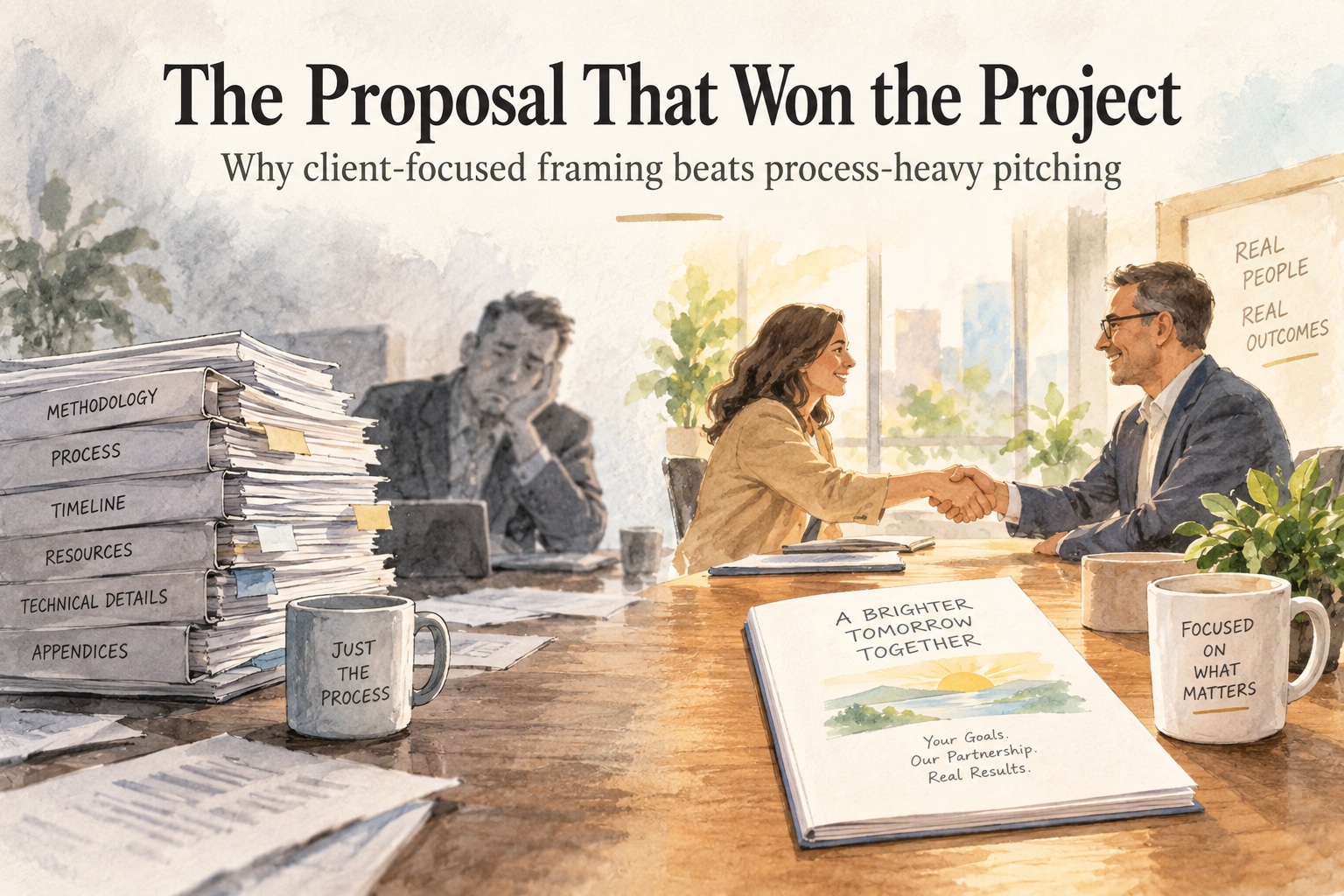
Two proposals can describe almost the same project, come from the same team, and promise the same quality of work, yet produce completely different reactions from a client. I learned that lesson after presenting one proposal that looked almost impossible to fault. It was beautifully designed, thoroughly researched, packed with detail, and organised into carefully defined phases. The client listened politely, asked sensible questions, thanked us for the presentation—and eventually hired someone else.
The next proposal we prepared was almost the opposite. It was shorter, visually simpler, and contained far less explanation about how we worked. Instead, it concentrated on what the client was struggling with, why that problem mattered, and what would be different once the project was completed. Before we had even finished presenting, the client was already talking about when we could start. The work we were selling had not suddenly become better; the way we framed its value had.
The Beautiful Proposal That Nobody Bought
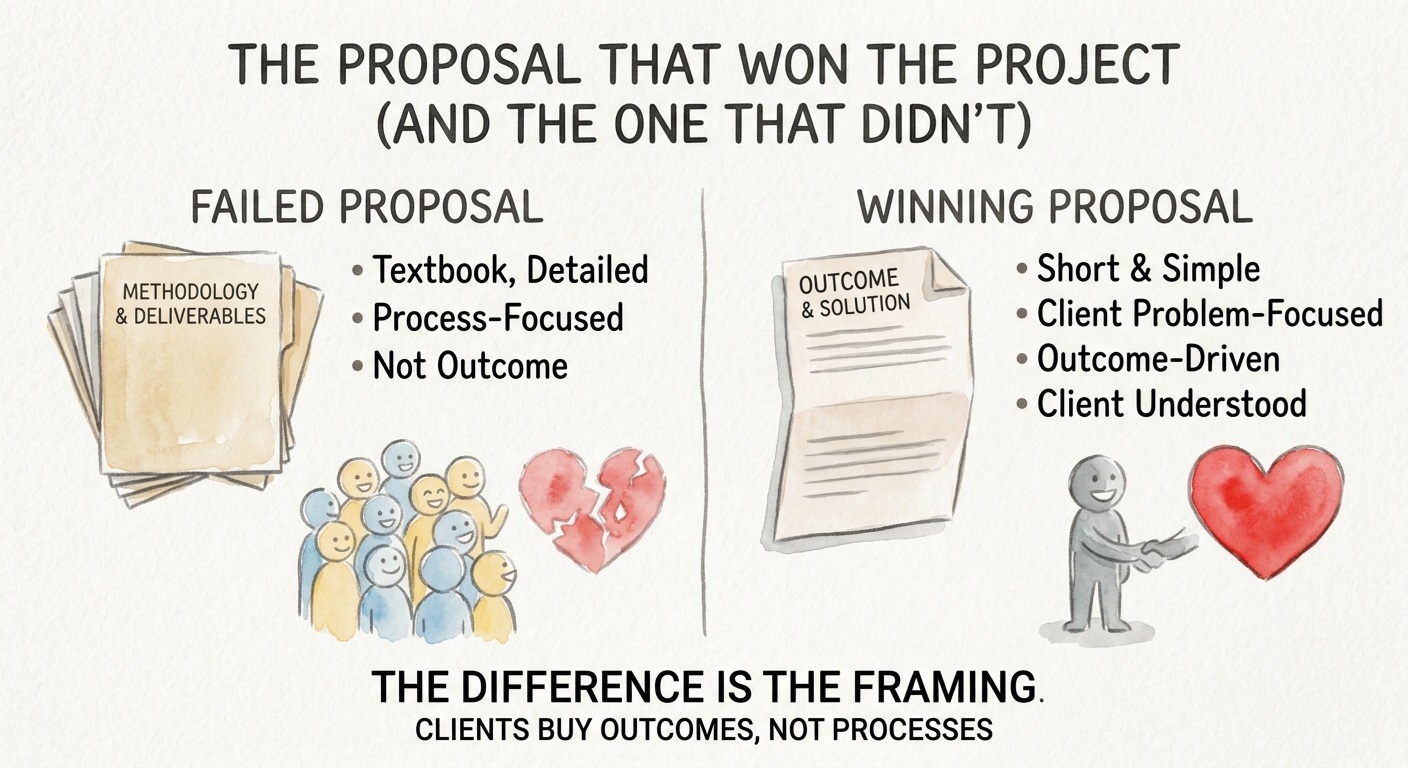
Our first proposal looked exactly like the sort of document agencies are often encouraged to produce. It opened with an introduction to our company, followed by our methodology, project stages, responsibilities, deliverables, milestones, timeline, and budget. Every section was polished, and almost every conceivable client question appeared to have been answered before it could even be asked.
From our perspective, this demonstrated professionalism. We wanted the client to see that we had thought everything through and had a mature process capable of managing the project from beginning to end. We spent a considerable amount of time explaining discovery, research, design, testing, implementation, and review because those were the things we believed proved we knew what we were doing.
The problem was that the client was not sitting in the room thinking about our process. They were thinking about their own business problem. They wanted to know whether the project would reduce complaints, improve conversions, simplify an inefficient workflow, or solve whatever issue had convinced them to seek outside help in the first place. Instead of answering that question immediately, we asked them to sit through a detailed explanation of how impressive our process was.
The proposal was technically complete but emotionally distant. It said a great deal about us and surprisingly little about what success would feel like for them.
A Polite Meeting Can Hide a Weak Response
The presentation itself gave us very few obvious warning signs. The client nodded, took notes, and asked several clarifying questions about timing and deliverables. Nothing suggested that we had lost them, which made the eventual rejection more frustrating because we believed the meeting had gone reasonably well.
Then came the familiar line: they would review everything internally and get back to us. Days passed, we followed up, and eventually learned that another firm had been selected. When we asked what had influenced the decision, the answer was painfully simple—the competing proposal had felt more compelling.
That word stayed with me because our proposal had contained more information. It had probably answered more technical questions and may even have demonstrated a stronger process. But completeness and persuasion are not the same thing. A proposal can be professionally impressive while still failing to give the client a strong reason to choose it.
We had answered, "How will we do this?" before convincingly answering, "Why should this matter to you?"
The Second Proposal Started Somewhere Completely Different
When the next opportunity arrived, we changed the structure dramatically. Instead of beginning with our company or methodology, we started with the client's situation using almost exactly the language they had used during our earlier conversations. The opening section described the problem as they experienced it, the consequences of leaving it unresolved, and the result they wanted to achieve.
Only after establishing that understanding did we describe our proposed solution. Even then, we kept the explanation focused on outcomes rather than internal process. Instead of saying that we would conduct stakeholder interviews, competitive analysis, workshops, wireframing, prototyping, and usability testing, we explained what those activities would ultimately give the client: clearer customer journeys, fewer points of confusion, faster completion of important tasks, and confidence that the final solution had been tested before launch.
The timeline was intentionally simple. The pricing was clear rather than buried inside several packages and optional additions, and the proposal avoided pages of explanation that mattered mainly to us. We were still going to follow a rigorous methodology behind the scenes, but the client did not need to become an expert in our workflow before feeling comfortable hiring us.
The entire proposal communicated one message: we understand the problem you are trying to solve, and we know what a successful outcome should look like.
Clients Buy Change, Not Methodology
This does not mean methodology is unimportant. A strong process helps teams manage uncertainty, avoid mistakes, communicate effectively, and consistently deliver better work. Clients absolutely deserve to know that an organised process exists, particularly when a project involves significant money, risk, or organisational change.
The mistake is making the process the main product. Clients rarely wake up excited because they are finally going to purchase a discovery workshop or receive twelve wireframes. Those are tools that help achieve something they actually care about, such as launching a service, increasing revenue, reducing operational costs, improving customer satisfaction, or making a complicated system easier to use.
A useful proposal therefore translates activities into outcomes. "We will conduct user interviews" becomes "we will identify why customers are abandoning the current process before redesigning it." "We will create prototypes" becomes "you will be able to test the new experience before spending money building it." The work remains exactly the same, but its relevance becomes much clearer.
That translation is what our first proposal was missing.
More Detail Can Sometimes Make a Decision Harder
There is a natural temptation to believe that adding more detail makes a proposal safer. If every task is listed, every milestone documented, and every possibility explained, surely the client will have fewer reasons to hesitate. In reality, too much information can introduce another problem: cognitive load.
A client reviewing several proposals does not necessarily want to understand every operational detail before deciding who they trust. Dense documents can make relatively straightforward decisions feel complicated, particularly when every agency uses different terminology for similar activities. The more effort required to understand the proposal, the easier it becomes to postpone the decision or choose the competitor who explained the same value more clearly.
Clarity does not mean hiding important information. It means giving information in the order the client actually needs it. Start with the problem and desired outcome, then explain the solution, scope, timing, investment, and relevant process. Supporting detail can always exist later in the document or as an appendix for people who need it.
A proposal should reduce uncertainty, not create another project for the client to decipher.
Using the Client's Own Language Builds Trust
One of the most effective changes in the successful proposal was surprisingly simple: we stopped translating the client's problem into our professional vocabulary. During discovery conversations, clients had already told us what frustrated them, what customers were complaining about, and what they wanted to improve. We began reflecting those same words back in the proposal.
That made the document feel immediately familiar. Instead of reading an agency's interpretation of their organisation, clients saw their own concerns clearly articulated and organised. That creates trust because understanding is demonstrated before expertise is claimed.
Professional terminology can sometimes create distance. Designers talk about user journeys, information architecture, interaction patterns, and design systems because those concepts are useful to us. A client may simply be worried that customers cannot find the checkout button or employees spend 20 minutes entering the same information twice.
The strongest proposal can speak both languages. It understands the professional solution while explaining it through the client's reality.
A Proposal Is Really a Story About the Future
Good proposals have more in common with storytelling than many teams realise. There is a current situation, something is preventing progress, and the client is trying to reach a better future. Your role is not to become the main character; it is to demonstrate how you can help them make that transition.
The first proposal effectively made our agency the hero. Look at our methodology. Look at our expertise. Look at how carefully we manage projects. All of those things were true, but they placed our company at the centre of a story that should have belonged to the client.
The successful proposal repositioned us as the guide. The client had the problem, the client had the goal, and our expertise existed to help close the gap between those two states. This subtle shift completely changed the tone of the conversation because success became something the client could picture rather than a collection of services they were expected to purchase.
When people can clearly imagine the outcome, the proposal becomes easier to believe in.
Confidence Often Looks Like Simplicity
Another lesson was that simplifying the proposal did not make us appear less capable. In fact, it created the opposite impression. When we could describe the problem, solution, schedule, and investment clearly, it suggested that we understood the work well enough not to hide behind unnecessary complexity.
Overexplaining can sometimes reveal our own anxiety. We add twenty slides because we are afraid the client will not understand the value, list every task because we worry they will question the price, and explain our entire methodology because we want to prove that significant work happens behind the scenes.
Confidence allows a proposal to be selective. It says enough to establish credibility and manage expectations without asking the client to understand every internal mechanism. The details still exist and can be discussed when relevant, but they no longer compete with the central message.
A clear proposal makes the decision feel clear too.
Process Still Matters — Just Put It in the Right Place
None of this means process should disappear entirely. Clients need to understand how decisions will be made, when they will be involved, what they are responsible for, and how the project will move forward. A vague promise of great results without any explanation of execution can be just as weak as an overly complicated methodology document.
The difference is hierarchy. Process should support the promise rather than becoming the promise itself. Explain enough methodology to show that the outcome is credible, then return the focus to what that process is intended to achieve.
For complex projects, process can also reduce perceived risk. Knowing that research happens before implementation, that prototypes will be tested, or that major decisions require approval can reassure stakeholders. But those details become much more persuasive once the client already believes you understand what they are trying to accomplish.
Outcome first. Evidence second. Process where it helps establish confidence.
Final Thoughts
The proposal that lost the project was arguably the more impressive document. It contained more detail, looked more polished, and demonstrated nearly every part of our methodology. Unfortunately, it answered the questions we wanted the client to ask rather than the questions they actually cared about.
The proposal that won was simpler because it began with empathy rather than explanation. It described the client's current problem, showed a believable future outcome, and made our role in getting there easy to understand. The process was still there, but it no longer dominated the conversation.
That experience permanently changed how I think about proposals. A proposal is not really a document about your agency, expertise, deliverables, or methodology. It is a document that helps a client decide whether they trust you to create a better situation than the one they have today.
So when preparing the next one, resist the temptation to begin with yourself. Start with what the client told you is wrong. Describe what success looks like in language they recognise, explain how you will help them reach it, and keep every other detail in service of that story.
The proposal with the most pages does not necessarily win. The one that makes the client feel most clearly understood often does.











Comments 0