

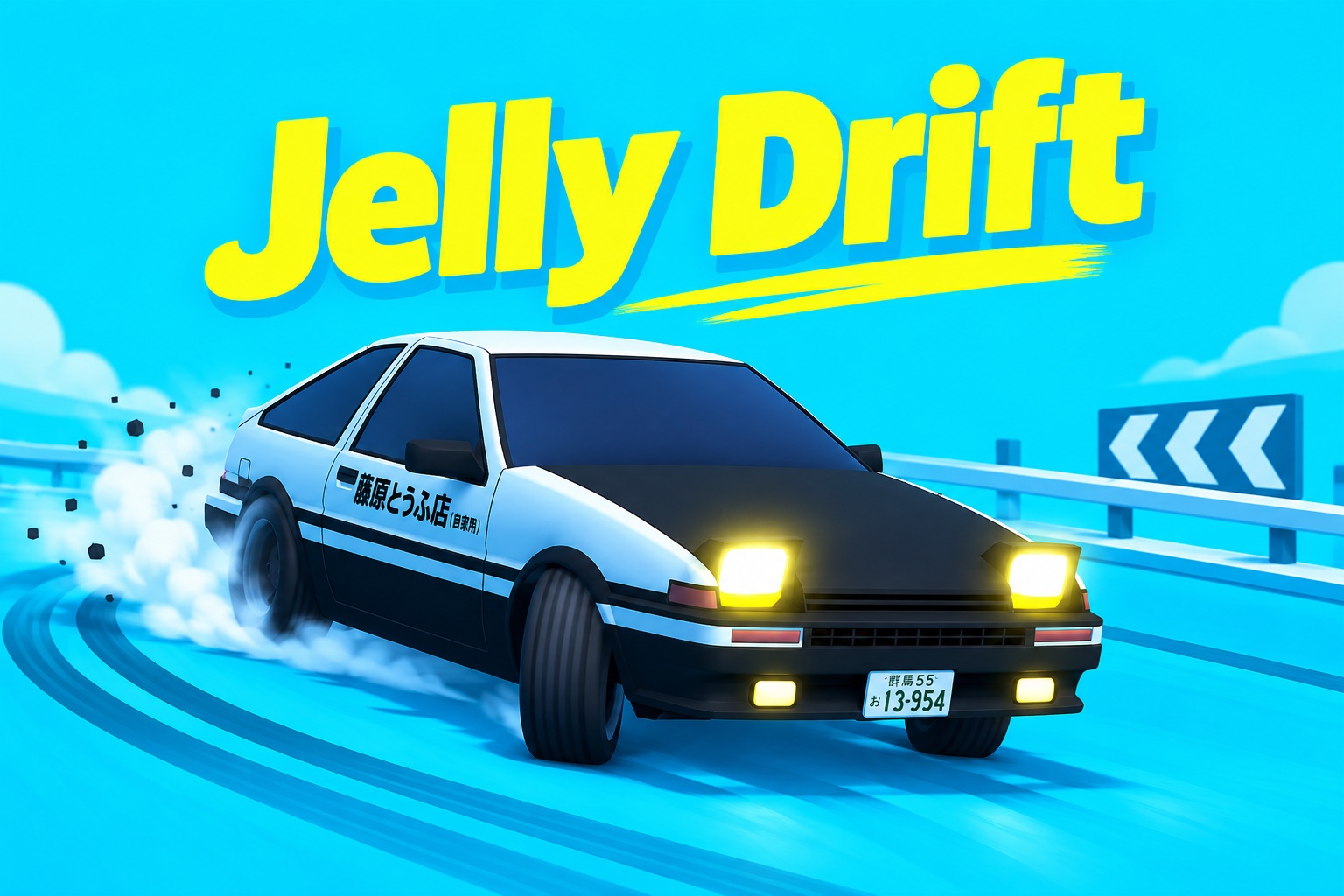
Jelly Drift is a deliberately unusual racing game where learning how to control the car is almost more important than simply driving quickly. Created by indie developer Dani, the game takes familiar arcade racing ideas and gives them an exaggerated physics system that makes every corner feel unpredictable during the first few attempts. Cars slide aggressively, momentum can quickly turn into a spin, and a seemingly simple bend can send an inexperienced driver completely off the road. What initially feels frustrating gradually becomes the main attraction once the player begins understanding how much steering, speed, and timing are needed to keep the car under control.
Rather than attempting to simulate realistic motorsport, Jelly Drift embraces chaotic handling and turns it into a skill-based challenge. The game features five tracks, seven cars, different skins, and the wonderfully ridiculous Banana Car, giving players several reasons to keep racing after becoming familiar with the basics. Each course asks players to learn its corners and decide whether a section should be taken with a controlled drift, a safer grip line, or a carefully timed correction. The result is a compact racing experience that can be hilarious when everything goes wrong and surprisingly rewarding when a difficult run finally comes together.
Now playable online through Lemon Web Games, Jelly Drift brings its slippery racing physics and fast-paced drifting directly into modern web browsers. Players can jump into a race, experiment with different cars, learn how the unusual handling behaves, and gradually improve their times without dealing with a complicated simulation setup. The browser-based experience is particularly well suited to the game's quick restart-and-try-again design, where even a disastrous run can immediately turn into another attempt. Whether you are chasing faster laps or simply enjoying the chaos of sliding around corners, Jelly Drift remains an entertaining example of how deliberately difficult controls can become the entire personality of a racing game.
A Racing Game Built Around Difficult Handling
The first thing most players notice about Jelly Drift is that the cars do not behave like vehicles in a typical arcade racer. Steering can quickly create a slide, and correcting too aggressively may send the rear of the car swinging in the opposite direction. The physics feel deliberately loose, forcing players to approach even simple corners differently from what they might expect. Learning to anticipate that movement is the real beginning of the game.
This unusual handling creates a steep but entertaining learning curve. New players may spend their first races leaving the road, spinning around, or approaching corners at completely the wrong angle. Gradually, however, the movement begins to make sense. Players learn that successful driving often depends on preparing for a corner before reaching it rather than reacting after the car is already sliding.
Once that understanding develops, Jelly Drift becomes far more satisfying. A corner that previously caused repeated crashes can eventually be taken smoothly with just the right amount of steering input. Linking several successful turns together feels especially rewarding because the player knows how easily the same section could have gone wrong. The difficulty becomes part of the fun rather than something separate from it.
Drifting Is About Controlling Momentum
Drifting is naturally central to Jelly Drift, but the game does not treat it as a simple button press that automatically guides the car around a corner. The vehicle carries significant momentum, and the player needs to understand how steering affects its direction while the tires are sliding. Entering a turn too aggressively can rotate the car far beyond the desired angle. Entering too cautiously may sacrifice valuable speed.
The best approach depends heavily on the corner. Some turns reward a wider entry that allows the car to rotate gradually, while tighter bends require earlier preparation and a much sharper correction. Players who attempt to use exactly the same drifting technique everywhere will quickly discover that different sections behave very differently. Learning the course therefore becomes just as important as learning the car.
A successful drift also requires thinking about the exit rather than only the corner itself. It is easy to begin a stylish slide and then discover that the car is pointing completely away from the next straight. Experienced players begin controlling the drift so the car finishes in a useful position. That transition from simply surviving corners to deliberately setting up the next section is where much of Jelly Drift's depth begins to appear.
Grip Can Sometimes Be Faster Than Sliding
Despite the title, drifting is not necessarily the perfect solution to every corner. Some sections can be taken more efficiently by maintaining grip and making a cleaner steering adjustment rather than deliberately throwing the car sideways. Players who learn when not to drift can often maintain greater stability and avoid unnecessary corrections. This gives the handling more nuance than simply sliding through everything.
Grip driving is particularly useful when the road provides enough space to maintain speed without requiring a large rotation. Keeping the car stable also reduces the risk of losing control immediately after the corner. The challenge is deciding whether the safer line will actually save time compared with a faster but more difficult drift. Different players may develop very different approaches to the same section.
The contrast between grip and drift makes experimentation worthwhile. A route that initially seems designed for a dramatic slide may actually produce a faster result when driven more smoothly. Conversely, a corner that feels awkward at normal speed can sometimes become easier when the car is intentionally rotated into it. Discovering these solutions is part of improving at Jelly Drift.
Five Tracks Provide Different Driving Challenges
Jelly Drift includes five courses, each designed to test the game's slippery handling in different ways. The early tracks provide opportunities to learn how the car behaves without immediately overwhelming the player with extremely complicated sequences. Later courses become more demanding, with longer corners and layouts that punish mistakes more severely. Progression therefore comes from both mastering the physics and learning increasingly difficult roads.
Track knowledge becomes incredibly important because the handling leaves little room for late reactions. Players who know a sharp corner is approaching can begin slowing or positioning the car before the bend becomes visible. Those racing a course for the first time may discover the turn only when they are already travelling too quickly to recover. Repeated attempts naturally improve performance.
The tracks are compact enough that learning them feels achievable. Instead of memorizing enormous racing circuits, players gradually recognize particular corners and sections after only a handful of runs. This makes improvement very noticeable. A course that initially feels completely uncontrollable can eventually become a sequence of familiar challenges.
Each Course Rewards Practice
Jelly Drift strongly encourages repetition because small improvements quickly become visible. A player who previously crashed several times may eventually complete the same course without leaving the road. After that, the focus shifts toward improving corner exits, maintaining speed, and reducing unnecessary steering. The same track therefore continues providing goals long after it has been completed once.
This progression is satisfying because it comes primarily from player skill rather than statistical upgrades. The car does not suddenly become easier simply because enough experience points were collected. Instead, the person controlling it gradually develops better timing and understanding. That makes faster runs feel genuinely earned.
Repeated practice can also reveal alternative approaches. Players may discover that one corner works better with an earlier drift, while another can be taken almost entirely through grip. Even small changes in entry position can affect how much correction is required afterward. These discoveries make racing the same course repeatedly more interesting than it might initially appear.
Seven Cars Encourage Experimentation
The game includes seven cars, allowing players to experiment with different vehicles while working through the available tracks. Even when the basic physics remain recognizable, changing vehicles gives players another reason to revisit courses and reconsider familiar sections. A car that feels comfortable to one player may not necessarily suit someone else's driving habits. Finding a preferred vehicle becomes part of the overall experience.
Car selection can also influence how confident the player feels when approaching difficult sections. Some drivers may prefer a vehicle that seems easier to control, while others may enjoy something that encourages more aggressive drifting. The game's exaggerated physics ensure that no choice completely eliminates the need for careful steering. Every car still demands respect when entering a difficult corner.
Experimentation also keeps practice sessions from becoming repetitive. After struggling with one vehicle for several runs, changing cars can make the same track feel fresh again. Players may discover that a previously troublesome course suddenly becomes easier to understand. Even when the differences are subtle, variety helps extend the game's replay value.
The Banana Car Captures the Game's Personality
The Banana Car has become one of Jelly Drift's most recognizable features because it perfectly reflects the game's sense of humor. Instead of treating racing as a completely serious competition, the game happily allows players to drive something as ridiculous as a banana-shaped vehicle. It fits naturally alongside the deliberately unstable physics and exaggerated crashes. Jelly Drift never pretends to be a realistic racing simulator.
The novelty would not matter much if the underlying driving were uninteresting, but the Banana Car works because it appears within a game already built around experimentation and challenge. Unlocking or using unusual vehicles gives players another reason to keep racing after becoming comfortable with the main courses. It also makes successful runs feel even more absurd when the vehicle looks completely inappropriate for serious motorsport.
That playful attitude is important to the overall experience. Difficult handling could easily become frustrating if the presentation treated every mistake as a serious failure. Jelly Drift instead embraces the chaos. Spinning off the road in a banana-shaped car feels far easier to laugh about than failing inside a strict racing simulation.
Low-Poly Visuals Keep Everything Clear
Jelly Drift uses a colorful low-poly visual style that keeps the tracks clean and readable. Environments are intentionally simple rather than overloaded with realistic textures and background detail. This makes it easier to focus on the road, upcoming corners, and competing vehicles. The visual style also suits the lighthearted personality of the game.
Cars are similarly straightforward in appearance, with recognizable shapes and bright presentation rather than complex simulation-level modelling. The minimalist look ensures that the physics remain the main attraction. Players spend more time thinking about the next corner than admiring reflective bodywork. This simplicity gives the game a distinct indie identity.
The visual approach also complements the speed of play. When the car begins sliding unpredictably, clear track edges and simple surroundings make it easier to understand what has gone wrong. A more visually complicated environment could make the already difficult handling even harder to read. The clean presentation helps maintain a useful balance between chaos and clarity.
The Camera Helps Sell the Sense of Speed
The camera follows the car smoothly and provides enough distance to see approaching sections of the track. This is important because Jelly Drift demands early preparation for difficult corners. Players need enough visual information to decide whether they should begin turning, reduce speed, or maintain their current line. A poor camera system would make the unusual physics far more frustrating.
The movement also contributes to the game's sense of speed. Sliding through a long corner while the camera follows the vehicle creates a satisfying feeling of momentum, particularly when the drift remains under control. When the car suddenly spins, the same camera makes the loss of control immediately obvious. Both success and failure are communicated clearly.
Because the presentation remains simple, the camera rarely needs to compete with cinematic effects or elaborate environmental animation. Its main job is to support driving. This straightforward approach suits a game where mechanical control is more important than spectacle. The road and the vehicle remain the center of attention.
Racing Against Opponents Adds Pressure
Jelly Drift is not purely about driving alone around empty courses. Other vehicles add competition and force players to think about positioning in addition to controlling their own car. A corner that feels manageable during practice becomes more difficult when another vehicle occupies the preferred racing line. Contact can also turn an otherwise clean run into immediate chaos.
The unusual physics make collisions particularly dangerous. Bumping another car may change the player's angle enough to trigger a spin or send the vehicle away from the road. Recovering costs valuable time, especially when opponents continue driving normally. This makes avoiding unnecessary contact an important skill.
At the same time, racing alongside opponents makes successful overtakes satisfying. Passing another vehicle while maintaining control through a difficult corner feels significantly better than simply recording a faster solo time. Competition adds urgency to the physics challenge. Players need both speed and enough control to remain on the track.
Difficulty Turns Each Victory into an Achievement
The game's difficult handling means even completing a clean race can feel rewarding during the early hours. Players are not simply competing against opponents; they are also fighting their own tendency to overcorrect. Every successful corner demonstrates that the player has learned something about how the car behaves. Gradual improvement becomes highly visible.
Higher difficulty naturally increases the pressure. Opponents become less forgiving, and mistakes that could previously be recovered from may now cost the race entirely. This encourages players to develop cleaner techniques rather than relying on chaotic corrections. A fast but inconsistent driver can struggle against someone taking slightly slower but more controlled lines.
That balance gives Jelly Drift surprising staying power. The basic game is easy to understand, yet becoming consistently good requires much more practice. There is always another corner that could be taken more efficiently or another run that could be cleaner. Racing becomes an ongoing process of refinement.
Shortcuts Reward Players Who Understand the Courses
As players become familiar with the track layouts, they may begin noticing opportunities to take faster routes or cut sections more aggressively. Finding a shortcut is only useful if the car remains under control afterward. A risky line that saves distance but causes a spin ultimately costs more time than staying on the road. This makes shortcut use another extension of the game's risk-versus-control philosophy.
Experienced players can approach these sections with confidence because they understand how the physics will react. They know how much steering is required, where the car is likely to slide, and when a correction needs to begin. New players attempting the same maneuver may simply leave the course. Knowledge therefore becomes as valuable as reaction speed.
Shortcuts also contribute to competitive time chasing. Once a standard route has been mastered, players naturally begin looking for ways to remove unnecessary distance. Small discoveries can lead to significantly faster runs. This is one reason Jelly Drift developed appeal among players interested in speedrunning and optimized times.
Time Chasing Gives the Game Long-Term Appeal
Completing the tracks is only the beginning for players who enjoy improving their performance. The simple structure makes Jelly Drift well suited to chasing personal best times. Because courses are relatively short, restarting after a poor opening corner is quick and painless. Players can immediately attempt another run rather than waiting through lengthy menus or loading sequences.
Small improvements become addictive. Shaving even a fraction of a second from a previous time may require taking one corner more efficiently or carrying slightly more speed through a difficult section. These goals provide motivation after ordinary racing has become familiar. The physics that initially seemed unpredictable gradually become something players try to exploit.
This also explains why experienced drivers can make Jelly Drift look dramatically easier than it actually is. Once the handling becomes familiar, movements that initially seemed chaotic start appearing deliberate. Watching a clean run can hide the amount of practice required to produce it. The gap between beginner and experienced play is part of the game's appeal.
Mistakes Are Usually Funny Before They Are Frustrating
Jelly Drift benefits enormously from the fact that failure often looks ridiculous. A small steering error can suddenly turn into a complete spin, an off-road excursion, or an awkward collision with another vehicle. Because the presentation is intentionally playful, these mistakes frequently become entertaining rather than purely frustrating. The game almost seems designed to produce amusing disasters.
Quick restarts help maintain that tone. A bad race does not require a lengthy recovery process before another attempt can begin. Players can immediately return to the course and try a different approach. This keeps frustration from accumulating too heavily.
The unpredictability also makes the game entertaining even when the player is not particularly skilled. Someone struggling with the physics can still enjoy watching the car slide wildly around the track. As control improves, the humor shifts toward the satisfaction of avoiding disasters that previously happened constantly. Both stages of the learning process have their own appeal.
Music Supports the Fast-Paced Racing
The game's music contributes to the energetic atmosphere without overwhelming the driving. Fast-paced tracks complement the constant movement and encourage players to keep pushing forward after mistakes. The soundtrack fits the playful indie presentation rather than attempting to imitate serious motorsport broadcasts. It adds energy without changing the game's relaxed personality.
Audio feedback also helps reinforce the sensation of movement. Engine sounds, collisions, and drifting noises make the car feel more active even within the minimalist visual presentation. A clean corner sounds and feels different from a messy collision. These small details support the driving mechanics.
The combination of music and physics creates a rhythm that becomes increasingly satisfying when a run goes well. Corners flow together, the car maintains speed, and the soundtrack reinforces the momentum. When something goes wrong, the sudden collision or spin creates an equally noticeable interruption. The audio helps make both outcomes feel immediate.
Dani's Humor Is Part of the Experience
Jelly Drift reflects the informal, humorous style associated with Dani's indie projects. The game does not surround itself with serious motorsport terminology or attempt to convince players that its physics are realistic. Instead, difficult controls and ridiculous vehicles are treated almost like part of the joke. That tone makes the experience approachable despite the demanding handling.
The Banana Car is the clearest example, but the entire presentation shares the same playful attitude. Simple menus, bright visuals, exaggerated physics, and quick races make the game feel like something created around one entertaining mechanical idea rather than a massive commercial racing franchise. This gives Jelly Drift plenty of personality.
That personality is also why the game's imperfections can become part of its charm. Players are not expecting a detailed simulation of tire temperatures or aerodynamic balance. They are trying to keep an intentionally slippery vehicle pointing in roughly the correct direction. The game succeeds because it fully understands what kind of experience it wants to provide.
A Compact Game with Plenty of Replay Value
Five tracks and seven cars may sound modest compared with enormous modern racing games, but Jelly Drift is built around replaying rather than simply consuming content once. Each course becomes a practice ground where players can improve lines, experiment with vehicles, and chase faster times. The demanding physics make repeated runs feel meaningfully different as skill increases. The focus is depth through mastery rather than quantity.
Different cars and skins provide additional reasons to keep playing, especially for players who enjoy unlocking and experimenting with the available options. The Banana Car adds a particularly memorable reward for dedicated racers. Changing vehicles can also refresh familiar tracks after many repeated attempts. The game remains compact without feeling immediately disposable.
Because races are relatively short, Jelly Drift works particularly well for quick sessions. Players can complete a few attempts, improve a time, and return later without needing to remember complicated progression systems. At the same time, anyone determined to master every track can spend considerably longer refining their driving. That flexibility is one of the game's strengths.
Why Jelly Drift Remains Enjoyable
Jelly Drift succeeds because its greatest weakness and greatest strength are effectively the same thing. The controls initially feel difficult, slippery, and almost unreasonable, but mastering that difficulty becomes the entire purpose of the game. If the vehicles handled perfectly from the first race, much of the challenge and personality would disappear. Improvement matters because control is never handed to the player automatically.
The game also understands the value of simplicity. There are no enormous upgrade trees, complicated vehicle tuning menus, or lengthy career stories distracting from the central mechanic. Players select a car, enter a track, and immediately begin dealing with the physics. That directness makes failure easier to accept because another attempt is always seconds away.
Most importantly, Jelly Drift creates memorable moments. A perfect drift can feel fantastic, while a disastrous spin can be equally entertaining for completely different reasons. Few racing games make both success and failure quite so amusing. That balance gives the game a charm that extends beyond its small amount of content.
Playing Jelly Drift Online Today
Through Lemon Web Games, Jelly Drift can now be played directly in your web browser with no downloads or setup required. Features of the web-based version include:
Playing Jelly Drift through a browser fits the game's straightforward racing structure particularly well. There is very little separating the player from the actual driving, making it easy to jump into a track and immediately begin practicing. A race that ends badly can quickly become another attempt, encouraging experimentation rather than making every mistake feel costly. The compact structure also makes it suitable for both short sessions and longer attempts at improving personal times.
Returning players can concentrate on refining techniques they already understand, while newcomers can experience the strange learning curve that made the game memorable in the first place. The first few attempts may involve more spinning than drifting, but improvement becomes noticeable surprisingly quickly. Once the physics begin to make sense, the same corners that initially felt impossible can become opportunities to carry speed and build a cleaner run.
Who Should Play Jelly Drift
Jelly Drift is particularly suitable for players who enjoy learning through repetition. The game does not immediately explain how to take every corner perfectly, so improvement comes from experimenting with speed, steering, and drift timing. Players willing to fail repeatedly will gradually begin recognizing exactly why each mistake happened. That process of understanding is the real progression system.
It is also a strong choice for players who prefer racing games without complicated management systems. There are cars and tracks to explore, but the main objective is always straightforward: drive faster and stay under control. The unusual physics provide enough complexity on their own. For players who enjoy mechanical mastery more than menus and customization, Jelly Drift offers a refreshingly focused experience.
Play Jelly Drift Online Now
Jelly Drift takes the familiar idea of racing around a track and makes it entertaining by deliberately refusing to give the player perfectly obedient cars. Every corner becomes a small negotiation between steering, speed, momentum, and the risk of losing control. Drifting can produce fast and stylish runs, while maintaining grip can sometimes provide the safer and more efficient option. Learning when to use each approach is what transforms the experience from chaotic sliding into deliberate racing.
Through Lemon Web Games, players can jump directly into Jelly Drift through a modern browser and begin learning its unusual driving physics immediately. The five tracks provide increasingly demanding challenges, while the available cars and skins encourage experimentation between runs. Chasing better times gives completed courses continued purpose, and the Banana Car provides exactly the kind of ridiculous reward that matches the game's personality. It is simple to start, difficult to master, and entertaining even when a race goes completely wrong.
Final Thoughts
Jelly Drift is a great example of a game turning an unconventional mechanical choice into its entire identity. The slippery handling initially feels like something that needs to be overcome, but gradually players realize that mastering those physics is the real game. Every successful drift, controlled recovery, and clean sequence of corners demonstrates improvement that comes directly from practice. There is no substitute for learning how the car responds when momentum begins pushing it somewhere you did not intend to go.
Its compact structure also works in its favor. Five tracks, seven cars, different skins, and the wonderfully absurd Banana Car provide enough variety without distracting from the central challenge. Rather than attempting to compete with enormous racing simulations, Jelly Drift focuses on short races, difficult handling, and repeated attempts at improvement. The low-poly presentation and playful sense of humor make failure easier to laugh at while still giving skilled players plenty of room to chase better performances.
What ultimately makes Jelly Drift memorable is the transformation from frustration into control. A new player may barely survive the first corners, while an experienced driver can eventually link together smooth slides and maintain speed through sections that once seemed impossible. Through Lemon Web Games, players can experience that learning curve directly in their browser, experiment with different cars, and discover why a deliberately difficult racing game can become so rewarding once everything finally begins to click.











Comments 0