

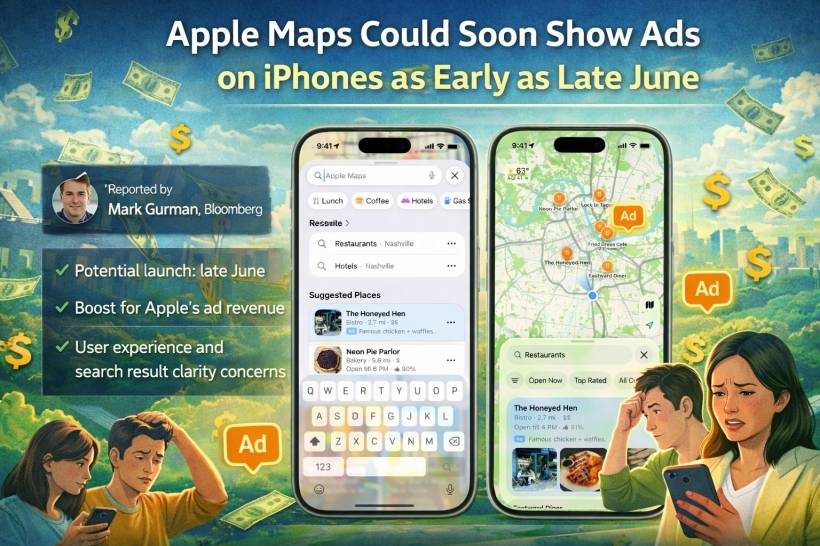
Apple has long positioned itself as a company that puts user experience first, especially compared with rivals whose businesses rely more heavily on advertising. That is one reason why the idea of ads appearing in Apple Maps feels like a notable shift. It is not exactly shocking from a business standpoint, but it does raise questions about where Apple wants to take its services next.
According to recent reporting, ads could begin appearing in Apple Maps on iPhones and other devices as early as late June, with broader rollout timing potentially stretching into the summer. If that happens, it would mark another step in Apple's steady expansion of its services business, which has become a far more important part of the company's overall revenue picture over the years.
On paper, this makes a lot of business sense. In practice, though, the real issue will be whether Apple can introduce advertising without making Maps feel more cluttered, more confusing, or less trustworthy.
Why Apple Would Do This
From a business perspective, the logic is easy to understand.
Apple's services division has grown into a massive part of the company's business, generating more than US$100 billion a year and accounting for a much larger share of total sales than it did a decade ago. That kind of growth naturally creates pressure to keep expanding the areas where revenue can be generated. Advertising, even at a relatively modest scale by Apple standards, represents another stream of income that fits into that strategy.
That is why ads in Apple Maps are not really about innovation in the traditional sense. They are about monetisation. Apple already has a huge user base, a deeply integrated ecosystem, and millions of people relying on its apps every day. From a corporate viewpoint, turning one of those high-traffic apps into an ad-supported revenue channel is a fairly straightforward decision.
The challenge is that users do not open Apple Maps thinking about Apple's services revenue. They open it because they want directions, nearby places, and accurate results without friction.
What Ads in Apple Maps Might Look Like
The basic idea is not unfamiliar. Anyone who has used Google Maps has probably already seen sponsored listings appear above organic search results. A restaurant, café, petrol station, or shop can effectively pay for better visibility when someone searches nearby.
If Apple follows a similar path, Apple Maps could end up showing promoted businesses more prominently when users search for places or services. This would likely affect not just iPhones, but other Apple devices and even the web version of Maps.
That sounds simple enough, but it is one of those features where the execution matters far more than the concept itself. Ads inside a maps app are different from ads on a news site or in a social media feed. In a maps app, people are often in a hurry. They may be driving, rushing to a meeting, looking for a clinic, or trying to find an unfamiliar location. In that setting, even a small amount of confusion can become a real problem.
The User Experience Problem
This is where the concern becomes more serious.
When ads appear above genuine search results, the line between what is promoted and what is actually the best match can become blurry. That is already something many users experience in other mapping platforms. If the labels are not clear enough, or if the design makes sponsored content look too similar to organic results, people can easily tap on the wrong place.
That may sound like a minor inconvenience, but in a maps app, the consequences are more annoying than they are in a normal search engine. Choosing the wrong listing could mean navigating to the wrong destination, wasting time, or missing an appointment. It becomes even more frustrating when the user does not have an exact address and is relying on the app to interpret a general search accurately.
In other words, this is not just about whether ads are present. It is about whether those ads interfere with the app's core purpose.
Apple has built much of its brand identity around simplicity and polish. So if ads in Apple Maps start to feel intrusive or misleading, that could clash quite badly with the company's usual image.
A Bigger Shift in Apple's Strategy
There is also a broader story here beyond just Maps itself.
For years, Apple has often contrasted itself against companies whose products are more heavily shaped by advertising. Whether directly or indirectly, the message has usually been that Apple makes money by selling devices and services, not by turning every corner of its ecosystem into an ad slot.
That distinction has already become less sharp over time. Apple's advertising efforts are not brand new, and the company has clearly been exploring more ways to expand that business. Still, bringing ads into Maps would make that shift feel more visible to everyday users.
It would also show how important services revenue has become to Apple's future. Hardware may still define the company's identity in the public mind, but services are increasingly central to its business model. As that side of the company grows, users may start seeing more places where monetisation appears inside Apple's own apps.
Will Users Accept It
A lot depends on how subtle or aggressive Apple decides to be.
If ads are clearly labelled, limited in number, and presented in a way that does not distort results too much, many users may simply accept them as part of the modern app experience. Plenty of people already tolerate sponsored listings elsewhere, especially if the overall app still works well.
But if Apple pushes too hard, the reaction could be more negative. Apple users tend to expect a cleaner, less commercial feel from the company's software. That expectation may not always be realistic in today's market, but it is still there. Maps is also one of those apps where trust matters a lot. People want to believe that the results they see are useful because they are relevant, not because someone paid to sit at the top.
Once that trust starts slipping, it is hard to rebuild.
Final Thoughts
Ads in Apple Maps may make perfect sense from a revenue standpoint, but they also risk changing how people perceive one of Apple's most practical everyday apps.
For Apple, this is likely another step in growing a services business that has already become a major financial engine. For users, however, the question is much simpler: will Apple Maps still feel like a tool designed to help you get where you need to go, or will it start to feel like another platform trying to sell visibility to the highest bidder?
That is really what will determine whether this move is accepted or criticised. Ads alone are not necessarily the problem. The real issue is whether they get in the way. And in a maps app, even a little friction can be a lot more noticeable than Apple may hope.











Comments 0