

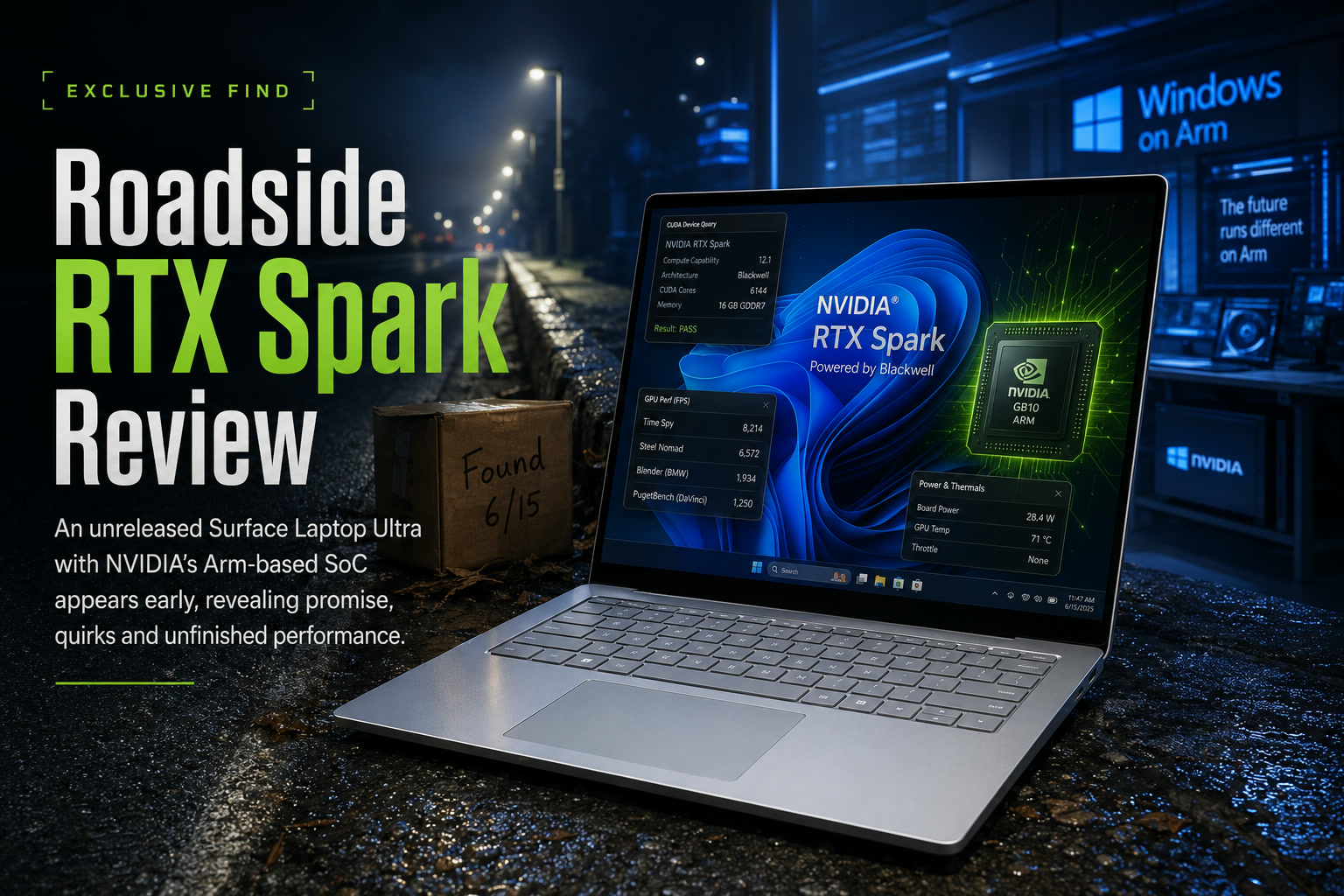
Unreleased hardware normally reaches reviewers through carefully controlled briefings, loan agreements and strict embargoes. This time, however, an alleged Microsoft Surface Laptop Ultra reportedly appeared in a far less conventional place: beside a road.
A long-time technology forum member using the name Fouquin claims to have found the laptop abandoned and initially assumed it was electronic waste. After taking it home and examining the machine, the user discovered what appears to be a pre-release Windows-on-Arm laptop powered by NVIDIA's upcoming RTX Spark system-on-chip.
Rather than simply posting a few photographs, Fouquin conducted an extensive series of performance, power and thermal tests. The results provide an unusual early glimpse at NVIDIA's attempt to combine Arm CPU cores, Blackwell graphics and CUDA support inside a premium Windows laptop.
However, this is clearly unfinished hardware running preview software. The findings are interesting, but they should not be treated as final launch-day performance.
An Extremely Unusual Hardware Leak
Prototype laptops occasionally appear through regulatory filings, shipping records or benchmark databases. Finding one beside a road is considerably less common.
According to Fouquin, the device was picked up because it looked as though someone had discarded it. Only later did its unusual hardware configuration become apparent.
The machine is described as a Microsoft Surface Laptop Ultra fitted with the highest-end RTX Spark configuration. The chip reportedly combines:
The name and final specifications may still change before commercial availability. Prototype branding is not always identical to what eventually appears in shops, and manufacturers frequently test several configurations before selecting the final product.
Even so, the presence of a large Blackwell GPU inside a thin Windows-on-Arm laptop makes this device particularly interesting.
Why NVIDIA's Entry into Windows-on-Arm Matters
Windows-on-Arm laptops have existed for years, but the market has recently become more competitive.
Qualcomm's Snapdragon X processors have helped improve performance and battery life, while Apple's M-series MacBooks continue to demonstrate how powerful and efficient Arm-based laptops can become when the processor, operating system and software are designed closely together.
NVIDIA entering this space could significantly change the competition.
The company already dominates several areas of GPU computing, including gaming, professional visualisation, artificial intelligence and scientific workloads. A laptop chip combining an Arm CPU with a capable Blackwell GPU could appeal to developers, creators and researchers who depend on CUDA.
It could also give Microsoft another high-performance processor option for Windows-on-Arm, reducing the platform's dependence on Qualcomm.
The challenge is that good hardware alone will not guarantee success. NVIDIA and Microsoft must also deliver mature drivers, stable power management and strong application compatibility.
The leaked prototype suggests that some of this work is still in progress.
The Laptop Initially Arrived with Outdated Drivers
The laptop reportedly came with old graphics drivers that limited the usefulness of the initial testing.
Fouquin later installed NVIDIA preview driver version 616.00, which enabled CUDA support for the integrated Blackwell GPU. This made it possible to run more meaningful compute and AI-oriented tests.
The update improved functionality, but it also changed the system's power behaviour.
Before the driver update, the laptop reportedly consumed around seven to eight watts while idle in Balanced mode. Afterward, that power level became closer to what the machine used under its Best Power Efficiency setting.
Balanced mode increased to roughly 12 watts at idle, while Performance mode reportedly reached approximately 23 watts before the system was placed under a serious workload.
Those are relatively high idle figures for a laptop intended to compete with efficient Arm-based systems.
However, preview drivers frequently prioritise debugging, compatibility and performance testing rather than battery optimisation. Background logging or incomplete power-state management may also increase consumption.
The retail version could behave very differently once the firmware and drivers are finalised.
Early Software Stability Is Clearly Not Ready
The prototype reportedly developed a repeatable lock-up after approximately one hour of use.
That behaviour alone demonstrates why the results should not be treated as a review of a finished commercial laptop. A system that freezes during ordinary operation is still undergoing validation or is running software that was never intended for public release.
Pre-production devices may contain:
The lock-up may have been caused by the graphics driver, the operating system image, prototype firmware or an interaction between several unfinished components.
It does not necessarily mean that the retail laptop will experience the same problem. Still, it shows that NVIDIA and Microsoft have meaningful software work remaining before launch.
CPU Performance Looks Competitive, but Not Class-Leading
Fouquin tested the laptop using the Phoronix Test Suite and several versions of Cinebench.
In Cinebench 2024, the RTX Spark CPU reportedly achieved:
In Cinebench 2026, it reportedly produced:
The benchmarks were conducted with an estimated 80-watt PL1 power limit, suggesting that the laptop was operating in its highest-performance profile.
The scores demonstrate that the 20-core Arm processor is capable of serious work. However, it reportedly trails Apple's M5 Pro systems and several established x86 platforms in parts of the test suite.
That comparison may appear disappointing considering the core count and high power limits, but the number of cores alone does not determine performance.
Results depend on several other factors, including:
Some benchmarks may also be better optimised for Apple Silicon or x86 processors than for NVIDIA's new architecture.
Until independent reviewers test final hardware using stable software, the early numbers provide only a rough indication of performance.
Power Profiles Do Not Yet Behave as Expected
One surprising result was the apparent lack of improvement in certain AI tests when switching from Balanced mode to Best Performance.
A performance profile would normally increase power limits, clock speeds or thermal allowances and produce a measurable benchmark gain. If the scores remain essentially unchanged, several explanations are possible.
The AI workload may already be limited by memory bandwidth, software or another component that receives no benefit from additional CPU power. The driver may also be applying the wrong power state, or the benchmark may not yet be fully optimised for RTX Spark.
This is another indication that the platform's power-management logic remains unfinished.
The final product will need clearly differentiated profiles. Users should be able to select quieter and more efficient behaviour when travelling, then obtain noticeably higher performance when connected to power.
Battery GPU Performance Is Surprisingly Consistent
One of the more encouraging findings is that GPU performance reportedly remains similar whether the laptop is connected to a charger or running on battery.
Many Windows laptops reduce graphics power substantially when unplugged. This protects battery life but can make demanding applications feel dramatically slower away from a power socket.
Apple has established a different expectation with its Arm-based MacBooks, which generally retain a large portion of their performance on battery.
Matching that consistency would be valuable for Windows-on-Arm.
Creators, developers and engineers could run GPU-accelerated tasks without feeling that the laptop becomes a different machine as soon as it is unplugged.
Of course, maintaining graphics performance on battery can shorten runtime considerably. The real test will be whether the retail laptop can balance performance with practical battery life.
The Blackwell GPU Does Not Yet Match Its Core Count
A GPU with 6,144 CUDA cores sounds extremely powerful, especially inside a laptop.
However, the early results were reportedly less impressive than the specification might suggest.
This is likely because the integrated GPU operates within a relatively restricted power envelope. Fouquin estimates that the graphics section is configured around a 50-watt total graphics power target, although the exact power distribution is difficult to determine because the CPU and GPU share the same system-on-chip limits.
The GPU reportedly operates at approximately 1,550MHz to 1,950MHz during normal demanding workloads, even though it can briefly reach around 2GHz to 2.2GHz under favourable conditions.
Max-Q technology is enabled, meaning the system prioritises power efficiency and operates below the GPU's possible thermal limit.
A large number of cores running at restricted power and frequency may perform very differently from a discrete Blackwell GPU with its own dedicated memory and a much higher power budget.
The integrated design may still be highly effective for CUDA, local AI processing and content-creation workloads. It simply should not be judged solely by comparing its core count with desktop graphics cards.
The CPU Regularly Approaches 100°C
Thermal behaviour appears to be one of the most concerning areas of the prototype.
Under Balanced and Best Power Efficiency modes, the CPU cores reportedly climb towards approximately 38 watts. Some of the X925 cores then reach between 98°C and 100°C before the cooling fans respond.
The fans apparently do not activate early enough to prevent initial thermal throttling. Once running, they can maintain the CPU at approximately 35 to 37 watts and around 2.6GHz.
In Best Performance mode, the cores reportedly consume between 44 and 50 watts and operate at roughly 2.8GHz while remaining close to 100°C.
Modern laptop processors are designed to operate near their thermal limits when performance is required, so reaching 100°C does not automatically indicate damage. Nevertheless, sustained operation at that temperature can affect fan noise, surface comfort and long-term performance consistency.
The delayed fan response is more unusual.
Ideally, the cooling system should anticipate a sustained workload and increase airflow before the CPU begins throttling. The inability to adjust fan behaviour may be another limitation of the prototype firmware or unfinished control software.
The GPU Runs Cooler Than the CPU
The integrated Blackwell GPU reportedly reached approximately 90°C during brief spikes but commonly operated between 80°C and 88°C when the fans were active.
That is still warm, but it is lower than the CPU's peak temperature.
The GPU also appears to encounter power limits before thermal limits. In other words, its performance is restricted mainly because it has reached the amount of power allocated to it, not because it has become too hot to continue.
This is consistent with a Max-Q design.
NVIDIA's efficiency-focused technology adjusts clock speeds, voltage and power distribution to achieve the best possible performance within a laptop's cooling and battery constraints.
The final system may allow the CPU and GPU to redistribute power dynamically depending on the workload. A rendering task could favour the GPU, while a compilation or simulation workload might allocate more power to the CPU.
That optimisation will be critical because the overall platform appears to operate within a shared maximum of approximately 95 to 105 watts, depending on the limit being measured.
The Cooling System May Need Further Tuning
The reported temperatures do not necessarily mean that the cooling hardware is inadequate.
The issue may be how the system controls it.
A prototype can have unfinished fan tables that wait too long before responding or do not properly account for short bursts of CPU activity. Microsoft and NVIDIA may still be testing the balance between noise, temperature and performance.
Aggressive fans would keep the processor cooler but could make the laptop unpleasantly loud during routine work. Conservative fan behaviour creates a quieter machine but may allow temperatures to rise rapidly.
Finding the correct balance requires extensive testing across different climates, workloads and device positions.
A laptop used in a warm Malaysian environment may also experience different thermal behaviour from one tested in a cooler room, making reliable cooling especially important for global markets.
Build Quality Appears to Be a Major Strength
Despite the software and thermal issues, Fouquin reportedly praised the physical construction of the Surface Laptop Ultra.
The laptop is said to feel well designed and solidly built, with a keyboard that offers firm feedback and very little wobble.
Keyboard quality matters greatly on a premium productivity laptop. Even a fast system can be frustrating if the keys feel shallow, unstable or inconsistent.
Microsoft's Surface devices have traditionally placed strong emphasis on industrial design, and the prototype appears to continue that approach.
The final price remains unknown, but the "Ultra" branding suggests that Microsoft may position it above ordinary Surface Laptop models.
Presence Detection Adds a Polished Touch
The prototype reportedly includes a keyboard backlight that dims automatically when the user walks away.
The laptop can then use its camera or presence sensor to detect when the person returns and wake the system or restore the keyboard lighting.
This type of feature is not revolutionary, but it contributes to the premium experience.
Presence sensing can also support security by automatically locking the computer when the user leaves. When combined with Windows Hello facial recognition, the system may wake and authenticate the user with minimal interaction.
The quality of this experience will depend on accuracy. A presence sensor that frequently activates when someone merely walks past could become irritating, while one that fails to lock the device would provide little security value.
The Review Should Be Treated as an Engineering Preview
The testing is impressively thorough, especially considering the strange circumstances under which the laptop was reportedly obtained.
Nevertheless, several limitations remain.
The device may not represent the final hardware revision. Its cooling system, battery, firmware and power limits may differ from commercial units. The operating system and graphics drivers are also unfinished.
The reviewer's test setup is not identical to the controlled methods used by professional publications. Results should therefore not be compared directly with unrelated benchmark databases without considering differences in configuration and software.
Most importantly, the device's origin has not been independently confirmed. It appears to be a prototype based on its hardware and behaviour, but the full story behind how it reached the roadside remains unknown.
Could This Become a CUDA-Focused MacBook Rival?
The most interesting possibility is that RTX Spark could create a new category of Windows laptop.
Apple currently offers strong CPU performance, efficient integrated graphics and consistent battery operation. Qualcomm provides increasingly capable Windows-on-Arm devices focused on productivity and battery life.
NVIDIA could differentiate itself through CUDA.
A portable Windows machine with a powerful integrated Blackwell GPU could appeal to:
The laptop may not need to outperform every discrete gaming GPU to succeed. It could instead provide an efficient, unified platform for workloads that benefit from NVIDIA's software ecosystem.
However, that opportunity depends on application compatibility, battery life, driver maturity and pricing.
Windows-on-Arm Compatibility Remains Crucial
Even excellent hardware can struggle when software support is incomplete.
Windows-on-Arm has improved significantly, with better native applications and stronger x86 emulation. Yet some specialist tools, games, drivers and enterprise applications may still behave differently from their x86 versions.
NVIDIA's involvement could encourage more developers to produce native Arm64 builds, particularly for CUDA-enabled applications.
Microsoft will also need to ensure that Windows scheduling, sleep behaviour, device drivers and application emulation work reliably on RTX Spark.
The reported lock-ups and unusual power profiles demonstrate how much the user experience depends on software integration.
Apple's advantage comes partly from controlling the processor, hardware and operating system together. NVIDIA and Microsoft will need similarly close coordination to deliver a competitive result.
Final Thoughts
The alleged Surface Laptop Ultra is one of the most unusual pre-release hardware discoveries in recent memory.
Finding an unreleased NVIDIA-powered Surface device beside a road sounds almost unbelievable, but the resulting tests provide a fascinating first look at RTX Spark.
The platform shows genuine promise. Its 20-core Arm CPU delivers respectable performance, the Blackwell GPU supports CUDA, and graphics speed appears consistent on battery and mains power. The laptop's construction, keyboard and presence-sensing features also suggest a carefully designed premium device.
At the same time, the prototype is clearly unfinished.
Its idle power consumption appears high, software stability is unreliable, thermal behaviour is aggressive and the GPU has not yet delivered performance matching the expectations created by its core count.
Those weaknesses may improve substantially before launch. Preview drivers, prototype firmware and early hardware can behave very differently from final retail products.
The larger question is not whether this roadside unit can defeat Apple's latest MacBook today. It is whether NVIDIA and Microsoft can transform the underlying concept into a stable, efficient and well-supported Windows-on-Arm platform.
If they succeed, RTX Spark could give Windows laptops something the market has not previously seen: a genuinely portable Arm machine built around NVIDIA's powerful CUDA and AI ecosystem.











Comments 0