

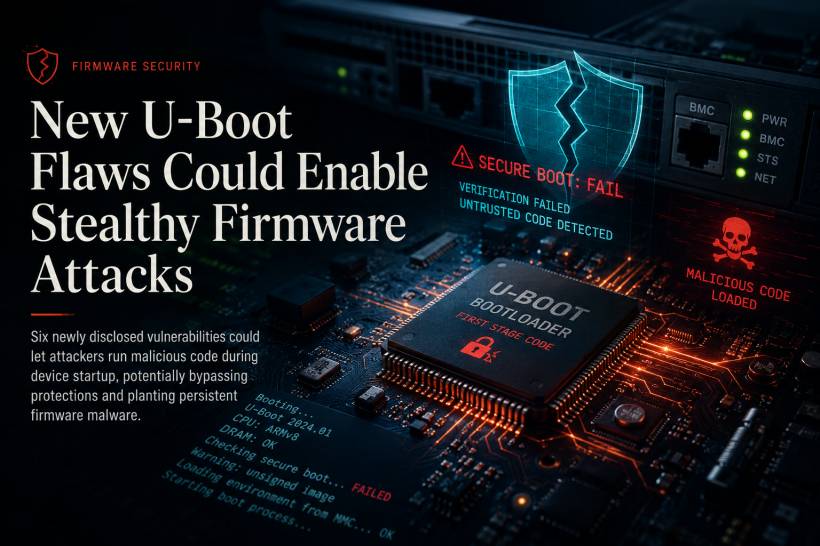
A newly disclosed group of security flaws in the widely used U-Boot bootloader could allow attackers to interfere with devices before the operating system and its security protections have even started. The vulnerabilities affect the process used to verify firmware images during startup. In the most serious cases, an attacker may be able to execute malicious code at the firmware level, potentially creating persistent infections that are extremely difficult to detect or remove.
The issue is particularly significant because U-Boot is not limited to a single type of product. It is used across a wide range of embedded Linux systems, including network appliances, industrial equipment, Internet of Things devices, servers and Baseboard Management Controllers.
Why U-Boot Is Such an Important Security Component
U-Boot is responsible for preparing a device and loading its operating system. It runs during the earliest stage of startup, before Windows, Linux or other operating systems become active.
This gives the bootloader a highly trusted position within the device.
If the boot process is compromised, an attacker may gain control before endpoint protection, monitoring agents, antivirus software or other defensive tools have started. This can allow malicious activity to remain hidden from security controls that normally operate within the operating system.
Bootloader vulnerabilities are therefore often considered more serious than ordinary application flaws because they affect the foundation on which the rest of the system depends.
Verified Boot Is Intended to Stop Untrusted Firmware
One of U-Boot's key security mechanisms is Verified Boot.
The feature uses cryptographic signatures to confirm that firmware and operating system images were signed by a trusted party before allowing them to load. In theory, this prevents modified or unauthorised firmware from being introduced into a device.
However, the newly identified vulnerabilities affect the code responsible for validating these signed images.
If an attacker can exploit weaknesses inside the verification process itself, the security mechanism intended to block untrusted firmware could instead become the point of entry.
Six Vulnerabilities Found in Firmware Verification Code
The flaws were identified in U-Boot's Flattened Image Tree signature-verification functionality. FIT images are commonly used to package kernels, device trees and other components needed during the boot process.
Two of the vulnerabilities may allow arbitrary code execution, while the other four can cause affected devices to crash or stop booting properly.
The disclosed issues include:
Although denial-of-service flaws may appear less severe than code-execution vulnerabilities, a crashed bootloader can still leave critical equipment unavailable or unable to start.
For networking, industrial and infrastructure devices, that downtime may have a much wider operational impact.
Some of the Vulnerable Code Has Been Present for Years
The affected code is believed to have existed since U-Boot version 2013.07.
That means the vulnerabilities could potentially affect more than 50 stable releases, along with numerous manufacturer-specific versions based on the same code.
This creates a complicated patching situation.
Hardware manufacturers often take an open-source bootloader such as U-Boot, modify it for their products and maintain their own firmware branches. As a result, the number of affected devices may extend far beyond the official project releases.
A security fix added to the main U-Boot codebase does not automatically update all routers, servers, industrial controllers or IoT appliances using older customised versions.
Attackers Could Gain Control Before the Operating System Loads
The arbitrary code-execution vulnerabilities are the most concerning because they could allow malicious instructions to run during firmware verification.
A successful attacker may be able to:
Firmware-level malware can be particularly persistent because it may remain active even after the operating system has been repaired, replaced or completely reinstalled.
In some cases, removing such an infection may require a trusted firmware reflash or even replacement of the affected hardware.
Physical Access May Not Always Be Required
Bootloader attacks are often associated with someone having direct physical access to a device, but that may not always be necessary.
Some systems, particularly server-management controllers, network appliances and embedded platforms, support remote firmware updates through administrative interfaces.
If an attacker has already compromised one of those management services, they may be able to upload a specially crafted firmware image remotely and use it to trigger one of the vulnerabilities.
This means the flaws could become part of a larger attack chain.
An attacker might first steal administrator credentials or exploit a web-management interface, then use the firmware-update mechanism to move deeper into the device and establish more persistent access.
BMC Systems Could Be Particularly Sensitive
Baseboard Management Controllers deserve special attention because they operate independently from the main server operating system.
A BMC allows administrators to remotely power servers on or off, view system status, access consoles and perform maintenance tasks even when the main operating system is unavailable.
Because of this powerful role, a compromised BMC can provide an attacker with a valuable and persistent foothold inside an organisation's infrastructure.
If the BMC's firmware-update process relies on a vulnerable version of U-Boot, an attacker who gains access to the management interface may be able to target the bootloader as part of a deeper firmware attack.
Organisations should therefore ensure that BMC interfaces are restricted, properly segmented and not directly exposed to the public internet.
Patches Are Available, but Vendors Must Deliver Them
Fixes for all six vulnerabilities have been accepted into U-Boot's main development code.
However, this does not mean every affected device is already protected.
Each manufacturer must review the patches, integrate them into its customised firmware, test the updates and then distribute new firmware packages to customers.
The process may take time, particularly for vendors supporting many products or maintaining heavily modified versions of U-Boot.
Customers are therefore dependent on the hardware manufacturer to release a device-specific update.
Older Devices May Remain Permanently Vulnerable
The greatest concern involves products that are no longer supported.
A router, industrial device, server controller or embedded appliance may continue operating for many years after its manufacturer has stopped providing firmware updates.
If such a device contains one of the vulnerable U-Boot versions, it may never receive a security fix.
Replacing unsupported equipment may not always be practical, especially in industrial or specialised environments. In those cases, organisations should consider additional protections such as stronger network segmentation, restricted management access and closer monitoring of firmware-update activity.
What Organisations Should Do
Administrators should begin by identifying devices that use U-Boot, particularly products with remote firmware-update capabilities or exposed management interfaces.
Recommended actions include:
Firmware and bootloader components are often overlooked in traditional patch-management programmes, which tend to focus mainly on operating systems and applications.
These vulnerabilities show why hardware firmware should also be included in regular vulnerability reviews.
Final Thoughts
The newly disclosed U-Boot flaws highlight how attackers may target the earliest and most trusted stages of a device's startup process.
While only two of the six issues are believed to support arbitrary code execution, those vulnerabilities could be especially damaging because they operate before the operating system and its security controls become active.
The fixes are now available in the upstream U-Boot project, but the real challenge will be how quickly individual hardware manufacturers incorporate them into their own firmware releases.
For organisations, the most important step is to understand where U-Boot is being used, particularly across network equipment, BMCs, industrial platforms and long-lived embedded systems.
Devices that no longer receive vendor support should be treated with particular caution, as they may remain exposed long after the vulnerabilities have been publicly disclosed.











Comments 0