

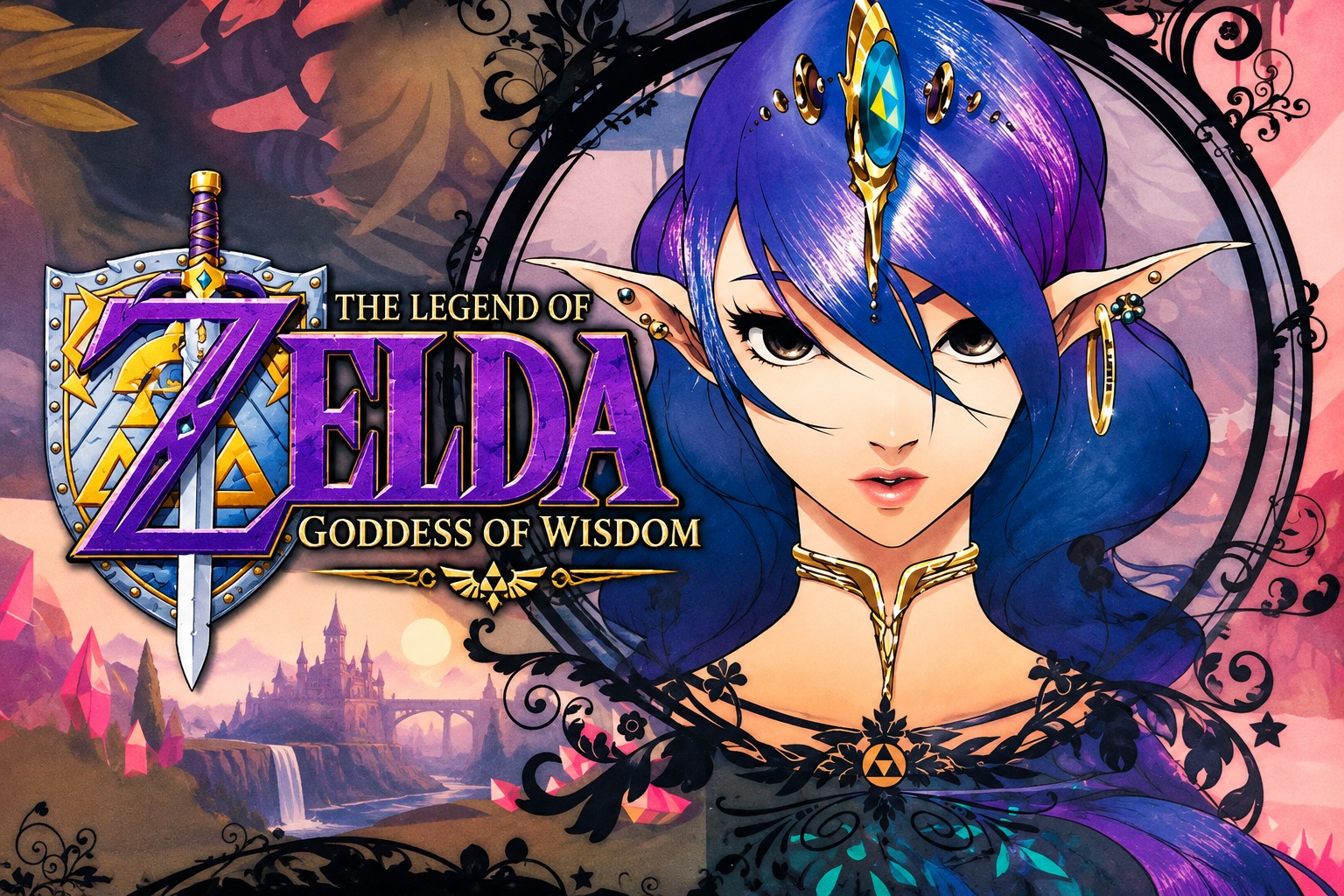
The Legend of Zelda: Goddess of Wisdom takes the familiar foundation of The Legend of Zelda: A Link to the Past and rebuilds it into a much more demanding adventure aimed primarily at players who already understand classic Zelda mechanics. Rather than simply changing enemy placement or increasing damage, this fan-made modification redesigns large portions of the overworld, dungeon layouts, puzzles, routes, and progression. Link still explores a recognizable 16-bit Hyrule using familiar equipment, sword combat, and item-based exploration, but players cannot rely on memories of the original game to know where everything leads. The result feels like returning to a familiar world only to discover that nearly every assumption about it needs to be reconsidered.
Goddess of Wisdom is especially notable for its emphasis on puzzle solving and advanced movement techniques. Dungeons frequently require players to manipulate blocks, light torches in carefully considered sequences, use bombs creatively, revisit earlier rooms, and understand how Zelda items interact with the environment in ways that the original adventure rarely demanded. Certain sections can be unforgiving, particularly for players who approach the game expecting the relatively accessible progression of A Link to the Past. This is an adventure designed around experimentation, observation, persistence, and a willingness to rethink a puzzle several times before the solution finally becomes clear.
Now playable online through Lemon Web Games, The Legend of Zelda: Goddess of Wisdom brings this challenging fan-made Zelda adventure directly into the web browser, allowing players to explore its altered version of Hyrule without relying on original hardware. Familiar sword combat, dungeon exploration, hidden secrets, item progression, and boss encounters remain central to the experience, but redesigned routes make the journey feel significantly different from the adventure many players already know. The browser-based version is particularly convenient for returning Zelda fans who want a tougher interpretation of the classic formula. For anyone who knows A Link to the Past almost by memory, Goddess of Wisdom provides an opportunity to become uncertain about Hyrule again.
Built on the Foundation of A Link to the Past
Goddess of Wisdom uses A Link to the Past as its technical and mechanical foundation, which means the basic controls immediately feel familiar to experienced Zelda players. Link can swing his sword, lift objects, dash, use bombs, fire arrows, equip magical items, and gradually gain access to areas that were impossible to reach earlier. The familiar interface and 16-bit presentation make the opening moments feel reassuringly recognizable. That familiarity does not last long once exploration begins.
The hack changes enough of the world that knowledge of the original adventure can sometimes become misleading. A route that once led toward an important landmark may behave differently, familiar areas may contain completely redesigned paths, and dungeons demand new solutions rather than reproducing Nintendo's original puzzles. Players therefore need to observe what is actually in front of them instead of automatically following remembered routes. This makes exploration feel surprisingly fresh despite using familiar graphics and mechanics.
That balance between familiarity and uncertainty is one of the hack's greatest strengths. Players already understand what Link can do, so the game does not need to spend hours introducing basic Zelda concepts. Instead, it can concentrate on asking more complicated questions about how those abilities should be used. The challenge comes from applying familiar tools in unfamiliar ways.
A Hyrule That No Longer Feels Completely Familiar
The overworld is one of the first places where experienced players realize that Goddess of Wisdom is not interested in simply recreating A Link to the Past. Roads, obstacles, hidden entrances, environmental barriers, and connections between regions have been rearranged to create a different exploration path. Familiar landmarks may still provide a sense of orientation, but reaching them can involve entirely new routes. This turns Hyrule back into somewhere worth investigating carefully.
Exploration frequently rewards players who examine suspicious walls, unusual terrain, isolated platforms, and environmental details rather than travelling directly toward the next obvious objective. Items collected during the adventure gradually expand what Link can access, encouraging players to remember locations that seemed impossible earlier. Returning to previous areas with new abilities can reveal passages that were easy to overlook. This preserves the satisfying exploration loop associated with classic Zelda.
The altered geography also means that players cannot always depend on instinct developed through years of replaying the original game. A veteran may know exactly where something should be in A Link to the Past and discover that Goddess of Wisdom has deliberately changed the situation. That uncertainty is refreshing. The hack makes experienced players explore again instead of simply executing a memorized route.
Dungeons Are the Heart of the Challenge
The dungeons are where Goddess of Wisdom becomes significantly more demanding. Rooms frequently contain puzzles that require understanding how multiple objects and mechanics work together rather than solving one obvious obstacle at a time. A block may need to be positioned for a later room, a torch sequence may need to be activated in a particular order, or a bomb may need to be used for something less obvious than destroying a cracked wall. Progress rewards careful thought.
Backtracking is often part of the puzzle structure rather than merely a consequence of becoming lost. A switch activated in one section can influence another area, while a newly opened route may require returning through previously explored rooms from a different direction. Players need to remember dungeon layouts and recognize when an apparently completed room still matters. This makes maps and spatial awareness increasingly important.
The difficulty can feel severe when the intended solution is not immediately obvious, but solving a particularly complicated dungeon section can be extremely satisfying. The game rarely rewards random movement for very long. Eventually, players need to understand why a room behaves the way it does. That emphasis makes Goddess of Wisdom especially appealing to players who consider dungeon puzzles the most enjoyable part of Zelda.
Block Puzzles Require Careful Planning
Pushable blocks appear throughout the adventure, but their placement can be considerably more demanding than the relatively straightforward block puzzles found in the original game. Moving one block into the wrong position can prevent access to another part of the room or leave Link unable to reach the correct switch. Players frequently need to think about the final arrangement before making the first push. Puzzle order matters.
Because blocks cannot always be repositioned freely after being moved, careless experimentation can require resetting a room. This encourages players to pause and study the environment before acting. A narrow passage, floor switch, or unreachable platform may provide the clue needed to understand the intended configuration. Patience becomes more valuable than speed.
The best block puzzles create a satisfying moment when the entire room suddenly makes sense. What initially looked like several unrelated obstacles becomes one connected mechanism. Goddess of Wisdom repeatedly aims for that type of realization. Players who enjoy spatial reasoning will find plenty to work through.
Torch Puzzles Make Fire More Important
Torches are another familiar Zelda element used in more demanding ways throughout Goddess of Wisdom. Lighting the correct torches can open doors, activate mechanisms, or change the state of a room. The challenge frequently involves determining the correct sequence or finding a position from which multiple targets can be reached efficiently. Simply carrying a fire-producing item is not enough.
Some puzzles require quick movement because flames may not remain active indefinitely. Players need to understand both the route and the timing before attempting the sequence. A solution can therefore involve planning first and execution second. Missing one step means trying again.
These mechanics make familiar equipment feel more useful. Items that players may have treated as occasional puzzle tools in A Link to the Past can become central to progression. Goddess of Wisdom frequently asks players to reconsider the full possibilities of Link's inventory. Almost every tool can become important.
Bombs Become Puzzle Tools as Well as Weapons
Bombs remain useful for destroying cracked walls and damaging certain enemies, but the hack also expects players to understand their physical effects more creatively. Explosions can interact with Link and the surrounding environment in ways that become part of advanced traversal and puzzle solving. Certain situations reward players who understand the timing and force of a bomb rather than treating it purely as an explosive key. This is one area where experienced Zelda players may find themselves learning new techniques.
Bomb-assisted movement can be demanding because positioning and timing need to be precise. A poorly placed explosive may push Link in the wrong direction or simply waste resources. Successful execution can allow access to locations that initially appear unreachable. These techniques contribute significantly to the hack's reputation for difficulty.
The important point is that Goddess of Wisdom expects deeper familiarity with the underlying game engine than the original adventure ever required. Mechanics that once felt incidental can become deliberate tools. Players are challenged to understand not only what an item was designed to do but what it is physically capable of doing.
Dash Techniques Add Another Layer to Traversal
The Pegasus Boots remain one of Link's most useful movement tools, allowing him to charge rapidly across open areas and smash through certain obstacles. Goddess of Wisdom expands the importance of dashing by designing situations where speed and momentum become parts of the solution. Players may need to line up carefully before beginning a charge or combine the dash with other movement techniques. This turns a familiar ability into a more advanced traversal tool.
Certain jumps or narrow routes can require accurate execution rather than simply holding the dash button. Players need to understand exactly where Link will move and how much room is available. Mistakes can mean falling, returning to an earlier platform, or repeating part of the puzzle. The challenge comes from precision.
These techniques provide another example of the hack building upon knowledge expected from experienced players. A newcomer learning the Pegasus Boots for the first time may find such sections frustrating. Someone already comfortable with A Link to the Past's movement system is more likely to appreciate how far the mechanic is being pushed. Goddess of Wisdom clearly assumes prior familiarity with classic Zelda.
Items Constantly Open New Possibilities
Like the original adventure, progression is closely tied to Link's expanding inventory. New items allow access to obstacles and locations that were previously impossible to overcome. This encourages players to remember suspicious areas and return once the appropriate equipment has been found. Exploration and item progression remain tightly connected.
What changes is the complexity with which those items are used. A hookshot may be needed for more than crossing one obvious gap, while bombs, arrows, magical tools, and movement abilities can become parts of larger multi-step puzzles. The player is rarely allowed to treat an item as having only one obvious purpose. Understanding combinations becomes increasingly important.
This approach keeps familiar equipment interesting. Longtime Zelda players already know what most items normally do, so simply reproducing the original puzzles would provide little challenge. Goddess of Wisdom instead asks how those same tools can be used in more complicated arrangements. The inventory becomes a puzzle vocabulary.
Combat Remains Familiar but More Punishing
Sword combat works much as experienced players would expect from A Link to the Past. Link can attack directly, use ranged items, defend with appropriate equipment, and exploit enemy patterns. Ordinary enemies may be mechanically familiar even when their placement has changed. This provides some stability inside an otherwise heavily redesigned adventure.
Enemy positioning, however, can make familiar threats significantly more dangerous. A creature placed near narrow platforms or environmental hazards becomes much harder to handle than the same enemy in an open room. Several opponents attacking together can also turn a simple encounter into a resource drain. Level design frequently amplifies the danger.
Players therefore benefit from using the full inventory rather than relying exclusively on the sword. Bombs, arrows, magic, and other tools can eliminate threats more safely when the environment makes close combat risky. The same principle that applies to puzzles also applies to fighting: familiar equipment becomes more valuable when used creatively.
Boss Battles Provide Major Milestones
Boss encounters act as important checkpoints after the demanding puzzles leading through each dungeon. Familiar combat principles remain relevant, including recognizing patterns, identifying vulnerabilities, and using appropriate dungeon items. However, arriving at the boss with limited health or resources can make the encounter much more difficult. Preparation matters.
Because the dungeons themselves can be exhausting, defeating the boss creates a strong sense of accomplishment. The player has already survived complicated navigation and puzzle solving before reaching the final confrontation. Victory therefore feels like completing an entire extended challenge rather than simply winning another fight. Each dungeon becomes a substantial achievement.
Bosses also help maintain the traditional Zelda rhythm. Exploration leads into a dungeon, puzzles reveal progress, key equipment expands Link's abilities, and a final battle marks completion. Goddess of Wisdom may greatly increase the difficulty, but it still understands the structure that makes classic Zelda adventures satisfying.
Hidden Secrets Reward Careful Exploration
Secret areas remain an important part of the experience. Bombable walls, hidden passages, suspicious environmental layouts, and optional routes can conceal useful items or rewards. Players who only follow the most obvious progression path may miss substantial content. Curiosity is consistently encouraged.
The redesigned overworld makes secret hunting especially interesting because knowledge from A Link to the Past cannot always be trusted. A wall that was meaningless in the original may now conceal something important, while a previously familiar secret might have disappeared entirely. Players need to treat the world as new. This restores the excitement of experimentation.
Hidden rewards can also make later challenges easier. Extra resources, equipment, or optional upgrades may provide valuable assistance during difficult dungeons. Thorough exploration therefore has practical consequences. Players who search carefully are often better prepared.
The Difficulty Is Designed for Experienced Zelda Players
Goddess of Wisdom is not intended to provide the same gentle difficulty curve as the original A Link to the Past. It assumes that players already understand basic Zelda controls, item interactions, dungeon logic, and navigation. Tutorials are not the focus. The game instead concentrates on creating challenges that build upon that existing knowledge.
This can make the opening hours surprisingly difficult for players approaching the hack as though it were an ordinary official Zelda game. Puzzles may require techniques that Nintendo rarely demanded, and routes can be less immediately readable. Progress occasionally involves experimentation that feels closer to solving a fan-designed challenge dungeon. Persistence is essential.
For experienced players, however, this difficulty is precisely the attraction. Someone who has completed A Link to the Past repeatedly may no longer find its original dungeons especially demanding. Goddess of Wisdom provides an opportunity to use those familiar mechanics under much tougher conditions. It transforms mastery of the original into the starting requirement rather than the final goal.
Trial and Error Is Part of the Experience
Certain puzzles are difficult to solve entirely through observation on the first attempt. Players may need to move a block, trigger a switch, or test an item interaction simply to understand what will happen. Failure provides information for the next attempt. This makes trial and error part of the learning process.
The important distinction is that experimentation should gradually produce understanding. A failed bomb jump reveals something about positioning, while an incorrect block arrangement shows which route becomes inaccessible. Players who pay attention can refine their approach. Repetition becomes purposeful rather than random.
This style naturally appeals more to patient players than those expecting constant forward progress. Goddess of Wisdom is comfortable allowing the player to become stuck for a while. Solving the problem is the reward. The adventure often feels closer to an extended puzzle challenge than a casual action game.
Backtracking Becomes Part of Dungeon Logic
Backtracking has always existed in Zelda, but Goddess of Wisdom uses it more aggressively. A new key, switch state, or item can transform a previously visited section into the next required route. Players may need to cross several rooms again while remembering exactly what changed. The dungeon becomes something to understand as a whole.
This structure rewards strong spatial awareness. Players who remember how stairways, doors, and floors connect can navigate much more efficiently after unlocking another path. Those who move without paying attention may find themselves repeatedly lost. Dungeon maps become extremely useful.
The design can occasionally feel demanding, but it also creates satisfaction when the entire layout finally becomes clear. Rooms that initially seemed disconnected reveal their relationship. The dungeon stops feeling like a maze and starts feeling like one large mechanism. This is one of the strongest forms of classic Zelda puzzle design.
The Familiar 16-Bit Presentation Still Works Beautifully
Because the adventure is built from A Link to the Past, it retains the colorful pixel artwork and clear visual language of one of the most celebrated 16-bit games. Link, enemies, items, environmental objects, and dungeon elements remain immediately readable. The visual familiarity allows players to concentrate on redesigned gameplay rather than deciphering an entirely new interface. It also preserves the nostalgic atmosphere associated with classic Zelda.
The artwork has aged particularly well because it prioritizes clarity over realism. Forests, mountains, towns, temples, and underground areas remain distinct even on modern displays. Character sprites communicate movement and attacks clearly. Nothing needs elaborate animation to remain understandable.
For players who love the original aesthetic, Goddess of Wisdom feels naturally connected to that era. It looks like a lost 16-bit Zelda adventure while behaving far more aggressively than an official release probably would. That combination gives the hack much of its appeal.
The Original Music Reinforces the Familiar Atmosphere
The recognizable soundtrack and audio cues inherited from the A Link to the Past foundation provide an immediate sense of nostalgia. Familiar themes accompany exploration, combat, discoveries, and dungeon progression. Even when the environment has been heavily redesigned, the music makes the adventure feel unmistakably Zelda. This creates an interesting contrast between familiar sound and unfamiliar geography.
Sound effects also remain important for puzzle feedback. Doors opening, switches activating, items appearing, and secret passages being revealed all provide immediate confirmation that something has changed. Experienced players instinctively understand these signals. The audio language requires almost no explanation.
This familiarity allows the hack to concentrate on complexity rather than presentation. Players already know what many sounds mean. When the familiar secret-discovery cue plays after solving an unusually difficult puzzle, the reward feels especially satisfying. Nostalgia and challenge work together.
Why Fan-Made Zelda Adventures Can Feel So Different
Official Zelda games need to accommodate a very broad audience, including players encountering the series for the first time. A fan-made modification has much more freedom to assume expertise and design specifically for experienced players. Goddess of Wisdom takes full advantage of that freedom. It does not need to teach what a hookshot or bomb does before asking players to use it creatively.
This allows puzzle complexity to escalate much faster. Techniques that might appear only as optional tricks in an official release can become mandatory progression tools. Dungeons can assume that players understand common Zelda patterns and deliberately subvert them. The result feels almost like a conversation between the hack designer and longtime fans.
That relationship is what makes the experience valuable. Goddess of Wisdom does not replace A Link to the Past; it depends on familiarity with it. The original adventure provides the language, and the hack writes much harder sentences using the same vocabulary. Players who know that language well are the ones most likely to appreciate what has changed.
A Different Kind of Zelda Replay
Many players return to classic Zelda games because familiarity itself is comforting. They remember where items are located, which route reaches the next dungeon, and how every puzzle works. Goddess of Wisdom offers almost the opposite experience. It uses familiar mechanics specifically to make the player uncertain again.
That uncertainty recreates something difficult to experience after repeatedly completing the original game. A doorway can lead somewhere unexpected, a dungeon room can create genuine confusion, and obtaining an item can trigger questions about where it should be used. The player once again needs to explore rather than remember. This is perhaps the hack's greatest achievement.
Experienced Zelda fans frequently spend years wishing they could forget a favorite game and experience it fresh again. A substantial redesign cannot literally provide that experience, but it can come surprisingly close. Goddess of Wisdom creates a new adventure inside a world that still feels deeply familiar.
Playing The Legend of Zelda: Goddess of Wisdom Online Today
Through Lemon Web Games, The Legend of Zelda: Goddess of Wisdom can now be played directly in your web browser with no downloads or setup required. Features of the web-based version include:
Playing Goddess of Wisdom through a browser provides a convenient way to experience a much tougher interpretation of classic 16-bit Zelda. The familiar controls make it easy for returning A Link to the Past players to begin immediately, but the redesigned world quickly demonstrates that prior knowledge will only help with mechanics rather than solutions. Players need to explore carefully, remember routes, and experiment with items in ways they may not have considered before. The challenge begins almost immediately.
The browser-based format also works well for a puzzle-focused adventure because difficult sections can be approached at the player's own pace. One session might involve clearing several rooms, while another could be spent figuring out a single complicated puzzle. Progress feels meaningful precisely because the game does not give solutions away easily. It is an adventure designed to make experienced Zelda players think again.
Who Should Play The Legend of Zelda: Goddess of Wisdom
Goddess of Wisdom is particularly suitable for players who feel that the original A Link to the Past has become too familiar. Knowing Link's abilities still provides a valuable foundation, but memorized routes and dungeon solutions no longer remove the challenge. The hack constantly asks players to reconsider how familiar equipment can be applied. Experienced fans are therefore challenged without needing to learn an entirely new game system.
Players should also be comfortable becoming stuck occasionally. Some puzzles require careful observation, experimentation, and advanced use of mechanics that were rarely mandatory in the original adventure. Progress can be demanding, but that difficulty creates the strongest moments of satisfaction. Solving a dungeon room after several unsuccessful attempts feels genuinely rewarding.
Play The Legend of Zelda: Goddess of Wisdom Online Now
The Legend of Zelda: Goddess of Wisdom transforms the familiar world and mechanics of A Link to the Past into a much tougher adventure built around redesigned environments and advanced puzzle solving. Link still carries the recognizable equipment, fights familiar enemies, explores dungeons, discovers secrets, and gradually expands his ability to travel through Hyrule, but the routes and solutions have been extensively reconsidered. Familiarity with classic Zelda helps, yet it rarely provides the complete answer. Players need to treat the adventure as something new.
Through Lemon Web Games, Zelda fans can enter this redesigned Hyrule directly through a modern browser and discover how demanding familiar mechanics can become when pushed far beyond their original difficulty. Dungeons reward patience, environmental observation, experimentation, and accurate execution, while the altered overworld encourages exploration without relying entirely on memories of Nintendo's original layout. For experienced players searching for another substantial 16-bit Zelda journey, Goddess of Wisdom offers exactly the kind of challenge that repeated playthroughs of the original can no longer provide.
Final Thoughts
The Legend of Zelda: Goddess of Wisdom succeeds because it understands that experienced Zelda players do not necessarily need more mechanics—they need familiar mechanics used in new and demanding ways. The sword, bombs, Pegasus Boots, dungeon switches, torches, movable blocks, and other classic elements already provide an excellent toolkit. By redesigning the environments around deeper applications of those tools, the hack creates puzzles that can surprise players who thought they knew everything A Link to the Past could do. Familiarity becomes preparation rather than an automatic solution.
Its difficulty will not appeal equally to everyone. Advanced movement requirements, complicated dungeon layouts, heavy backtracking, and puzzles that sometimes demand experimentation can make progression considerably more frustrating than in an official Zelda adventure. Yet those same qualities are exactly what make Goddess of Wisdom rewarding for its intended audience. Every solved puzzle and completed dungeon feels earned because the game assumes the player is capable of more than following obvious clues.
For longtime Zelda fans, perhaps the greatest achievement is simply making 16-bit Hyrule feel uncertain again. The graphics, sounds, items, enemies, and controls remain instantly recognizable, yet the world demands renewed attention. Through Lemon Web Games, players can rediscover that feeling directly in their browser, entering a Hyrule that looks familiar while hiding an entirely different challenge beneath the surface. For anyone seeking a tougher fan-made continuation of the classic A Link to the Past style, The Legend of Zelda: Goddess of Wisdom remains a fascinating and demanding adventure.











Comments 0