

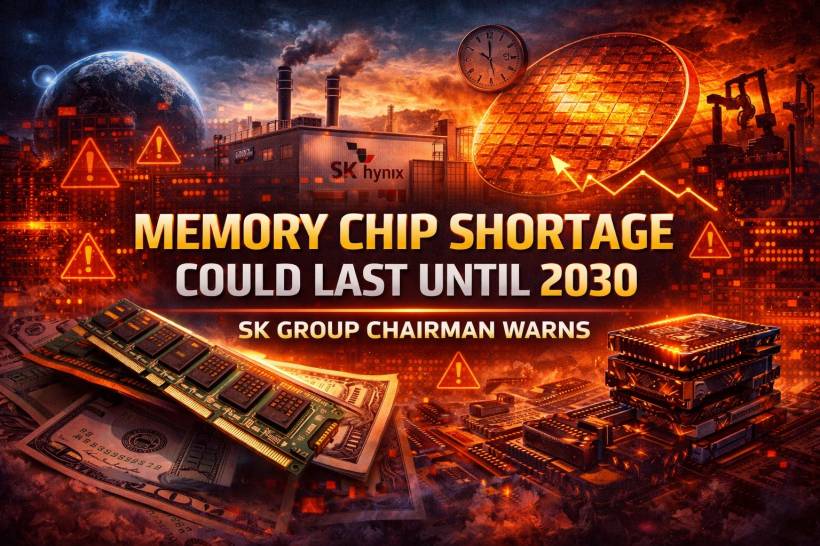
If you were hoping the memory chip situation would settle down soon, the latest warning from SK Group suggests that may not happen anytime soon. According to SK Group chairman Chey Tae-won, the supply crunch affecting the memory industry could continue all the way until 2030. His main point was simple: demand is rising faster than the industry can realistically expand wafer supply, and fixing that imbalance is not something that can be done in a year or two.
That matters because memory chips sit at the center of far more devices than most people realise. They are not just important for AI servers and data centres. They also affect everyday products such as laptops, desktops, smartphones, and other electronics that rely on DRAM and related memory components. So when the people running one of the world's biggest memory groups say the shortage may last several more years, this is not just an industry footnote. It is a sign that the ripple effects could continue to shape pricing and supply across consumer tech as well.
Why the Problem Is Becoming Harder to Fix
Chey said the industry's wafer supply is trailing demand by more than 20%, and that is a serious gap in a sector where scaling up takes enormous time and investment. Even when chipmakers decide to expand, it can take four to five years before new wafer capacity is ready. In other words, the industry cannot simply flip a switch and catch up.
This is where the AI boom has really changed the picture. Demand for memory is no longer being driven only by traditional PC and smartphone cycles. Now, there is also intense competition to secure high-bandwidth memory, or HBM, which is critical for AI accelerators and data centre workloads. That has pushed manufacturers to channel more resources into advanced memory products that deliver better margins and stronger long-term demand.
The problem is that while this makes business sense for the suppliers, it also creates pressure elsewhere in the market.
AI Is Pulling the Industry in One Direction
SK Hynix, Samsung, and Micron are the three names that dominate this part of the semiconductor world, and all three are heavily focused on meeting AI-related demand. SK Hynix is especially important here, as Reuters reported that it holds about 57% of the global HBM market and roughly 32% of the broader DRAM market. That gives the company enormous influence over how memory capacity is prioritised.
This helps explain why conventional DRAM is becoming a growing concern. If more factory capacity, more investment, and more engineering focus are directed toward HBM for AI customers, there is naturally less room left for the kind of memory used in mainstream devices. That does not mean consumer memory disappears, but it does mean supply tightness can worsen and prices can stay elevated longer than many buyers would like.
In that sense, this is not just a shortage story. It is also a prioritisation story. AI is becoming the customer that gets served first.
Why This Could Hit PCs and Smartphones Too
One of the more interesting parts of Chey's remarks is that he did not just warn about shortages. He also cautioned against the industry becoming too fixated on HBM. That warning feels especially relevant now because the memory market is already showing signs of strain outside the AI segment. Samsung has described the current environment as an "unprecedented supercycle," while TrendForce has projected a very sharp jump in conventional DRAM contract prices in early 2026.
For consumers, this could translate into more expensive devices or tighter inventory for certain models, especially if manufacturers face higher component costs. For PC makers and smartphone brands, it adds another layer of pressure at a time when they are already balancing margins, demand uncertainty, and changing buyer expectations.
So while AI may be the headline, the side effects could land much closer to home. A prolonged memory crunch does not stay inside the server rack. It eventually works its way down into the gadgets people buy every day.
SK Hynix Says It Is Working on Price Stability
Chey also said SK Hynix is preparing measures aimed at stabilising DRAM prices, with CEO Kwak Noh-jung expected to announce a plan. At the moment, though, there are not many specifics in public. Reuters noted that Chey did not explain what those measures would actually involve.
That leaves plenty of room for interpretation. It could mean more disciplined supply management, a longer-term customer strategy, or some effort to reduce price volatility rather than push prices down sharply. But whatever the final approach looks like, it is clear the company knows this issue is becoming bigger than a simple market cycle.
And that makes sense. Once a shortage drags on for years instead of quarters, it becomes a structural issue. At that point, the conversation shifts from "when will prices cool?" to "what kind of market are we entering?"
Expansion Is Happening, But Not Fast Enough
To be fair, the major memory players are not standing still. Micron is ramping up investment aggressively, including a second facility in Taiwan and a US$24 billion plant in Singapore. SK Hynix is also building out advanced packaging and HBM-related facilities, while Samsung is looking for longer-term contracts to smooth out volatility and lock in demand.
But these moves actually reinforce the core problem Chey described. They show that the industry sees the demand wave clearly and is spending heavily to prepare for it. The catch is that fabs and cleanroom space take years to build, and construction costs are rising too. Micron's latest results even showed that strong AI demand is being accompanied by a major jump in capital spending, which unsettled investors despite the company's strong earnings.
So yes, expansion is happening. It is just not happening at the speed needed to erase the shortage quickly.
The Consumer Market Is No Longer the Main Priority
Another sign of where the market is heading came late last year, when Micron said it would exit its consumer memory business to focus more heavily on advanced memory used in AI data centres. That move was a strong signal that the industry's center of gravity is shifting. Consumer demand still matters, but it is no longer the most attractive battleground.
That shift may prove to be one of the biggest long-term consequences of the AI era. For years, the memory market swung heavily around smartphone launches, PC refresh cycles, and gaming demand. Now the biggest influence may increasingly come from hyperscalers, AI chipmakers, and cloud infrastructure operators.
For regular buyers, that means the fate of mainstream tech pricing may be shaped more and more by enterprise AI spending rather than ordinary consumer demand.
Final Thoughts
The warning from SK Group is striking not because it is dramatic, but because it sounds realistic. A shortage lasting until 2030 suggests the memory market is no longer dealing with a temporary bottleneck. It may be entering a longer period where AI demand keeps pulling supply toward high-value segments, while everyone else competes for what remains.
That does not mean every phone, laptop, or PC is about to become unaffordable. But it does suggest that the pressure on memory pricing may linger longer than many expected, especially for conventional DRAM. In that sense, Chey's warning feels less like a prediction meant to shock the market and more like a reminder that the semiconductor world has changed. The AI boom is not just creating new opportunities. It is also redrawing the supply map for the rest of the tech industry.











Comments 0