

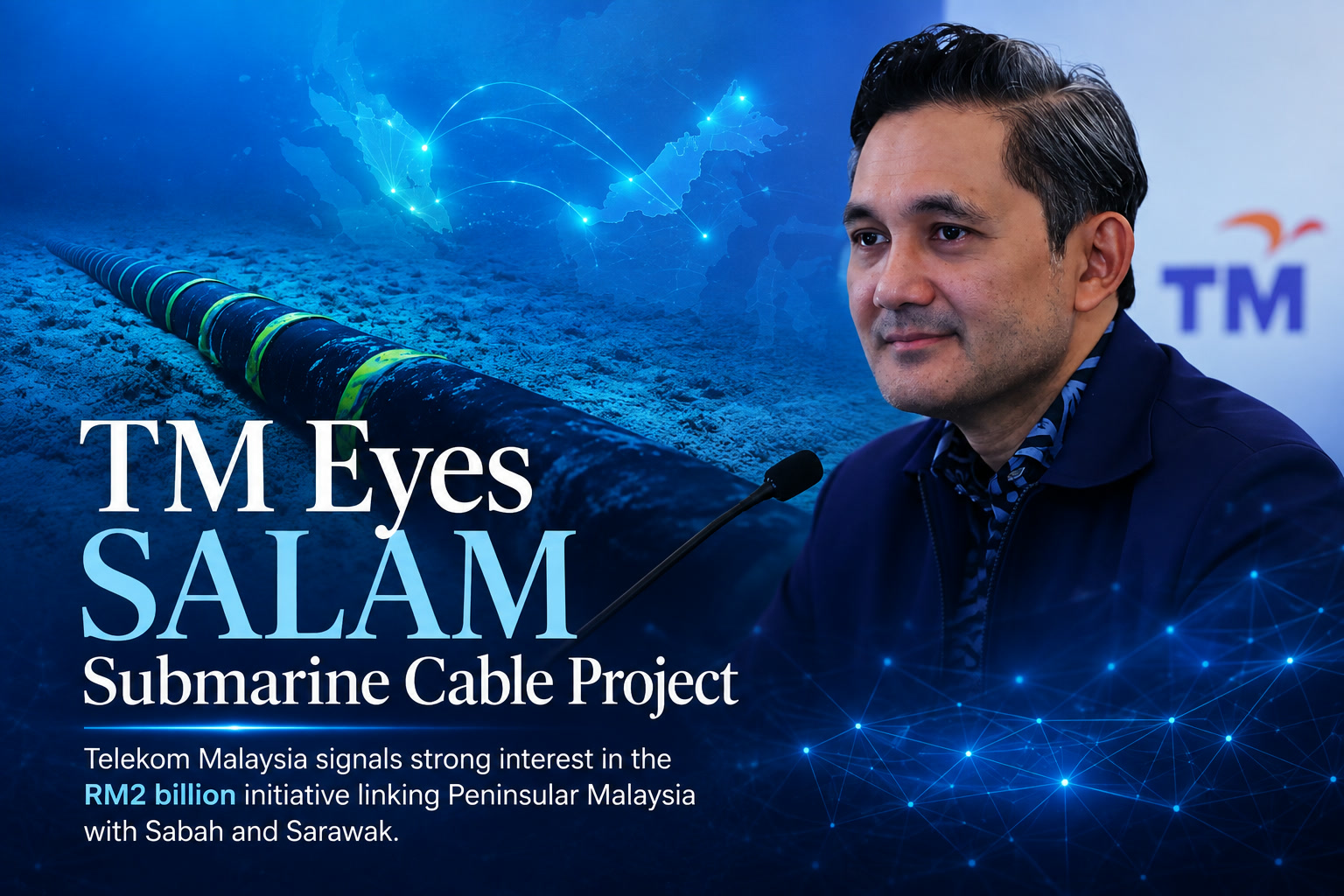
Malaysia's push to strengthen the digital connection between Peninsular Malaysia, Sabah and Sarawak could soon involve one of the country's biggest telecommunications players.
Telekom Malaysia Bhd (TM) has confirmed that it is interested in participating in the upcoming SALAM submarine cable project, a major national infrastructure initiative designed to improve connectivity and network resilience between East and West Malaysia.
TM Group Chief Executive Officer Datuk Amar Huzaimi Md Deris said the company is currently evaluating the available options and views SALAM as one of the projects it is particularly keen to participate in.
While TM's interest is clear, the company has not confirmed whether it has already submitted a formal proposal to the Malaysian Communications and Multimedia Commission (MCMC).
Still, considering TM's existing nationwide fibre network and involvement in international submarine cable systems, its potential participation would hardly come as a surprise.
What Exactly Is the SALAM Project?
SALAM stands for Sambungan Kabel Dasar Laut MADANI, and it is essentially a major new submarine fibre-optic network intended to strengthen digital connectivity between Peninsular Malaysia, Sabah and Sarawak.
The planned network is substantial.
SALAM is expected to span approximately 5,582km and consist of:
The project isn't simply about increasing internet speeds.
Its broader purpose is to create a more resilient national telecommunications backbone, ensuring Malaysia has additional routes available if another cable suffers an outage, damage or maintenance disruption.
For a country whose territory is divided by the South China Sea, submarine cables are an essential part of keeping the national digital network connected.
Why Malaysia Needs More Submarine Cable Capacity
It's easy to think of internet connectivity as something largely delivered through mobile towers and fibre cables running underneath roads.
But when data needs to travel between Peninsular Malaysia and East Malaysia, much of that traffic ultimately depends on undersea fibre-optic infrastructure.
That makes submarine cables critical national infrastructure.
If there are too few cable routes, a fault affecting one of them can potentially result in congestion, slower services or reduced network resilience.
Having additional independent routes provides redundancy.
Think of it like building another highway between two major cities.
You might not need every lane every day, but when traffic increases or another road becomes unavailable, having that additional capacity suddenly becomes extremely important.
SALAM is intended to provide exactly that kind of resilience for Malaysia's digital network.
MCMC Is Looking for Industry Partners
The Malaysian Communications and Multimedia Commission recently invited eligible telecommunications licensees to express their interest in participating in the project.
Companies interested in SALAM are required to provide both a registration of interest and a draft Universal Service Plan for consideration.
The initiative is being pursued under Malaysia's Universal Service Provision (USP) framework, which is generally used to expand and improve communications infrastructure in areas where commercial investment alone may not provide sufficient coverage.
At this stage, however, several important details remain unclear.
MCMC has yet to publicly provide a definitive construction timetable or final deadline covering the entire proposal process.
That means SALAM is still very much in the planning and procurement phase.
TM's comments therefore indicate interest rather than confirmation that it has secured any role in the project.
TM Says It Is Optimistic About Participating
During a briefing covering TM's second-quarter financial performance, Huzaimi described the company as optimistic about opportunities to improve connectivity between the two sides of Malaysia.
SALAM, he said, is one of the initiatives that TM is particularly interested in evaluating.
What wasn't disclosed was whether the company had already submitted a draft proposal to MCMC.
That distinction is worth keeping in mind.
TM may be keen to participate, but there is currently no confirmation that it has been selected to build or operate any part of the network.
The procurement process could also involve other eligible telecommunications infrastructure providers.
RM2 Billion Has Been Allocated Under Budget 2026
SALAM isn't a small infrastructure programme.
The Malaysian government allocated RM2 billion under Budget 2026 towards the submarine cable initiative, highlighting how strategically important connectivity between Peninsular Malaysia and East Malaysia has become.
That investment isn't only about consumer broadband either.
The additional capacity is expected to support a much broader range of digital services, including:
As Malaysia attracts more data-centre and cloud investment, the amount of data moving across the country's networks will continue increasing.
The underlying infrastructure therefore needs to grow alongside it.
SALAM Could Be Important for Malaysia's Data Centre Ambitions
Malaysia has become an increasingly important data-centre market in Southeast Asia.
Johor in particular has attracted major investments from hyperscalers and technology companies, while Kuala Lumpur and other regions continue expanding their own digital infrastructure.
But data centres don't operate in isolation.
They require enormous amounts of network capacity to exchange information with users, businesses, cloud platforms and other data centres.
This makes submarine cables a fundamental part of the equation.
More cable capacity between Peninsular Malaysia, Sabah and Sarawak could make it easier for digital services hosted in one region to reliably serve customers in another.
As AI workloads become increasingly common, those requirements only become more demanding.
AI Needs Connectivity Just as Much as Computing Power
When people talk about artificial intelligence infrastructure, the conversation usually focuses on GPUs, servers and data centres.
But all of those systems need extremely fast networks.
AI applications routinely transfer large amounts of information between:
A bottleneck anywhere along that route reduces performance.
That's why initiatives such as SALAM can indirectly contribute to Malaysia's AI ambitions.
The cable itself doesn't perform artificial intelligence calculations, of course.
But it provides part of the infrastructure necessary for AI services to operate reliably at national scale.
East Malaysia Could Benefit Significantly
The project could be particularly meaningful for Sabah and Sarawak.
Improving connectivity between East Malaysia and the country's major digital infrastructure hubs could support everything from ordinary broadband access to enterprise cloud services.
Better backbone connectivity can eventually contribute towards:
Again, SALAM doesn't automatically solve every connectivity challenge in East Malaysia.
Local fibre networks, mobile towers and last-mile infrastructure remain equally important.
But strengthening the backbone gives those services a more robust foundation to operate on.
Redundancy May Be Just as Important as Speed
One of SALAM's biggest benefits could actually be something users rarely notice: redundancy.
Submarine cables sometimes fail.
They can be damaged by ship anchors, fishing activity, geological events or other incidents. Maintenance can also temporarily take sections offline.
If a telecommunications network has multiple independent routes available, traffic can be redirected when one pathway becomes unavailable.
Without adequate redundancy, a single failure can have a much larger effect.
SALAM therefore isn't simply designed to make connections faster.
It's also intended to make Malaysia's national communications infrastructure harder to disrupt.
For businesses, hospitals, government agencies, financial services and cloud providers, that reliability can be even more important than raw bandwidth.
TM Already Has Experience With International Submarine Cables
TM wouldn't be entering unfamiliar territory if it eventually becomes involved with SALAM.
The telecommunications company already participates in multiple submarine cable systems connecting Malaysia to the broader region and international networks.
One recent example is the Asia Direct Cable (ADC).
ADC connects Malaysia with several major Asian markets, including:
International systems such as ADC help connect Malaysia to global internet infrastructure, cloud services and data centres elsewhere in Asia.
SALAM would serve a somewhat different purpose.
Rather than primarily improving international connectivity, its focus is strengthening the domestic connection between Peninsular Malaysia and East Malaysia.
Together, these types of cables form different layers of Malaysia's overall connectivity infrastructure.
Submarine Cables Are Becoming Strategic Infrastructure
There was a time when submarine cables were largely regarded as telecommunications infrastructure that ordinary users rarely needed to think about.
That's changing.
Today, these cables underpin practically everything digital:
Even wireless technologies such as 5G eventually depend on physical fibre networks somewhere in the chain.
The mobile connection between your phone and a nearby tower may be wireless, but much of the data leaving that tower eventually travels through fibre.
So as Malaysia's digital economy grows, submarine cable capacity becomes increasingly strategic.
This Could Also Strengthen Malaysia's Digital Sovereignty
There's another broader consideration.
Building additional domestic cable routes gives Malaysia greater control and resilience over how data moves between different parts of the country.
Rather than depending excessively on a limited number of existing connections or indirect international routes, SALAM could provide more direct domestic capacity.
That matters particularly as governments around the world increasingly treat communications infrastructure as part of national resilience.
Telecommunications networks are no longer simply commercial infrastructure.
They're increasingly viewed alongside electricity, water and transportation as systems that need to remain available during disruptions.
The Project Is Still at an Early Stage
Despite TM's interest, SALAM isn't something consumers should expect to start using immediately.
Major submarine cable projects take considerable time.
Before a new cable becomes operational, developers typically need to work through:
A system stretching more than 5,500km is therefore a significant engineering project.
MCMC also hasn't announced a final construction timeline yet.
So even after the participating telecommunications companies are eventually selected, it could still be some time before SALAM enters service.
Final Thoughts
TM's interest in the SALAM submarine cable project makes plenty of sense.
As Malaysia's national telecommunications provider, TM already operates extensive fibre infrastructure and participates in major regional submarine cable systems.
SALAM would give the company another opportunity to strengthen one of the most important links in Malaysia's communications infrastructure: the connection between Peninsular Malaysia, Sabah and Sarawak.
The project's RM2 billion allocation, 5,582km planned network and 10 cable landing stations also show that this isn't simply another incremental telecommunications upgrade.
It's an investment in the backbone that will increasingly support broadband, 5G, cloud computing, data centres, artificial intelligence and Malaysia's broader digital economy.
Whether TM ultimately becomes one of the companies responsible for building SALAM remains to be seen.
But as Malaysia becomes increasingly dependent on cloud platforms, AI services and always-connected digital infrastructure, one thing is becoming very clear:
the cables running beneath the sea are becoming just as important to Malaysia's digital future as the towers, fibre networks and data centres we can actually see.











Comments 0