


For much of the past year, Ethereum appeared trapped in Bitcoin's shadow. Whenever the cryptocurrency market weakened, ETH tended to fall harder. When conditions improved, Bitcoin frequently recovered first and attracted most of the institutional attention.
July finally disrupted that pattern.
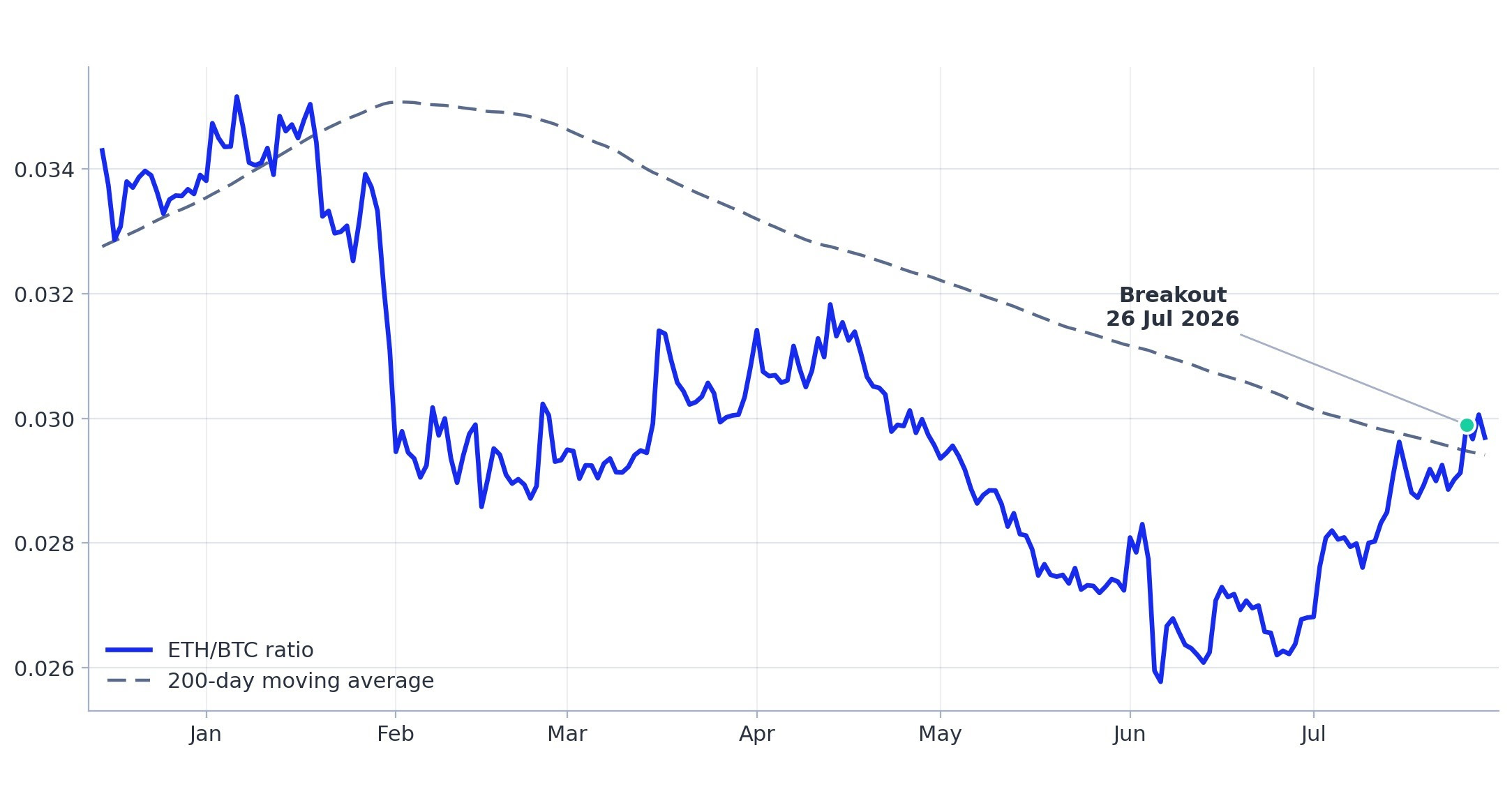
Over a recent 30-day period, Ethereum gained approximately 24%, compared with about 8% for Bitcoin. The ETH/BTC ratio—the amount of Bitcoin one ether can purchase—also climbed to a three-month high and moved back above its 200-day moving average for the first time since January. That technical shift does not guarantee a lasting recovery, but it shows that Ethereum has begun outperforming Bitcoin rather than merely following it upward.
Naturally, this has revived the familiar conversation about an approaching "altcoin season." However, Ethereum performing well for one month does not automatically mean the entire crypto market has entered a new phase.
Ethereum Is Still the Faster and More Volatile Boat
There is a relatively simple explanation for part of Ethereum's sudden strength: ETH generally behaves like a higher-risk version of Bitcoin.
When investors become cautious, they often move towards Bitcoin because it is the largest, most liquid and most widely recognised cryptocurrency. Ethereum and smaller digital assets may then suffer sharper declines as traders reduce exposure to risk.
When confidence returns, the same relationship can work in the opposite direction. Money starts moving further along the risk curve, and Ethereum may rise faster than Bitcoin.
This means Ethereum's recent outperformance is not necessarily mysterious. The asset that fell harder during the earlier weakness is now responding more aggressively to improving sentiment.
The important question is whether the rally represents only a high-beta rebound or the beginning of a longer change in how investors value Ethereum.
The ETH/BTC Ratio Is Showing Signs of Life
Looking only at ETH's price in US dollars can be misleading because both Ethereum and Bitcoin may rise together when the broader market improves.
The ETH/BTC ratio provides a more useful comparison. When that ratio rises, Ethereum is gaining value relative to Bitcoin. When it falls, Bitcoin is performing better.
The ratio recently reached around 0.030 BTC and reclaimed its 200-day moving average. Ethereum's 24% monthly gain compared with Bitcoin's roughly 8% advance created a performance gap of approximately 16 percentage points.
Crossing the 200-day average matters because traders commonly use it to distinguish a sustained trend from a shorter-lived bounce. Ethereum spent months unable to remain above that level, so reclaiming it suggests that some of the persistent selling pressure has eased.
Nevertheless, one technical breakout does not erase the longer-term chart. The ETH/BTC ratio still faces resistance above its current level, and a short period above the moving average could reverse quickly if market sentiment deteriorates.
ETF Money Has Started Favouring Ethereum
The clearest evidence of changing investor behaviour may be found in regulated exchange-traded products.
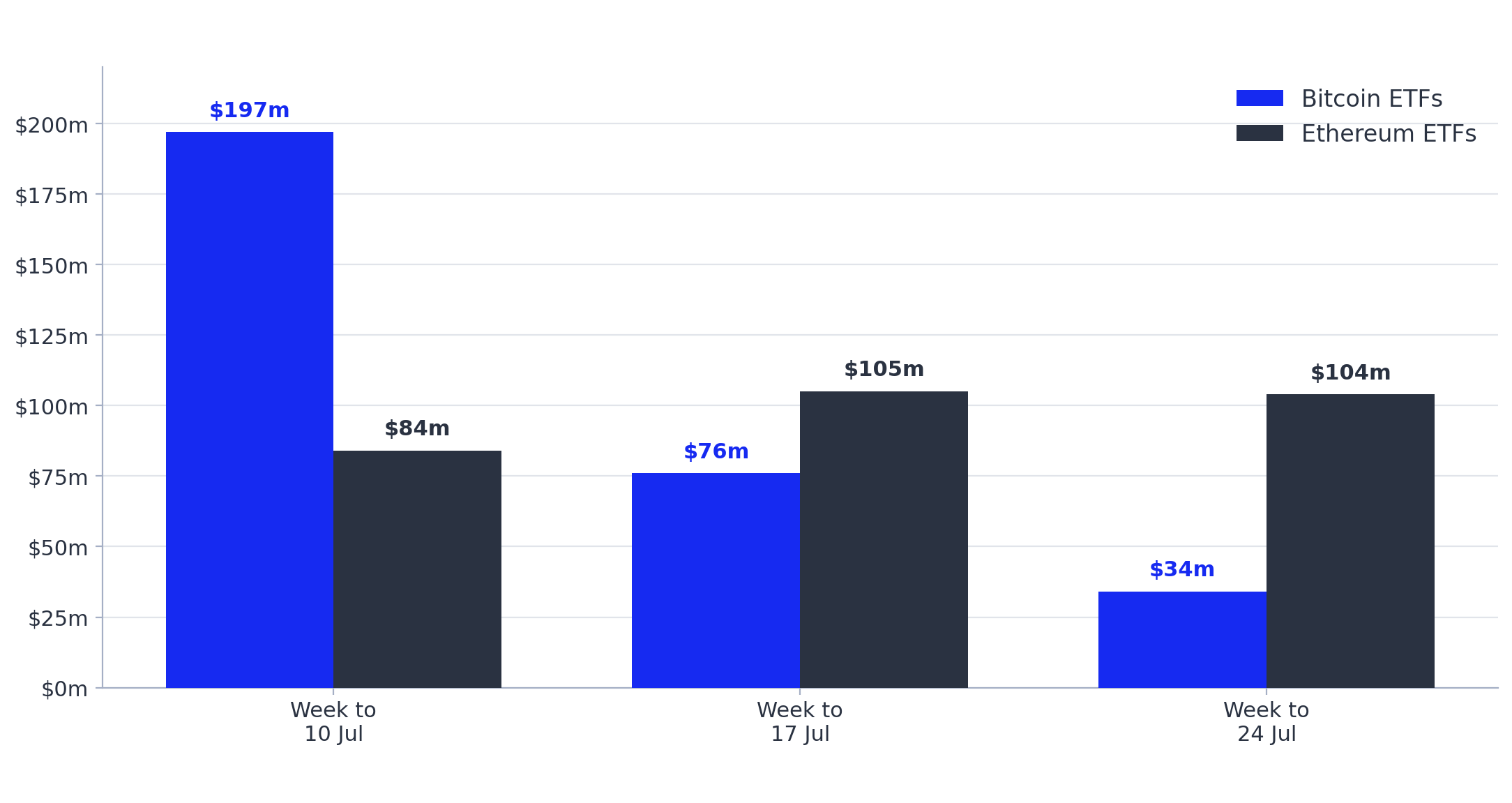
US spot Ether ETFs recorded approximately US$103.9 million in net inflows during the week of July 20 to 24. Bitcoin ETFs attracted around US$33.79 million during the same period, meaning Ethereum funds received roughly three times as much new money.
That result was not entirely isolated. Ethereum ETF inflows also exceeded Bitcoin ETF inflows during other weeks in 2026, suggesting that at least some institutional allocators are deliberately increasing their exposure to ETH rather than simply buying the entire crypto market indiscriminately.
ETF flows can change rapidly and should not be treated as permanent commitments. Even so, they reveal where the marginal investment dollar is going. When relatively small shifts in demand consistently favour Ethereum, the ETH/BTC ratio can respond strongly.
Morgan Stanley Gives Ethereum Another Institutional Boost
Ethereum's renewed momentum was reinforced when Morgan Stanley Investment Management launched the Morgan Stanley Ethereum Trust and Morgan Stanley Solana Trust on July 28, 2026.
The Ethereum product trades under the ticker MSSE and seeks to track the performance of ether. Both newly launched products charge an expense ratio of 0.14% and intend to stake part of their underlying assets to earn rewards. Morgan Stanley states that it will not retain any portion of those staking rewards for itself.
This matters for more than the immediate amount of money entering the fund.
A major financial institution offering Ethereum exposure alongside Bitcoin strengthens the argument that ETH is developing into a recognised institutional asset rather than remaining merely a token used by crypto enthusiasts.
The staking component is particularly relevant because Ethereum can potentially generate network rewards. Bitcoin's primary investment narrative is based on scarcity and its role as a potential digital store of value. Ethereum offers a different proposition: an asset that helps secure and operate a programmable financial network.
That distinction gives institutions another reason to evaluate ETH separately from Bitcoin.
Ethereum Finally Has a Clearer Job Again
One of Ethereum's greatest difficulties during the previous two years was explaining exactly why investors needed to own ETH.
Bitcoin has a straightforward story. Its supply is limited, its rules are relatively simple and supporters describe it as digital gold.
Ethereum's story is more complicated. It is a blockchain platform, a settlement network, a smart-contract system, a home for decentralised finance, a stablecoin network, an asset-tokenisation platform and an ecosystem of Layer 2 networks.
That flexibility is valuable, but it can make the investment argument difficult to communicate. When everything is presented as a use case, none of the individual explanations feels especially memorable.
The narrative may now be becoming clearer: Ethereum is increasingly being positioned as financial infrastructure.
The Ethereum Foundation's institutional portal describes the network as hosting more than 60% of global stablecoin supply and a substantial share of tokenised real-world assets. It highlights uses including programmable payments, tokenised funds, treasury products and round-the-clock settlement.
Instead of asking whether Ethereum will replace ordinary money, the more practical question is whether financial products, stablecoins and tokenised assets will continue using Ethereum and its Layer 2 networks as settlement infrastructure.
That is a more durable story than simply hoping the price rises.
Stablecoins Give Ethereum Everyday Relevance
Stablecoins may be one of Ethereum's strongest but least glamorous advantages.
They allow users and institutions to transfer tokenised versions of currencies such as the US dollar across blockchain networks. They are used for trading, payments, settlement, savings products and transferring value between different parts of the digital-asset ecosystem.
Ethereum's main network reportedly hosts around US$155 billion in stablecoins, while its Layer 2 networks host billions more.
ETH itself is not a stablecoin, but it plays an important role in the surrounding infrastructure. It is used to pay transaction fees, secure the network through staking and support applications operating across the ecosystem.
The investment argument is therefore similar to owning part of the infrastructure supporting digital financial activity. The stronger and more active that infrastructure becomes, the easier it is to explain why ETH should have enduring demand.
Tokenisation Could Strengthen the Long-Term Case
Ethereum is also benefiting from increased interest in tokenising real-world assets.
Tokenisation converts ownership or claims on assets—such as government bonds, funds, commodities or property—into blockchain-based tokens. These assets can potentially be transferred and settled continuously rather than being limited to ordinary market hours.
The Ethereum ecosystem already hosts tokenised treasury and cash-equivalent products from institutions including BlackRock, Securitize, Superstate and Ondo.
This does not mean the entire global financial system will immediately migrate onto Ethereum. Regulatory requirements, custody arrangements, privacy concerns and competing blockchain networks remain important obstacles.
However, tokenisation gives Ethereum a concrete institutional use case. It helps shift the conversation away from speculative applications and towards infrastructure that could support recognisable financial products.
Holding ETH Is Different from Merely Trading It
During weaker market periods, many investors treated Ethereum primarily as a volatile asset to buy and sell.
Its developing role in staking, stablecoin settlement and tokenised finance creates reasons for institutions to hold it for operational or strategic purposes.
An organisation may hold ETH because it needs to pay network fees. A fund may hold it to provide regulated investment exposure. A staking operation may hold it to help secure the network and earn rewards. A company building Ethereum-based products may keep ETH as part of its treasury.
These buyers may still sell when conditions change, but their motivation is broader than simply expecting a quick price increase.
A more diverse owner base could eventually make Ethereum's demand less dependent on short-term retail speculation. That possibility is arguably more important than one month of impressive price performance.
This Still Does Not Confirm Altcoin Season
Ethereum's recovery has encouraged claims that the market is entering another altcoin season, but the evidence remains incomplete.
BlockchainCenter defines altcoin season as a period in which at least 75% of the top 50 eligible cryptocurrencies outperform Bitcoin over 90 days. Its current index stands at 63 and explicitly states that the market has not yet reached altcoin season.
Bitcoin dominance also remained close to 59% in the market data accompanying Ethereum's recent rally.
This suggests that capital has rotated towards Ethereum without spreading broadly across the rest of the market.
A genuine altcoin season normally involves sustained outperformance across many large-, medium- and smaller-cap assets. At present, the movement looks more like a concentrated Bitcoin-to-Ethereum rotation than a market-wide rush into alternative cryptocurrencies.
Bitcoin Dominance Still Matters
Bitcoin remains the centre of the cryptocurrency market.
It has the largest market value, deepest liquidity, strongest institutional recognition and clearest investment narrative. When uncertainty increases, capital frequently returns to Bitcoin first.
Ethereum can outperform for several weeks while Bitcoin still maintains overall market dominance. The two conditions are not contradictory.
For Ethereum's rally to signal a genuine regime change, investors would likely need to see sustained ETH/BTC strength, continuing ETF inflows, stronger network usage and broader participation across the Ethereum ecosystem.
One successful month provides an encouraging starting point, but not enough evidence to declare a permanent reversal.
The Higher-Beta Problem Has Not Disappeared
Ethereum's stronger rebound can be exciting during a rising market, but the same sensitivity creates additional risk when sentiment turns.
If macroeconomic conditions weaken, technology stocks decline or investors begin reducing speculative exposure, Ethereum may once again fall faster than Bitcoin.
This is the uncomfortable symmetry behind high-beta assets: the characteristic that produces impressive rallies is often the same one that creates painful drawdowns.
Investors should therefore be cautious about interpreting outperformance as proof that Ethereum has become safer or more stable. The network's fundamentals may be improving while the asset itself remains highly volatile.
Why This Rally Feels More Convincing Than Some Earlier Bounces
Ethereum has produced temporary recoveries before, many of which eventually faded.
The current movement feels somewhat different because several pieces are improving simultaneously.
The ETH/BTC ratio has moved above an important technical level. Ethereum ETFs have recently attracted stronger flows than Bitcoin funds. Morgan Stanley has introduced a regulated Ether product with staking exposure. Stablecoin and tokenised-asset activity continue to give the network a recognisable institutional purpose.
None of these developments guarantees higher prices. Together, however, they provide a more substantial foundation than a rally driven entirely by online enthusiasm and leveraged speculation.
Ethereum is not simply rising because traders have rediscovered an old token. It is also benefiting from a clearer explanation of what the network is becoming.
Ethereum Does Not Need to Beat Bitcoin at Bitcoin's Game
Comparing Ethereum with Bitcoin sometimes creates the mistaken assumption that only one of them can remain important.
Bitcoin is primarily designed around scarcity, security and transferring its native asset. Ethereum is built as a programmable settlement and application platform.
Ethereum does not need to become a better version of digital gold. Its stronger opportunity may be becoming the infrastructure underneath stablecoins, tokenised investments, decentralised applications and new forms of financial settlement.
That story is more complicated than Bitcoin's, but it may also support a wider range of demand.
The danger is that Ethereum must continue proving its usefulness while managing competition from Solana and other networks, as well as complexity across its own Layer 2 ecosystem.
Final Thoughts
Ethereum has finally enjoyed a period in which it is gaining faster than Bitcoin rather than losing faster.
Its approximately 24% monthly advance, improving ETH/BTC ratio and stronger ETF inflows demonstrate that investor interest has returned. The launch of Morgan Stanley's Ethereum product provides further evidence that ETH is gaining recognition within traditional financial markets.
More importantly, Ethereum appears to be recovering a clear purpose. Stablecoins, asset tokenisation, staking and programmable settlement offer practical reasons to use and hold ETH beyond short-term price speculation.
However, it is too early to declare a lasting regime change. Bitcoin dominance remains high, broader altcoins have not consistently taken over and the current Altcoin Season Index remains below its confirmation threshold.
Ethereum has remembered how to win, at least for now. The difference this time is that the network has stronger reasons to remain relevant after the excitement surrounding the rally fades.
Whether July marks the beginning of a longer Ethereum revival or merely another powerful high-beta rebound will not be decided by one price chart. It will depend on whether institutional flows continue, network activity grows and Ethereum can turn its role as financial infrastructure into lasting demand.











Comments 0