

Healthcare organisations have spent years strengthening infection prevention programmes, but many interventions still begin only after a patient shows signs of colonisation or infection.
Sentara Health is taking a more proactive approach.
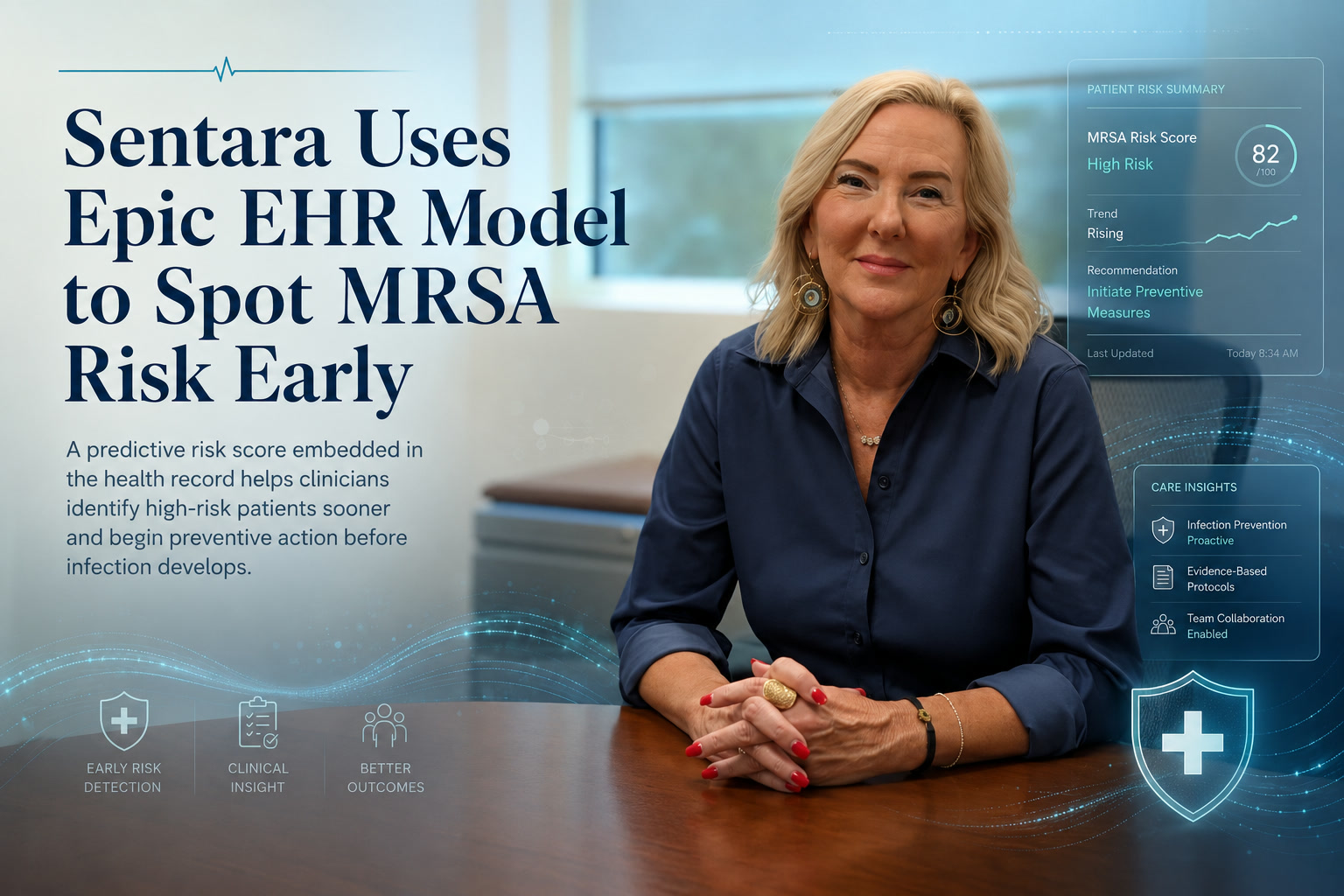
The Virginia-based health system has developed a predictive MRSA risk score directly within its Epic electronic health record, allowing clinical teams to identify patients who may be at higher risk of developing hospital-onset MRSA bacteremia before the infection actually occurs.
Rather than replacing established infection prevention practices, the model acts as an additional early-warning layer, helping clinicians identify patients who may benefit from targeted preventive treatment.
Moving From Reactive Infection Control to Prevention
The initiative grew out of Sentara's wider effort to reduce healthcare-associated infections and improve performance against comparable healthcare organisations.
MRSA, or methicillin-resistant Staphylococcus aureus, became an important focus because hospital-onset bacteremia continued to represent a significant patient safety risk despite existing infection prevention measures.
Clinical and operational teams began reviewing previous MRSA cases to determine whether there were patterns that could have indicated risk earlier.
Post-infection reviews, literature analysis and historical patient data showed that many patients who eventually developed MRSA shared identifiable risk factors before infection appeared.
That raised an important question: Could those patients be recognised early enough for clinicians to intervene before MRSA developed?
Epic Already Contained Much of the Needed Data
Sentara realised that much of the information required to assess MRSA risk was already contained inside Epic.
Instead of asking clinicians to manually review multiple risk factors for every admission, the health system developed a model capable of automatically analysing relevant demographic, clinical and utilisation data.
The predictive score considers factors such as:
These factors are combined to generate a risk score for the patient.
Patients reaching a score of six or higher may become eligible for Sentara's targeted prophylaxis protocol, although certain patient populations are intentionally excluded.
High-Risk Patients Receive Preventive Treatment
For eligible patients, the preventive protocol includes daily chlorhexidine gluconate treatment along with povidone iodine nasal swabs.
The objective is to reduce the likelihood of MRSA progressing to hospital-onset bacteremia in patients who have already been identified as particularly vulnerable.
Importantly, Sentara does not view the predictive model as a replacement for standard infection prevention practices.
Existing measures remain in place.
Instead, the model gives care teams another opportunity to intervene earlier by identifying patients whose combination of risk factors may not otherwise be immediately obvious.
The Project Required More Than Just an Algorithm
One of the more important aspects of Sentara's project was the multidisciplinary approach used to build it.
The initiative involved infection prevention specialists, physicians, nurses, process improvement teams and Epic analysts.
That collaboration helped ensure the predictive model was not only technically accurate but also practical within everyday clinical workflows.
A predictive model can perform exceptionally well mathematically and still fail if clinicians find it difficult to use.
Sentara therefore focused heavily on making the risk information visible in the tools and workflows frontline staff were already using.
Sentara Avoided Adding Another Interruptive Alert
Clinical alert fatigue is a well-known problem in healthcare.
When clinicians receive too many pop-ups and warnings, even important notifications can eventually become background noise.
Instead of adding another interruptive alert, Sentara embedded MRSA risk information into existing Epic workflows.
Risk information became available through areas such as admission workflows, patient lists, nursing reports, flowsheets, healthcare-associated infection huddle reports and Nurse Brain tasks.
This meant nurses and other caregivers did not need to open another application or respond to another pop-up.
The information simply became part of the clinical environment they were already using.
That design decision was crucial to adoption.
The Workflow Continued Evolving After Launch
Sentara did not treat the initial implementation as finished.
Feedback from frontline users led to several changes.
Documentation was moved into flowsheets so that patient care technicians could participate more easily. ICU patients were automatically included in the process, while prophylaxis was incorporated into the organisation's Nursing Patient Safety Protocol.
These refinements reduced friction and made MRSA prevention feel more like part of normal nursing care rather than an additional technology-driven task.
Daily healthcare-associated infection huddles and Epic reporting also allowed leaders to monitor compliance and quickly identify gaps requiring attention.
This created an important feedback loop between the predictive model, frontline care and operational oversight.
MRSA Cases Fell Significantly
The results reported by Sentara were substantial.
Hospital-onset MRSA bacteremia cases declined from 53 cases in 2022 to 29 cases in 2023, representing an improvement of roughly 45%.
The organisation also reported improvement in its standardised infection ratio.
While predictive analytics alone cannot necessarily take credit for every prevented infection, the programme gave Sentara a more systematic way to identify risk and apply preventive interventions across multiple hospitals.
That standardisation is important.
Without automated identification, prevention can depend heavily on whether an individual clinician notices a particular combination of risk factors.
Embedding the model into Epic allows those same risk criteria to be applied more consistently across the organisation.
There Are Financial Benefits as Well
Avoiding hospital-acquired infections has benefits far beyond improving quality metrics.
MRSA bacteremia can result in longer hospital stays, additional medications, more diagnostic testing and significantly greater resource utilisation.
Sentara estimates that avoided MRSA cases could generate approximately US$120,000 to US$384,000 in annual cost avoidance.
If the improvements can be sustained over a longer period, projected savings could approach US$2 million.
Those financial benefits are secondary to patient safety, but they demonstrate how well-designed clinical analytics can simultaneously improve outcomes and reduce unnecessary healthcare costs.
Technology Alone Was Not Enough
Perhaps the most important lesson from Sentara's experience is that predictive technology alone does not transform clinical outcomes.
According to Sentara senior IT specialty analyst Jill Marciano, factors such as nursing engagement, workflow adoption, leadership accountability and continuous monitoring were just as important as the risk model itself.
That is an important distinction.
Healthcare organisations sometimes focus heavily on the accuracy of an algorithm while underestimating the operational changes required around it.
A model can identify a patient as high risk with excellent accuracy, but that prediction has little value if the clinical team never sees it or fails to act.
The real value appears only when the prediction becomes part of a reliable clinical process.
Predictive Analytics Should Be Treated as Clinical Transformation
Sentara recommends that healthcare organisations considering similar projects approach predictive analytics as a broader clinical transformation initiative rather than simply an IT implementation.
That means involving multidisciplinary stakeholders from the beginning and ensuring technology fits naturally into existing workflows.
Success should also be measured beyond the algorithm itself.
Organisations should monitor areas such as:
This broader view helps ensure the technology continues producing meaningful results after the initial implementation period.
Final Thoughts
Sentara Health's MRSA initiative demonstrates how predictive analytics can become much more useful when it is embedded directly into the clinical workflow.
Instead of waiting until an infection develops, the Epic-based risk model helps identify patients who may be vulnerable much earlier, giving care teams an opportunity to begin preventive measures before the situation becomes more serious.
The reduction from 53 hospital-onset MRSA bacteremia cases to 29 within a year is encouraging, but perhaps the more important achievement is the workflow behind it.
Sentara did not simply build an algorithm and expect clinicians to adapt around the technology. It integrated the model into familiar Epic tools, refined the process based on frontline feedback and created ongoing monitoring through nursing and infection prevention workflows.
That approach offers a useful lesson for healthcare organisations exploring predictive AI and analytics.
The technology can identify the risk, but improving patient outcomes still depends on how effectively people act on that information.











Comments 0