

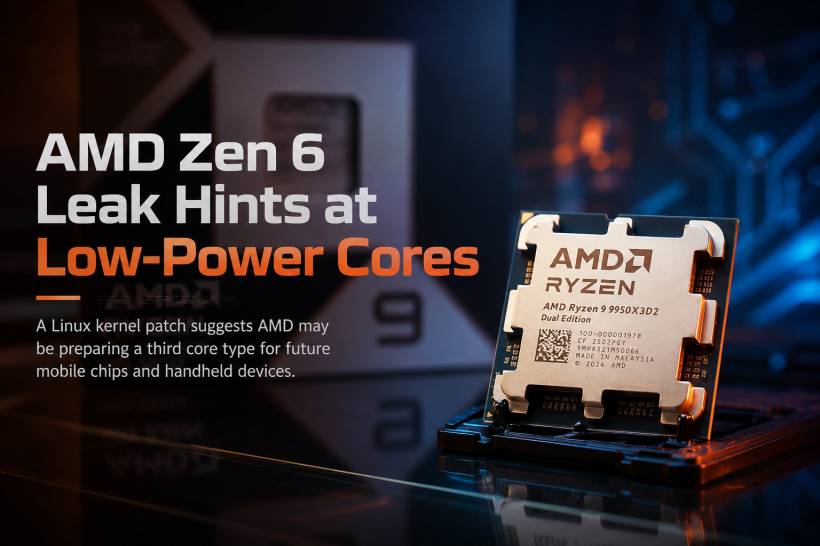
AMD's next-generation Zen 6 architecture is still some distance away from an official launch, but a small Linux kernel update has offered an interesting early clue about where the company could be heading. The patch introduces support for a new AMD "Low Power" CPU core type, alongside the existing Performance and Efficiency classifications used by Linux. On paper, it sounds like a minor software update. In practice, it may point toward a more advanced multi-tier CPU design for future AMD chips, particularly in laptops, handheld gaming devices and compact systems where battery life matters just as much as raw speed.
A Small Linux Patch With a Bigger Meaning
Hardware announcements normally arrive with product names, benchmark charts and plenty of marketing language. This one did not.
Instead, the clue appeared in a Linux kernel patch that teaches the operating system how to recognise a third AMD CPU core category: Low Power. AMD's own patch description says these cores are intended for background and idle workloads where minimising power use matters more than delivering high performance.
That is important because modern processors are no longer designed around a simple idea of "all cores should do everything." Different types of work benefit from different types of cores.
Opening a game, compiling code, editing video or handling a demanding application needs fast, responsive processing power. Meanwhile, checking notifications, syncing files, handling background services or keeping the operating system responsive does not always need the same high-performance cores running at full speed.
A dedicated low-power core could allow AMD systems to handle those lighter jobs more efficiently, helping the main cores remain available for heavier work while also reducing unnecessary battery drain.
AMD Is Moving Towards a Three-Tier Core Strategy
AMD already has experience with varied core designs.
Its current approach includes standard Zen cores for stronger performance and Zen "c" cores that are designed to be denser and more space-efficient. The new Low Power classification appears to add another layer below that, potentially creating a more specialised structure:
• Performance cores for demanding applications, gaming and intensive workloads
• Dense or efficiency-focused cores for improved multi-core capacity and lower space requirements
• Low-power cores for light background tasks, idle activity and energy-sensitive workloads
That does not necessarily mean AMD is copying Intel directly. Intel's hybrid designs use distinct Performance and Efficiency core architectures, while AMD has traditionally tried to preserve stronger architectural consistency across its different core types. Still, the overall goal is similar: use the right hardware for the right workload instead of treating every task as equally demanding.
Why Low-Power Cores Could Matter More on Mobile Devices
The most obvious place for this kind of design is in laptops.
A modern laptop spends a large portion of its day doing relatively light work: browser tabs updating in the background, cloud storage syncing, messaging apps checking for notifications, security tools running scans and the operating system managing connected devices.
Running those small tasks on a dedicated low-power core could reduce the need to wake up faster, more power-hungry CPU clusters. In theory, that could improve idle efficiency, extend battery life and reduce heat during everyday use.
The same idea could be especially valuable in gaming handhelds. Handheld devices have to balance performance, heat, battery capacity and physical size much more tightly than desktop PCs. A small group of low-power cores could handle the operating system, downloads, background services and interface functions while the more powerful cores focus on the game itself.
That is the sort of design choice that may not show up dramatically in a benchmark chart, but could make a device feel more practical in real-world use.
The Zen 6 Link Is Plausible, but Not Yet Confirmed
It is understandable that attention has quickly shifted toward Zen 6. AMD has already been preparing Linux support for Zen 6-related CPU models, and the new Low Power classification arrives at a time when future Zen 6 products are widely expected to be taking shape behind the scenes.
However, it is still important not to overstate what has been confirmed.
The patch does not name Zen 6. It does not reveal a Ryzen model, a release date, a final core count or the exact technical difference between a standard dense core and this newly identified low-power type. It simply confirms that AMD is preparing operating-system support for processors that can report a Low Power core category.
This is meaningful evidence of AMD's direction, but it is not a full product announcement.
Could This Be Connected to a Future PlayStation Handheld?
Naturally, the discussion has also revived rumours surrounding a future Sony handheld reportedly powered by an AMD chip codenamed Canis.
Some earlier reports claimed that this device could combine Zen 6c cores with a pair of low-power Zen 6 cores, with the smaller cores handling system-level and non-gaming tasks. Other alleged specifications, including graphics configuration, memory setup, power targets and launch timing, remain inconsistent across rumours and have not been confirmed by Sony or AMD.
The new Linux patch makes the general idea of AMD low-power cores more believable. It does not confirm that Canis exists, that Sony is using it, or that any leaked console specifications are accurate.
For now, that connection belongs firmly in the rumour category.
What This Could Mean for Future Ryzen Devices
For consumers, the most exciting possibility is not simply "more cores." It is smarter use of cores.
A future Ryzen laptop may be able to stay responsive during light everyday work without constantly drawing power from its fastest CPU cores. A gaming handheld could dedicate more of its energy budget to the game instead of system housekeeping. Even compact desktops and mini PCs could potentially benefit from lower idle power use.
Of course, the operating system scheduler will be just as important as the hardware itself. Windows and Linux need to recognise which tasks belong on which cores, and software developers need to avoid assuming that every CPU thread has identical performance characteristics.
That is why AMD's Linux preparation matters. It suggests that software support is being considered early, rather than treated as an afterthought once the hardware arrives.
Final Thoughts
The new Linux patch is not a complete Zen 6 reveal, but it is one of the clearest signs yet that AMD may be expanding its processor strategy beyond the usual performance-core and dense-core approach.
A dedicated Low Power core type could help future AMD laptops, handhelds and compact devices deliver better battery life, cooler operation and more efficient background performance without sacrificing the speed people expect from Ryzen hardware.
For now, the sensible view is simple: the low-power core classification is real, while the exact Zen 6 products, configurations and handheld-console connections remain unconfirmed. Still, it is a development worth watching because it could shape how AMD designs its most portable devices over the next few years.











Comments 0