

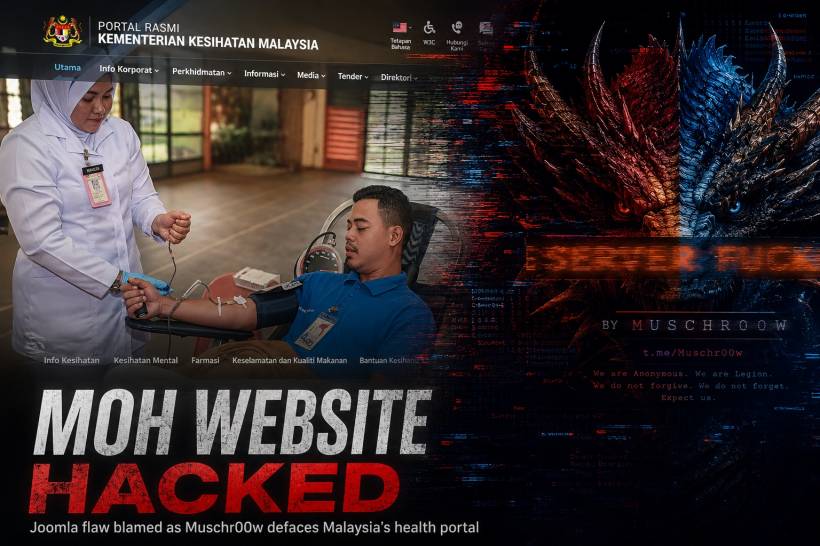
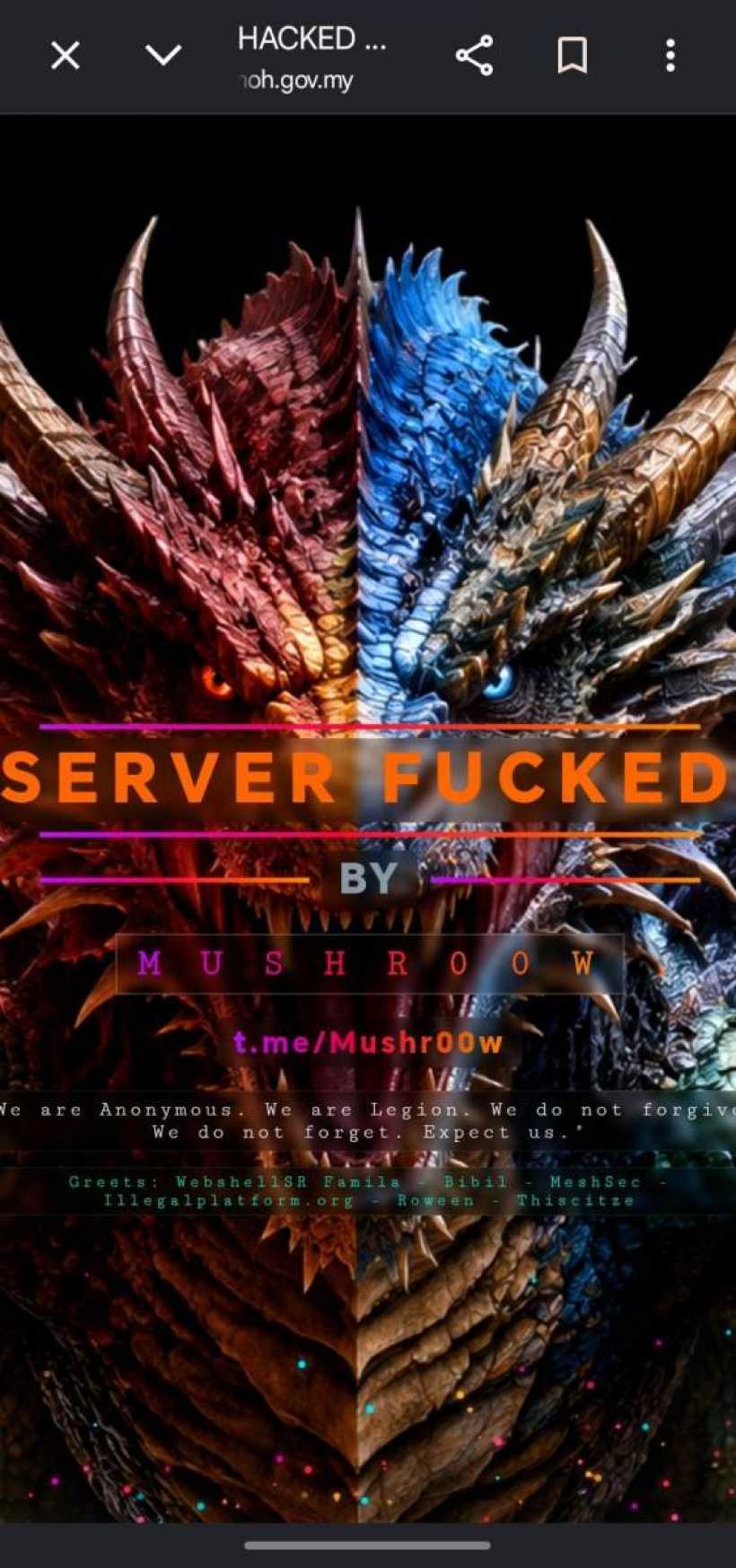
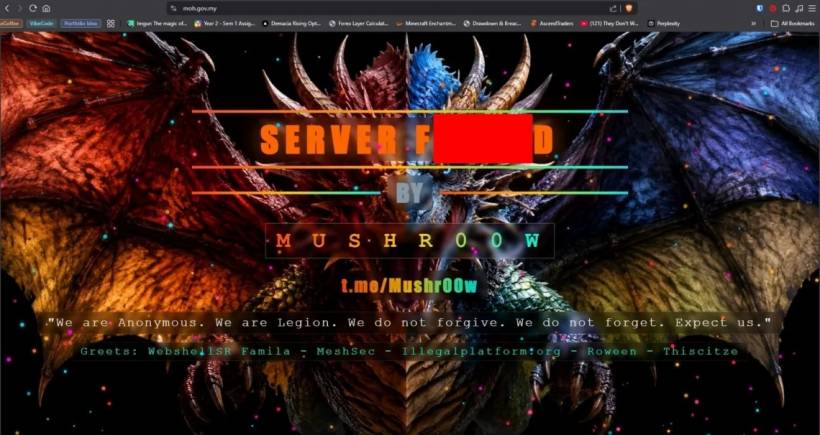
Malaysia's Ministry of Health (MOH) website became the latest high-profile public-sector portal to be hit by a cyber incident, after its official domain, moh.gov.my, was defaced with a message claiming responsibility under the name MUSHR00W. During the disruption, visitors and search previews showed a replacement page carrying the attacker's branding, an "Anonymous"-style slogan, and references to several other names or groups. MOH later confirmed that its website had been compromised, took the portal offline, and advised the public not to access the site or download anything from it while recovery work was under way.
For ordinary visitors, the incident was an immediate reminder that even familiar government websites can become unsafe when compromised. A trusted .gov.my domain does not automatically mean that every page, download, or link is safe during an active cyber incident.
The MOH website was not the only portal affected. The National Cyber Security Agency (NACSA) said several Malaysian government websites were believed to have been compromised through the same Joomla Content Editor, or JCE, vulnerability. This included websites linked to the Ministry of Health, the Malaysia Co-operative Societies Commission, the Handicraft Development Corporation, and the Women's Development Department.
While the visible defacement was the most public part of the incident, the bigger concern is what may have happened behind the scenes.
What Happened to the MOH Website?
The MOH website appeared to have been defaced by an attacker or group using the name MUSHR00W. The defacement page used cybercrime-style branding, referenced several other names, and included language commonly associated with online hacktivist culture.
However, it is important to separate claims from confirmed facts.
At this stage, MUSHR00W should be described as the name used on the defacement page, not as a confirmed identity or officially attributed hacking group. There is no publicly verified information confirming who is behind the name, where they are based, whether they are part of a wider group, or whether they have any genuine connection to Anonymous.
Cyber attackers often use well-known phrases, symbols, and group references to attract attention, build a reputation, or make an attack appear larger than it is. A defacement message can show who is claiming responsibility, but it does not by itself prove the identity, motive, or affiliation of the person behind it.
The Root Cause: A Critical Joomla Content Editor Weakness
The suspected entry point was a critical vulnerability in Joomla Content Editor (JCE), a popular editor extension used by Joomla-powered websites.
The weakness involved a missing authorisation check in JCE's profile-import functionality. In simple terms, an attacker did not need to log in first. They could abuse the vulnerable feature to create or import a rogue editor profile with overly permissive upload settings.
That rogue profile could then be used to upload malicious PHP files to the web server.
Once malicious PHP code is uploaded and executed, an attacker may gain control far beyond a normal website page.
The attack chain can be understood like this:
• A vulnerable Joomla website runs an outdated JCE version.
• An unauthenticated attacker abuses the profile-import weakness.
• The attacker creates a rogue editor profile with unsafe upload permissions.
• The rogue profile allows executable files, including PHP scripts, to be uploaded.
• The attacker uploads a malicious file, often called a web shell or backdoor.
• The web server executes the malicious file.
• The attacker may then alter pages, create hidden access, steal credentials, or move deeper into the hosting environment.
This is why the issue is classified as a serious remote code execution vulnerability. It is not merely a website-content problem. It can become a full server compromise.
Why a Website Defacement Is More Serious Than It Looks
A defaced homepage is highly visible, but it may only be the surface-level sign of a broader incident.
If an attacker successfully uploaded and executed code on the server, the potential consequences could include:
• Website defacement or fake public information.
• Persistent backdoors that allow the attacker to return later.
• Theft of administrator, FTP, database, SSH, or hosting credentials.
• Creation of rogue Joomla administrator accounts.
• Upload of malicious scripts into web-accessible folders.
• Modification of legitimate website files.
• Lateral movement into other websites or systems on the same hosting environment.
• Potential exposure of files or data stored on the affected server.
It is also important not to assume that a visible defacement automatically means personal information was stolen. A defacement proves that website integrity was affected, but it does not by itself confirm a data breach. The full scope can only be determined through technical investigation, log review, and forensic analysis.
Why Simply Updating JCE Is Not Enough
Updating JCE is essential, but an update alone does not clean an already-compromised server.
The vulnerability was addressed in JCE version 2.9.99.5, followed by additional hardening in version 2.9.99.6. Website owners should move to the latest supported JCE release, which at the time of writing is version 2.9.99.7. Older sites that cannot immediately meet the requirements for a full update should use the vendor's temporary patch only as a short-term measure while planning a proper upgrade.
The key point is simple: patching closes the door, but it does not remove an attacker who may already be inside.
If a malicious PHP file, rogue editor profile, hidden administrator account, or stolen credential already exists, the attacker may retain access even after the vulnerable extension has been updated.
Signs That a Joomla Website May Have Been Hit
Joomla administrators and hosting teams should check for indicators of compromise immediately.
• Unknown or recently created JCE editor profiles.
• Editor profiles with permissions allowing PHP or executable file uploads.
• Suspicious PHP files inside /images/, /media/, /tmp/, or other upload folders.
• Strange file names designed to look harmless, such as image-related files containing hidden PHP code.
• Unfamiliar Joomla administrator accounts.
• Unexpected changes to templates, homepage files, .htaccess, or extension files.
• Web server log entries involving unusual JCE profile-import activity.
• New scheduled tasks, cron jobs, redirects, or outbound connections.
• Reused credentials across other websites, hosting panels, databases, or FTP accounts.
How Website Owners Can Avoid This Issue
The most important lesson from the MOH incident is that public-facing websites need continuous security maintenance. Joomla, WordPress, Drupal, and other content platforms are only as secure as their weakest installed extension.
Website owners should take the following actions:
• Update Joomla core, JCE, extensions, themes, and server software promptly.
• Upgrade JCE to the latest supported release rather than stopping at the minimum patched version.
• Remove JCE completely if it is not required.
• Temporarily disable JCE if an urgent update cannot be completed safely.
• Restrict Joomla administrator access through VPN, IP allowlisting, multi-factor authentication, or an additional access-control layer.
• Remove unused plugins, themes, components, and administrator accounts.
• Limit file-upload permissions to only the file types genuinely required by the website.
• Prevent PHP execution inside upload folders wherever the hosting configuration allows it.
• Review JCE editor profiles regularly and remove unknown or overly permissive profiles.
• Use unique, strong passwords for Joomla, hosting, FTP/SFTP, SSH, databases, and email accounts.
• Rotate credentials immediately if compromise is suspected.
• Deploy a web application firewall to block known exploit attempts and suspicious upload behaviour.
• Monitor web server, Joomla, authentication, and firewall logs.
• Keep tested backups that are stored separately from the production website.
• Perform regular vulnerability scans and file-integrity checks.
• Separate public-facing websites from critical internal systems wherever possible.
What To Do If a Website Is Already Compromised
An organisation that suspects exploitation should not treat it as a routine website update.
The recommended incident-response approach is:
• Isolate the affected server from the internet where practical.
• Preserve logs, suspicious files, and evidence before deleting anything.
• Update Joomla and JCE immediately to close the entry point.
• Identify and remove rogue JCE profiles.
• Search for malicious PHP files and web shells across the hosting environment.
• Review Joomla administrator accounts and remove unauthorised users.
• Rotate all website, database, hosting, FTP/SFTP, SSH, and cloud credentials.
• Scan for persistence methods such as cron jobs, modified templates, altered configuration files, and hidden backdoors.
• Restore from a known-clean backup if the integrity of the live environment cannot be trusted.
• Continue monitoring after recovery because attackers may attempt to return using stolen credentials or previously planted access.
A Reminder for the Public
For the public, the advice is straightforward. When an official website announces that it has been compromised, avoid entering personal information, downloading files, or clicking unfamiliar links on that domain until the agency confirms it is safe again.
Use verified government social-media channels, official mobile applications, verified service portals, or direct helplines for urgent information while the affected website is being restored.
Final Thoughts
The MOH website incident is a warning that cyber resilience is not just about having a website online. It is about keeping every component behind that website patched, monitored, controlled, and ready to recover.
The claimed MUSHR00W defacement may have been the most visible part of the incident, but the real lesson lies in the underlying Joomla JCE vulnerability. A single missing authorisation check can become the path to full server access when patch management, file-upload controls, monitoring, and incident response are not strong enough.
For Malaysian organisations still running Joomla, this is the time to review JCE deployments, patch urgently, verify server integrity, and assume that an update alone is not a complete recovery plan.











Comments 0