

Cloud infrastructure has become an important part of modern government technology because it offers flexibility, scalability and easier access to advanced services such as artificial intelligence. But the more sensitive the information becomes, the more important it is to know exactly where that data is stored, who controls it and whether an overseas provider could potentially gain access.
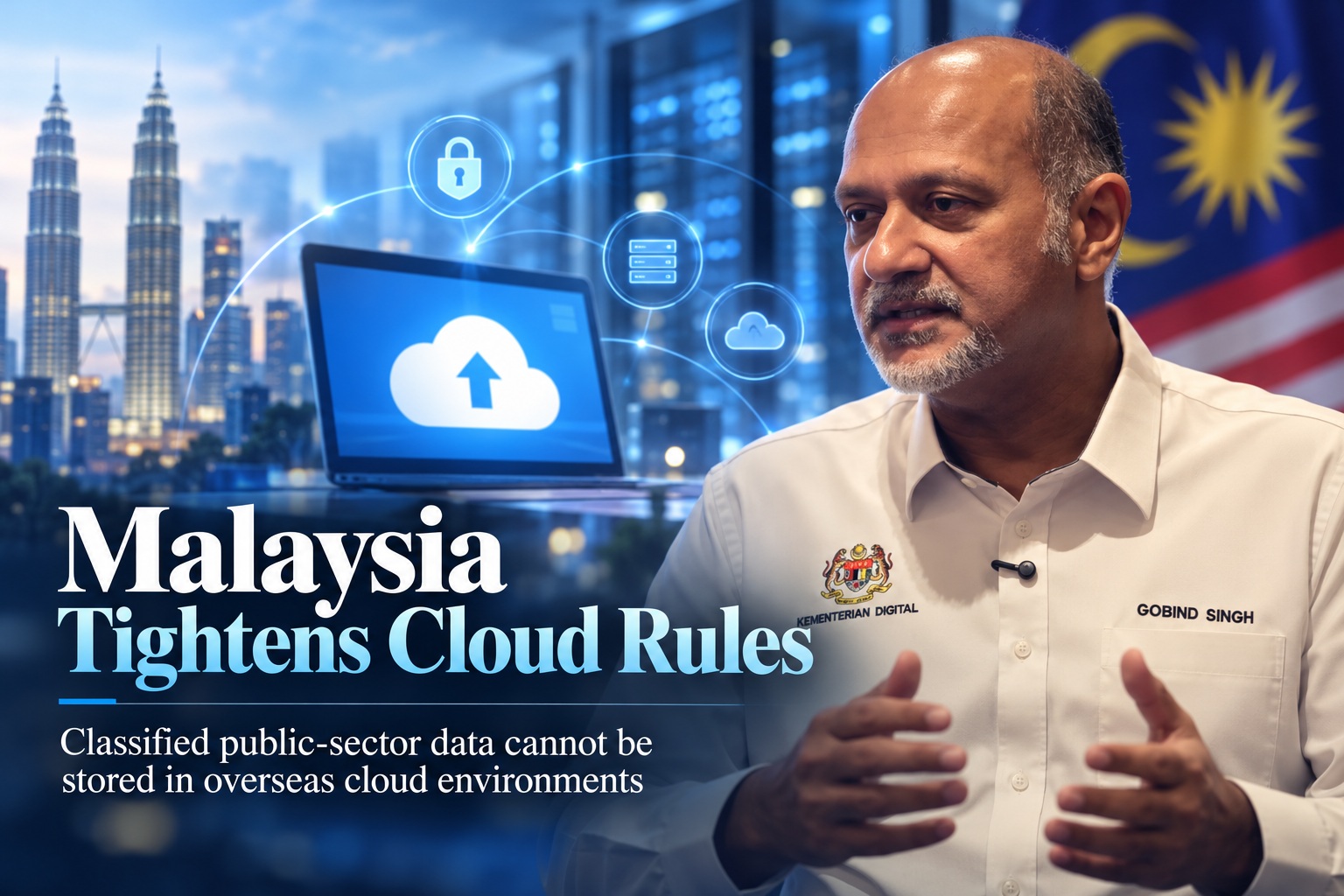
Malaysia is drawing a clear line when it comes to sensitive government information. Digital Minister Gobind Singh Deo has confirmed that confidential and restricted public-sector data cannot simply be placed in overseas cloud environments. Such information must instead remain within approved domestic private or hybrid cloud infrastructure, while overseas cloud services are reserved for information that is open and considered non-sensitive.
Sensitive Government Data Must Remain In Malaysia
The policy is designed around the principle of data sovereignty.
Confidential and restricted government information may only be stored using domestic private or hybrid cloud environments. This keeps sensitive datasets within infrastructure operating under Malaysian jurisdiction rather than placing them directly inside overseas cloud environments.
Only public-sector information classified as open or non-sensitive may be stored overseas.
This creates a clear separation between cloud workloads where convenience and scalability are acceptable and those where national control over the underlying data takes priority.
Why Data Sovereignty Matters
Cloud computing frequently involves infrastructure operated by multinational technology companies.
Even when a service is used from Malaysia, the physical servers storing or processing information could theoretically be located in another jurisdiction unless specific controls are imposed.
That raises difficult questions when government information is involved.
Which country's laws apply?
Could foreign authorities legally request access?
Who controls encryption?
Could the provider itself technically access the information?
For ordinary public information, these concerns may be manageable. For confidential government information, they become far more significant.
Malaysia's policy attempts to reduce that exposure by keeping sensitive datasets within domestic cloud environments.
Not All Cloud Data Is Treated The Same
The policy does not mean Malaysian government agencies are prohibited from using overseas cloud services completely.
Instead, the rules distinguish between different categories of information.
Open and non-sensitive data may still be placed in overseas cloud environments where appropriate.
Confidential and restricted information receives much tighter treatment.
That allows government agencies to benefit from international cloud platforms for less sensitive workloads without applying the same risk model to every dataset.
A public website and a classified government database clearly do not require identical security controls.
Encryption Is Mandatory At Rest And In Transit
Location is only one part of the security model.
Government data must also be encrypted both at rest and in transit according to requirements under the National Cryptography Policy.
Encryption at rest protects information while it is stored.
Encryption in transit protects it while moving between systems, such as when information travels between a government agency and a cloud platform.
Using both approaches reduces the risk that readable government information becomes exposed if storage infrastructure or network communications are intercepted.
The Government Keeps Control Of Encryption Keys
Perhaps one of the most important safeguards is ownership of the encryption keys.
The keys used to protect government information remain under government ownership and control rather than being handed entirely to the cloud provider.
This matters because encryption becomes much less meaningful if the same third-party provider storing the information also has unrestricted access to the keys needed to decrypt it.
Government-controlled keys provide an additional separation.
Even when foreign technology providers are involved in processing certain workloads, they should not independently possess everything required to access protected government information.
Foreign Providers Should Not Be Able To Read The Data Independently
The objective is to reduce the possibility that a foreign cloud provider could independently access Malaysian government information.
That protection is relevant even if an overseas authority requests access from the service provider.
If the provider does not control the encryption keys, handing over encrypted storage does not automatically provide readable information.
This does not make every legal or technical risk disappear, but it significantly strengthens the government's control over its own data.
In practical terms, data sovereignty involves not only knowing where information sits but also controlling the mechanisms needed to unlock it.
AI Providers Face Additional Restrictions
The government's rules become even stricter when artificial intelligence services are involved.
Government AI procurement contracts include clauses preventing service providers from using government or public-sector data to train their AI models.
This is particularly important with generative AI systems, where organisations may otherwise worry that information submitted for processing could later be incorporated into model training pipelines.
Under the government's approach, data provided for an AI workload is there to complete that particular task.
It is not meant to become training material for the provider.
Government Data Must Not Be Retained For AI Training
The restrictions also cover storage.
Information submitted to AI providers is not supposed to be retained indefinitely.
Once the required processing has been completed, the data must be deleted.
That reduces the amount of government information sitting inside third-party systems long after the original task has finished.
Data minimisation is an important security principle because information that no longer exists inside a provider's environment cannot later be exposed through a breach of that environment.
AI Contracts Include The Restriction As A Standard Clause
According to Gobind, restrictions on using government data for model training are included across the government's AI procurement contracts.
Making this a contractual requirement is important.
Without explicit terms, different AI providers may operate under very different policies regarding retention, telemetry and model improvement.
A standard government clause creates clearer expectations.
The provider knows what it is permitted to do with the information, while the public agency has a contractual basis for enforcing those restrictions.
Government Agencies Must Minimise Data Before Using AI
The safeguards do not stop with the technology provider.
Government agencies themselves are also expected to reduce the amount of sensitive information sent into AI systems.
Public-sector AI guidelines require agencies to minimise, conceal or anonymise data before processing it using AI.
That means an AI system should receive only the information genuinely needed to perform the task.
If an individual's identity is unnecessary, identifying information should ideally be removed or obscured beforehand.
This reduces the consequences if information is accidentally exposed.
Data Minimisation Should Be The Default
Sending an entire dataset to an AI model simply because it is convenient is poor security practice.
Suppose an agency wants AI to analyse broad trends within a dataset.
If names, identity numbers or detailed personal records are not needed for that analysis, those details should not be included.
Removing unnecessary fields reduces both privacy and security risk.
The principle is straightforward:
If the AI does not need to see something, do not give it that information.
That is particularly important when external providers are involved.
Anonymisation Can Reduce Privacy Exposure
Anonymisation goes a step further by attempting to prevent processed information from being linked back to specific individuals.
For government agencies handling citizen information, this can be extremely important.
Datasets may contain enough information to provide useful statistical or operational insight without retaining personal identifiers.
Proper anonymisation therefore allows agencies to use AI capabilities while reducing the amount of personally identifiable information entering the system.
However, agencies still need to perform anonymisation carefully because poorly anonymised datasets can sometimes be reidentified when enough additional information is available.
Cloud Convenience Must Be Balanced Against Risk
The government's policy reflects a broader reality facing almost every large organisation.
Cloud services are incredibly useful.
They allow organisations to scale infrastructure quickly, deploy new services without buying hardware and gain access to increasingly sophisticated AI tools.
But convenience does not eliminate responsibility.
The more sensitive the information, the stronger the controls around location, access, encryption and retention need to become.
This is especially true for governments because the information involved may affect national security, critical services or millions of citizens.
Private And Hybrid Cloud Remain Important
Domestic private and hybrid cloud environments provide a compromise between traditional on-premises infrastructure and fully outsourced public cloud services.
A private cloud can offer many of the automation and flexibility benefits associated with cloud computing while maintaining tighter organisational control over infrastructure.
Hybrid models allow agencies to separate workloads according to sensitivity.
Less sensitive services might make use of public cloud resources while restricted information remains within a controlled domestic environment.
That approach can help government agencies modernise without treating every workload identically.
The Policy Also Applies To AI Infrastructure
Cloud computing and AI are increasingly difficult to separate.
Many AI platforms rely heavily on cloud infrastructure because training and inference require substantial computing resources.
Government agencies may therefore need to evaluate not only where a cloud provider stores data but also where an AI model actually processes it.
The same sovereignty principles become relevant.
Where does the data travel?
Which systems process it?
How long is it retained?
Which company controls the infrastructure?
Those questions need clear answers before sensitive information enters an AI workflow.
Security Depends On More Than Server Location
Keeping data inside Malaysia is important, but location alone does not guarantee security.
A poorly protected domestic server can still be compromised.
Government agencies still need strong identity controls, monitoring, access management, encryption, vulnerability management and incident response.
Domestic hosting should therefore be considered one layer of protection rather than the entire security strategy.
The same applies to private cloud infrastructure.
If administrator accounts are weak or encryption keys are poorly managed, geographical location will not solve the problem.
Government-Controlled Keys Add An Important Layer
Strong key management is particularly critical.
The government needs to ensure encryption keys are stored securely, rotated where appropriate and accessible only by authorised systems or personnel.
Losing control of an encryption key can be just as serious as exposing the encrypted information itself.
Hardware security modules and other specialised key-management technologies can provide additional protection for critical cryptographic material.
The principle remains that data and the keys protecting it should not simply fall under uncontrolled third-party ownership.
AI Governance Legislation Is Also Being Prepared
The Digital Ministry is also drafting an AI governance bill.
The proposed legislation is intended to strengthen accountability around how AI systems are developed and used.
That becomes increasingly important as government agencies deploy AI across more functions.
Questions around data protection are only one part of responsible AI governance.
Authorities also need to consider transparency, decision accountability, bias, cybersecurity and what happens when automated systems make mistakes.
A dedicated governance framework could establish clearer responsibilities.
Public-Sector AI Needs Clear Accountability
If an AI system is used to assist with a government decision, someone still needs to be responsible for the outcome.
Responsibility cannot simply be transferred to an algorithm or technology provider.
Agencies need policies defining who approves AI systems, how their outputs are reviewed and when human intervention is required.
That becomes especially important if AI begins influencing decisions affecting citizens directly.
Governance therefore needs to evolve alongside adoption.
Foreign Technology Can Still Be Used With The Right Controls
Malaysia's approach does not appear to be about excluding foreign cloud or AI companies entirely.
Global providers often offer technology, scale and expertise that would be difficult to reproduce locally.
The goal is instead to establish conditions under which those services can be used safely.
Sensitive government information should remain within appropriate domestic environments.
Government-controlled encryption limits provider access.
AI training restrictions prevent information from becoming part of commercial models.
Data minimisation reduces what providers receive in the first place.
Together, those controls create a more balanced approach.
This Could Influence Private-Sector Practices Too
Although these requirements specifically concern government information, they provide useful lessons for Malaysian businesses as well.
Companies handling sensitive customer information should also ask similar questions when adopting cloud and AI systems.
Where is the data stored?
Who controls the encryption keys?
Can the provider use submitted information for model training?
How long is the information retained?
Can it be deleted?
Organisations may discover that convenience-focused default configurations are not appropriate for their most sensitive information.
AI Adoption Makes Data Classification More Important
None of these safeguards work properly if organisations do not know what information they possess.
Government agencies need clear data classification.
Open information can be handled differently from confidential information.
Restricted datasets need stronger controls.
Without proper classification, staff may unintentionally upload sensitive data to services that are only approved for public or non-sensitive information.
This makes information governance an increasingly important foundation for both cloud and AI adoption.
Staff Awareness Will Be Just As Important
Technical policies can still fail through everyday user behaviour.
An employee could copy confidential information into an unapproved public AI chatbot without realising that doing so violates policy.
Training therefore needs to accompany the technical controls.
Public-sector employees should understand what information can be processed through external platforms and which services are officially approved.
Clear policies reduce the chance that convenience overrides security.
Final Thoughts
Malaysia's restrictions on storing sensitive public-sector information overseas demonstrate how cloud adoption is increasingly being balanced against data sovereignty and cybersecurity.
Confidential and restricted government information must remain within domestic private or hybrid cloud environments, while only open and non-sensitive information may be stored in overseas cloud environments. Government data must also be encrypted both while stored and while travelling between systems, with encryption keys remaining under government control.
AI providers face additional restrictions. Government information cannot be used to train their models, it must not be retained unnecessarily and it needs to be deleted after processing. Agencies themselves must also minimise, conceal or anonymise information before submitting it to AI systems.
These measures are sensible because cloud and AI technologies are becoming too important for government agencies to ignore, but convenience cannot come at the expense of control over sensitive national data.
As Malaysia moves further towards digital government and wider AI adoption, the challenge will not be whether cloud and AI should be used. It will be ensuring that they are used without losing control over the information entrusted to them.











Comments 0