

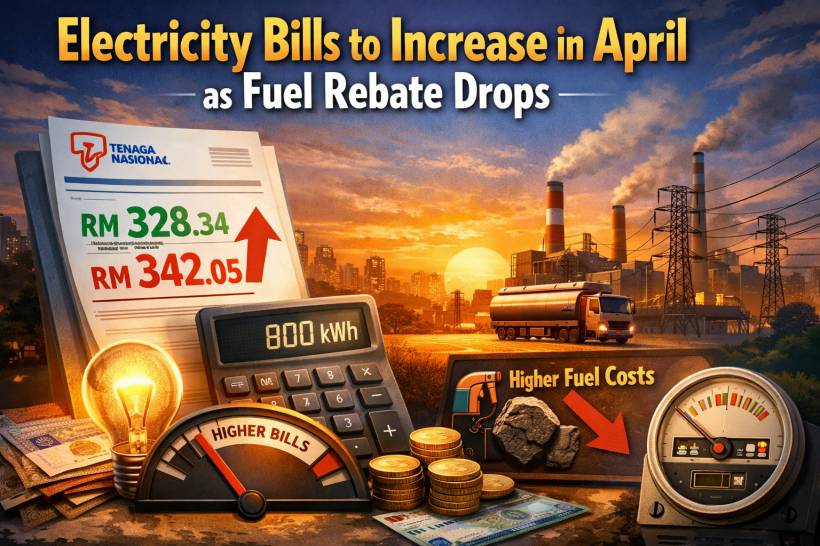
For many households and businesses in Malaysia, April is bringing a not-so-welcome change to the monthly electricity bill. While there is still a rebate under Tenaga Nasional Bhd's Automatic Fuel Adjustment mechanism, that rebate is now much smaller than it was in March. In simple terms, that means consumers who are affected by the adjustment will end up paying more this month.
This is not because electricity tariffs have been overhauled entirely, but because the monthly rebate tied to fuel costs has been reduced quite sharply. It is one of those changes that may look minor on paper when measured in sen per kilowatt-hour, but once applied to actual usage, the difference becomes much more noticeable.
What Changed in April
For April, the Automatic Fuel Adjustment, or AFA, has been set at a rebate of 0.47 sen per kWh. In March, the rebate was 2.15 sen per kWh. That means the rebate has been reduced by 1.68 sen per kWh from one month to the next.
Because consumers are now receiving a smaller rebate, the final electricity bill becomes higher. The tariff is not necessarily being framed as a direct price hike in the traditional sense, but the end result for affected users is effectively the same. A lower rebate means less offset against the actual cost of electricity generation.
To put that into perspective, a consumer using 800kWh would have paid RM328.34 in March. In April, that same usage would result in a bill of RM342.05. That is a noticeable increase for a single month, especially for households with heavy electricity use or for businesses that already operate on tight margins.
Why the Bill Changes From Month to Month
The AFA system was introduced by the Energy Commission in July last year. Its purpose is to adjust electricity tariffs every month based on actual cost conditions, especially fuel prices and exchange rate movements.
This includes factors such as the price of coal and gas used by power plants, as well as currency changes that can affect the cost of imported fuel. In other words, when generation costs become less favourable, consumers may receive a smaller rebate or potentially face a surcharge, depending on the situation.
The AFA replaced the older Imbalance Cost Pass-Through mechanism, or ICPT, which was reviewed every six months. The newer system is more dynamic, which means changes can now be felt on a monthly basis instead of waiting half a year.
That makes the billing structure more responsive to market conditions, but it also means consumers may need to pay closer attention to monthly tariff announcements because the amount can shift more frequently.
Who Will Not Be Affected
Not everyone will feel the impact of this April adjustment.
Domestic users who consume below 600kWh per month are exempted from the AFA. That generally covers households with monthly bills of around RM216 or less. For this group, the automatic fuel adjustment does not apply, regardless of whether it is a rebate or a surcharge.
Consumers who subscribe to the green electricity tariff are also excluded from the AFA. This category covers users who choose electricity that is certified as coming from renewable energy sources.
So while higher-usage households and many other electricity users may see their bills rise, lower-consumption domestic users still remain shielded from this monthly fluctuation.
There Is a Limit to How Much It Can Rise
One important safeguard in the AFA framework is that monthly increases are capped. If the adjustment turns into a surcharge, it cannot exceed 10% of the allowed generation tariff for that month unless Cabinet approval is obtained.
That cap is meant to prevent sudden and excessive jumps in electricity bills. Interestingly, while surcharges are limited, rebates do not have a ceiling. So if fuel costs fall significantly, consumers can theoretically receive a much larger rebate without that same restriction.
This structure creates a measure of protection for consumers during periods of higher energy costs, while still allowing them to benefit when market conditions improve.
The Trend Ahead Does Not Look Especially Encouraging
Based on TNB's three-month projection, rebates are expected to remain relatively low in the months ahead.
The projected rebate is 0.39 sen per kWh in May, 0.91 sen per kWh in June, and just 0.08 sen per kWh in July 2026. That suggests consumers should not expect a major relief in the immediate term, at least based on the current forecast.
Although these are still rebates rather than surcharges, the small figures indicate that electricity costs may stay elevated compared to periods when rebates were more generous.
A Look at the AFA Trend So Far
Looking back at the monthly rebate figures gives a clearer picture of how much things have shifted over time.
In July 2025, there was no rebate. August recorded a rebate of 1.45 sen per kWh, followed by 1.10 sen in September. Then came a much larger reduction in costs for consumers, with rebates of 6.50 sen in October, 8.91 sen in November, and 6.42 sen in December.
The rebate then began shrinking in early 2026, falling to 4.99 sen in January, 2.77 sen in February, 2.15 sen in March, and now just 0.47 sen per kWh in April.
That pattern shows a clear trend. Consumers previously benefited from stronger rebates toward the end of 2025, but those savings have gradually narrowed as 2026 progressed.
What This Means for Consumers
For households that use more electricity, this April adjustment is another reminder that monthly energy costs can shift more quickly under the AFA framework. Air-conditioning, water heaters, dryers, and other high-consumption appliances can make the impact more obvious, particularly in larger homes.
For businesses, especially those with high operational electricity needs, even small changes in tariff rebates can accumulate into a more meaningful cost increase across multiple premises or facilities.
This also means budgeting for electricity may become a little less predictable than before. Under the old six-month review system, changes were less frequent. Now, with monthly adjustments, users may need to keep a closer eye on tariff announcements if they want to anticipate bill changes more accurately.
Final Thoughts
April's electricity adjustment may not look dramatic at first glance, but the reduced rebate does translate into higher bills for consumers who are covered by the AFA system. The drop from 2.15 sen per kWh in March to 0.47 sen per kWh in April is enough to make a visible difference, especially for higher-usage households and businesses.
The bigger story here is not just that bills are rising this month, but that electricity pricing in Malaysia has become more fluid under the monthly fuel adjustment model. For consumers, that means understanding your energy usage matters more than ever, because even modest changes in rebate levels can have a real effect on what you end up paying.











Comments 0