

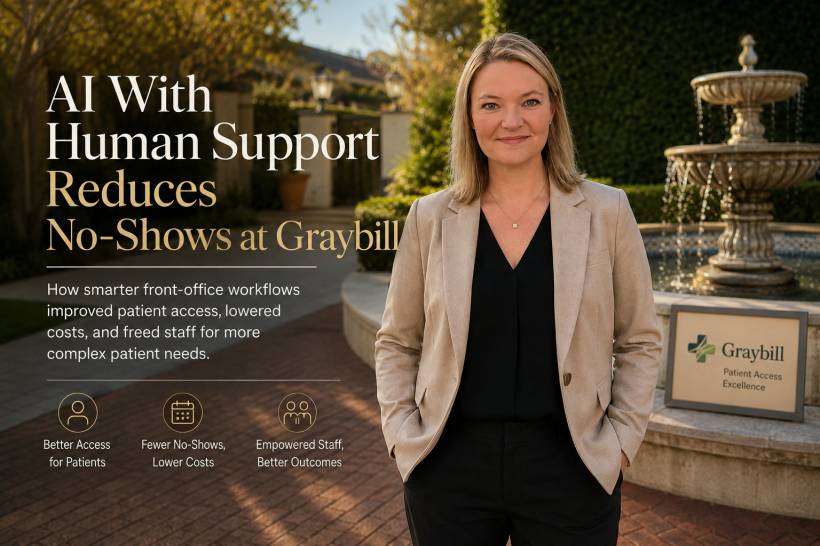
Artificial intelligence is often presented as a quick solution for healthcare organisations facing staff shortages, long call queues and growing administrative workloads. However, Graybill Medical Group found that the technology delivered the strongest results only after the organisation first addressed the operational problems behind those pressures.
Rather than replacing employees with automation, the physician-led practice used AI to handle repetitive, high-volume tasks while allowing staff to focus on patients whose concerns required empathy, judgement and personal attention.
The approach reportedly helped Graybill reduce front-office costs by 50%, lower patient no-shows by 24% and shorten call waiting times without adding more clinical resources.
The Front Office Had Become a Barrier to Care
For many patients, accessing healthcare begins long before they enter an examination room. It starts with a phone call, an appointment request, a question about a referral or an attempt to obtain medical information.
When those interactions become slow or difficult, the front office can unintentionally become a barrier to treatment.
Graybill's centralised communication centre was experiencing increasing pressure as call volumes grew. Patients faced longer waits, more calls were abandoned and appointment scheduling became less efficient.
At the same time, employees were spending much of their day completing repetitive administrative work, including:
These tasks were necessary, but they left staff with less time for conversations that genuinely required human involvement.
The Organisation Did Not Begin With AI
Graybill's transformation did not start with a decision to purchase an AI platform.
Leadership first examined what was preventing patients from accessing care efficiently. Instead of relying only on individual complaints, the practice reviewed operational data such as call waiting times, abandonment rates, appointment availability, missed appointments, staffing expenses and patient feedback.
Employee feedback was equally important. Staff members working inside the communication centre understood where processes were slowing down and which requests consumed the most time.
The combined findings pointed to the communication centre as an area where improvements could benefit the entire organisation.
It was not simply a call-centre problem. Poor communication workflows affected appointment availability, provider schedules, patient satisfaction and continuity of care.
Technology Was Used to Support the Workflow
Once the operational issues were understood, Graybill looked for a partner willing to learn how the organisation already worked.
The objective was not to force employees into an entirely new operating model. Instead, the technology needed to fit around existing clinical and administrative processes while removing unnecessary work.
Graybill worked with Third Way Health, which combines AI-based agents with human support for front-office and administrative activities.
The provider studied existing processes, identified inefficiencies and supported the practice as an extension of its operational team rather than functioning only as a software supplier.
Only after that groundwork was completed did Graybill introduce AI into patient communication workflows.
AI Took On Repetitive, High-Volume Requests
The technology was assigned tasks that occurred frequently and followed relatively predictable processes.
These included routine appointment scheduling, answering common questions and guiding patients towards the appropriate service or resource.
Automating these interactions reduced the volume of basic requests reaching employees. Staff could then spend more time supporting patients whose circumstances were complicated, sensitive or difficult to resolve through a scripted response.
This division of responsibility was central to the project.
AI was used where consistency and speed mattered most. Human employees remained involved where empathy, critical thinking and contextual understanding were necessary.
Human Support Remained Essential
Healthcare conversations are not always straightforward.
A patient may call about an appointment but then reveal concerns about worsening symptoms, transportation problems, financial difficulty or confusion about a treatment plan. These situations require more than an automated answer.
By reducing the number of routine enquiries handled manually, Graybill created more capacity for staff to deal with complex patient needs.
This helped prevent automation from becoming another obstacle. Patients could receive faster assistance for simple requests while still reaching a person when the situation required one.
The model recognised that AI and human service are not competing options. They can support different parts of the same patient journey.
Why the Reduction in No-Shows Matters
Graybill's reported 24% decline in patient no-shows may be one of the most significant outcomes of the initiative.
A missed appointment affects more than a single empty time slot. It can delay diagnosis, interrupt continuity of care and prevent another patient from using the available appointment.
For providers, frequent no-shows also reduce schedule efficiency and create unpredictable gaps throughout the working day.
Lowering the no-show rate helped Graybill make better use of existing clinical capacity. More patients could attend scheduled care without the organisation needing to immediately add more physicians, examination rooms or clinical teams.
This demonstrates how improvements in administrative processes can produce meaningful clinical benefits.
Lower Costs Without Removing the Human Element
The practice also reported a 50% reduction in front-office costs.
Cost savings in healthcare are sometimes associated with reducing staff or limiting patient access. Graybill's approach focused instead on lowering the amount of repetitive work that employees had to complete manually.
When routine enquiries are processed more efficiently, staff can dedicate their time to activities that provide greater value to patients and care teams.
The objective was not simply to make the front office cheaper. It was to create a more sustainable model that could handle increasing demand without allowing service quality to decline.
Shorter Waits Improve the Entire Patient Experience
Long telephone queues can quickly damage a patient's confidence in a healthcare organisation.
Patients may wonder whether they will face similar delays when trying to obtain test results, change an appointment or ask an urgent question. Some may abandon the call entirely and postpone care.
By shortening call waiting times, Graybill improved the first stage of the patient experience.
Faster responses also reduced repeated calls, which can further increase communication-centre volume. When patients receive help during the first interaction, fewer follow-ups are required and staff can manage demand more effectively.
Change Management Helped Employees Accept the System
Introducing AI into a workplace can create anxiety, particularly when employees believe the technology is intended to replace them.
Graybill reduced that concern by involving operational teams and designing the system around existing workflows.
Employees could see that the technology was taking responsibility for repetitive tasks rather than removing the need for their experience and judgement.
This collaborative approach helped make adoption smoother and reduced disruption during implementation.
Clear communication was essential. Staff needed to understand which tasks would be automated, which interactions would remain human-led and how responsibilities would change.
Healthcare Organisations Should Start With the Problem
One of the most important lessons from Graybill's experience is that healthcare leaders should not begin by asking, "Where can we use AI?"
A more useful question is, "Which operational problem is making it harder for patients or staff?"
The answer may involve appointment scheduling, referral management, billing enquiries, prior authorisation, patient reminders or call routing. Once the problem is clearly defined, organisations can decide whether AI is the appropriate tool.
Without that operational clarity, a healthcare organisation risks installing impressive technology that does not solve the real issue.
Implementation Should Not End at Go-Live
Launching an AI-supported workflow is only the beginning.
Healthcare organisations need to monitor performance continuously and adjust the process based on patient feedback, employee experience and operational data.
Useful measures may include:
These measurements help determine whether the technology is genuinely improving access or simply moving the problem somewhere else.
For example, faster call answering would have limited value if patients were frequently transferred to the wrong department or required to call again.
Patients Should Be Involved Early
Healthcare organisations should also consider the patient's perspective before redesigning communication workflows.
Patients need to understand when they are interacting with an automated system, how they can request human assistance and what will happen to the information they provide.
The experience should remain simple, accessible and respectful. Older patients, people with disabilities and those with limited digital confidence may require alternative channels.
AI should expand access rather than force every patient into one method of communication.
Privacy and Governance Still Matter
Using AI in patient-facing operations introduces important governance responsibilities.
Healthcare organisations must understand how conversations are recorded, where data is processed, how long information is retained and whether the technology provider can access patient details.
Access controls, audit logs and escalation procedures should be established before implementation.
The system should also have clear limits. It must not provide clinical advice or make decisions beyond its approved role unless it has been specifically designed, validated and governed for that purpose.
Human oversight remains essential, particularly when a patient's request could involve safety, urgent symptoms or sensitive personal information.
A Practical Model for Healthcare AI
Graybill's experience provides a useful model for other healthcare providers:
First, identify the operational bottleneck. Next, redesign the workflow and remove unnecessary steps. Then introduce AI only where automation can improve speed and consistency. Human staff should remain responsible for complex, emotional and judgement-based interactions.
Finally, measure the results and continue improving the process.
This sequence helps prevent technology from becoming the strategy itself.
Final Thoughts
Graybill Medical Group's results show that AI can improve healthcare administration without removing the human support patients depend on.
The practice began with operational analysis rather than software selection. It used automation for repetitive interactions and preserved human involvement where empathy and judgement mattered most.
The result was lower front-office costs, shorter waiting times and fewer missed appointments—outcomes that improved both operational performance and patient access.
The broader lesson is that successful healthcare AI is rarely about replacing people. It is about redesigning work so technology handles predictable tasks while employees have more time to support patients with complex needs.











Comments 0