

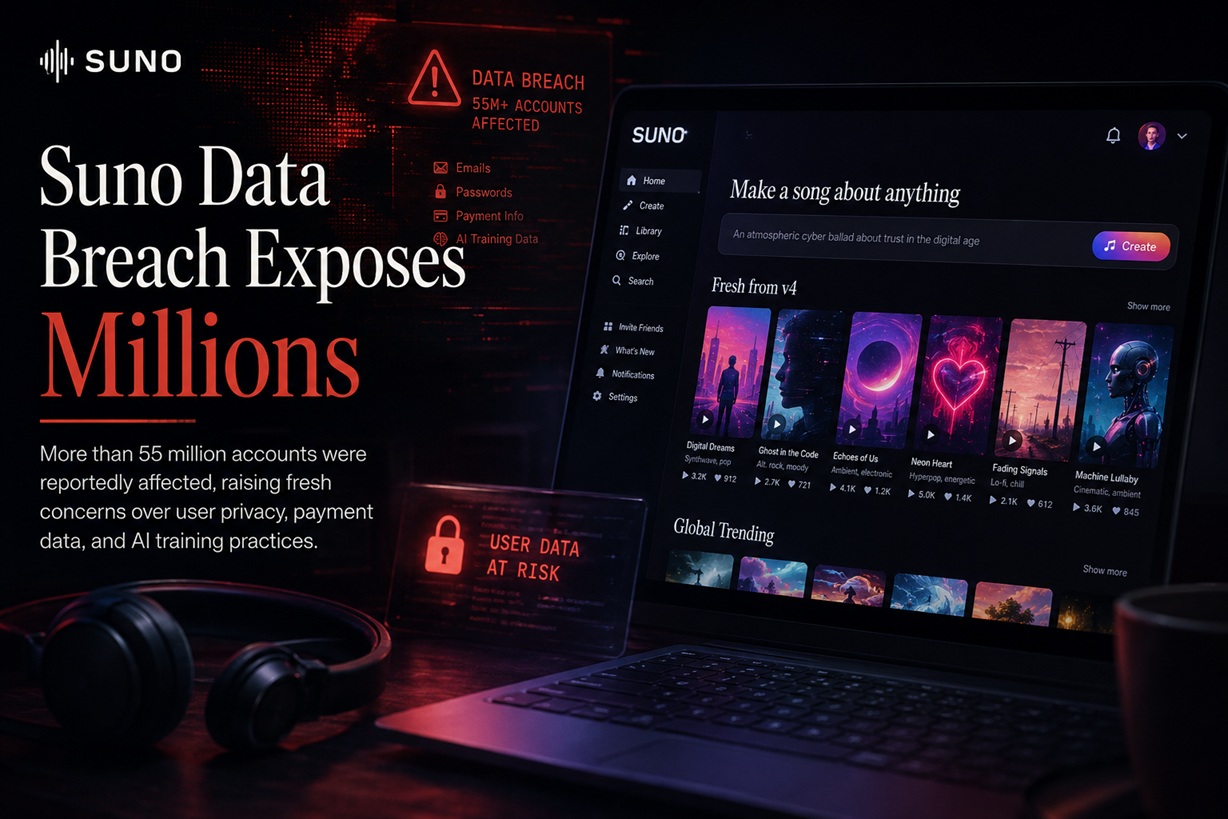
AI music platform Suno is facing fresh scrutiny after a stolen database reportedly exposed personal information linked to more than 55.3 million user accounts. The incident is believed to be connected to a cyberattack that occurred in November 2025, but details only became widely known after security researchers and journalists obtained information from the compromised systems.
Beyond the scale of the customer data exposure, the breach has also drawn attention because the stolen material reportedly included internal source code and references to how Suno assembled data for training its generative music models.
The result is a security incident that touches two of the most sensitive issues surrounding modern AI platforms: how they protect their users and how they obtain the material used to train their systems.
What Is Suno?
Suno is a generative AI service that allows users to create complete songs from simple text instructions.
A person can describe a genre, mood, theme or musical style, and the platform generates a track that may include vocals, lyrics and instrumental accompaniment. This has made it popular among casual creators, content producers and people experimenting with AI-generated music.
Its rapid growth has also attracted controversy.
Major music companies and artists have questioned whether services such as Suno were trained using copyrighted recordings without permission. The company has previously argued that using publicly available music for AI development can fall within fair-use principles, while rights holders maintain that copying recordings for model training requires authorisation.
The newly reported breach has brought those debates back into focus because internal files may reveal more about the material collected during development.
More Than 55 Million Accounts Reportedly Affected
According to breach-notification service Have I Been Pwned, the compromised database contained information associated with 55,364,811 accounts.
The exposed records reportedly included several categories of personal and transactional information, such as:
The available information does not suggest that complete payment-card numbers were exposed.
Suno has said it does not receive or store customers' full card details through Stripe, its payment-processing provider. That limits the immediate risk of someone using the stolen database alone to make direct card transactions.
However, partial financial information can still be valuable to criminals when combined with names, contact details and purchase history.
Why Partial Information Can Still Be Dangerous
A data breach does not need to contain passwords or full card numbers to create a serious risk.
Names, addresses, phone numbers and transaction records can help criminals build highly convincing phishing messages. An attacker may pretend to represent Suno, Stripe, a bank or another online service and include real personal details to make the communication appear legitimate.
For example, a fraudulent email might refer to a user's previous subscription, claim that a payment method needs to be updated and direct the victim to a fake login page.
Phone numbers can also be used for scam calls or text messages, while physical addresses may increase the sensitivity of the exposure.
The danger comes from the combination of information. A criminal who possesses several accurate details about a person may have a much easier time gaining their trust.
The Attack Reportedly Began Through a Supply-Chain Compromise
The person believed to be behind the intrusion reportedly used the online alias "ellie.191."
According to reporting about the incident, the attacker entered Suno's internal environment through a supply-chain compromise involving an employee's credentials.
A supply-chain attack occurs when criminals target a third-party product, service provider, development tool or connected account that an organisation depends on. Instead of attacking the main company directly, they exploit a trusted route into its systems.
Once the employee credentials were compromised, the attacker reportedly gained access to internal source code and customer information.
This type of incident illustrates why protecting employee accounts is so important. One stolen identity may allow an attacker to reach repositories and systems far beyond the employee's normal daily tasks, particularly when permissions are too broad or access is not closely monitored.
Strong multifactor authentication, short-lived access tokens and least-privilege controls can reduce that risk, although no single protection can prevent every attack.
Leaked Code Reportedly Reveals AI Training Practices
The breach became even more controversial when the stolen source code appeared to contain references to large-scale collection of music, lyrics and audio from external platforms.
The materials reportedly mentioned sources including:
Some files were said to reference more than two million YouTube Music clips, together with hundreds of thousands of hours of additional audio.
These reports do not automatically establish that every referenced file was used in the final commercial models. Source code may contain old experiments, incomplete pipelines, testing tools or abandoned data-processing systems.
Nevertheless, the alleged scale of the collection adds further pressure on Suno to explain where its training material came from and what permissions, licences or legal justifications were used.
Security Breach and Copyright Dispute Now Overlap
Suno was already facing legal action from major record companies, including Sony Music and Universal Music Group.
The labels accuse the platform of using copyrighted recordings without permission to develop its generative models. Suno has acknowledged that its training involved publicly available music and related information, while arguing that the process is legally protected under fair use.
The data breach does not resolve that legal argument.
Whether collecting publicly accessible music for AI training is lawful remains a complex and contested question. Accessibility is not the same as ownership, and placing a song online does not necessarily grant companies permission to copy it into a commercial training dataset.
At the same time, fair-use assessments depend on factors such as purpose, transformation, market impact and the amount of material used. Courts may ultimately need to decide how those principles apply to generative AI.
The leaked material may therefore become relevant to ongoing lawsuits if it provides more detail about what Suno collected and how the information was processed.
Suno Acknowledges a Security Incident
A Suno representative reportedly confirmed that the company experienced a security incident in November 2025.
The company said the intrusion was contained quickly and mainly involved outdated source code. It also did not dispute the reported number of accounts connected to the exposed database.
Suno has emphasised that it does not have access to users' complete payment-card numbers through Stripe.
However, the company has not issued a prominent public breach notice on its website or sent individual notifications to all reportedly affected users.
Suno's position is that direct notification was not required under the privacy laws it determined were applicable to the incident.
Why the Lack of Individual Notification Is Controversial
Whether a company is legally required to notify users depends on several factors.
These can include the types of data exposed, the jurisdictions involved, the likelihood of harm and the specific wording of relevant privacy laws.
Legal compliance, however, is not always the same as good communication.
When tens of millions of accounts are reportedly connected to a breach, users may reasonably expect the company to explain:
Even when notification is not legally mandatory, transparent communication can help users protect themselves and preserve trust.
Silence may create more uncertainty, especially when customers first learn about an incident through news reports or an independent breach-checking service.
Users Should Change Reused Passwords
There is no clear indication in the reported dataset description that Suno account passwords were exposed.
Even so, users should review their password practices.
Anyone who reused the same password for Suno and another service should change it immediately on every affected account. Password reuse allows criminals to take credentials stolen from one platform and test them across email, social media, shopping and financial services.
Each important account should have a unique password. A reputable password manager can generate and store those credentials without requiring the user to remember every one.
Multifactor authentication should also be enabled wherever available. This adds another barrier when someone attempts to sign in with a stolen password.
Be Alert for Suno-Themed Phishing Scams
The most likely immediate threat from this type of breach is targeted phishing.
Users should be cautious of unexpected messages claiming that:
Criminals often create urgency to stop people from thinking carefully. Messages may threaten account closure or claim that action must be taken within a few hours.
Rather than selecting a link in an email or text message, users should open Suno through their usual bookmark or type the official address directly into the browser.
Verification codes, passwords and complete card details should never be shared in response to an unsolicited message.
Monitor Card and Bank Activity
Although the reported exposure involved only partial card details and expiry dates, affected users should still review their financial statements.
Any unfamiliar payment—even a small amount—should be investigated.
Criminals sometimes begin with low-value test transactions before attempting larger purchases. Users should contact their card issuer promptly when they identify activity they do not recognise.
It may not be necessary to replace a payment card solely because partial details were exposed. The appropriate response depends on the information involved and the advice provided by the bank or issuer.
However, users should be especially careful when receiving calls from people claiming to know the card's expiry date or recent transaction history. Possessing those details does not prove that the caller represents the bank.
Checking Whether an Email Appears in the Breach
Users can check their email addresses through established breach-notification services such as Have I Been Pwned.
A match does not necessarily mean an account has been taken over. It means the email address appeared within data connected to a reported breach.
The service can also show whether the same address was involved in older incidents from other companies.
People should access breach-checking services independently rather than following links in unsolicited emails claiming their information has been exposed.
Attackers regularly imitate legitimate security warnings to steal even more information from concerned victims.
A Reminder That AI Platforms Hold Conventional Personal Data
The incident demonstrates that an AI company is still a data company.
Users may associate Suno mainly with generated songs and creative experiments, but the platform also processes the same information held by many online businesses: identities, contact details, subscriptions and payment records.
This means AI companies need traditional security controls alongside their model-development expertise.
Protecting training infrastructure alone is not enough. Customer databases, employee accounts, code repositories, third-party integrations and billing systems must all be secured.
Rapid growth can make this difficult. A service that expands from a small startup into a platform serving tens of millions of accounts may accumulate systems and permissions faster than its security programme can mature.
That is why access reviews, incident exercises and vendor-risk assessments should grow alongside the user base.
The Breach Raises Questions About Data Governance
The apparent exposure of both user information and AI-development materials suggests that sensitive resources may have been accessible through connected internal systems.
Strong data governance requires organisations to understand:
Source code should not automatically provide a route to customer databases, and customer-service systems should not expose model-development infrastructure.
Separating systems and limiting permissions can prevent one compromised account from becoming a company-wide breach.
Final Thoughts
The reported Suno breach is significant not only because of its scale, but because it exposes the complicated relationship between AI development, customer privacy and copyright.
More than 55 million accounts were reportedly connected to the stolen data, with names, contact details, addresses, purchase history and partial payment information among the exposed records.
At the same time, leaked internal files have intensified questions about how Suno assembled the enormous datasets needed to generate complete songs from text prompts.
Suno says the incident was contained and did not expose full payment-card numbers. However, users should still change reused passwords, monitor financial activity and remain cautious of convincing phishing attempts built around the leaked information.
The broader lesson is straightforward: an innovative AI platform is only as trustworthy as the security, transparency and data governance supporting it. Creating impressive music through artificial intelligence may attract millions of users, but protecting those users must remain just as important as improving the model.











Comments 0