

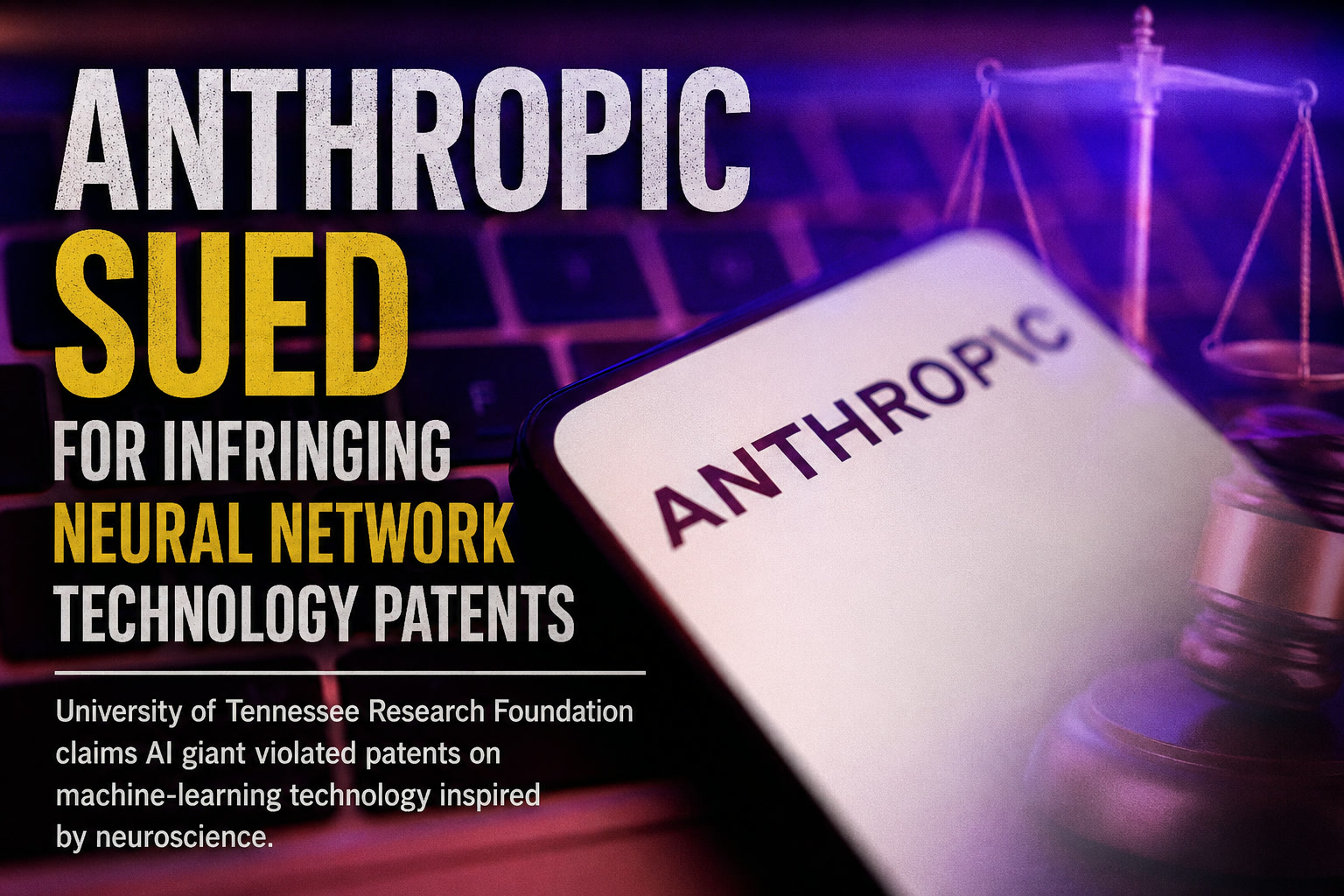
Anthropic is facing a new intellectual property challenge, but this time the dispute is not about copyrighted books, training datasets or AI-generated content. The University of Tennessee Research Foundation has filed a lawsuit in a Delaware federal court accusing the Claude developer of infringing two patents connected to neural networks and neuroscience-inspired machine-learning technology. The foundation is seeking financial compensation and a court order that would prevent Anthropic from continuing any activity found to infringe the patents.
The case is significant because it is believed to be the first patent infringement lawsuit brought against Anthropic. It also expands the legal debate surrounding generative AI beyond the familiar question of where companies obtained their training material.
University Research Foundation Takes Anthropic to Court
The lawsuit was brought by the University of Tennessee Research Foundation, commonly known as UTRF. The nonprofit organization is responsible for managing and licensing intellectual property created through research conducted within the University of Tennessee system.
According to the complaint, Anthropic's AI systems allegedly make use of technology covered by two patents developed by university professors. The patents are described as relating to advances in artificial intelligence, machine learning, neuromorphic computing and computing systems inspired by the way biological brains process information.
UTRF argues that these inventions represent meaningful contributions to the development of neural-network technology and that Anthropic has used the protected methods without obtaining the necessary authorization or licence.
At this stage, however, these remain allegations made by the foundation. The court has not ruled that Anthropic infringed either patent.
Anthropic Rejects the Allegations
Anthropic has disputed the foundation's claims and indicated that it intends to fight the case.
A company spokesperson said Anthropic disagreed with the allegations and would defend the lawsuit vigorously. The response suggests that Anthropic may challenge whether its systems actually use the patented methods, whether the patent claims apply to its technology or potentially whether the patents themselves are valid and enforceable.
The foundation, meanwhile, used much stronger language in its complaint. It argued that Anthropic's treatment of intellectual property extended beyond previous controversies involving copyrighted material.
That reference appears intended to connect the patent case with the company's earlier copyright dispute involving authors and books used in AI development. However, the two legal matters concern different types of intellectual property and will have to be assessed under different legal standards.
This Case Is About Technology, Not Training Data
Much of the legal attention surrounding generative AI has focused on the information used to train large language models.
Writers, artists, publishers and other rights holders have questioned whether AI companies should be allowed to use copyrighted material for model training without first securing permission. Copyright generally protects original works of authorship, including books, music, films, software and other forms of creative expression.
The University of Tennessee case is different.
Instead of arguing that Anthropic copied protected content, the foundation claims that the underlying operation of Anthropic's AI systems infringes patented inventions. Patent rights can allow their owners to prevent others from using a protected invention without authorization, even when the alleged infringer developed its own product independently.
In simple terms, a copyright lawsuit may ask whether protected content was copied or improperly used. A patent lawsuit can ask whether a product or system performs a process that falls within the technical claims of an existing patent.
That distinction could make the Anthropic case particularly important for the wider AI industry.
Why Neural Network Patents Can Become Complicated
Modern artificial intelligence systems are built using many layers of technology.
A large language model may involve neural-network architectures, training techniques, optimization methods, data-processing systems, inference engines and specialized hardware. Some components may be based on widely published research, while others may be covered by patents held by universities, companies or individual inventors.
A patent dispute therefore does not necessarily mean that one company copied another company's complete AI model. The disagreement may concern a specific process, mathematical technique, system design or method used somewhere within a much larger platform.
For UTRF to succeed, it will need to show that one or more Anthropic systems satisfy the relevant elements contained in the asserted patent claims. Anthropic may respond by arguing that its implementation operates differently, that the claims have been interpreted too broadly or that earlier research makes the patents invalid.
These questions usually require detailed technical evidence, expert testimony and careful examination of how the accused systems actually work.
That could be challenging in the generative AI sector, where companies do not publicly disclose every detail of their model architectures, training processes or internal infrastructure.
The Lawsuit Arrives After a Major Copyright Settlement
The patent complaint emerged shortly after a California federal judge approved Anthropic's USD1.5 billion settlement in a class-action copyright case brought by authors.
That earlier case concerned the company's use of books in connection with training its AI models. The new lawsuit, by contrast, focuses on whether Anthropic's technology itself allegedly falls within patents controlled by the University of Tennessee Research Foundation.
The timing places additional attention on how leading AI companies handle intellectual property.
Training data has received most of the public attention, but AI developers must also consider patents, software licences, trade secrets and contractual restrictions when building and commercialising their systems.
As the AI market becomes more valuable, universities and technology companies may examine their existing patent portfolios more closely to determine whether today's commercial AI products make use of research developed years earlier.
What the University Foundation Wants
UTRF has asked the court to award an unspecified amount of monetary damages.
It is also requesting an injunction, which would prohibit Anthropic from continuing activities found to infringe the patents.
An injunction can be particularly serious in a technology dispute because it may affect how a company develops, operates or distributes its products. However, requesting an injunction does not mean one will automatically be granted.
The foundation must first prove its infringement claims, and the court would then consider the appropriate legal remedy. The dispute could also end through a licensing agreement or settlement rather than a final trial judgment.
For now, no damages have been determined, and there has been no ruling that requires Anthropic to change or suspend its AI services.
Why the Outcome Could Matter Beyond Anthropic
A closely watched decision could influence how other AI developers assess patent risk.
Many current AI systems are built on decades of research conducted by universities, public institutions and private laboratories. Academic discoveries often move into commercial applications through licences, partnerships or startup companies, but disagreements can emerge when a patent owner believes its invention has been adopted without permission.
If UTRF succeeds, other research institutions may become more active in identifying potential AI-related infringement and enforcing their patents.
If Anthropic successfully defeats the claims, the decision could provide guidance on how older neural-network patents should be interpreted when applied to modern large language models.
Either way, the dispute may encourage AI companies to conduct more extensive reviews of patents covering machine learning, model architectures and neuromorphic computing before releasing new systems.
The Case Is Still at an Early Stage
The lawsuit has only recently been filed, meaning many important details remain unresolved.
Anthropic will have an opportunity to formally respond to the complaint. The parties may then enter a discovery process involving documents, technical records, depositions and expert analysis.
The court may also need to interpret the wording of the patent claims before deciding whether Anthropic's technology falls within them.
Patent litigation can take considerable time, particularly when the technology is complex. The filing therefore represents the beginning of the dispute rather than evidence that either side has already won.
Final Thoughts
The University of Tennessee Research Foundation's lawsuit introduces a different dimension to the growing legal pressure surrounding generative AI.
Previous disputes have largely concentrated on the content used to train AI models. This case asks a more fundamental question: whether the technology operating inside a leading AI platform makes use of inventions already protected by university-owned patents.
Anthropic has rejected the allegations and says it will defend itself vigorously, while UTRF is seeking damages and an order preventing further alleged infringement.
The eventual outcome could have implications far beyond a single company. As artificial intelligence becomes increasingly commercialized, ownership of the research, methods and technical foundations behind these systems may become just as contested as ownership of the data used to train them.











Comments 0