

Qualcomm is finally putting some numbers behind its upcoming Snapdragon C platform, giving us a much clearer picture of what the company has planned for the entry-level Windows laptop market.
The chip was originally introduced as a lower-cost alternative to Qualcomm's more premium Snapdragon X-series processors, with the company talking about laptops potentially starting around the US$300 mark. Until now, however, Qualcomm had shared relatively little about the actual hardware powering those machines.
That has changed. We now have CPU and GPU specifications, details about the integrated NPU, some early battery-life claims and, unsurprisingly, a set of Qualcomm's own performance comparisons against an Intel-powered budget laptop.
The Snapdragon C isn't trying to compete with high-end Core Ultra or Ryzen machines. Instead, Qualcomm appears to be aiming directly at the inexpensive Windows laptops typically powered by entry-level Intel processors.
An Eight-Core Kryo CPU Sits at the Heart of Snapdragon C
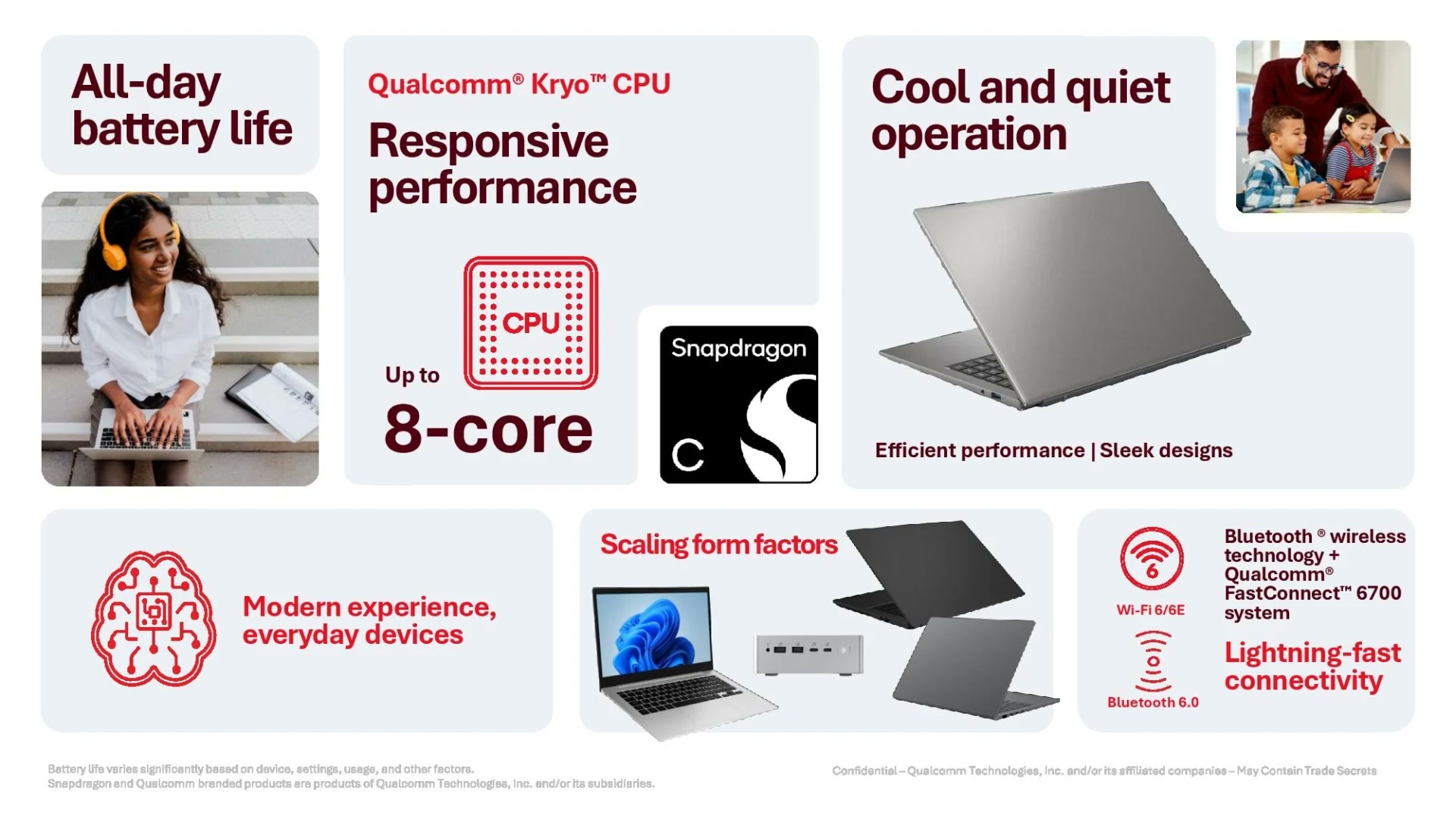
According to Qualcomm's newly published specifications, the Snapdragon C uses an eight-core Kryo CPU.
The processor can reach a maximum single-core frequency of 3GHz, while its multi-core operating frequency tops out at 2GHz.
There is also 2MB of cache.
Those numbers immediately make it clear that this isn't intended to be a performance monster.
Snapdragon C is being positioned much further down the product stack, where laptops are expected to handle everyday tasks such as browsing, Office applications, video conferencing, streaming, schoolwork and basic productivity rather than heavy rendering or high-end gaming.
That is an important distinction.
A budget laptop doesn't necessarily need extraordinary benchmark scores. What matters more is whether it feels responsive during everyday use while remaining inexpensive, quiet and power-efficient.
And that is exactly the territory Qualcomm appears to be targeting.
Integrated Adreno Graphics Handle the GPU Side
Graphics are provided by an integrated Adreno GPU running at up to 900MHz.
Qualcomm hasn't positioned Snapdragon C as a gaming platform, so expectations should remain realistic here.
The GPU is more likely intended for everyday graphics acceleration, media playback, user-interface rendering and perhaps lighter games.
Still, integrated graphics performance matters more than it might initially appear.
Modern browsers, streaming applications, video conferencing tools and Windows itself increasingly make use of GPU acceleration.
An efficient integrated GPU can therefore improve the overall responsiveness of a low-cost system even when nobody is actually playing games.
It could also prove useful for entry-level creative applications and hardware-accelerated video processing, depending on what codecs and APIs Qualcomm ultimately supports.
Yes, Snapdragon C Still Gets an NPU
One interesting inclusion is Qualcomm's Hexagon NPU.
Dedicated neural processors have rapidly become standard across modern laptop platforms as Windows and applications increasingly introduce AI-assisted features.
Qualcomm hasn't yet provided enough information to position Snapdragon C alongside Microsoft's higher-end Copilot+ PC requirements, but including an NPU at all demonstrates that AI acceleration isn't being reserved exclusively for expensive machines.
That could become increasingly important over the next few years.
Features such as background blur, noise cancellation, image processing, transcription and other local AI workloads can benefit from dedicated neural hardware without unnecessarily loading the CPU.
For budget laptops, efficiency may ultimately matter more than raw AI performance.
Qualcomm Promises "All-Day" Battery Life — Without Giving a Number
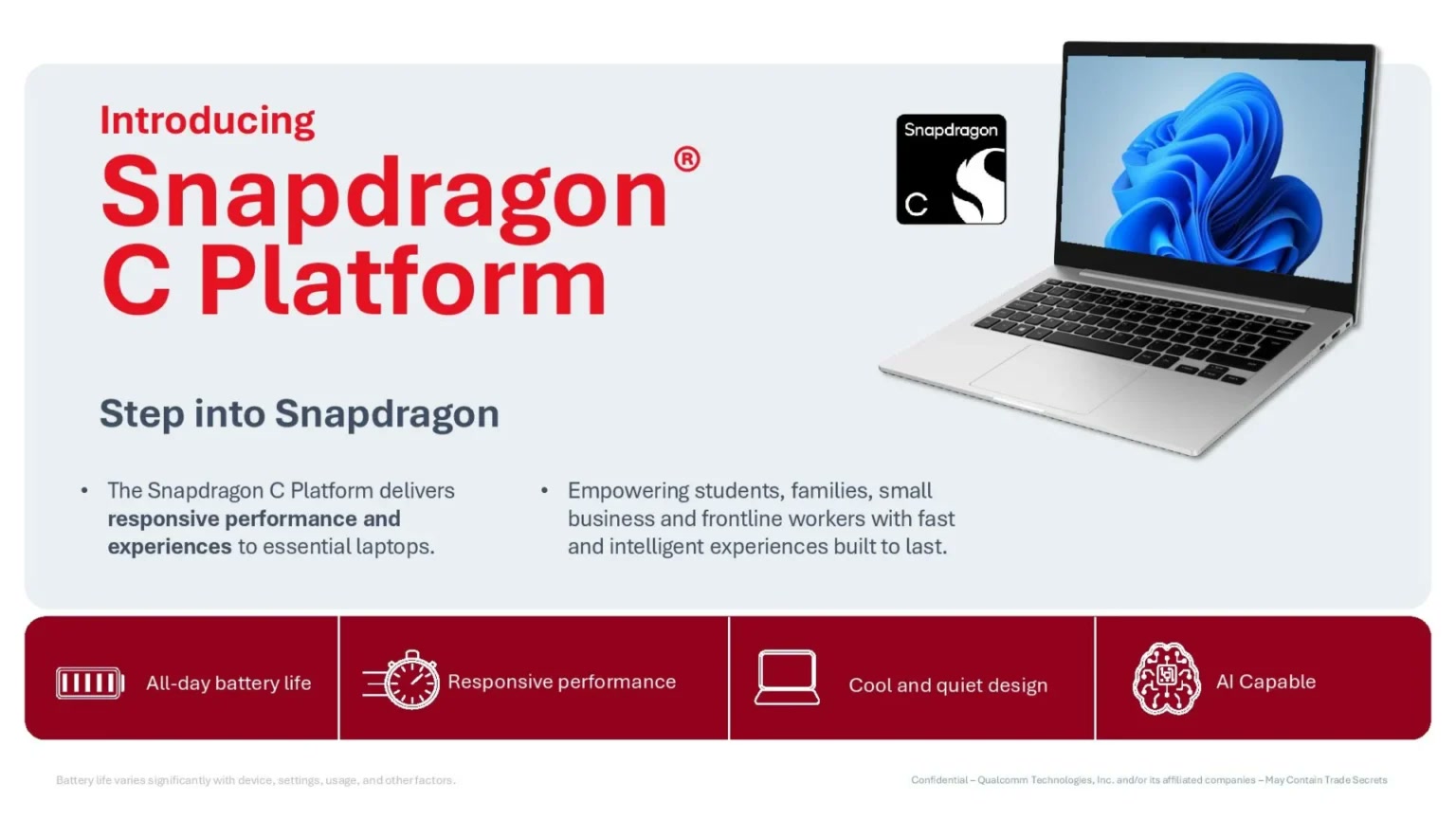
Battery endurance is naturally one of the areas Qualcomm wants to highlight.
The company is advertising "all-day battery life" for Snapdragon C systems.
There is, however, an important catch: Qualcomm isn't attaching a specific number of hours to that claim.
As usual, the company notes that battery life can vary significantly depending on factors including the laptop design, battery capacity, display, settings, workload and usage patterns.
That is perfectly reasonable because Qualcomm supplies the processor rather than designing every Snapdragon C laptop itself.
A manufacturer could pair the chip with a large battery and efficient display, while another could prioritise cost and install a much smaller battery.
Two laptops using exactly the same Snapdragon C processor could therefore deliver very different endurance.
In practice, the final battery-life numbers will largely depend on manufacturers such as Acer, ASUS, HP and Lenovo.
ARM Efficiency Could Be Snapdragon C's Biggest Advantage
This is where Qualcomm's broader Windows-on-ARM strategy becomes particularly interesting.
The company's Snapdragon laptop platforms have increasingly focused on efficiency rather than simply trying to win raw performance benchmarks.
For inexpensive laptops, that could arguably be even more valuable.
Low-cost Windows machines frequently have to compromise somewhere.
Manufacturers may use smaller batteries, inexpensive cooling systems or thin chassis designs simply to meet a certain price.
A processor requiring less power and producing less heat could therefore enable manufacturers to build lighter, quieter machines without dramatically increasing manufacturing costs.
That could potentially allow Snapdragon C laptops to offer a better everyday experience than traditional budget PCs, even when the benchmark numbers aren't particularly spectacular.
Qualcomm Is Comparing Snapdragon C Against Intel's N250
Naturally, Qualcomm isn't revealing these specifications without showing a few competitive benchmarks as well.
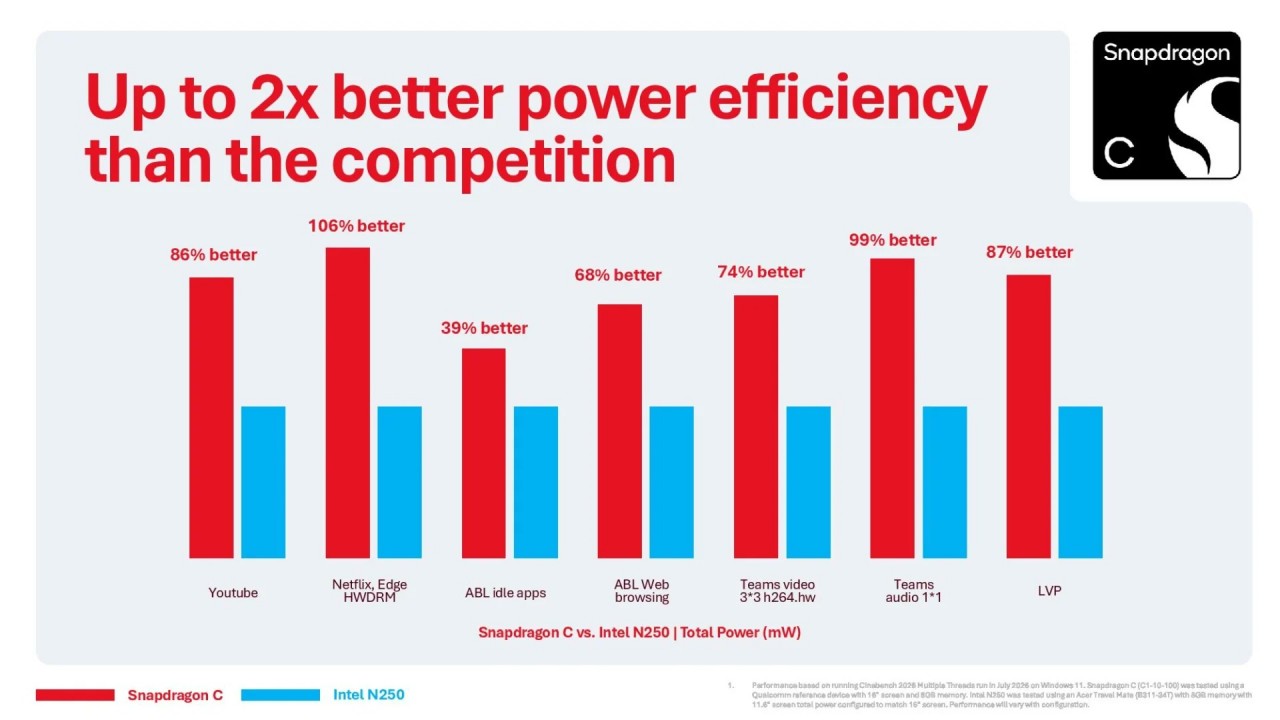
The company is comparing a Snapdragon C reference laptop against an Acer TravelMate powered by Intel's N250 processor.
Both configurations reportedly use 8GB of RAM.
Qualcomm's reference machine uses a 16-inch display, while the Acer system has an 11.6-inch screen. Qualcomm says power consumption in the comparison was configured to compensate for the display-size difference.
That methodology is worth keeping in mind because this is not simply a direct comparison between two identical retail laptops.
One machine is Qualcomm's own reference platform, while the other is an existing commercially available system.
Still, it gives us an early indication of where Qualcomm believes Snapdragon C belongs competitively.
"Up to Twice the Performance" Needs Some Context
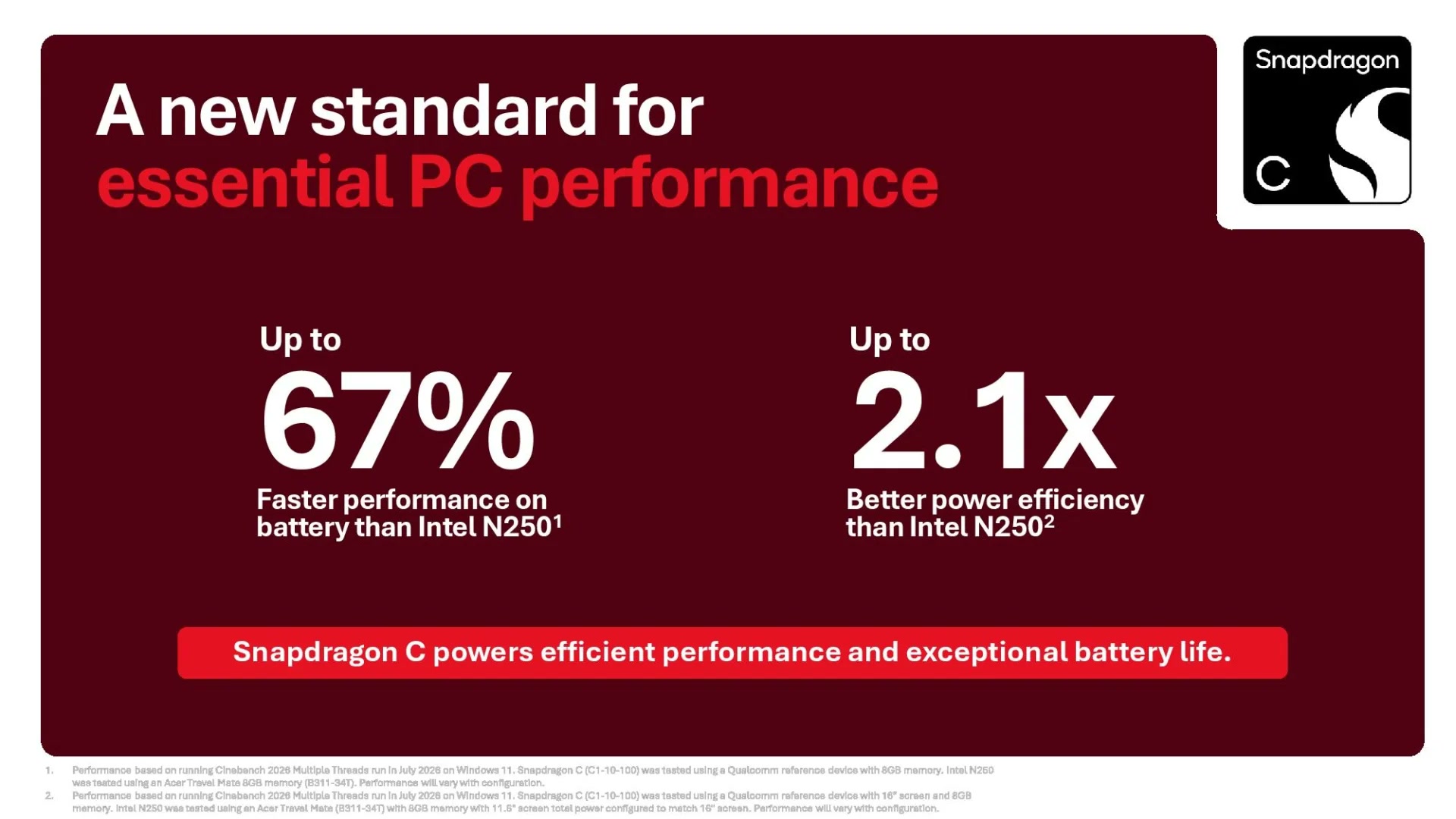
Qualcomm claims Snapdragon C can offer up to around twice the performance of Intel's N250 in certain tests.
But "up to" is doing quite a lot of work there.
Across the various benchmarks shown, Qualcomm's reported advantage apparently ranges from approximately 39% to 106%, depending on the workload.
That's still potentially significant.
Even at the lower end of that range, a 39% improvement could be noticeable in certain applications.
The 106% figure is what allows Qualcomm to make the attention-grabbing "up to twice as fast" statement, but it shouldn't be interpreted as meaning Snapdragon C will literally double performance in every application.
Actual performance will vary substantially depending on what software is being used.
Unplugged Performance Could Be Even More Interesting
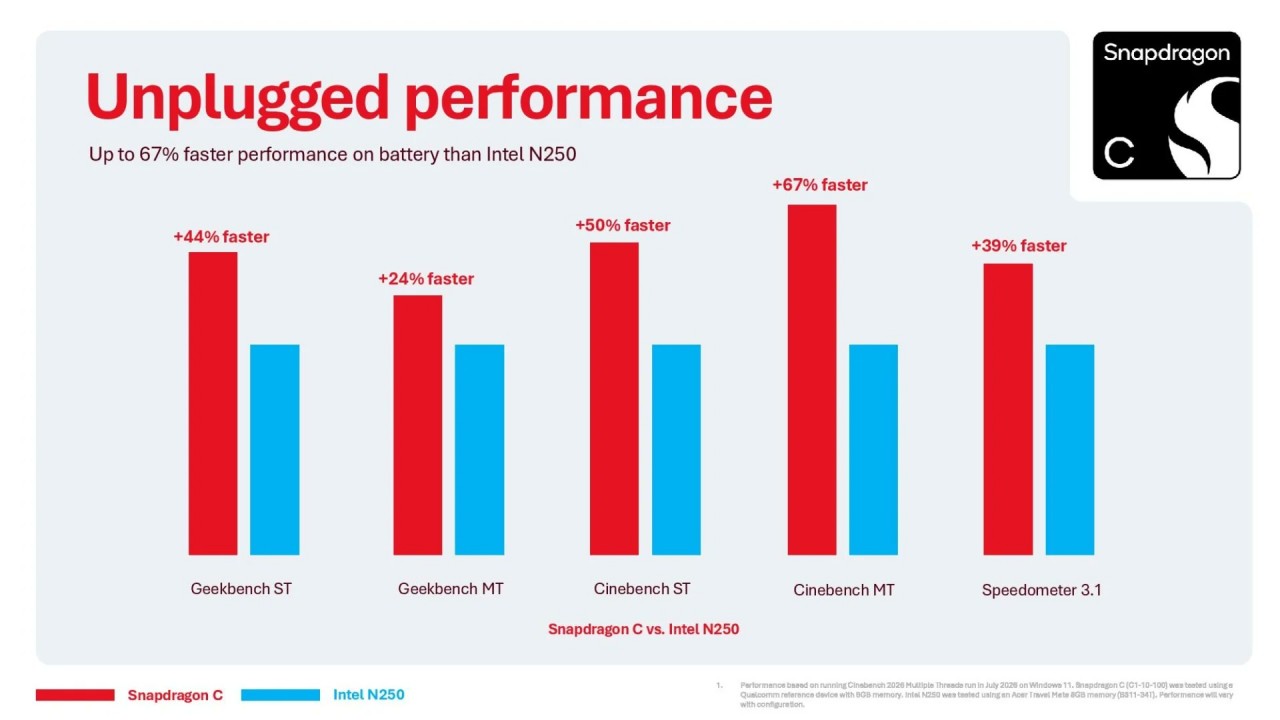
One area where Snapdragon C may prove particularly competitive is performance when running on battery power.
According to Qualcomm's figures, its reference system delivers between 24% and 67% better unplugged performance compared with the Intel N250 configuration tested.
That could matter more than maximum plugged-in benchmark results.
A laptop is supposed to be portable, after all.
If a system performs strongly while connected to the charger but aggressively reduces performance the moment it is unplugged, the user isn't really getting the same experience away from a desk.
ARM-based laptops have increasingly emphasised maintaining consistent performance while running on battery.
If Snapdragon C can deliver that behaviour in machines costing only a few hundred dollars, that could become one of its strongest selling points.
The Real Competition Is the Budget Laptop Market
It would be misleading to look at Snapdragon C and compare it directly with flagship Snapdragon X Elite machines.
That isn't what Qualcomm is trying to build.
This processor is aimed at laptops where manufacturers currently use chips such as Intel N-series processors and other low-cost platforms.
These are the machines commonly purchased for classrooms, students, administrative work, families and basic business deployments.
In that segment, several things matter more than benchmark leadership:
price, responsiveness, battery life, thermals and reliability.
If Snapdragon C can offer respectable everyday performance while dramatically improving battery endurance, it could be an appealing proposition.
There is, however, still one major issue Qualcomm needs to overcome.
Windows on ARM Compatibility Still Matters
Even though Windows on ARM has improved enormously, software compatibility remains something buyers should consider.
Native ARM applications generally provide the best combination of performance and power efficiency.
Applications compiled only for traditional x86 processors may instead need to run through Windows' compatibility and emulation layers.
Modern Snapdragon Windows machines have become significantly better at this, but compatibility can still vary depending on the software.
For a typical student or home user relying mainly on Edge, Chrome, Microsoft 365, streaming services and mainstream applications, this may barely be noticeable.
Businesses relying on specialised legacy applications, older hardware drivers or proprietary software may need to verify compatibility first.
Interestingly, the lower-cost segment may actually work in Qualcomm's favour.
Many entry-level laptop buyers primarily use web-based applications anyway.
US$300 Laptops Are the Target
When Qualcomm initially introduced Snapdragon C, it spoke about laptops potentially starting at around US$300, or roughly RM1,200 before local taxes, pricing adjustments and configuration differences.
That would put Snapdragon C machines firmly into entry-level territory.
The question is whether manufacturers can actually reach that price.
Memory and storage prices can fluctuate considerably, and component shortages can quickly push manufacturing costs higher.
Laptop makers also need to factor in the display, battery, chassis, RAM, SSD, Wi-Fi hardware and licensing costs.
So while Qualcomm may design its platform around US$300 machines, that doesn't necessarily guarantee every Snapdragon C laptop will appear at that price.
Some manufacturers may instead use the processor inside slightly more premium configurations.
Acer Has Already Shown a Snapdragon C Laptop
We already know at least one commercial system is coming.
Acer showcased its upcoming Aspire Go 15 powered by Snapdragon C as part of its Computex 2026 lineup.
Pricing hasn't been confirmed yet, but the Aspire Go family is traditionally aimed at affordable everyday computing.
That makes it a logical first home for Qualcomm's entry-level platform.
The bigger test will come when retail hardware begins arriving and we can compare Snapdragon C systems against similarly priced Intel and AMD laptops.
Reference-platform benchmarks are useful, but real laptops can behave very differently depending on cooling, memory configuration and manufacturer power limits.
ASUS, HP and Lenovo Are Also On Board
Acer won't be the only company using Snapdragon C.
Qualcomm says ASUS, HP and Lenovo are also preparing devices based on the platform.
That is important because a new processor architecture is only useful if manufacturers actually adopt it.
Having several of the world's largest PC brands onboard means Snapdragon C should have a much better chance of reaching mainstream consumers.
It could also create competition between manufacturers to see who can produce the most attractive Snapdragon C laptop.
Some may focus aggressively on price.
Others may prioritise battery capacity, thinner designs or better displays.
That variety could ultimately make the platform more interesting than the processor specifications alone suggest.
Snapdragon C Could Bring ARM to a Much Wider Audience
Until relatively recently, Windows-on-ARM laptops tended to occupy somewhat unusual positions in the market.
Some were premium products, while others were experimental devices with compromises that made them difficult to recommend universally.
Snapdragon C represents a different strategy.
Qualcomm appears to be trying to make ARM-powered Windows laptops completely ordinary.
Instead of asking consumers to spend premium money to experiment with a new architecture, Snapdragon C could put the technology into inexpensive machines bought by students, families and businesses.
That could dramatically increase the number of ARM-based Windows PCs in circulation.
And the larger that installed base becomes, the greater the incentive for software developers to produce native ARM versions of their applications.
Microsoft Also Has Plenty to Gain
Qualcomm isn't the only company that would benefit from Snapdragon C succeeding.
Microsoft has spent years trying to establish Windows on ARM as a genuine alternative to traditional x86 computing.
Affordable laptops could be crucial to that effort.
Premium machines help demonstrate what's technically possible.
Budget machines, however, create volume.
If schools, universities, businesses and everyday consumers begin buying millions of low-cost ARM-powered laptops, developers have a much stronger reason to optimise their software for the architecture.
That creates a feedback loop.
More users encourage better software support, and better software support makes ARM laptops more attractive to even more users.
Performance Per Watt May Matter More Than Peak Performance
The most interesting question surrounding Snapdragon C isn't whether it can defeat every competing Intel processor in benchmarks.
It obviously won't.
The more important question is how much usable performance Qualcomm can deliver for every watt of power consumed.
For an entry-level laptop, that could make the difference between a machine that needs to be charged halfway through the day and one that comfortably lasts through classes or a work shift.
It could also determine whether manufacturers need active cooling fans or can build quieter systems with simpler thermal designs.
Those advantages may not appear immediately on a specification sheet, but they can dramatically affect everyday usability.
Final Thoughts
Snapdragon C is shaping up to be one of Qualcomm's more interesting laptop processors, precisely because it isn't designed to be spectacular.
An eight-core Kryo CPU reaching 3GHz, integrated Adreno graphics and a Hexagon NPU aren't going to threaten flagship laptop processors.
But that isn't the point.
Qualcomm is targeting a completely different audience — people who simply need an affordable Windows laptop that feels responsive, lasts a long time on battery and handles everyday applications reliably.
Its early performance claims against Intel's N250 look encouraging, particularly the reported advantages when running unplugged.
But manufacturer pricing, actual battery capacity and real-world Windows-on-ARM compatibility will ultimately determine whether Snapdragon C succeeds.
If companies such as Acer, ASUS, HP and Lenovo can genuinely deliver capable Snapdragon C laptops near the originally suggested US$300 starting point, Qualcomm may finally have the processor it needs to push Windows on ARM out of the premium niche and into the mainstream budget PC market.











Comments 0