

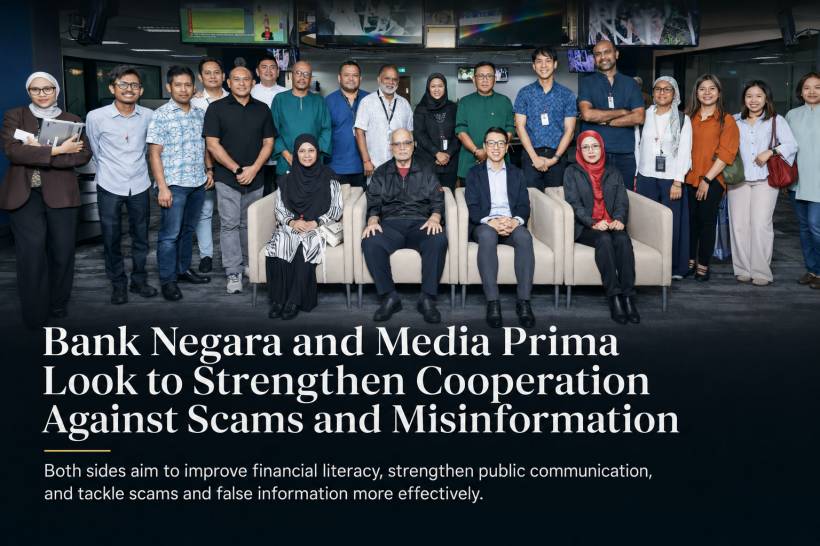
Bank Negara Malaysia is looking to work more closely with the media as misinformation, online scams, and artificial intelligence-driven deception become bigger challenges for the public. The central bank recently paid a courtesy visit to Media Prima's News and Current Affairs division at Balai Berita, where both sides discussed public communication, financial education, scam awareness, and possible future collaboration across print, television, radio, and digital platforms.
The visit highlights a growing concern in Malaysia: financial misinformation can spread quickly, especially online, and many scams are becoming more convincing by misusing trusted names, official-looking branding, and even the identities of public figures.
Why Bank Negara Wants Stronger Media Collaboration
Bank Negara Malaysia's strategic communications director, Roy Lim Way Zhi, said official institutions such as the central bank need strong partnerships with the media to ensure the public receives accurate and timely information.
This is especially important because financial and economic issues are not always easy for the public to understand. Topics such as monetary policy, inflation, banking safeguards, interest rates, scam prevention, and consumer financial protection can seem technical, but they affect everyday Malaysians.
Lim noted that some issues may not always be popular or widely discussed, but people still need to understand their context and implications. This is where the media plays an important role.
When financial matters are explained clearly, people are more likely to make informed decisions and less likely to fall for misleading claims.
Scams and Misinformation Are Becoming More Sophisticated
The need for closer cooperation comes at a time when online scams are becoming harder to detect.
Scammers today do not rely only on simple fake messages or obvious suspicious links. Many now use more polished tactics, including fake advertisements, cloned websites, impersonation of trusted organisations, manipulated images, and misleading social media posts.
Artificial intelligence also adds another layer of concern. AI tools can be used to create realistic-looking content, fake voices, convincing messages, and even fabricated videos. This makes it easier for scammers to imitate legitimate institutions or personalities.
For organisations like Bank Negara and Media Prima, this creates a shared responsibility. BNM has the authority and expertise on financial matters, while media platforms have the reach to inform the public quickly and widely.
The Media's Role in Financial Literacy
Financial literacy remains an ongoing challenge. Many people may not fully understand how scams work, what warning signs to look for, or how to verify whether a financial claim is genuine.
This is why consistent public education is important. Scam awareness cannot be treated as a one-time campaign because scam tactics keep changing.
The media can help by explaining financial issues in simple language, highlighting common scam methods, sharing public advisories, and giving people practical steps to protect themselves.
For example, public communication can help remind Malaysians to:
• Verify information through official channels
• Be cautious of investment offers that promise unrealistic returns
• Avoid sharing banking details or one-time passwords
• Check whether financial companies are properly licensed
• Report suspicious messages, calls, or advertisements
These reminders may sound basic, but they remain important because many scams succeed by creating panic, excitement, urgency, or false trust.
Trusted Brands Are Being Misused by Scammers
Media Prima's News and Current Affairs group managing editor, Jasbant Singh, said collaboration between Bank Negara and Media Prima is becoming increasingly important because both organisations carry strong public trust.
That trust is exactly what scammers often try to exploit.
There have been cases where trusted brands, public personalities, official institutions, and media programme names are misused in online scams. This can include fake news-style advertisements, false investment promotions, edited images, or misleading posts that appear to be linked to reputable organisations.
When scammers misuse the names of institutions such as Bank Negara or media brands such as Media Prima, the public may be more likely to believe the scam is real.
Jasbant said these incidents have strengthened Media Prima's commitment to work more closely with BNM to fight misinformation and protect the public.
Why Public Trust Matters
Public trust is one of the most important tools in fighting misinformation.
When people know where to find reliable information, they are less likely to depend on random social media posts or forwarded messages. However, trust can also be damaged when scammers use the names of legitimate institutions to spread false information.
This is why fast, clear, and consistent communication is important. If a misleading claim or fake advertisement spreads online, official institutions and media organisations need to respond quickly before more people are affected.
A strong partnership between BNM and the media can help ensure that accurate information reaches the public faster and in a format they can understand.
Using Multiple Platforms to Reach Different Audiences
One of Media Prima's strengths is its wide reach across different platforms. Through print, broadcast, and digital channels, it can reach audiences who consume news in different ways.
This matters because not everyone gets information from the same source. Some people still rely on television news, while others follow online portals, social media pages, video clips, or mobile updates.
By working across multiple platforms, financial education and scam awareness messages can reach more Malaysians, including those who may not actively search for information on official websites.
A multi-platform approach also makes it easier to repeat important messages in different formats, which is useful for public education.
A Shared Effort to Improve Public Understanding
The courtesy visit was not only about scams. It also focused on broader public communication and financial education.
Economic and financial decisions can sometimes be misunderstood if they are not explained clearly. When people lack context, misinformation can fill the gap. This can lead to confusion, panic, or wrong assumptions about financial policies and market developments.
By working more closely with the media, BNM can help ensure that complex topics are communicated in a way that is accurate but still accessible to ordinary readers and viewers.
At the same time, media organisations can ask questions, raise public concerns, and help present important financial information in a way that connects with everyday experiences.
Final Thoughts
Bank Negara Malaysia's engagement with Media Prima shows how important communication has become in the fight against scams and misinformation.
In today's digital environment, false information can spread quickly, and scams can look more professional than ever. Trusted institutions and media organisations need to work together to make sure the public receives accurate, timely, and easy-to-understand information.
For Malaysians, this kind of cooperation can help improve financial awareness, reduce confusion, and strengthen protection against scams.
The challenge will not disappear overnight, but stronger collaboration between BNM and major media platforms can make it harder for misinformation to take hold and easier for the public to know what is true.











Comments 0