

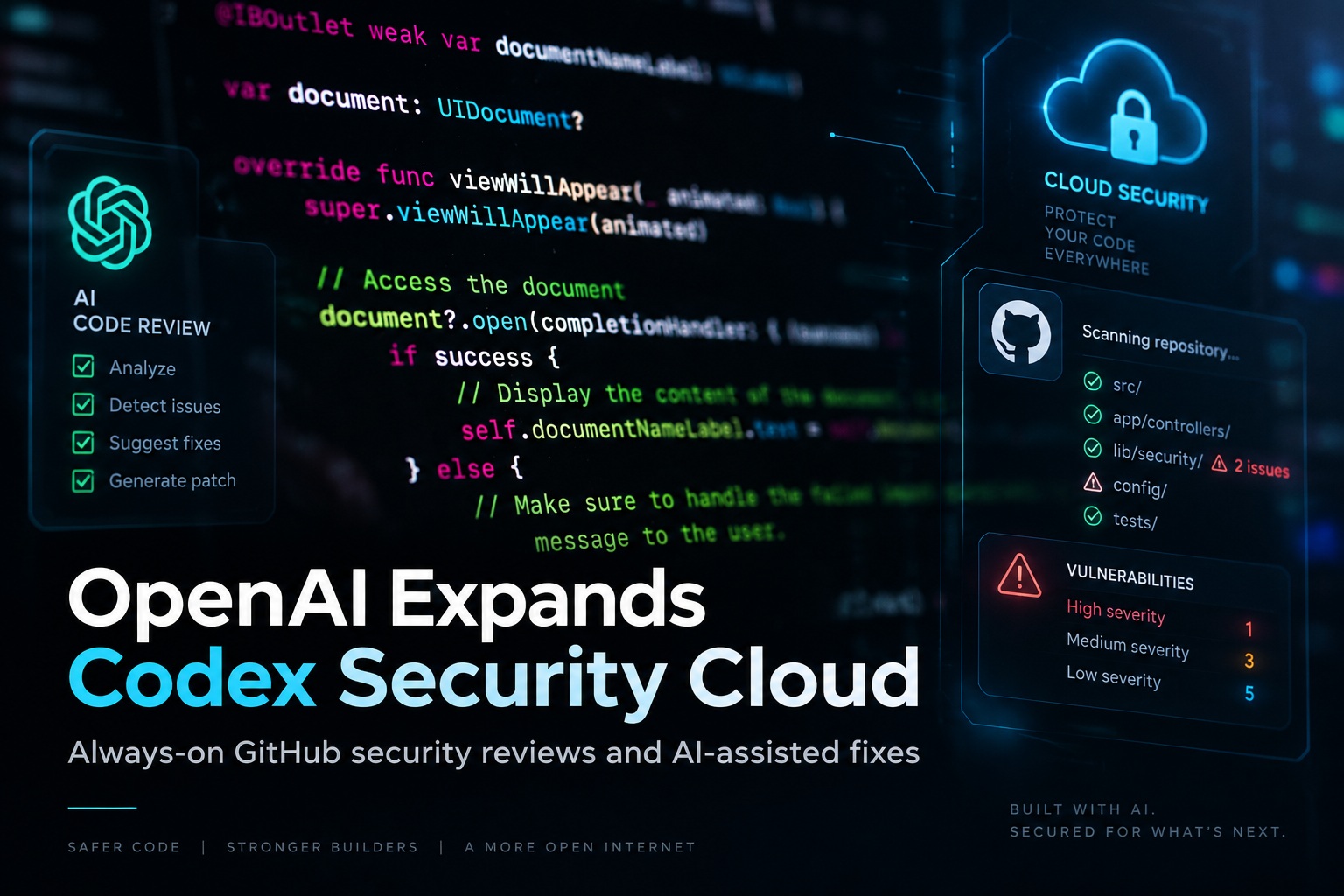
OpenAI has expanded Codex Security Cloud with always-on application security capabilities designed to review GitHub repositories, investigate potential vulnerabilities, and prepare proposed fixes for developers and security teams to evaluate.
The service runs in the cloud, which means security analysis can continue even when an engineer's local machine is offline. OpenAI says Codex Security Cloud can review repositories and newly committed code without requiring a developer to keep an active desktop session running, effectively turning security checks into a persistent part of the development workflow.
Continuous Security Analysis for GitHub Repositories
Once a GitHub repository is connected, Codex Security Cloud can examine the broader codebase rather than limiting analysis to a single file or pull request.
That repository-wide context could be useful when security issues depend on relationships between several parts of an application. A vulnerability may involve an authentication component in one directory, a configuration file somewhere else, and a data-handling function located in another service.
Looking at the complete repository gives the system more context for understanding those interactions.
After the initial integration, new commits are continuously reviewed as they enter the repository. This means security analysis can happen alongside normal development rather than being reserved for occasional manual scans.
Security Reviews Continue Even When Your Laptop Is Closed
One of the more practical aspects of the platform is that the scanning process runs entirely through OpenAI's cloud infrastructure.
Developers do not need to leave Codex running locally or keep their development machine connected while the analysis takes place. OpenAI describes the system as capable of preparing security findings and potential fixes "even when your laptop is closed."
For distributed engineering teams, that could make security reviews easier to integrate into existing GitHub workflows because the analysis does not depend on one engineer's workstation.
It also moves Codex beyond being purely an interactive coding assistant and toward becoming a continuous background service.
Codex Security Cloud Investigates Potential Vulnerabilities
Detection is only the first step. OpenAI says the platform can also investigate suspicious findings to determine how they relate to the surrounding application.
This investigation stage is intended to help developers understand whether an issue is isolated or connected to broader architectural behaviour.
The service also attempts to deduplicate findings, grouping multiple alerts that appear to originate from the same underlying vulnerability.
Alert duplication is a common problem in application security tools. A single issue can sometimes generate several warnings across related files or components, forcing security teams to determine whether they are looking at multiple vulnerabilities or different symptoms of the same problem.
Reducing that duplication could make the resulting security queue easier to manage.
Proposed Fixes Still Require Human Approval
When Codex Security Cloud identifies an issue, it can prepare a suggested remediation for developers or security engineers to review.
Importantly, the AI does not simply push those fixes directly into production. Human review remains between the generated patch and acceptance of the change.
That review stage is essential because a security fix can introduce its own problems. A patch might eliminate the vulnerability while changing application behaviour, breaking compatibility, or creating a regression somewhere else.
Developers therefore remain responsible for reviewing the proposed code, running tests, and confirming that the change actually resolves the issue without introducing new ones.
Repository Context Could Improve Security Analysis
Traditional scanners often analyse files or code patterns individually. That can work well for known weaknesses but may miss vulnerabilities that emerge from the way several components interact.
Codex Security Cloud's repository-level approach is intended to provide a broader understanding of application behaviour.
For example, a security issue may only become visible when authentication logic, API permissions, environment configuration and database access are examined together.
An AI system capable of following those relationships could theoretically identify more contextual weaknesses than a scanner focused only on isolated patterns.
However, OpenAI has not provided benchmark data showing how accurately the service performs this type of analysis.
No Public Detection Metrics Yet
One important limitation is that OpenAI has not published measured results for detection accuracy, false-positive rates, or patch quality.
That means claims around effectiveness currently remain based on the company's description of the product rather than independently demonstrated performance.
For security teams evaluating the platform, these metrics will matter considerably.
A scanner that identifies many vulnerabilities but also generates excessive false positives can create additional work rather than reducing it. Likewise, automatically generated remediation suggestions are only useful if they reliably fix the underlying problem without introducing new defects.
Real-world adoption will therefore depend on how well Codex Security Cloud performs across large, complex repositories.
Daybreak Blue Models Are Included
Codex Security Cloud also includes access to cyber-capable models through Daybreak Blue by default.
These models are intended to provide stronger security analysis capabilities for tasks such as vulnerability investigation, code reasoning, and remediation preparation.
The combination of specialised security models and repository-wide context could make the service particularly useful for teams already using Codex for software development.
Instead of introducing an entirely separate security workflow, developers can potentially access security capabilities through the same environment they already use for coding tasks.
Available Through Codex Desktop and Web
Codex Security Cloud is available through plugins for Codex desktop and web, while the actual repository scanning and investigation happen in OpenAI's cloud environment.
That separation is important because the local interface becomes primarily the place where developers interact with findings, ask questions, and review proposed fixes.
The heavier continuous analysis remains in the cloud.
For organisations already using Codex, this could make adoption relatively straightforward because security becomes another capability within the existing development interface rather than a completely separate product.
Security Moves Closer to the Development Workflow
The broader direction reflects a growing shift toward integrating security earlier and more continuously into software development.
Traditional security reviews often happen relatively late, sometimes after development is largely complete. Continuous repository analysis moves security closer to the point where code is actually being written.
If a vulnerability can be identified shortly after a commit enters the repository, developers may still have the surrounding context fresh in their minds.
That could make remediation easier than discovering the same issue weeks later during a formal security review.
Whether Codex Security Cloud significantly reduces that detection time will depend on its actual performance, which OpenAI has not yet quantified publicly.
Human Review Remains the Final Safety Layer
Even with increasingly capable AI security tools, the role of developers and security engineers remains important.
Automated systems can help identify suspicious code, investigate relationships and suggest patches, but software security involves more than simply recognising patterns.
Teams still need to understand business logic, application behaviour, architecture, compliance requirements and the consequences of changing production code.
Codex Security Cloud therefore appears designed to assist the security review process rather than replace it.
The AI can perform much of the repetitive analysis, while human specialists remain responsible for deciding whether the findings and proposed fixes are correct.
Final Thoughts
OpenAI's expansion of Codex Security Cloud moves Codex further beyond conventional code generation and into continuous application security.
The ability to review complete GitHub repositories, monitor new commits, investigate suspected vulnerabilities, deduplicate findings and prepare proposed patches could make security analysis more closely aligned with everyday development.
Its cloud-based design also means the process can continue without relying on a developer's local machine, giving engineering teams an always-on security layer around their repositories.
The major unanswered question is effectiveness. OpenAI has not yet published detailed metrics covering detection accuracy, false positives or the reliability of generated fixes.
For now, the most important part of the workflow remains unchanged: AI can help find and prepare solutions to security issues, but human review and testing still determine whether those fixes are safe to ship.











Comments 0