

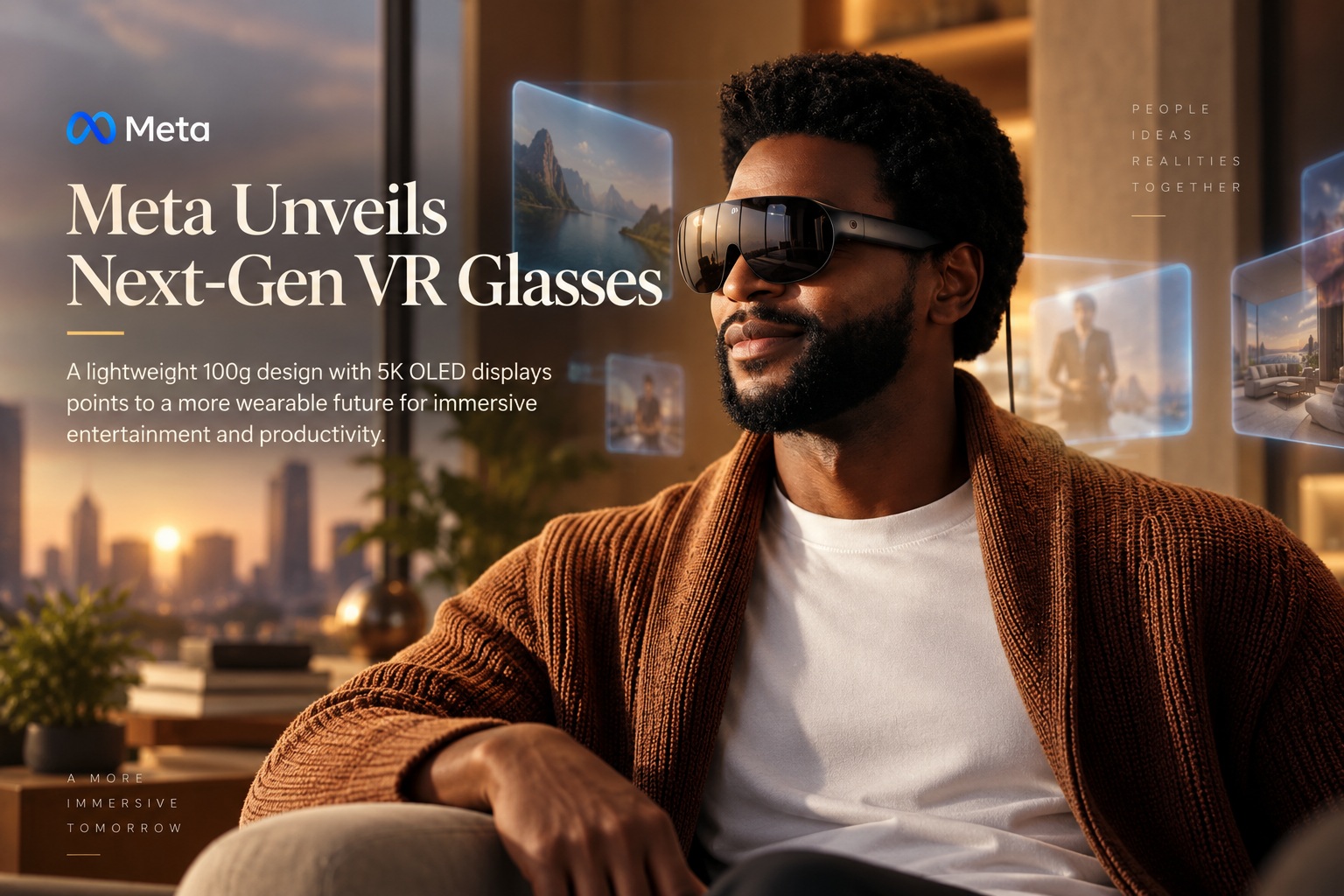
Meta has unveiled its next-generation VR Glasses at Meta Connect 2026, introducing a dramatically lighter approach to virtual reality that looks far closer to oversized eyewear than the bulky headsets most people associate with VR. The new device weighs just 100g while still offering high-resolution micro-OLED displays, full-colour passthrough, eye and hand tracking, immersive entertainment, productivity tools, and built-in Meta AI.
CEO Mark Zuckerberg described the new glasses as an important step toward making immersive computing something people are more willing to wear regularly. Meta still sees holographic augmented-reality glasses as part of its long-term future, but conventional VR headsets remain too bulky for many consumers. The new product attempts to bridge that gap by retaining the immersion of VR while significantly reducing the size and weight of the hardware.
A 100g Design That Looks More Like Glasses
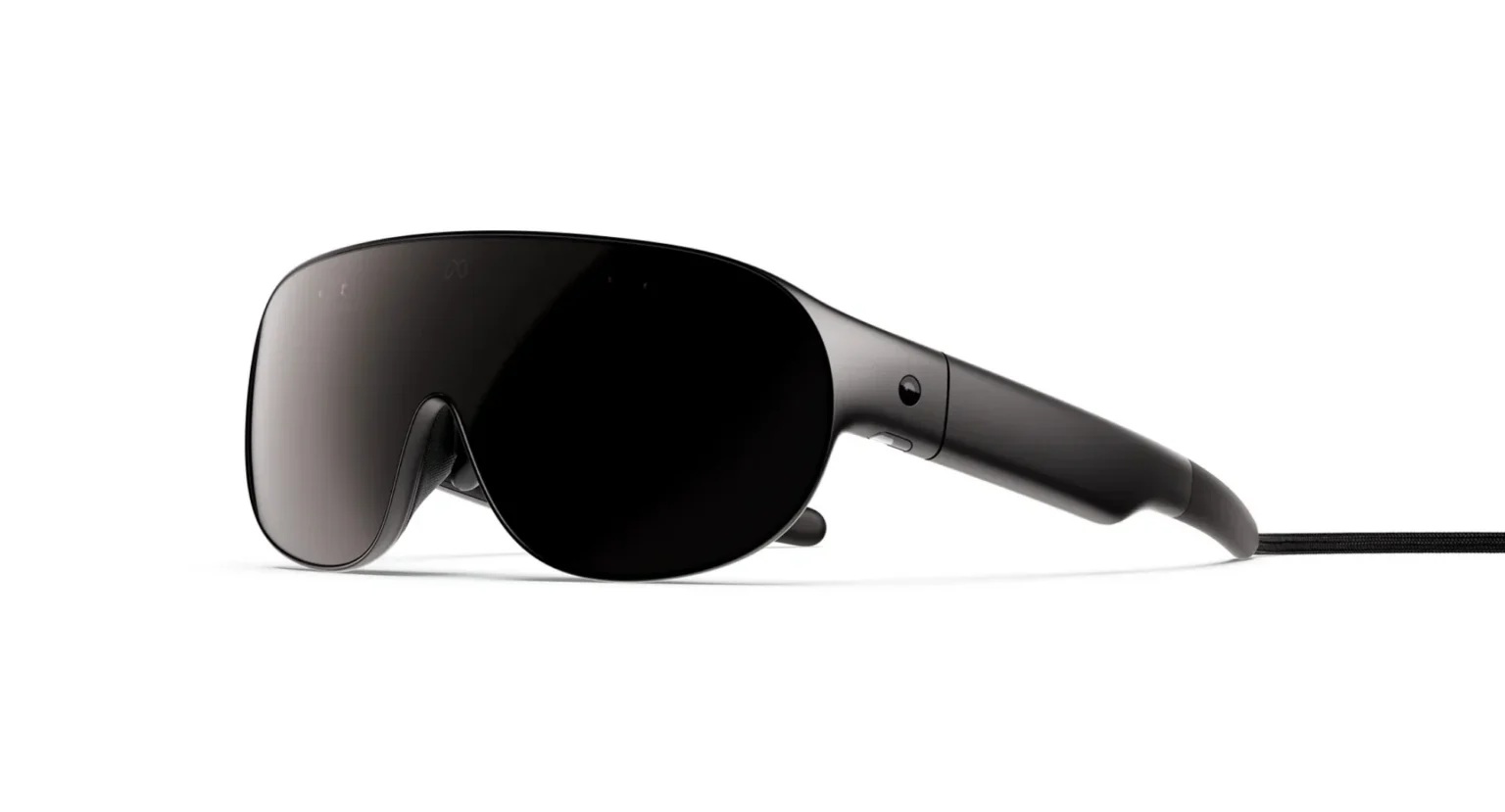
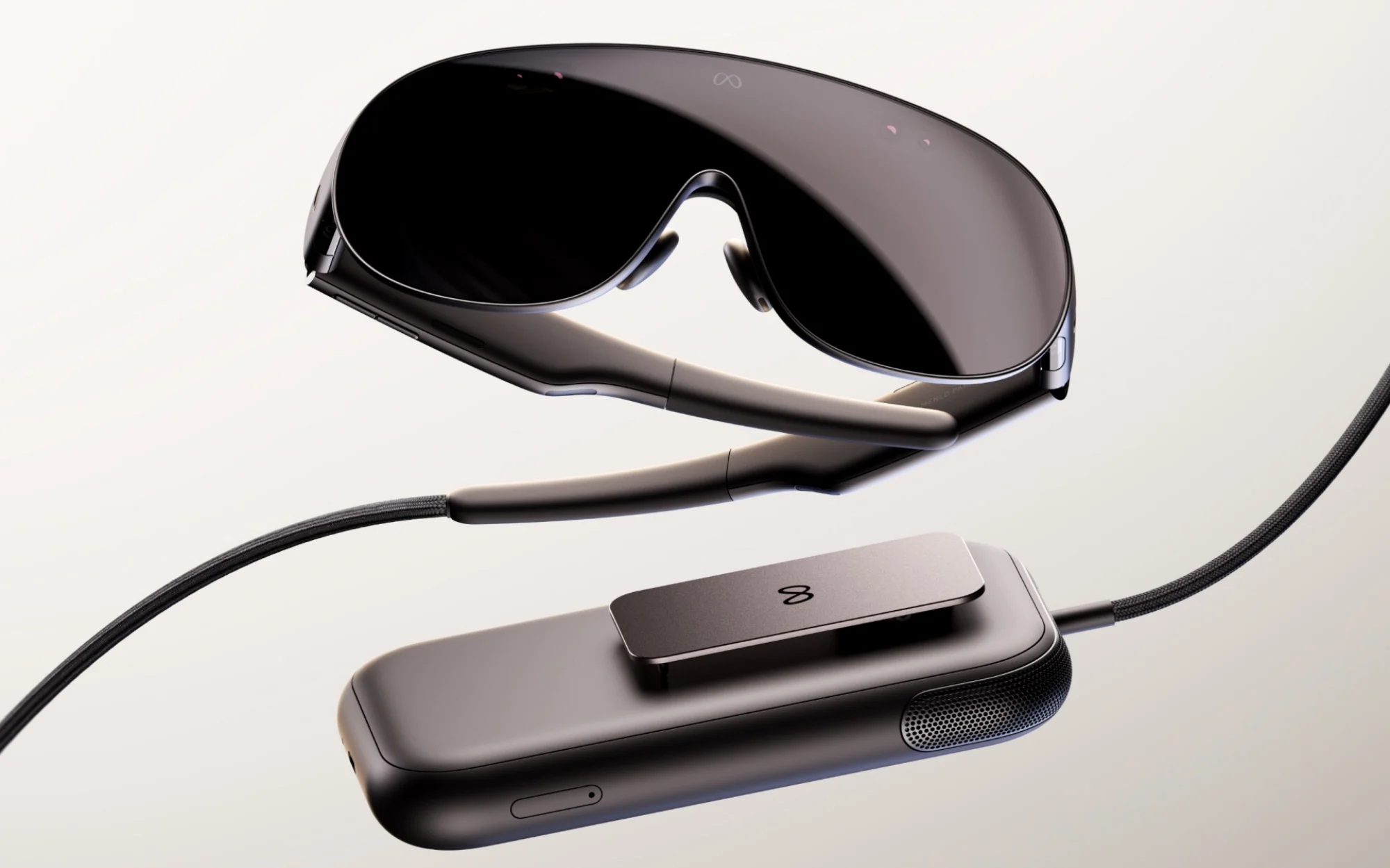
The biggest physical improvement is weight. Meta says the new VR Glasses come in at only 100g, making them approximately five times lighter than the Meta Quest 3. The frame uses magnesium alloy to keep weight down while maintaining enough structural strength for the displays, cameras, sensors, and other electronics packed inside.
Rather than completely hiding the fact that they are a VR device, the glasses resemble a substantially thicker pair of sunglasses. Even so, reducing the weight to around 100g could make an enormous difference during long gaming sessions, movie viewing, or productivity work, where traditional headsets can eventually create noticeable pressure around the forehead and face.
Meta also supports custom prescription lenses for users who need vision correction. The VR Glasses are not intended to fit over existing spectacles, so prescription users will need compatible inserts rather than simply wearing their normal glasses underneath.
Ten Cameras Handle Passthrough, Tracking and Authentication
Meta has packed the frame with six external cameras, which are responsible for full-colour passthrough and movement tracking. Passthrough allows users to see their physical surroundings without removing the glasses, making it possible to blend virtual interfaces with the real environment and move around more naturally.
Another four inward-facing cameras provide eye tracking, allowing the system to understand where the wearer is looking. Eye tracking can improve interface control and potentially support techniques such as foveated rendering, where the system concentrates rendering resources on the area the user is actually viewing.
The cameras also enable hand recognition for gesture-based controls, reducing dependence on physical controllers during everyday interaction. Meta has additionally included iris recognition, allowing the wearer to authenticate themselves biometrically rather than repeatedly entering passwords or PINs.
5K Micro-OLED Displays Push Visual Quality Further
For visual output, Meta is using micro-OLED panels with a combined 5K-class resolution, providing 2412 x 2288 pixels for each eye. The displays operate at up to 120Hz, which should help maintain smooth motion in games, films, and virtual desktop environments.
Meta rates the display at approximately 37 pixels per degree, with a 70-degree horizontal field of view. While field of view remains an important consideration for immersion, the high pixel density should help reduce the visible pixel structure that has traditionally made VR displays feel noticeably different from looking at a physical monitor.
The glasses also support Dolby Vision, giving Meta another way to position the product as more than a gaming device. High-resolution virtual screens could make the glasses particularly attractive for films, streaming content, and private large-screen viewing where installing a physical television or projector is impractical.
Dolby Atmos Turns the Glasses Into a Personal Cinema
Audio support includes Dolby Atmos, complementing the Dolby Vision display system and strengthening Meta's focus on entertainment. The idea is that users can put on the glasses and experience a giant virtual cinema screen with spatial audio without requiring an enormous television or dedicated home theatre.
Unlike watching content on a phone or laptop, a virtual screen can appear significantly larger than the physical device being used. The screen can effectively fill a wall, float inside a simulated theatre, or become part of a fully immersive environment.
That could be especially useful for people living in smaller spaces or travelling frequently. Instead of carrying a large display, the user carries a 100g wearable and creates the screen virtually whenever it is needed.
IMAX Comes to Virtual Reality
One of Meta's headline entertainment partnerships is with IMAX. The company describes the VR Glasses as the first IMAX Enhanced-certified VR device, allowing compatible films to use expanded aspect ratios and presentation features associated with the IMAX format.
Meta also plans to offer hundreds of 3D movies through purchases, rentals, and participating streaming platforms. Disney is among the major partners, with Disney+ expected to introduce selected 3D films from November, including content from the Marvel catalogue.
This gives the glasses a stronger entertainment proposition than simply providing a large virtual screen. If enough studios support the format, Meta could effectively create a personal 3D cinema that follows the user anywhere.
VR Enhanced Cinema Goes Beyond a Floating Movie Screen
Meta is also introducing what it calls VR Enhanced Cinema, which attempts to make films interact with the virtual environment rather than simply displaying them inside a rectangular frame. Compatible experiences can include immersive surroundings, additional three-dimensional elements, dynamic visual effects, and spatial audio extending beyond the movie itself.
Among the first titles announced are Avengers: Infinity War and Star Wars: Episode IV – A New Hope, with both expected to receive VR Enhanced Cinema presentations next year. These experiences could surround the viewer with environments inspired by the film while the main movie continues playing in front of them.
National Geographic is taking a different approach and is expected to launch an application featuring 180-degree 3D video in 2027. Nature, travel, and documentary content could be particularly well suited to immersive viewing because the user can feel as though they are standing within the scene rather than simply observing it through a conventional screen.
Gaming Still Plays an Important Role
Meta has not forgotten its existing VR audience. More than 75 hand-controlled games are expected to be available when the VR Glasses launch, allowing users to interact directly through hand tracking without necessarily reaching for a controller.
For more traditional VR gaming, the glasses can also connect to Meta's Touch Plus controllers. This provides compatibility with existing Quest-style experiences that depend on physical buttons, analogue sticks, triggers, and more precise motion tracking.
Supporting both interaction styles gives developers considerably more flexibility. Casual applications can rely on gestures and eye tracking, while more complex games can continue using dedicated controllers without forcing developers to redesign everything around hand tracking.
The Glasses Can Also Become a Virtual Workstation
Meta is positioning the VR Glasses as a productivity device as well. Users can connect them to a computer and create multiple virtual displays, effectively surrounding themselves with several screens even when working from a single laptop.
This concept has obvious appeal for people who work remotely or travel frequently. A laptop may provide only one relatively small display, while the glasses could create several large virtual monitors positioned around the user's field of view.
The lighter design could be particularly important here. Virtual desktop systems are not especially useful if the headset becomes uncomfortable after 45 minutes, so bringing the device closer to ordinary eyewear could make multi-hour productivity sessions more realistic.
Meta AI Is Built Into the Experience
Naturally, Meta AI is integrated throughout the device. Users can issue voice commands to search for content, start films, control playback, open applications, and interact with other parts of the system without navigating menus manually.
Combined with eye tracking and hand gestures, this creates several ways of controlling the interface. The user might look at an object, gesture toward it, or simply ask Meta AI to perform an action depending on what is most convenient.
The full-colour passthrough system also gives the AI some awareness of the surrounding environment, potentially allowing virtual information to interact more naturally with physical space. Meta is clearly thinking of the glasses as a spatial computing platform rather than simply another Quest headset in a smaller body.
Meta Introduces Hologram-Style Virtual Presence
Another feature is a digital Hologram representation intended for virtual communication with other people. Instead of appearing as a conventional flat video call, users can interact through spatial representations designed to create a stronger sense of presence.
This fits Meta's long-running vision of making digital communication feel more physical. A person could theoretically appear inside the user's room while both participants remain in completely different locations.
The usefulness will depend heavily on how convincing the representations become and how much setup is required. Still, combining lightweight glasses, eye tracking, passthrough, spatial audio, and AI creates a much stronger foundation for virtual presence than the early avatar-based VR experiences Meta experimented with several years ago.
A More Practical Form of Spatial Computing
Taken together, the hardware points toward something broader than conventional VR. The glasses support gaming, but they can also behave like a cinema, virtual workstation, communications device, and AI interface.
That versatility could make the device more appealing to people who never considered buying a dedicated gaming headset. Someone might initially purchase it for private movie viewing or multiple virtual monitors and only occasionally use the gaming features.
Reducing the weight is crucial to making that strategy work. Traditional headsets are easy to tolerate for a dedicated gaming session, but far less attractive as something a person might wear throughout different parts of the day.
The Price Is Still Very Premium
Meta says the VR Glasses will launch in spring 2027 for US$1,299.99, approximately RM5,300 before local taxes and other pricing adjustments. That places them far above mainstream Quest devices and firmly into premium spatial-computing territory.
At that price, Meta will need to convince buyers that the glasses can genuinely replace or complement several devices rather than functioning only as an expensive VR gaming accessory. Entertainment partnerships, productivity features, 5K displays, and the lightweight construction all appear designed to strengthen that argument.
There is currently no confirmed Malaysian availability. Meta has historically offered limited official distribution for several of its VR and smart-glasses products in Malaysia, so an official local launch should not be assumed.
Malaysian Buyers May Need to Look at Imports
If Meta follows its previous regional strategy, Malaysian enthusiasts may eventually need to rely on parallel importers or specialist electronics retailers. Existing Quest headsets and Meta's Ray-Ban smart glasses have already reached Malaysia through unofficial channels despite limited official availability.
Buying through imports introduces several considerations, including warranty support, replacement parts, prescription lenses, and access to region-specific services. Those issues become more important when purchasing hardware costing well above RM5,000.
Local availability may become clearer closer to the spring 2027 launch, particularly if Meta decides to expand distribution alongside the new product category.
Final Thoughts
Meta's new VR Glasses could represent one of the most important changes to its virtual-reality hardware in years. The headline specification is not simply the 5K micro-OLED display or 120Hz refresh rate, but the 100g weight, which addresses one of the most persistent limitations of traditional VR headsets.
The rest of the hardware is equally ambitious. Six external cameras, four eye-tracking cameras, iris authentication, gesture control, Dolby Vision, Dolby Atmos, IMAX Enhanced certification, AI integration, virtual desktops, and support for existing Quest controllers give the device a much broader purpose than gaming alone.
Meta is effectively attempting to turn VR from something people deliberately put on for a session into something light enough to use whenever a large virtual screen, immersive film, game, or workspace would be useful.
The US$1,299.99 price means it will not be a mass-market product at launch, and Malaysian availability remains uncertain. Even so, the direction is significant.
For years, the industry has tried to make virtual reality more powerful. Meta's next challenge is arguably more important: making immersive computing light and comfortable enough that people actually want to keep wearing it.











Comments 0