

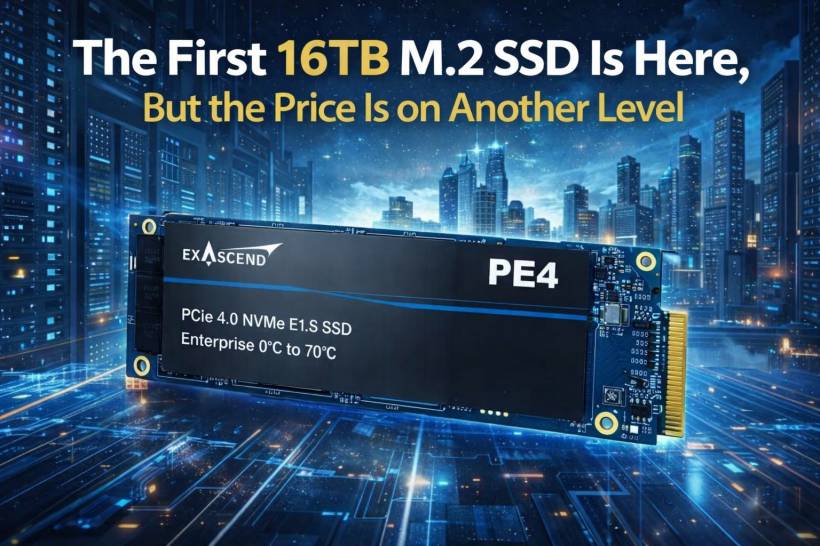
The idea of a 16TB M.2 SSD almost sounds unreal, especially when most people still see 1TB or 2TB as the sweet spot for everyday use. Even 4TB and 8TB drives still feel premium to many buyers. So hearing that a 16TB M.2 SSD now exists naturally grabs attention. On paper, it sounds like a dream product for anyone who wants massive storage in an incredibly compact form.
But once you look a little closer, the story becomes much more interesting. Yes, the drive is real. Yes, it fits into the M.2 conversation. But no, this is not the kind of SSD most users will be adding to a gaming PC or home laptop anytime soon.
A 16TB M.2 SSD Is No Longer Just a Fantasy
For a long time, high-capacity SSDs in small form factors felt like something reserved for the distant future. The M.2 market has steadily moved upward over the years, with 8TB already being considered a very high-end option. Now, that ceiling has been pushed even further with the Exascend PE4, a drive that offers a huge 16TB of storage.
That alone is a notable milestone. Packing that much capacity into a compact drive is an impressive technical achievement, and it shows just how far solid-state storage has come. Not too long ago, 16TB of SSD storage would have meant much larger enterprise drives or extremely expensive custom configurations. Seeing that figure attached to something associated with the M.2 format is enough to make enthusiasts stop and take notice.
But This Is Not Really a Consumer SSD
This is where expectations need to be adjusted. While the Exascend PE4 may sound exciting to PC builders and storage enthusiasts, it is not aimed at the mainstream consumer market.
It is designed primarily for enterprise use. That means the target audience is not the average person upgrading a desktop for faster game loading or more room for video projects. Instead, this drive is meant for environments where reliability, endurance, density, and workload stability matter more than flashy benchmark numbers.
The PE4 is intended for demanding professional and enterprise scenarios such as servers, datacentres, NAS environments, and workstation caching. In other words, this is the sort of product built for businesses and infrastructure, not for someone casually looking to expand their Steam library.
That distinction matters because enterprise storage often follows a very different philosophy from consumer hardware. These products are designed to handle sustained workloads, harsher operating conditions, and longer duty cycles. So while the capacity may sound exciting from a consumer perspective, the real selling point here is how that capacity can be deployed in professional systems where space and reliability are critical.
Compact Form Factor, Different Priorities
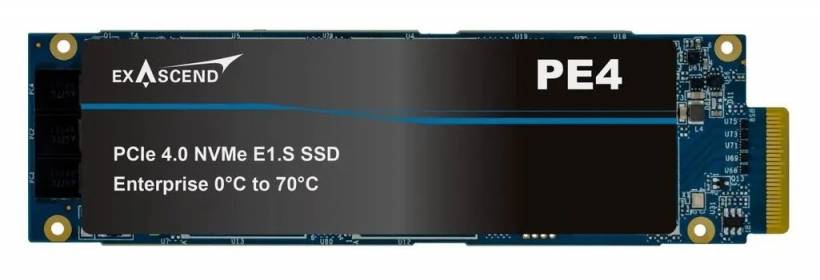
Another reason this SSD stands out is its form factor story. The Exascend PE4 is available in E1.S, which is an enterprise and datacentre-oriented form factor, but it also still uses the familiar M.2 2280 format. That makes it especially interesting, because M.2 2280 is something most PC users immediately recognise.
Still, just because it shares a form factor that looks familiar does not mean it behaves like a typical enthusiast SSD. This is not one of those bleeding-edge consumer PCIe drives chasing record-breaking transfer rates to impress gamers and benchmark fans.
Even though it is listed as a PCIe 4.0 SSD, its sequential speeds are relatively modest by current premium SSD standards, with average reads of 3,270MB/s and writes of 2,980MB/s. Those numbers are not slow in a general sense, but they are clearly not the headline attraction here.
For a regular buyer, those speeds might even seem underwhelming for such an expensive product. But again, this is because the PE4 is not trying to win on raw consumer appeal. It is built around a different set of priorities, where stability, endurance, capacity density, and enterprise suitability matter more than top-tier peak throughput.
The Price Is the Real Shock
As impressive as the technology is, the biggest talking point is obviously the cost.
The Exascend PE4 comes with a retail price of US$15,935, which works out to roughly RM62,400. That is an extraordinary figure for any SSD, let alone one that many people might initially mistake for a super-premium consumer upgrade.
To put that into perspective, the price is more than 14 times higher than the Samsung 9100 Pro 8TB, which retails at RM4,269. And even that Samsung drive is already considered expensive by consumer standards. So the gap here is enormous.
At that level, the PE4 stops being a product most people would compare against normal storage purchases. It becomes something else entirely. This is not a "should I buy this for my next PC build?" kind of product. It is a specialised tool with a price tag that reflects its niche role.
Why Enterprise Storage Prices Can Look So Extreme
At first glance, paying over RM62,000 for a single SSD sounds absurd. But enterprise hardware often exists in a different economic reality from consumer tech.
Businesses buying this kind of storage are not just paying for capacity alone. They are paying for a product designed to survive sustained workloads, fit into constrained system layouts, support critical infrastructure, and operate within environments where downtime can be far more expensive than the hardware itself.
That does not make the price any less shocking to everyday buyers, but it does explain why direct comparisons with consumer SSDs only go so far. A gaming enthusiast looks at price per terabyte. A datacentre or enterprise customer may be thinking about physical density, deployment efficiency, endurance, and long-term operational value.
Impressive, But Far From Practical for Most People
There is definitely something fascinating about seeing a 16TB SSD in such a compact form factor. It is the kind of hardware that sparks curiosity and gives a glimpse into where storage technology is heading. Over time, products like this often serve as a sign of what may eventually become more accessible to the broader market.
But right now, the Exascend PE4 is more of a showcase of possibility than a realistic purchase for ordinary users. The capacity is remarkable, but the pricing and enterprise focus place it firmly outside the range of mainstream adoption.
For most people, even high-end consumers, an 8TB SSD already feels like a luxury. A 16TB M.2 SSD at over RM62,000 is operating in a completely different universe.
Final Thoughts
The arrival of a 16TB M.2 SSD is a genuine milestone in storage technology, and it proves that the upper limit for compact SSD capacity is continuing to climb. That alone makes the Exascend PE4 worth talking about.
At the same time, this is not the kind of product that changes the consumer market overnight. Its enterprise positioning, average PCIe 4.0 speeds, and extremely high asking price make it clear that this drive is built for specialised workloads rather than everyday users.
So yes, the world now has a 16TB M.2 SSD. The catch is that most people will only be admiring it from a distance.











Comments 0