

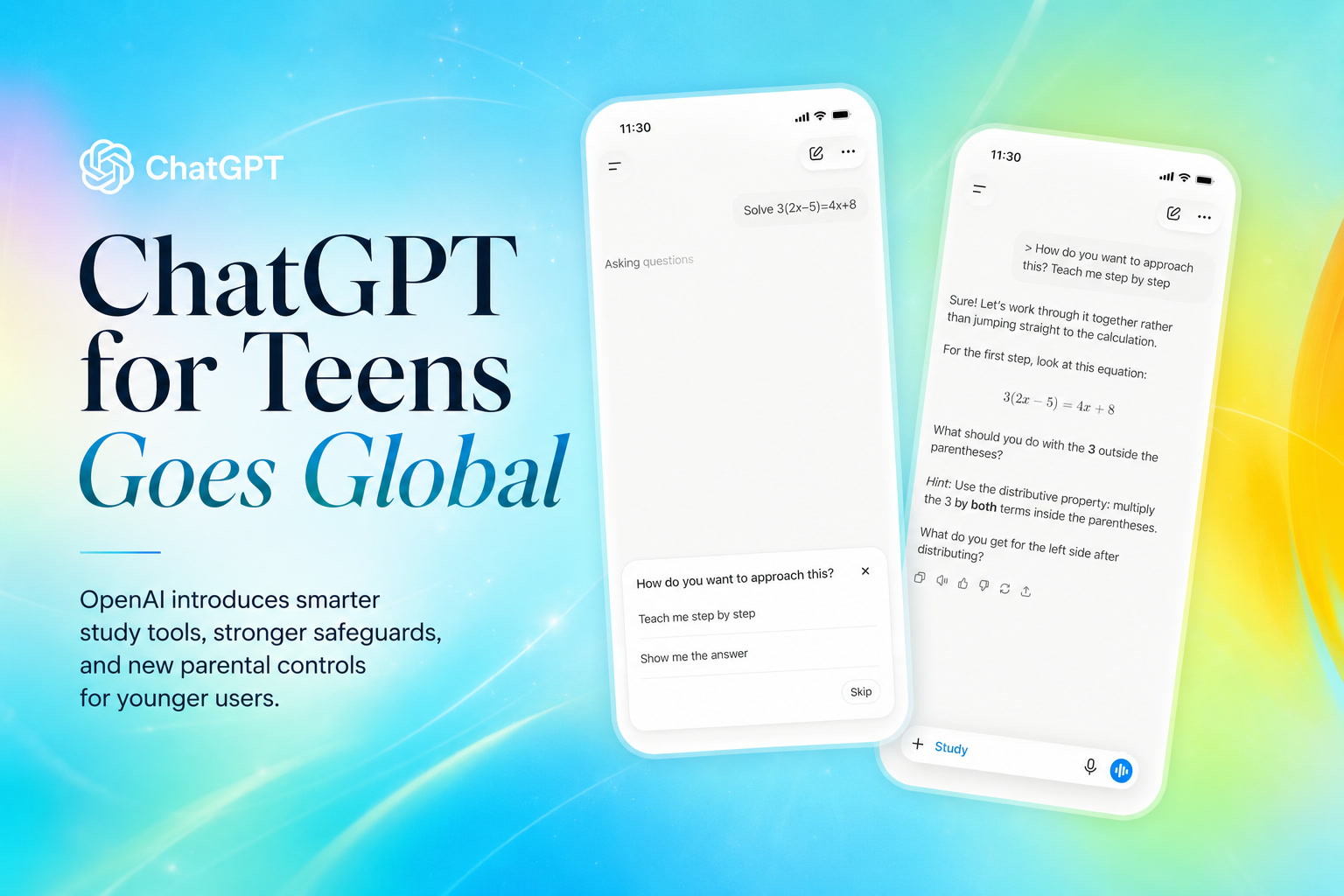
AI has already become part of how many students study, research, brainstorm and work through difficult subjects. The challenge, of course, is making sure younger users aren't simply using AI as an instant answer machine — or wandering into conversations and content that were never designed with teenagers in mind.
OpenAI is now addressing that more directly with ChatGPT for Teens, a new age-appropriate ChatGPT experience designed specifically for users under 18. Announced on 18 August 2026, it combines stronger safety protections with new learning tools, healthier-use features and additional controls for parents.
Importantly, this isn't really a completely separate ChatGPT chatbot or standalone AI model. Think of it more as a special version of the ChatGPT experience, where different safeguards, behaviours and learning features automatically apply when the system identifies someone as a teenager.
And there is quite a lot more going on here than simply filtering a few inappropriate responses.
ChatGPT Wants Teens to Learn, Not Just Copy Answers
Probably the most interesting part of ChatGPT for Teens is its stronger emphasis on education.
Students have obviously been using generative AI for homework for years now, but there has always been an uncomfortable question hanging over it: is the student actually learning, or are they simply copying whatever ChatGPT produces?
OpenAI is trying to push usage towards the former.
At the centre of that approach is Study Mode, which is designed to guide students through a problem instead of immediately handing over the final answer. It can break concepts into smaller steps, ask guiding questions and check whether the student actually understands what they are doing.
ChatGPT for Teens expands that idea with several education-focused features:
That last feature is particularly interesting because it turns Study Mode from something students have to remember to activate into something that can become part of a normal homework routine.
Instead of saying, "give me the answer to question five," the system is increasingly designed to respond more like a tutor saying, "let's work out how to get there."
OpenAI Is Also Working With CodeAI
Alongside ChatGPT for Teens, OpenAI has announced a partnership with CodeAI focused on AI literacy for both students and educators.
The objective goes beyond simply teaching young people how to write better prompts. OpenAI says the collaboration will help students understand how AI works, how to question its responses, how to recognise mistakes and how to use these systems creatively rather than treating everything generated by AI as automatically correct.
That distinction matters.
As generative AI becomes increasingly common in schools and universities, knowing when not to trust an AI-generated answer may eventually become just as important as knowing how to ask for one.
Teachers are also part of that equation. OpenAI says educators should continue having a meaningful role in deciding how AI enters classrooms rather than having the technology effectively dictate the learning process itself.
Teen Accounts Get Stronger Protections Automatically
The other major part of this update is safety.
ChatGPT now uses several signals to estimate whether an account may belong to someone under 18. Users who declare that they are between 13 and 17, or whose accounts are predicted to belong to someone under 18 and are eligible, can automatically be placed into the ChatGPT for Teens experience.
Once that happens, additional safeguards become part of the experience.
These protections cover areas including:
The intention isn't to make ChatGPT useless whenever a serious topic comes up. Teens may still need to discuss sensitive subjects for schoolwork, research or genuine personal questions. Instead, the system is supposed to handle those areas with more age-appropriate boundaries and additional safeguards.
OpenAI also notes that ChatGPT itself isn't intended for children under 13, while users aged 13 to 18 are required to have parental consent.
Parents Get More Control — Without Reading Every Conversation
Parents who link their ChatGPT account with their teenager's account gain access to a dedicated set of parental controls.
One particularly useful feature is Quiet Hours, which allows parents to specify times when ChatGPT simply cannot be used. Parents can also manage several other features, including voice, memory and image generation.
Current parental controls include the ability to:
Importantly, linking an account does not normally give parents access to their teenager's ChatGPT conversations. OpenAI says parental notifications are intended for limited, higher-risk situations rather than routine monitoring of everything a teenager asks the chatbot.
That makes the system more of a safety framework than a parental surveillance dashboard.
Safety Alerts Are Reserved for More Serious Situations
OpenAI already has a safety-notification system for linked teen accounts.
If its systems identify signs that a teenager may be experiencing acute distress or considering serious self-harm, the situation can be reviewed by specially trained staff. In certain high-risk circumstances, the linked parent may then receive an alert.
OpenAI has also expanded notifications to some serious violent-threat situations and says it is adding additional notifications relating to eating disorders. The company says these alerts are deliberately narrow, with the idea being to involve real-world support when it may genuinely matter rather than notifying parents over ordinary conversations.
It's an important distinction because AI safety isn't simply about refusing certain prompts. Sometimes the safer response is recognising when an AI conversation should point someone towards an actual person.
No Falling in Love With the Robot
Here's another interesting change.
We've seen plenty of discussion over the past few years about people becoming emotionally attached to AI companions, sometimes treating chatbots as romantic partners or believing that the AI genuinely has feelings for them.
OpenAI clearly doesn't want ChatGPT encouraging that type of relationship with minors.
The updated under-18 behaviour goes beyond simply blocking explicit sexual roleplay. ChatGPT for Teens is designed to avoid romantic language, emotional dependency and behaviour suggesting that the AI has genuine feelings or consciousness.
In other words, ChatGPT can still be friendly and conversational, but it shouldn't be trying to become someone's virtual boyfriend, girlfriend or emotional replacement for real-world relationships.
That's probably one of the more significant safeguards in this entire update, especially as AI assistants become increasingly natural and convincing in the way they communicate.
ChatGPT Will Also Tell Teens to Take a Break
The protections aren't limited to what teens can talk about.
OpenAI is also focusing on how long and how intensely teenagers interact with AI.
Teen users can receive break reminders encouraging them to step away after extended periods of ChatGPT usage. OpenAI says the broader goal is to encourage healthier technology habits while ensuring the chatbot remains a tool rather than something that begins replacing normal offline activities or relationships.
There are a few other subtle changes too:
None of these measures sounds particularly dramatic individually, but together they make the teen version feel considerably more deliberate than simply placing a content filter on normal ChatGPT.
What Happens If ChatGPT Gets Your Age Wrong?
Age prediction isn't going to be perfect, and OpenAI openly acknowledges that.
Its age-prediction system can look at different account signals — such as general conversation topics, usage patterns, when ChatGPT is normally used and how long an account has existed — when estimating whether someone may be under 18.
An adult could therefore theoretically be placed into the teen experience by mistake.
If you're 18 or older and that happens, OpenAI allows you to verify your age and remove the teen protections. The current verification process can involve a live selfie or government-issued identification through third-party verification provider Persona, depending on the country. OpenAI says it does not receive the actual ID or selfie used for verification.
OpenAI Is Stress-Testing These Teen Safeguards
Behind all of these visible features is a broader safety effort.
OpenAI says its teen protections are informed by developmental science, outside experts and dedicated testing of its safeguards, particularly in areas where younger users may face greater risk.
The company has also started publishing dedicated under-18 evaluations within its system-safety materials. These evaluations examine how its models behave in difficult teen-specific situations involving areas such as self-harm, eating disorders, violence, age-restricted products and sexual content.
That doesn't mean every safeguard will work perfectly — OpenAI itself acknowledges that guardrails can sometimes fail or be bypassed — but publishing teen-specific evaluation work gives researchers and the public another way of measuring whether these systems are actually improving.
ChatGPT for Teens Is Rolling Out Globally
OpenAI officially introduced ChatGPT for Teens on 18 August 2026. Its latest Help Center information says age prediction and the associated teen experience are rolling out globally, although the European Union has a slightly different rollout schedule because of regional requirements.
For teenagers, parents and educators, this marks a fairly substantial shift in how ChatGPT approaches younger users.
Previously, much of the conversation around AI in education revolved around whether students should be allowed to use it at all. ChatGPT for Teens suggests the industry may now be moving towards a different question: if students are going to use AI anyway, how do we design it so that it actually helps them learn without introducing unnecessary risks?
Final Thoughts
ChatGPT for Teens is probably one of OpenAI's more important consumer updates this year, not because it gives teenagers access to dramatically more powerful AI, but because it changes how that AI behaves around them.
The combination of Study Mode, homework reminders, quizzes, Study Hours and parental controls makes ChatGPT feel increasingly like a learning assistant rather than merely an answer generator. At the same time, stronger restrictions around sensitive material, emotional dependence, romantic roleplay and excessive usage recognise that teenagers shouldn't necessarily interact with AI under exactly the same rules as adults.
There will inevitably be debates about age prediction, privacy, how restrictive these safeguards should be and how accurately AI can determine someone's age. But the broader direction makes sense: AI tools used by teenagers need to be useful enough to help them grow, while still recognising that younger users deserve additional protections.
And perhaps the most encouraging part is the educational philosophy behind the update. Instead of simply making ChatGPT better at answering homework questions, OpenAI is increasingly trying to make it better at helping students figure out the answers themselves.











Comments 0